MUMBAI — Buried inside Reliance Industries’ FY26 annual report is a number that, on its own, sums up just how fast India’s media landscape has been reshaped: revenue from operations at Reliance’s Media & Entertainment vertical — which houses JioStar, Jio Studios, and Network18 — came in at ₹34,917 crore for FY26, nearly double the ₹17,762 crore reported in FY25. Gross revenue jumped 96.6% to ₹40,682 crore. EBITDA more than tripled, rising 218.7% to ₹5,842 crore, at a 16.7% margin.
Those numbers alone would be a notable story for almost any company. But there’s important context that makes this growth both less surprising and more significant than it first appears — and a strategic pivot toward AI that suggests Reliance sees this as just the opening chapter.
Why the Comparison Looks So Dramatic — and Why That’s the Point
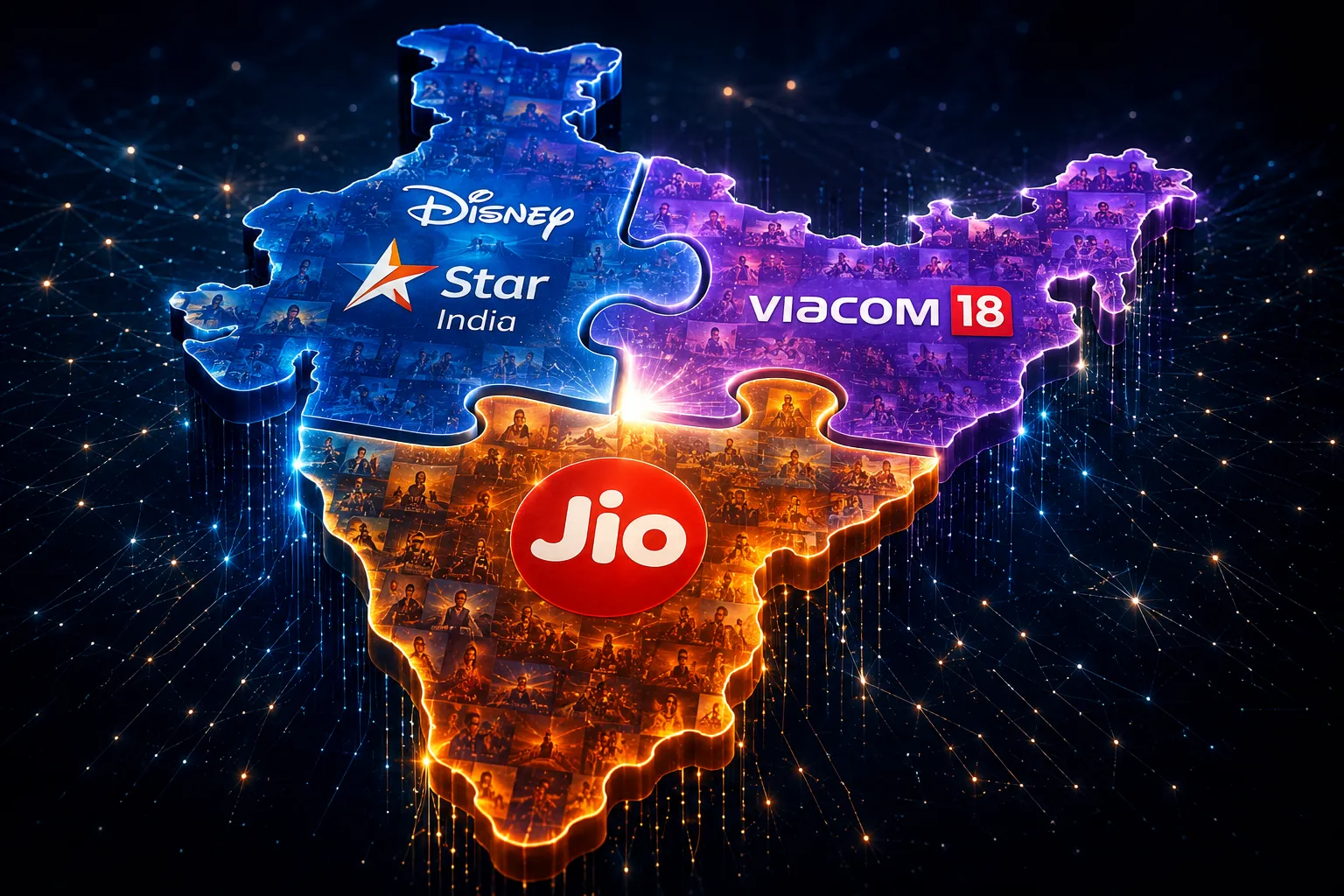
The near‑doubling isn’t simply organic growth. It partly reflects the fact that JioStar itself is barely a year old. Reliance Industries, The Walt Disney Company, and Viacom18 formally merged their television and digital media businesses on 14 November 2024, creating JioStar as a single entity combining Star India’s TV network and sports rights, Viacom18’s entertainment channels, and Jio’s digital platforms. The FY25 figure of ₹17,762 crore therefore only captured JioStar’s financials for the partial period from that November merger date through 31 March 2025 — roughly four and a half months. FY26 is the first full year of the combined entity.
That distinction matters, but it doesn’t make the underlying story less impressive — it arguably makes it more important. A full year of JioStar operating as a unified business has produced a company that, on a standalone basis, posted ₹36,248 crore in gross revenue and ₹3,210 crore in profit after tax for FY26 — a media company now operating at a scale that puts it among the largest in India by revenue, built from what were three separate, often competing, businesses just two years ago.
JioHotstar: From Merged Apps to a Global‑Scale Streaming Platform
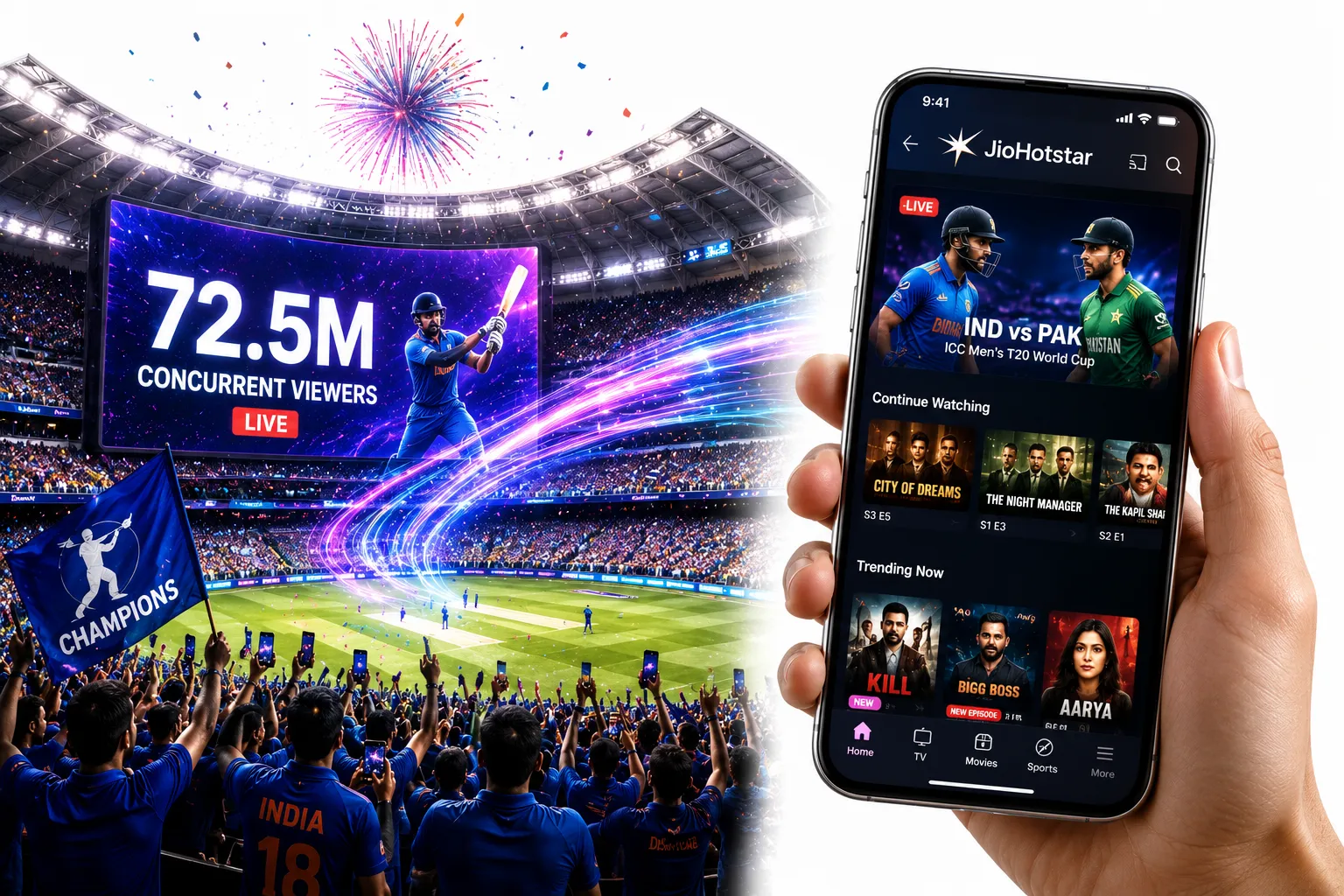
If one product explains where this growth came from, it’s JioHotstar — the streaming platform created by merging JioCinema and Disney+ Hotstar on 14 February 2025. The growth trajectory across FY26 has been striking: monthly active users hit roughly 500–550 million by March 2026. JioHotstar segment operating revenue reached ₹31,048 crore with an EBITDA of ₹4,885 crore (15.7% margin) and a profit before tax of ₹3,228 crore.
The 72.5 million peak concurrent viewers for the ICC Men’s T20 World Cup final is a global streaming benchmark. Combined with more than 250 days of live sports reaching what Reliance describes as a billion screens, sport has clearly been the single biggest growth engine. The India–England Anderson‑Tendulkar Trophy became the most‑watched Test series ever on a digital platform, with 170 million viewers. Wimbledon 2025 saw 77% growth on JioHotstar, and the newly acquired US Open 2025 delivered the highest ever linear TV minutes for that event: 388 million.
Still Winning on the Old Screen: Linear TV Dominance
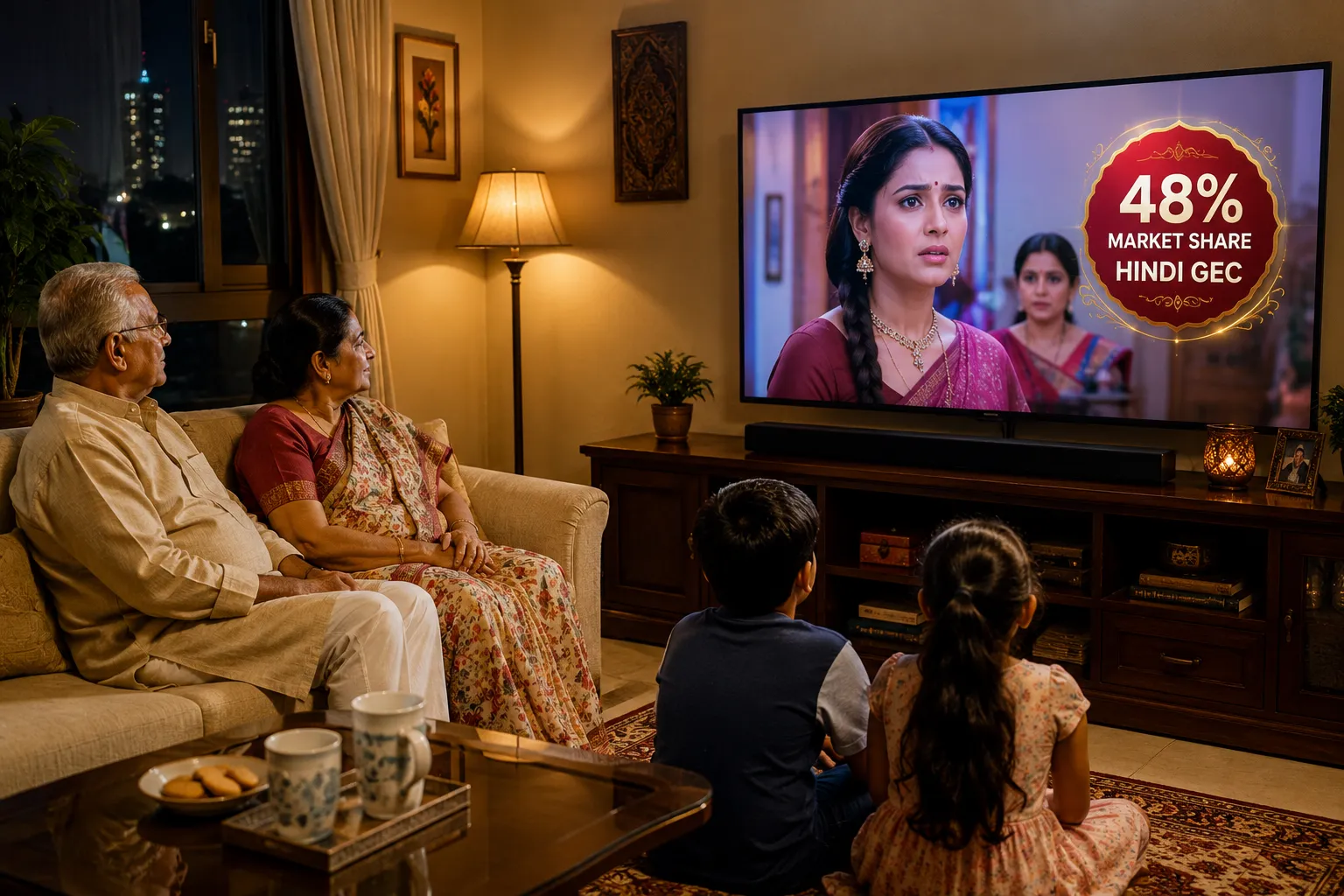
For all the streaming‑era framing, JioStar’s traditional television business remains a major part of the story — and it’s not shrinking. Linear TV viewership share grew 0.8 percentage points year‑on‑year to 34.7%, which the company says is close to the combined share of its next three competing networks put together. Across the entertainment genre specifically, JioStar reached over 810 million viewers with a 34.2% viewership share.
The company’s dominance is especially pronounced in the Hindi general entertainment channel (GEC) category, where JioStar commands a 48% market share — essentially controlling half of India’s biggest entertainment TV market. That leadership extends across regional language markets too, with JioStar holding the top position in Marathi, Malayalam, Kannada, Bangla, Telugu, and Tamil markets — a footprint that gives the company genuinely national reach across India’s linguistically fragmented media landscape.
Jio Studios: 40% of India’s Box Office, and a Hollywood‑Style Acquisition
On the film side, Jio Studios had a breakout year. The unit delivered more than 40% of India’s total box office in FY26 — meaning two out of every five rupees spent on cinema tickets in the country went to a Jio Studios production. The standout was the Dhurandhar franchise, which crossed ₹3,000 crore in worldwide gross revenues, instantly placing it among the biggest film franchises in Indian cinema history.
Beyond box office numbers, Jio Studios made a strategically significant move by acquiring a 50.1% stake in Sikhya Entertainment — a production house Reliance’s annual report describes as one of India’s most globally recognised, with Oscar‑winning pedigree. The acquisition signals an ambition that goes beyond commercial blockbusters: building a portfolio that can compete for prestige and international recognition as well as domestic box office dominance. Reliance has framed Jio Studios’ future explicitly around a "technology‑first approach, including AI" — suggesting AI tools are integral to how it will develop and produce content going forward, not just a back‑office efficiency play.
Network18: The News Pillar — With a More Complicated Picture
Network18 remains positioned as the news arm of Reliance’s media empire. The annual report describes Network18 as India’s number one TV news network, with a 14.1% viewership share — ahead of its nearest rivals. Its digital portfolio reaches roughly 300 million people per month across platforms, while Moneycontrol Pro continues to hold its position as India’s largest paid digital news subscription product, and Firstpost has crossed 9 million subscribers on YouTube.
That said, Network18 Media & Investments Limited — the listed entity — has had a financially mixed recent picture on a standalone basis, reporting a net loss of roughly ₹510 crore against revenue of around ₹6,888 crore in 2025, even as its operating income remained positive at around ₹208 crore. This is a useful reminder that the M&E vertical’s headline growth is overwhelmingly a JioStar and JioHotstar story — Network18’s value to the group lies more in its reach, influence, and content pipeline (including its 56.89% ownership by Reliance Industries) than in standalone profitability at this stage.
The Pivot: "AI Will Define the Next Era of Entertainment"
Perhaps the most forward‑looking part of Reliance’s FY26 disclosure isn’t a number at all — it’s a statement of intent. The company’s annual report states plainly that AI will define the next era of entertainment, and that as India’s largest media and entertainment platform, Reliance has the responsibility to lead that transformation — reimagining everything from script to screen and from idea to experience.
Reliance frames this as more than an efficiency play. The stated ambition spans three areas:
Content creation — using AI tools throughout the production pipeline, consistent with Jio Studios’ "technology‑first" framing.
Consumer experience — AI‑led discovery and recommendation systems for navigating an increasingly fragmented content landscape.
Audience engagement — including a strategic shift toward smartphone‑native micro‑content (often described as "micro‑dramas") and in‑app commerce‑led streaming, where viewing and shopping become more directly integrated.
The business logic is straightforward: content costs are rising, audiences are fragmenting, and attention is harder to hold than ever. Reliance’s bet is that AI‑driven discovery, production efficiency, and new revenue models let a platform‑agnostic operator like JioStar — spanning linear TV, premium streaming, regional languages, sports, films, and news — keep growing engagement and monetisation simultaneously.
The Bottom Line
Strip away the merger‑accounting nuance, and the FY26 numbers tell a consistent story: JioHotstar has become one of the largest streaming platforms in the world by users and live‑event scale. JioStar’s linear TV business is more dominant than ever despite the streaming shift. Jio Studios went from a film unit to a genuine box‑office powerhouse with global acquisition ambitions. And Network18 — even with its own financial challenges — gives the group unmatched news reach. Tie all of that together with an explicit, top‑down commitment to AI across content, discovery, and monetisation, and Reliance’s Media & Entertainment vertical looks less like a side business and more like a third major pillar of the conglomerate, alongside its energy and retail operations — one that, on this year’s numbers, is now growing faster than almost anything else in the group.