Green Hydrogen Gold Rush: How Reliance and ReNew Are Betting $30 Billion on India's Next Energy Export
On a quiet morning in March 2026, the global energy industry received a jolt. Reliance Industries—India's largest private conglomerate—signed a $3 billion, 15-year agreement with South Korea's Samsung C&T Corporation to supply green ammonia, a derivative of green hydrogen.
The deal, commencing in the second half of FY2029, was not a memorandum of understanding or a preliminary handshake. It was a binding Supply and Purchase Agreement—one of the largest long-term green ammonia off-take agreements announced globally.
"This sets a new benchmark in the global energy landscape, with India emerging as an exporter of green fuels produced through an end-to-end value chain anchored in the country," Reliance said in a regulatory filing.
The message was unmistakable: India's green hydrogen ambitions had just crossed the threshold from policy to profit. The world's most expensive conversation was becoming the world's most valuable export.
The Mission: 5 Million Tonnes by 2030
To understand the magnitude of this shift, one must first understand the National Green Hydrogen Mission (NGHM) . Launched with a budget outlay of ₹19,744 crore (approximately $2.4 billion), the mission has a deceptively simple goal: make India a global hub for green hydrogen production, usage, and export. The target is ambitious: 5 million metric tonnes (MMT) of annual green hydrogen production capacity by 2030.
In 2026, the mission moved decisively from ambition to execution, driven by competitive pricing, long-term demand creation, and sectoral integration, according to Mission Director Abhay Bakre.
The metrics are tangible. As of February 2026, approximately 8,000 tonnes per annum of green hydrogen production capacity has already been commissioned in India. Under the mission's incentive schemes:
15 companies have been awarded a total 3,000 MW per annum of electrolyser manufacturing capacity, with total incentives of ₹4,440 crore.
18 companies have been awarded cumulative green hydrogen production capacity of 862,000 tonnes per annum.
Reliance's $10 Billion Green Empire
While the national mission sets the stage, Reliance Industries provides the spectacle.
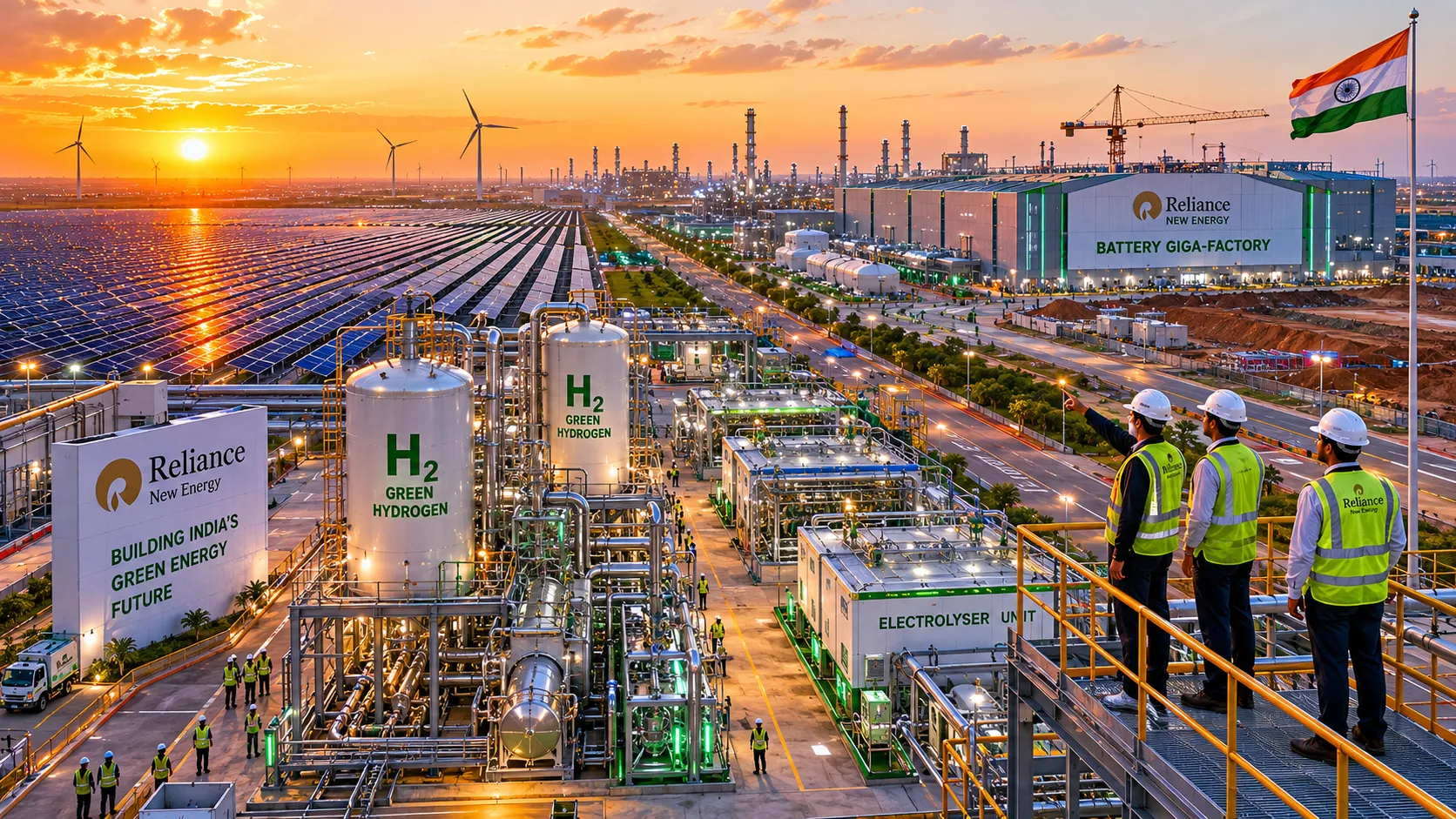
The conglomerate is building what it describes as an "integrated clean energy ecosystem" anchored around its Jamnagar green energy complex in Gujarat—a sprawling facility designed to rival the world's largest renewable manufacturing hubs.
The numbers are staggering:
Solar Manufacturing: The Jamnagar complex is on track to scale up to 10 GWp per annum, with plans for further expansion to 20 GWp.
Battery Storage: Reliance's Battery Energy Storage System (BESS) giga-factory is in advanced stages of commissioning, with initial annual production capacity of 40 GWh, eventually scaling to 100 GWh.
Green Hydrogen Target: The company is working toward 3 million metric tonnes per annum of green hydrogen production capacity by 2032 for global markets.
Solar Power for Captive Use: A 6 GWp solar power project in Andhra Pradesh is in development, alongside a massive 550,000-acre Kutch renewable energy project expected to commence power generation in FY27.
Total investment across these clean energy initiatives is estimated to exceed $10 billion over the next three years.
Anant Ambani, Executive Director at Reliance, summed up the strategy: "We are proud to partner with Samsung C&T to supply green ammonia that is cost-competitive and reliable. This partnership marks an important step in India's clean energy journey".
The Cost Collapse: From $5.4 to $2 Per Kilogram
The most dramatic story in Indian green hydrogen, however, is not about scale—it is about price.
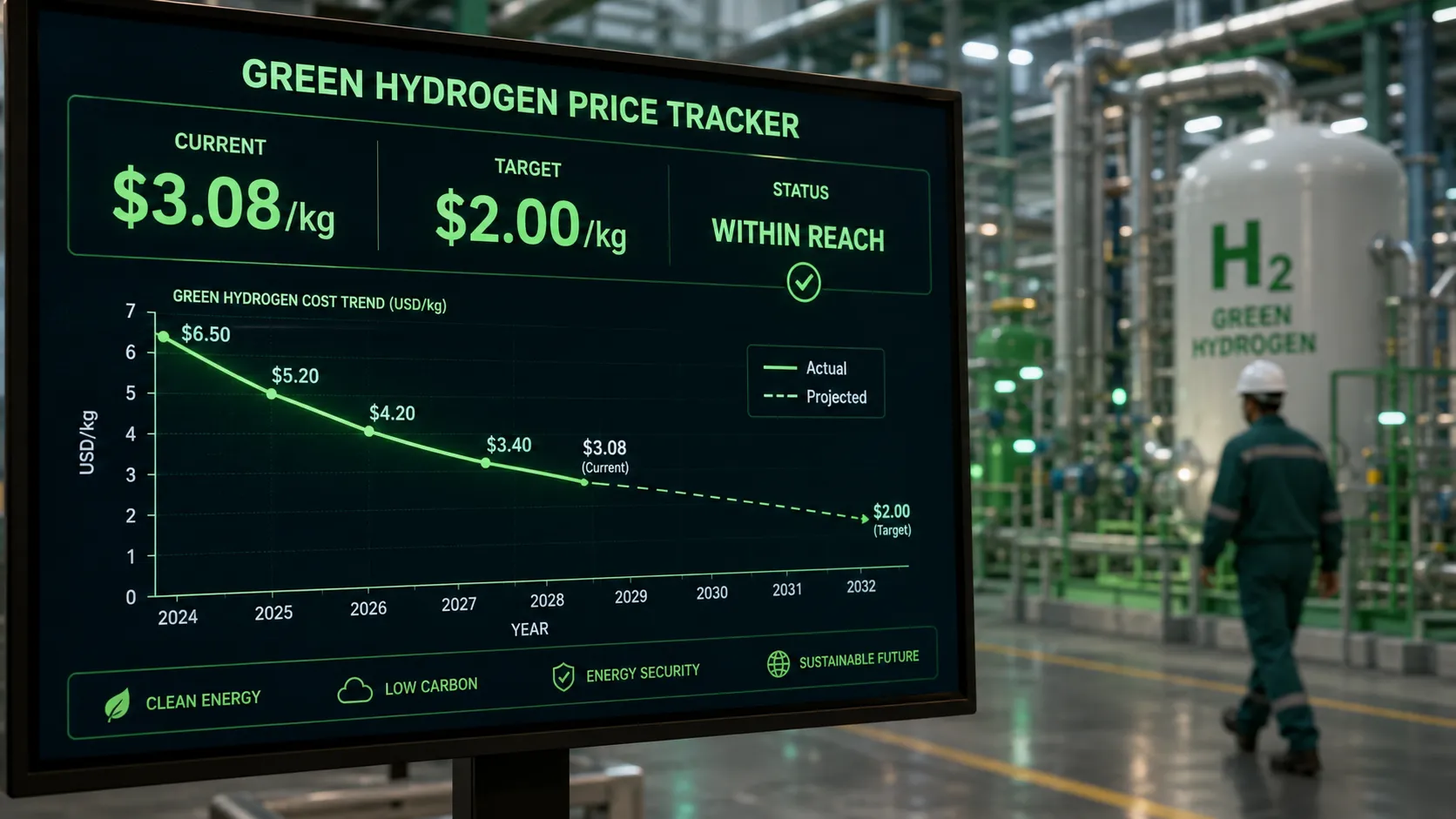
When the NGHM was launched, the cheapest green hydrogen globally was around $5.4 per kilogram. Through competitive tenders and falling renewable energy costs, that number has been slashed.
In January 2026, Union Minister Hardeep Singh Puri announced at India Energy Week that green hydrogen costs had fallen below $4 per kilogram, now in the $3–4 range. By March 2026, a tender for supplying 10,000 tonnes of green hydrogen to the Numaligarh Refinery in Assam discovered a record-low price of ₹279 per kilogram (approximately $3.08) —the lowest ever recorded in India.
Former NITI Aayog CEO Amitabh Kant remarked that India is "steadily advancing towards its target of producing green hydrogen at $2 per kilogram". Mission Director Abhay Bakre has projected that the $2 per kilogram target should be reached by 2032.
For context, renewable energy (solar and wind) accounts for approximately 50% to 70% of the total cost of green hydrogen production, according to a World Bank Group report. As India's renewable energy tariffs continue to fall—driven by domestic solar module manufacturing capacity exceeding 100 GW under the PLI scheme—the $2 target appears increasingly inevitable.
The Global Market: 150 Million Tonnes of Demand
India is not building this capacity in a vacuum. The global hydrogen market is projected to grow from 100 million metric tonnes per annum (MMTPA) in 2024 to 150 MMTPA by 2030, a 50% increase driven almost entirely by clean hydrogen.
Europe and Japan are actively seeking import partners. At India Energy Week 2026, Han Feenstra, Senior Policy Advisor at the Netherlands' Ministry of Economic Affairs, noted that European hydrogen markets are shifting toward demand mandates and import frameworks, opening "long-term opportunities for reliable partners like India, whose cost competitiveness and policy clarity make it a natural contributor to Europe's decarbonisation ambitions".
India's ambition is to capture 10% of global green hydrogen demand by 2030. The country is well on its way: Indian firms are already exporting green ammonia to markets such as Germany and Singapore.
The Policy Engine: SIGHT and Beyond
The mission's operational framework, SIGHT (Strategic Interventions for Green Hydrogen Transition) , carries an allocation of ₹17,490 crore for production incentives and electrolyser manufacturing. The scheme provides two financial incentive mechanisms: one for domestic electrolyser manufacturing and another for green hydrogen production.
Key policy enablers include:
Exemption from Inter-State Transmission System (ISTS) charges for 25 years for green hydrogen plants commissioned by December 31, 2030.
Duty benefits under the SEZ Act for renewable energy equipment used exclusively for captive consumption.
Production-linked incentives (PLI) for electrolyser manufacturing, with a target of 20 GW by 2030.
Manufacturing-led scale-up is accelerating: 3,000 MW of electrolyser manufacturing capacity has already been awarded across 15 companies, with the government aiming to achieve 59% domestic value addition in electrolyser manufacturing by 2030.
The Final Verdict: India's New Oil
For the Global Indian investor, the green hydrogen story represents a generational opportunity.
The sector is projected to attract investments worth ₹8 lakh crore (approximately $96 billion) , generate around six lakh (600,000) new jobs, and reduce carbon dioxide emissions by 50 million tonnes each year.
The 8,000 tonnes commissioned to date is a fraction of the 5 million tonne target. But the trajectory matters more than the starting point. With binding export deals in hand, electrolyser manufacturing capacity being built, and production costs approaching global competitiveness, India is not merely participating in the green hydrogen transition—it is attempting to lead it.
Reliance's $3 billion deal with Samsung C&T is the first of many such announcements. As Anant Ambani noted, it "marks the first in a series of long-term offtake partnerships that will support the expansion of RIL's New Energy platform".
The gold rush has begun. And this time, the gold is green.
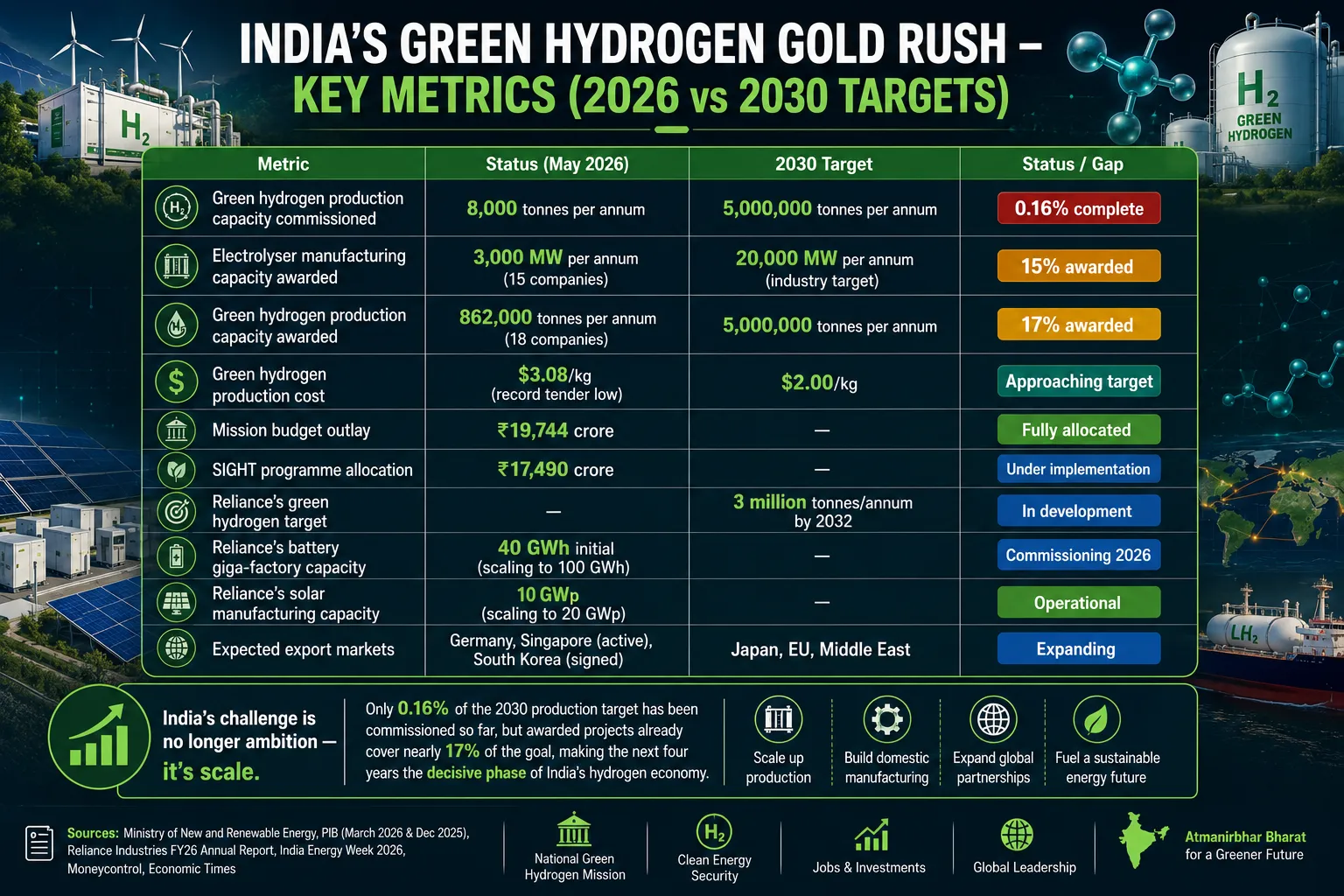
CHART: "India's Green Hydrogen Gold Rush – Key Metrics (2026 vs 2030 Targets)"
Metric | Status (May 2026) | 2030 Target | Status / Gap |
|---|---|---|---|
Green hydrogen production capacity commissioned | 8,000 tonnes per annum | 5,000,000 tonnes per annum | 0.16% complete |
Electrolyser manufacturing capacity awarded | 3,000 MW per annum (15 companies) | 20,000 MW per annum (industry target) | 15% awarded |
Green hydrogen production capacity awarded | 862,000 tonnes per annum (18 companies) | 5,000,000 tonnes per annum | 17% awarded |
Green hydrogen production cost | $3.08/kg (record tender low) | $2.00/kg | Approaching |
Mission budget outlay | ₹19,744 crore | — | Fully allocated |
SIGHT programme allocation | ₹17,490 crore | — | Under implementation |
Reliance's green hydrogen target | — | 3 million tonnes/annum by 2032 | In development |
Reliance's battery giga-factory capacity | 40 GWh initial (scaling to 100 GWh) | — | Commissioning 2026 |
Reliance's solar manufacturing capacity | 10 GWp (scaling to 20 GWp) | — | Operational |
Expected export markets | Germany, Singapore (active), South Korea (signed) | Japan, EU, Middle East | Expanding |
Sources: Ministry of New and Renewable Energy, PIB releases (March 2026, December 2025), Reliance Industries FY26 Annual Report, India Energy Week 2026, Moneycontrol, Economic Times


