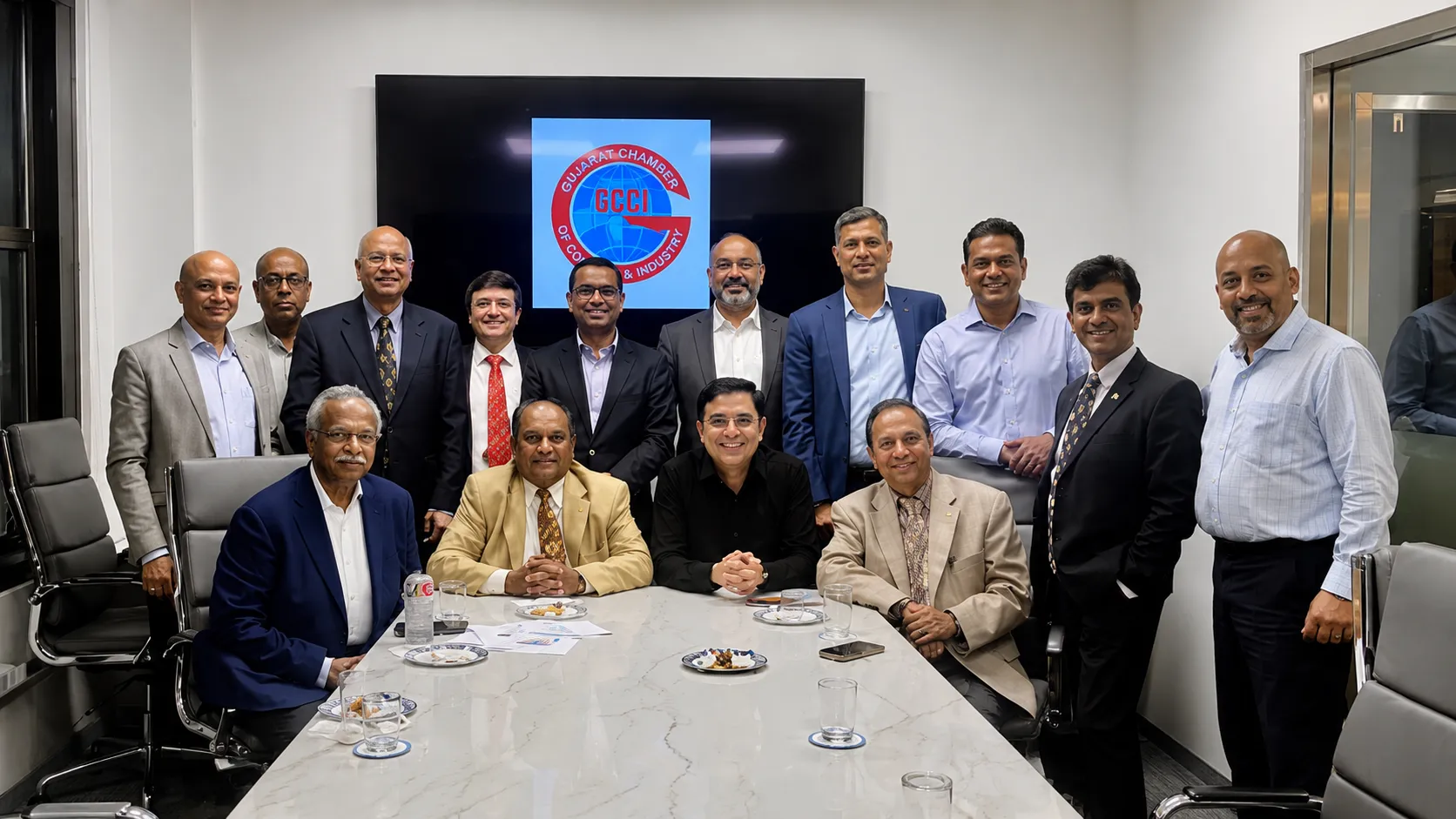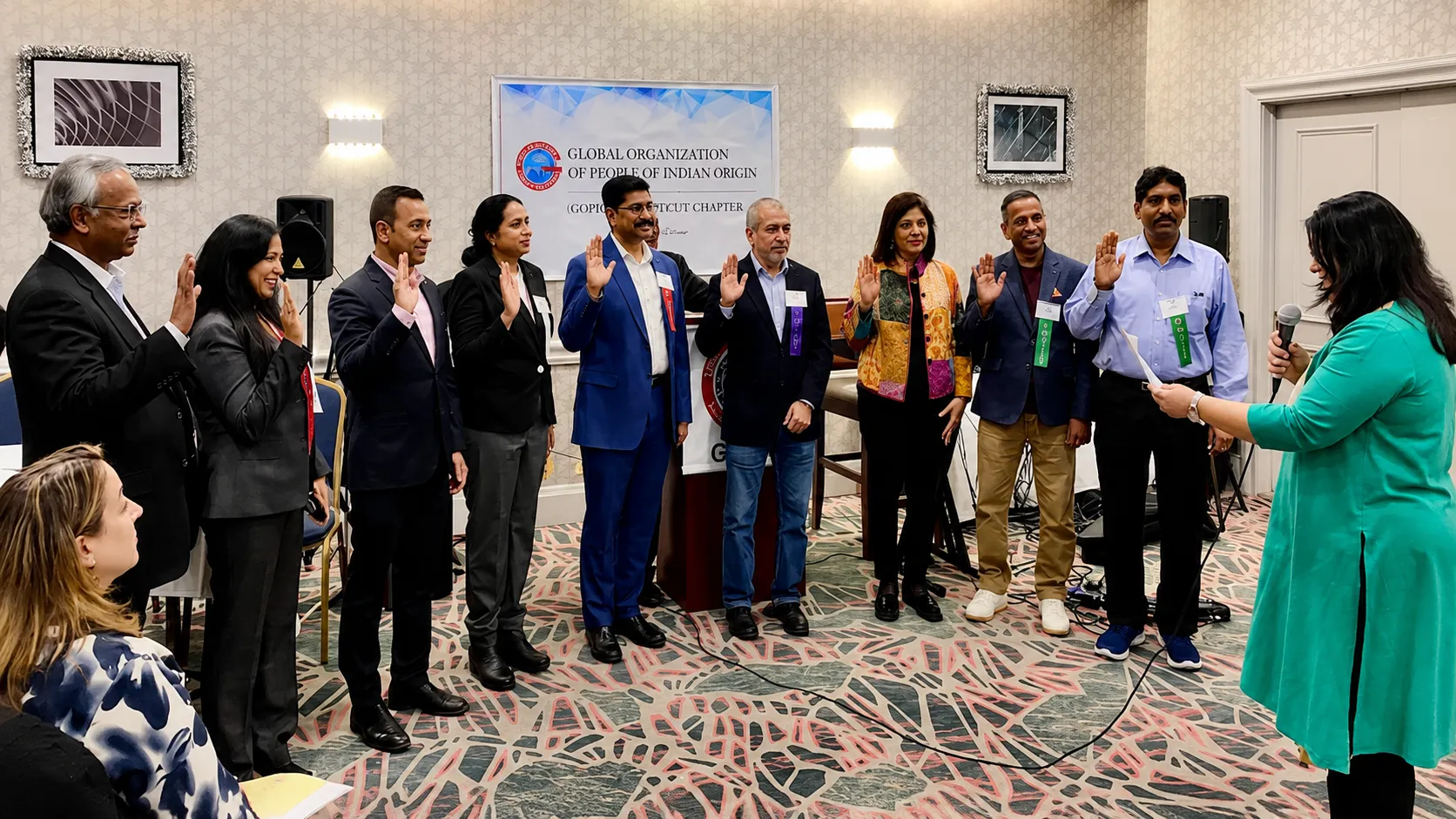
HARTFORD, CONN. — On the same afternoon that Governor Ned Lamont signed the Connecticut-India Trade Commission into law, a second, quieter but equally consequential milestone unfolded at the State Capitol: the formal inauguration of the Connecticut chapter of the Global Organization of People of Indian Origin (GOPIO) Chamber of Commerce and Industry. For a diaspora organization that has spent nearly four decades building grassroots networks across the United States, the Connecticut launch represents a shift from informal community mobilization toward structured, state-recognized economic advocacy.
The chamber's inauguration was led jointly by Consul General of India in New York, Binaya Srikanta Pradhan, and Gov. Lamont, in a ceremony that drew State Sen. Sujata Gadkar-Wilcox, GOPIO Founder President and Chairman Dr. Thomas Abraham, GOPIO International President Prakash Shah, and a wide cross-section of elected officials, business leaders, entrepreneurs and professionals from Connecticut's Indian American community. The presence of GOPIO's top national and international leadership at a single-state chapter launch signals how seriously the organization is treating Connecticut as a proof-of-concept for a broader expansion strategy.
According to the Consulate General of India, the new chapter is designed to strengthen trade and investment ties, promote entrepreneurship and innovation, and expand business and professional linkages between India and Connecticut — objectives that dovetail directly with the mandate of the newly created Connecticut-India Trade Commission. That overlap is not incidental. Diaspora organizers have long argued that grassroots business networks and formal government commissions function best when built in tandem: one supplying political legitimacy and legislative access, the other supplying the on-the-ground entrepreneurial energy and professional networks that make trade partnerships tangible.
GOPIO itself is not a new player in this space. Founded in 1989, the organization has built one of the largest global networks of people of Indian origin, with chapters spanning dozens of countries and, within the United States, an increasingly dense footprint of state and metro-level chambers of commerce. Dr. Thomas Abraham's decades of leadership have positioned GOPIO as one of the primary vehicles through which the Indian diaspora in America organizes its collective economic and civic interests — from advocating for immigration reform to, increasingly, building formal business bridges between U.S. states and Indian states and industries.
For Connecticut specifically, the chamber launch comes at a moment of accelerating Indian American economic presence in the state's technology, healthcare, financial services and higher-education sectors. Hartford's historic insurance and financial industry, Stamford's corporate headquarters cluster, and the research ecosystems around Yale and the University of Connecticut have all seen growing Indian American participation over the past two decades — yet, participants at the launch noted, that economic weight had rarely translated into a single organized advocacy body with a direct line to state government. The new chamber aims to close that gap.