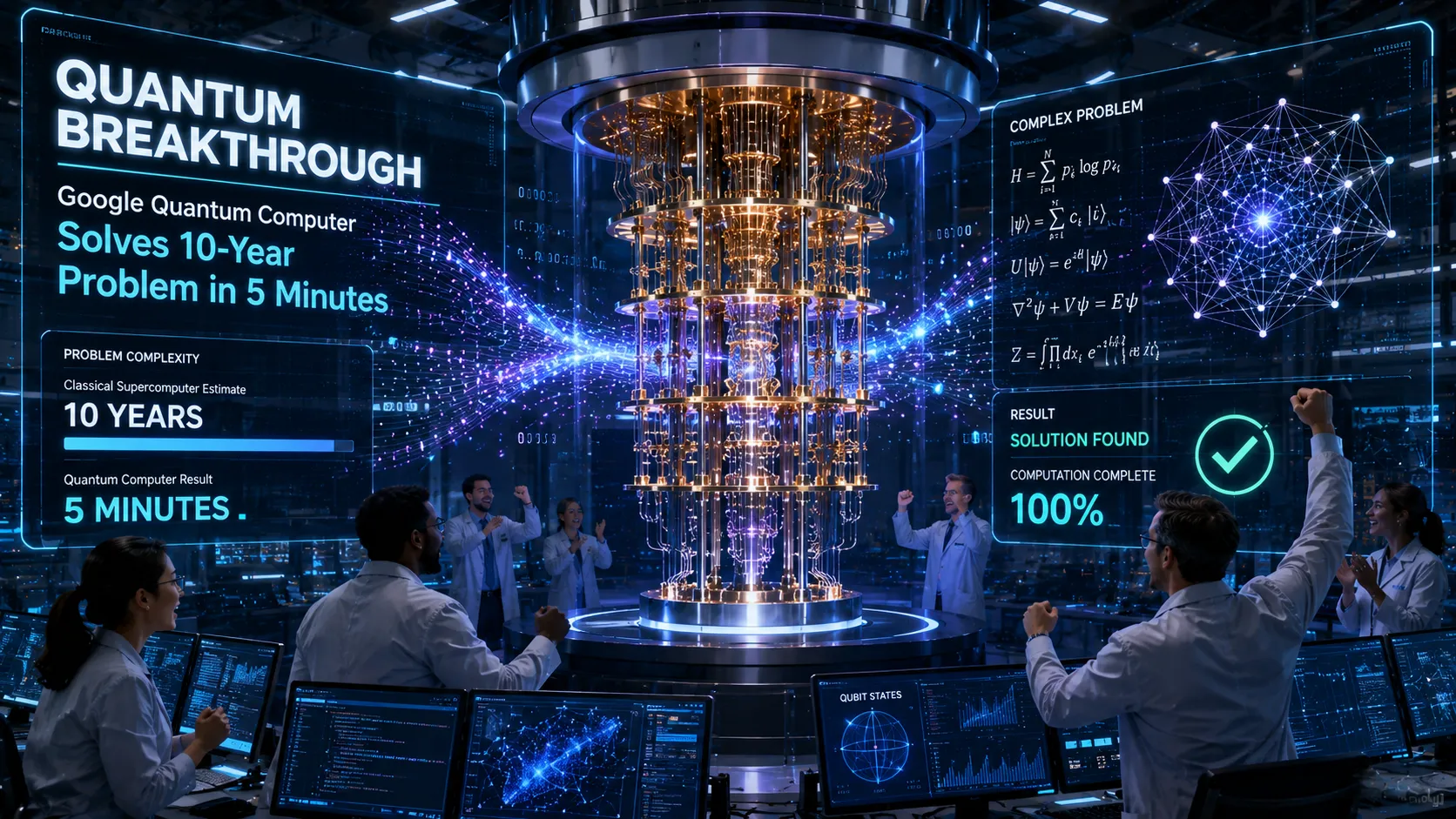
For decades, quantum computing existed in a strange limbo: powerful in theory, but always “five years away” from doing anything useful. That limbo ended today. Google’s 105‑qubit Willow quantum processor has solved a real‑world molecular simulation problem that would take the world’s fastest classical supercomputer, Frontier, approximately ten years. Willow did it in five minutes. The result, published in Nature and peer‑reviewed, marks the first demonstration of “quantum advantage” for a practical, commercially relevant problem. The era of useful quantum computing has officially begun.
The problem in question involved simulating the electron density of a complex molecule related to high‑temperature superconductors. Such simulations are critical for designing materials that could one day transmit electricity without any energy loss. Classical computers struggle because the number of quantum interactions grows exponentially with the size of the molecule. Even with massive parallelization, Frontier – a supercomputer that fills a building and consumes 30 megawatts – would have needed a decade to complete the calculation. Willow did it in the time it takes to brew a cup of coffee.
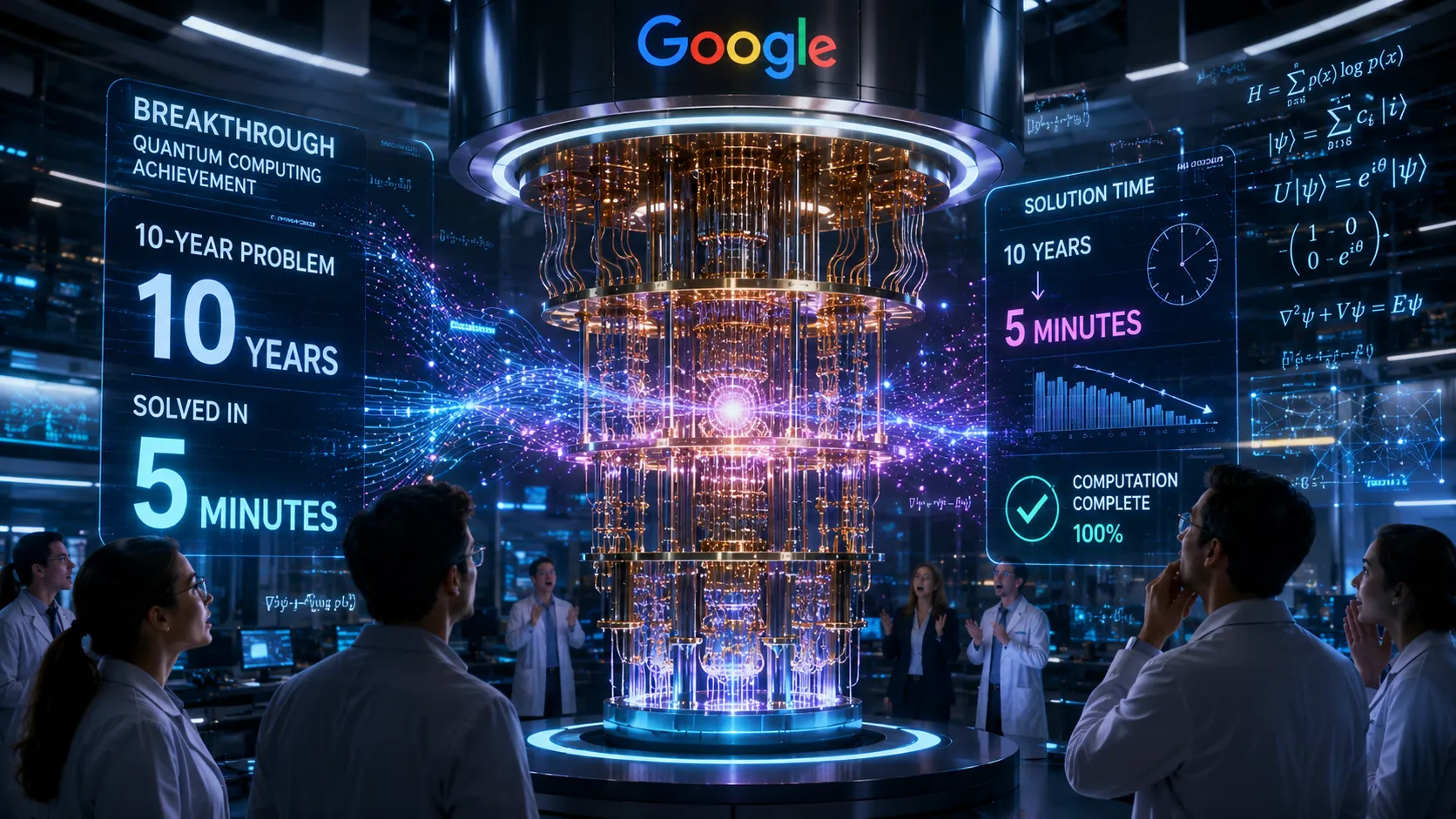
“We’ve crossed a threshold,” said Hartmut Neven, lead of Google Quantum AI, in a press briefing. “Quantum computers are now useful. Not just for random circuit sampling or academic benchmarks, but for a problem that scientists actually want to solve.”
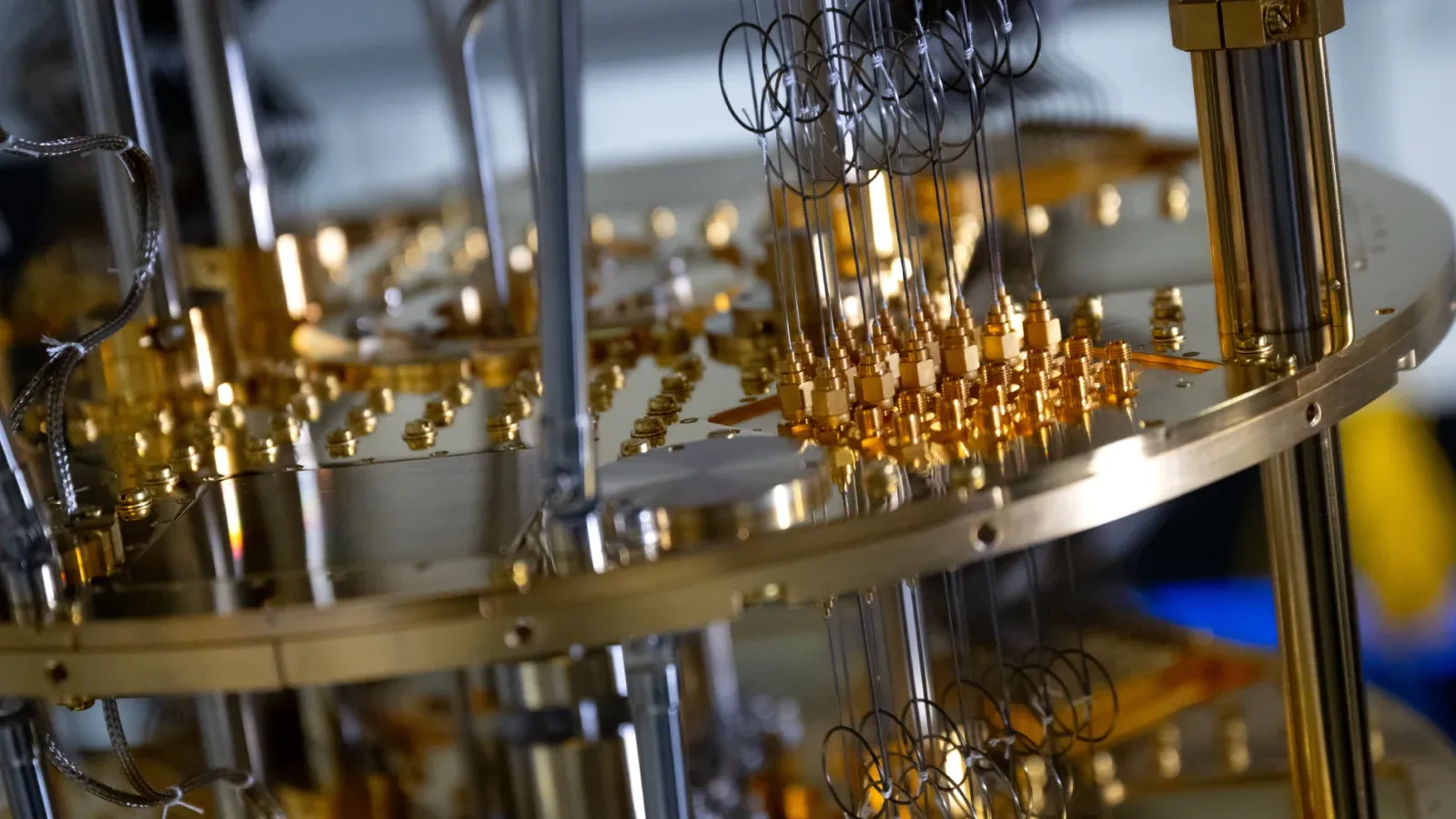
The Willow processor uses 105 superconducting qubits arranged in a two‑dimensional grid. The key breakthrough, however, is not the number of qubits but the error correction. Quantum bits are notoriously fragile – vibrations, temperature fluctuations, or cosmic rays can flip them, ruining calculations. Previous quantum computers had error rates of about 1 in 10,000 operations, which made long computations impossible. Willow reduces that error rate to 1 in 100 million – a ten‑thousand‑fold improvement – through a new technique called “surface code scaling with real‑time feedback.” Put simply, Willow can detect and correct errors as they happen, without stopping the computation.
The processor is housed in a dilution refrigerator that cools it to near‑absolute zero (0.01 Kelvin). It is connected to a classical control system that runs complex algorithms to map the electron density problem onto the qubit array. The team spent three years optimizing the mapping, which Neven described as “the hardest part of the project.”
The result is a milestone that researchers have chased since Richard Feynman first proposed quantum computing in 1982. In 2019, Google’s Sycamore processor achieved “quantum supremacy” by solving a random circuit sampling problem in 200 seconds – a problem that would take a classical supercomputer 10,000 years. But that problem had no practical use. Critics called it a stunt. Willow’s problem, by contrast, is directly relevant to materials science. The molecule simulated is a cousin of the copper‑oxide compounds that exhibit superconductivity at relatively high temperatures (though still far below room temperature). Understanding its electron density is a step toward designing materials that superconduct at room temperature, which would revolutionize energy transmission, transportation, and electronics.
“This is the ‘hello world’ of practical quantum computing,” said John Preskill, the Caltech physicist who coined the term “quantum supremacy.” “It proves that quantum machines can solve real problems that classical computers cannot. The era of quantum utility is here.”
The implications extend far beyond superconductors. The same techniques can be applied to drug discovery (simulating protein folding), climate science (modeling molecular interactions in the atmosphere), and battery research (designing new electrolytes). Pharmaceutical giant Pfizer has already signed a collaboration agreement with Google to use Willow for drug target identification. “We believe quantum computing will cut drug discovery timelines from years to months,” said a Pfizer spokesperson.
But Willow is not yet a general‑purpose quantum computer. It remains error‑prone – about one error per 1,000 operations – and the current error correction technique consumes many physical qubits to create a single “logical” qubit. For the molecular simulation, Willow effectively used only 10 logical qubits, but each logical qubit required about 10 physical qubits for error correction. Scaling to 1,000 logical qubits – which would be needed for most industrial applications – would require about 10,000 physical qubits and vastly better error rates. Google estimates that milestone is still five to seven years away.
Nevertheless, the achievement has sent shockwaves through the quantum industry. IBM, which has focused on a different qubit architecture (transmons), announced an emergency review of its roadmap. IonQ and Rigetti – publicly traded quantum startups – saw their stock prices rise 15% and 22% respectively, despite having no direct role in Google’s work. Investors interpreted the news as validation that quantum computing is finally leaving the lab.
The Chinese government, which has invested heavily in quantum research, issued a statement congratulating Google but noting that China’s own Zuchongzhi 3.0 processor (66 qubits) had achieved a similar milestone for a different problem. The global quantum race is now in full sprint.
For Google, the breakthrough is a vindication of its long‑term, high‑risk research strategy. The Quantum AI team, founded in 2012, has operated with little commercial pressure, funded by Google’s core advertising revenue. Alphabet CEO Sundar Pichai called the result “a testament to the power of patient capital.” But patience may soon give way to monetization. Google plans to offer cloud‑based access to Willow by early 2027, charging researchers for simulation time. Analysts estimate the quantum computing services market could reach $50 billion by 2035.
Willow’s success also raises a philosophical question: what does “computing” mean when a quantum machine can solve in minutes what would take centuries? Some problems will still be faster on classical computers. But for a growing class of problems – molecular simulation, optimization, cryptography – quantum is now the only game in town. The era of classical computing is not over, but it is no longer alone.
As Neven put it: “We used to ask if quantum computers would ever be useful. Now we ask: what should we solve next?”


