Girish Mathrubootham — From Chennai to Nasdaq: The Freshworks Story That Changed Indian SaaS Forever
The Zoho Days That Shaped a Founder
Before Freshworks, there was Zoho. Girish Mathrubootham, a Chennai‑born engineer with a degree from Shanmugha Arts, Science, Technology & Research Academy (SASTRA), joined Zoho Corporation (then AdventNet) in 2001 as a product manager. For nearly a decade, he helped build Zoho’s customer relationship management (CRM) and support products.
At Zoho, Girish learned the art of bootstrapping, product‑led growth, and serving small and medium businesses (SMBs) — customers that incumbents like Salesforce and Oracle ignored. He also learned the value of building a global product from Tamil Nadu, hiring local talent, and refusing to move to Silicon Valley.
But by 2010, Girish had an itch. He saw that customer service software (helpdesk software) was either too expensive (Zendesk charged $50+ per agent per month) or too clunky (open‑source solutions required IT expertise). He believed there was a gap for an affordable, beautiful, and easy‑to‑use helpdesk built specifically for SMBs.
He also had a personal pain point. His iPod had broken, and getting a replacement through Apple's support system was a nightmare. He thought: Why can't customer service be simple and human?
That frustration became the founding idea for Freshdesk (later rebranded to Freshworks). In October 2010, Girish quit Zoho, teamed up with his former colleague Shan Krishnasamy, and started coding in a rented apartment in Chennai's Perungudi neighbourhood.
The Chennai Garage‑to‑Global Story
Freshdesk launched in 2011 with a radical proposition: a cloud‑based helpdesk that was free for up to 3 agents, and paid plans starting at $9 per agent per month — one‑fifth of Zendesk's price. The user interface was clean, the setup took minutes, and the product "just worked."
Initial growth was slow. Girish and Shan personally answered support tickets, wrote blog posts, and reached out to early users on Twitter. But the product was so intuitive that users began recommending it to others. This was product‑led growth (PLG) before the term was coined — the product itself was the primary marketing channel.
By 2012, Freshdesk had 1,000 customers, including HP and Sony. Accel Partners invested $1 million in seed funding — the first external capital Girish had taken. Unlike most Indian founders who rush to move to the US, Girish kept the engineering and product teams in Chennai. "Talent in Tamil Nadu is world‑class and loyal," he told TechCrunch in 2015. "Why would I leave?"
The strategy paid off. By 2016, Freshdesk had over 50,000 customers, was generating $50 million in annual recurring revenue (ARR), and had raised $150 million from Tiger Global, Google Capital, and Sequoia. The company rebranded to Freshworks to reflect its expanding suite of products (Freshsales, Freshchat, Freshcaller, Freshservice).
The Nasdaq Moment — A Historic First for Indian SaaS
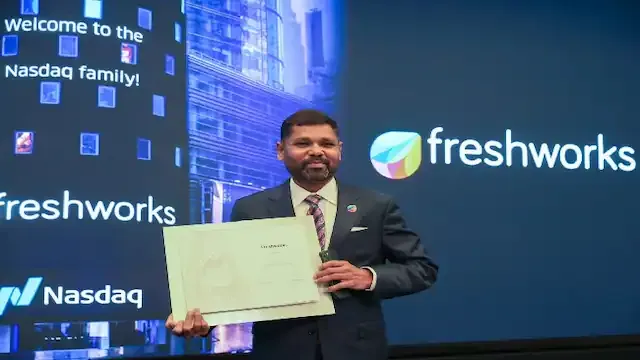
On September 22, 2021, Girish Mathrubootham rang the Nasdaq bell in New York. Freshworks listed at a valuation of $10.1 billion, making it the first Indian SaaS company to go public on a US exchange. The stock surged 25% on the first day, giving the company a market cap of over $12 billion.
The IPO was historic for three reasons:
It proved that Indian SaaS could compete globally: Freshworks was not a services company or an outsourcing firm. It was a genuine product company with global customers (including Honda, Bridgestone, and Hugo Boss).
It validated Chennai as a SaaS hub: Freshworks employed over 4,000 people in Chennai alone, with average salaries 40% lower than Silicon Valley but quality just as high. Dozens of Freshworks alumni went on to found their own SaaS startups (Chargebee, Uniphore, etc.), creating a thriving ecosystem.
It inspired a generation of Tamil Nadu founders: Girish became a folk hero in the state's tech circles. His story — middle‑class Chennai boy, Zoho alumnus, no Ivy League degree — was deeply relatable.
At the time of IPO, Girish owned approximately 10% of Freshworks, making his personal wealth over $1 billion. But he famously told The Economic Times: "The money is just a scorecard. What matters is that we built a global company from Chennai."
The AI Pivot: Freshworks’ Next Chapter
Post‑IPO, Freshworks faced the same challenge as every SaaS company: how to integrate generative AI without cannibalizing existing products. Girish moved quickly. In 2023, Freshworks launched Freddy AI — a generative AI co‑pilot embedded across all products.
Freddy AI can:
Automatically summarize customer support tickets and suggest responses (reducing agent handling time by 40%).
Predict which customers are likely to churn and recommend retention actions.
Generate knowledge base articles from past support conversations.
Translate support content into 30+ languages in real time.
The AI investments paid off. In 2024, Freshworks reported $600 million in annual revenue, with 20% year‑on‑year growth and operating margins improving to 15%. The stock, which had dipped post‑IPO, recovered to $22 billion market cap by mid‑2026.
Girish has also made strategic acquisitions: Device42 (IT asset management) for $230 million, and AnsweriQ (AI for customer service) for an undisclosed sum. These moves position Freshworks as a full‑stack customer experience (CX) platform, competing head‑on with Zendesk and Salesforce.
The Freshworks Ecosystem: Creating a Tamil Nadu SaaS Cluster
One of Girish's most enduring legacies is the Freshworks effect. Dozens of SaaS startups in Chennai have been founded by Freshworks alumni, creating a self‑sustaining ecosystem:
Chargebee (subscription billing) — Founded by Krish Subramanian, a Freshworks veteran.
Uniphore (conversational AI) — Founded by Umesh Sachdev and Ravi Saraogi, though not directly a Freshworks alum, benefited from Chennai's SaaS talent pool.
Zarget (conversion optimization) — Founded by Freshworks alumni, later acquired by Freshworks itself.
Countly (analytics) and many others.
Girish actively mentors these founders, invests through his family office, and has even hosted "Freshworks Founder Fridays" — informal sessions where alumni entrepreneurs share learnings.
He has also been vocal about policy changes to support Tamil Nadu's startup ecosystem, including faster patent approvals, better digital infrastructure in Tier‑2 cities (Coimbatore, Madurai, Trichy), and tax incentives for R&D.
Leadership Philosophy: Customer Obsession, Not Ego
Girish is known for his customer‑obsessed leadership style. He personally reads support tickets, calls unhappy customers, and has a rule that every product feature must be tied to a customer request. "If no customer asked for it, we don't build it," he says.
He is also famously frugal. Freshworks' Chennai headquarters is functional, not flashy. Girish still flies economy on short-haul flights and uses a modest office. This frugality has trickled down — Freshworks has one of the highest "runway" ratios (cash vs burn) in Indian SaaS.
His management philosophy is captured in his book (not yet written, but often quoted in interviews): "Hire for hunger, not credentials. Trust your Chennai team. And never, ever move your R&D out of India."
Challenges and Critiques
Freshworks has not been without controversy. In 2022, the company faced a slowdown in enterprise sales as macro conditions worsened, leading to a 10% workforce reduction (about 500 employees). Girish handled it with unusual transparency, writing a detailed email explaining the decision and offering generous severance.
Another critique is that Freshworks' growth has slowed from 40%+ in pre‑IPO days to 15–20% now — still healthy but no longer hypergrowth. Competitors like Zendesk have cut prices, and AI‑native startups (e.g., Intercom's AI bots) are emerging. Girish's response is to double down on mid‑market customers (100–1,000 employees), where Freshworks has the strongest product‑market fit.
Finally, some investors have questioned whether Freshworks should move its headquarters to the US for tax and valuation reasons. Girish has resisted, keeping the official HQ in Chennai. "We are a Tamil Nadu company that happens to sell globally," he has said.
Lessons for Tamil Nadu Entrepreneurs
You don't need to move to Bengaluru or Silicon Valley: Freshworks proved that Chennai can host a global SaaS giant.
Product‑led growth beats sales‑led growth: Build a product so good that it sells itself.
Acquisitions are for capability, not ego: Freshworks' acquisitions have been small, strategic, and well integrated.
IPO is not the finish line: Girish is now focused on AI and long‑term value creation.
The Road Ahead
As of 2026, Girish Mathrubootham is 50 years old. Freshworks is on track to cross $1 billion in annual revenue by 2028. The company is expanding aggressively in Europe and Japan, and Freddy AI is being positioned as a "co‑pilot for every desk worker."
Girish has stepped back from day‑to‑day operations, promoting a new CEO (internal candidate), but remains Executive Chairman. He is spending more time on his philanthropic initiative — Freshworks for Good — which provides free SaaS licenses to NGOs and schools in Tamil Nadu.
His legacy is secure: he took Indian SaaS from zero to Nasdaq, put Chennai on the global tech map, and inspired a generation of founders to dream big without leaving home.


