DiasporaCampus6 MIN READ

From Trafalgar Square To Radcliffe Camera: How India's 'Cockroach' Student Protests Mobilised Campuses Across Britain

Over the course of a single week, solidarity demonstrations tied to India's NEET protest movement spread to Oxford, Nottingham, Manchester, Edinburgh and Glasgow — a striking illustration of how quickly a domestic Indian political movement can now mobilise diaspora students across an entire country

By Nisha Omkumar · Author28 July 2026
From Trafalgar Square To Radcliffe Camera: How India's 'Cockroach' Student Protests Mobilised Campuses Across Britain

India's 'Cockroach Janta Party'-led student protest movement, which ultimately secured the resignation of Union Education Minister Dharmendra Pradhan after 36 days of sustained demonstrations, did not remain confined to Delhi's Jantar Mantar or India's own campuses — over the course of a single week, solidarity demonstrations tied directly to the movement spread across a striking range of British university towns and cities, from Trafalgar Square in central London to the Radcliffe Camera at Oxford University, alongside protests in Nottingham, Manchester, Edinburgh, Glasgow, Leeds, Liverpool, and Cardiff, offering a vivid illustration of just how rapidly a domestic Indian political movement can now mobilise diaspora student communities across an entire country.

The movement's origins trace back to allegations that surfaced around India's National Eligibility-cum-Entrance Test, the country's national medical and dental college entrance examination, when a 'guess paper' circulating ahead of the 2026 exam was found to closely match the actual question paper subsequently administered to millions of student applicants. That controversy, combined with a subsequent police crackdown on protesters demonstrating in Delhi, catalysed a rapidly escalating protest movement that drew in student groups, youth organisations, and the satirical Cockroach Janta Party, alongside prominent education-reform campaigner Sonam Wangchuk, who joined the movement through an extended hunger strike that drew further national and international attention.

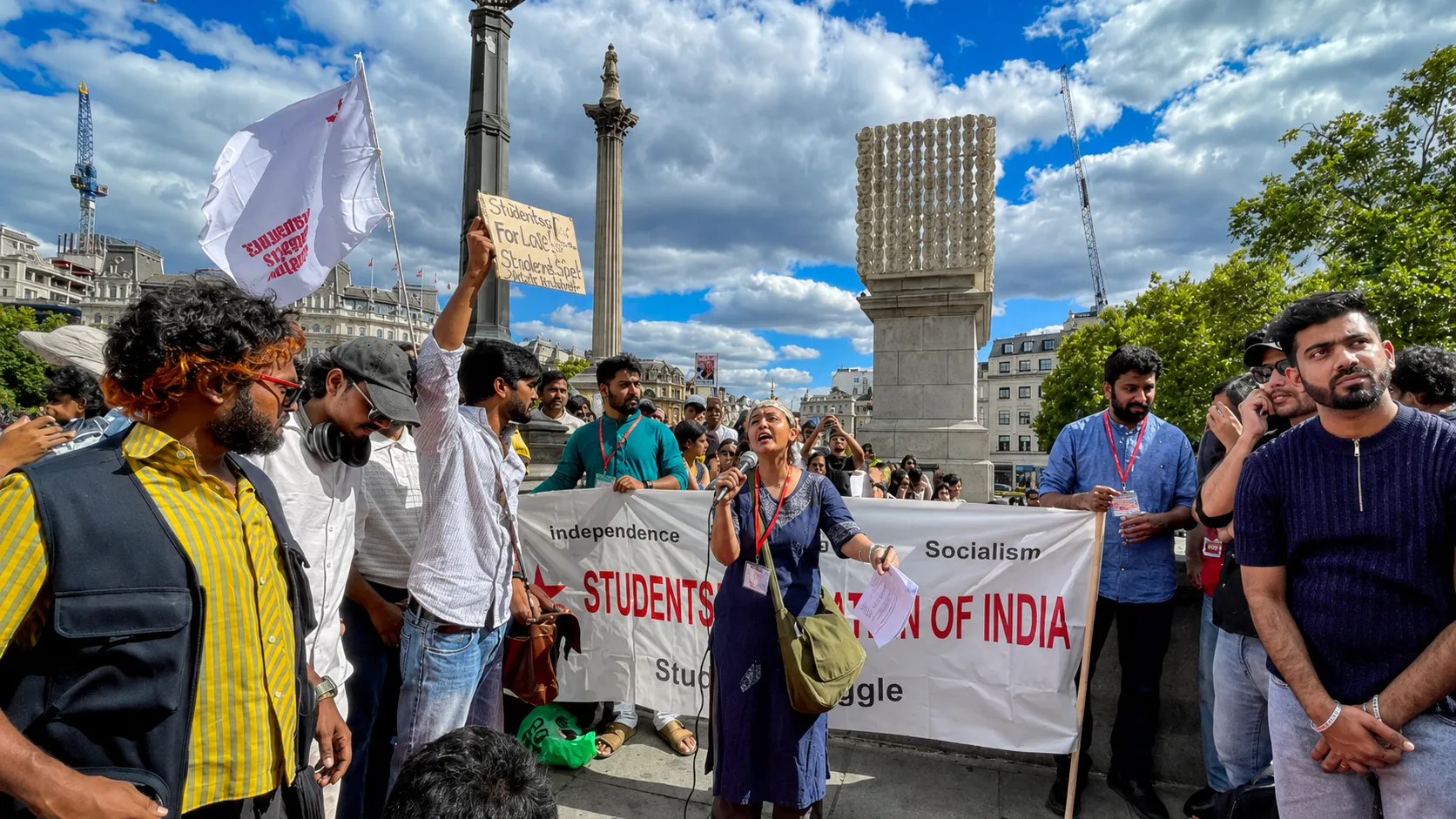
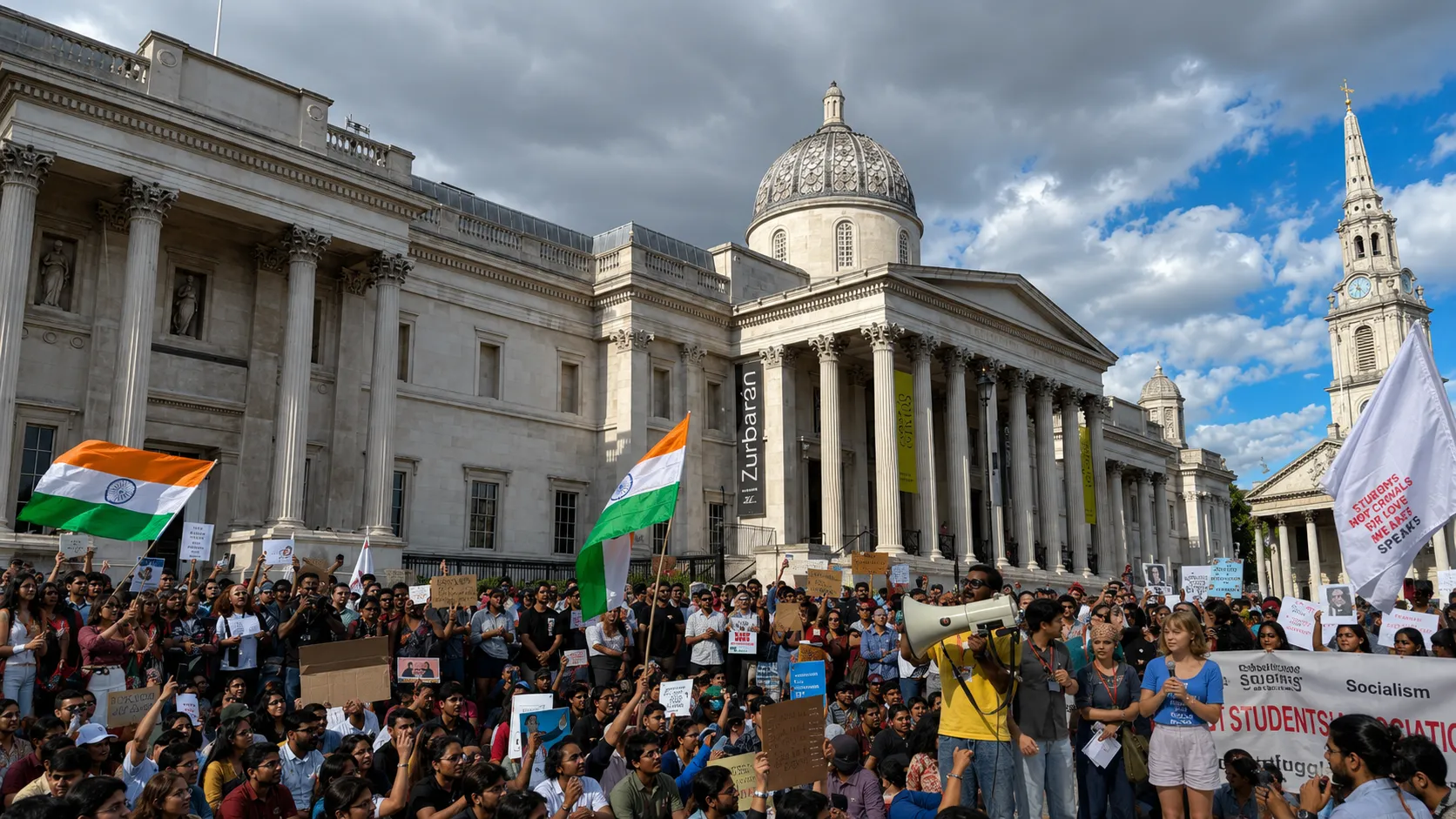
The UK demonstrations that emerged in solidarity with this Indian movement followed a genuinely rapid mobilisation timeline, with the earliest wave of protests, organised jointly by the South Asia Solidarity Group, the UK unit of the Students' Federation of India, and the India Workers' Association, gathering hundreds of demonstrators outside the Indian High Commission in central London under the slogan 'Cockroaches of London Unite, Rise in Protest' — a direct reference to the CJP movement's own satirical branding, which had emerged from government officials' dismissive characterisation of the original protesters, a label the movement subsequently reclaimed as a rallying identity.
ChatGPT Image Jul 28, 2026, 01_09_49 PM.png

SFI-UK Secretary Somiha Chatterjee, addressing the initial London gathering, expressed solidarity with students in India observing hunger strikes and specifically condemned what she characterised as sustained police brutality against peaceful demonstrators in Delhi — remarks echoed across the subsequent wave of demonstrations that spread to additional UK cities over the following days. Demonstrators at the London protest carried placards reading 'Inquilab Zindabad' and 'Pradhan Istifa Do,' explicitly demanding accountability, transparency, and fairness in the conduct of India's public examination system.

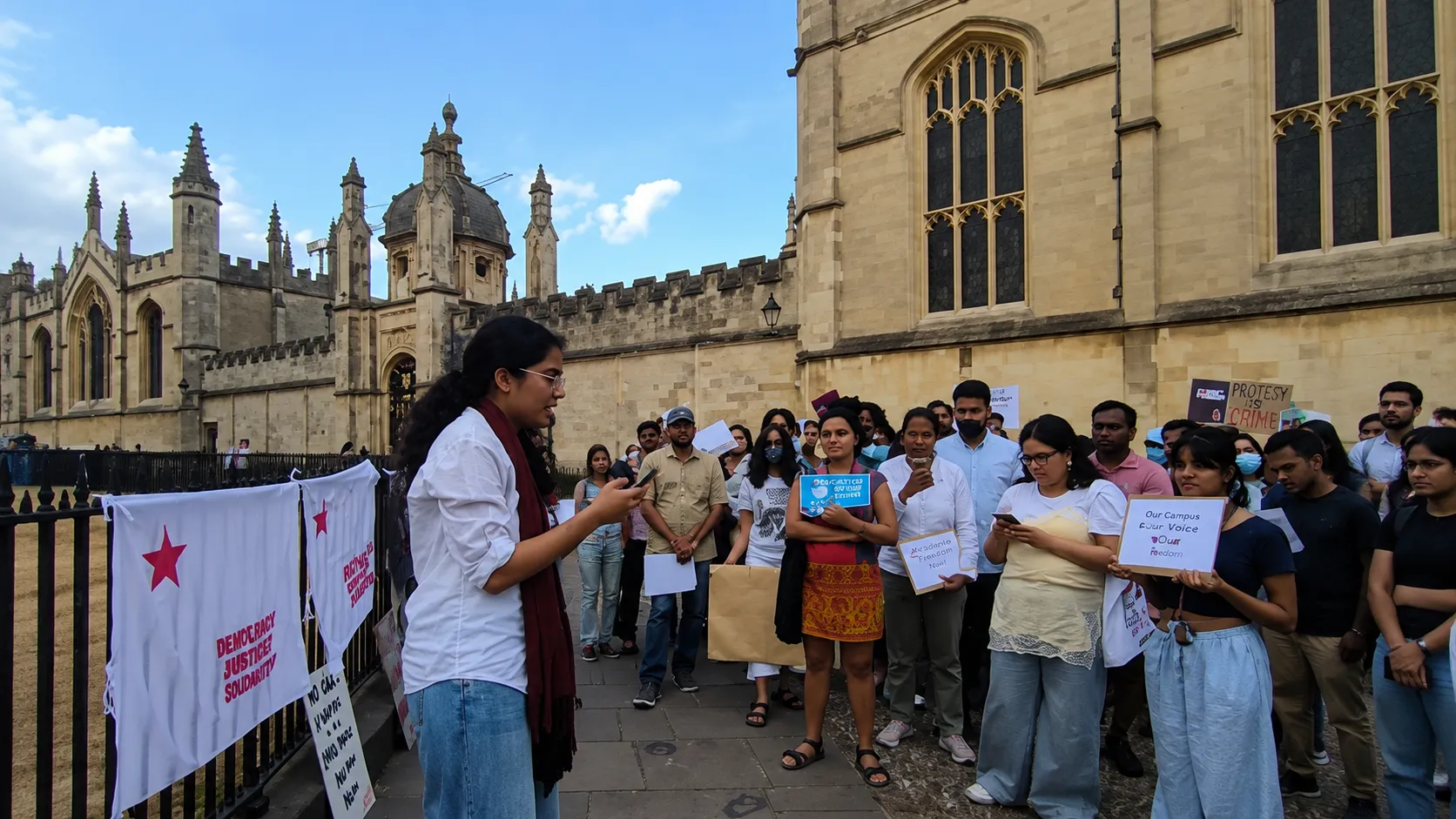
The movement's spread to Oxford University specifically, where demonstrations were reported at the Radcliffe Camera — one of the university's most recognisable landmark buildings — reflects the significant population of Indian students enrolled across Britain's leading universities, many of whom maintain close personal and family connections to exactly the kind of competitive examination systems, including NEET, that shape educational opportunity and access back in India. For many of these students, the protest movement carried genuinely personal resonance well beyond abstract political solidarity, given their own or their siblings' and cousins' direct experience navigating India's intensely competitive examination culture.

As the protests continued through the week, further demonstrations were organised outside the Consulate General of India in Edinburgh and in Glasgow, with organisers describing what they characterised as a massive turnout at these Scottish demonstrations. That geographic spread — from England's major cities through to Scotland's own substantial Indian diaspora communities — underscores the extent to which the protest movement's messaging and organisational infrastructure successfully traversed what might otherwise have remained largely England-centric diaspora political mobilisation.

What started as a protest in just one city spread to several small and big Indian cities, and from there, across the Indian diaspora in England, Ireland, Scotland, the USA, Germany, the Netherlands and Canada.
Coverage of how the CJP protest movement spread globally through diaspora networks

Following Pradhan's resignation on July 25, the character of the UK demonstrations shifted rapidly from protest to celebration, with SFI-UK's various city chapters organising what they described as victory gatherings marking the movement's core demand being met, while explicitly signalling that broader campaign objectives — including compensation for families of NEET aspirants alleged to have died by suicide following the examination controversy, and the release of hunger-striker Sonam Wangchuk — remained unmet and would continue to be pursued. The Leeds SFI-UK committee specifically described its own gathering as a celebration of the win the movement had achieved both within India and across the international diaspora networks that had mobilised in solidarity.

The broader international dimension of this diaspora mobilisation extended well beyond Britain alone, with comparable solidarity demonstrations tied to the same movement reported across Ireland, the United States, Germany, the Netherlands, and Canada — reflecting the genuinely global reach of India's diaspora student and activist networks, and the speed with which contemporary social media infrastructure allows a protest movement's messaging, imagery, and organisational calls-to-action to propagate across multiple countries and continents within the same compressed news cycle that shaped the movement's escalation within India itself.

For Britain's universities specifically, hosting this wave of solidarity demonstrations across multiple campus towns offers a useful, if not entirely novel, illustration of how international students, and Indian students in particular given their substantial and growing numbers across UK higher education, increasingly bring the political concerns and controversies of their home countries directly into their British campus and civic life, rather than treating their time studying abroad as politically disconnected from developments back home. That dynamic has become an increasingly well-documented feature of how diaspora communities engage with British public life more broadly, extending well beyond this specific NEET-related mobilisation into a range of other India-linked political controversies that have periodically found expression through UK-based demonstrations and campus organising in recent years.

ChatGPT Image Jul 28, 2026, 01_11_24 PM.png

As the immediate protest cycle now winds down following Pradhan's resignation and the broader wave of celebratory gatherings that followed, the coming weeks are likely to offer a useful test of whether the organisational infrastructure and cross-city coordination this movement built across British universities and diaspora communities persists as a durable, ongoing network, or whether it gradually demobilises now that the specific catalysing controversy has reached what most participants regard as a successful resolution — a pattern that has, in previous comparable diaspora mobilisation episodes, often determined whether a single protest movement leaves behind lasting organisational capacity or simply a memorable, but ultimately time-limited, moment of collective diaspora action.

University administrators across the affected campuses have, according to student organisers, generally maintained a hands-off posture toward the demonstrations, treating them as legitimate exercises of student political expression rather than matters requiring institutional intervention, consistent with UK universities' broader, long-established tradition of tolerating campus political organising so long as demonstrations remain peaceful and do not disrupt core academic activity.

For India's own government and diplomatic missions in Britain, the scale and coordination of this diaspora mobilisation is likely to register as a data point worth watching closely, given how directly it demonstrates the continued strength of transnational organisational networks linking Indian domestic political movements with diaspora communities across multiple Western countries simultaneously — networks that, this particular episode suggests, remain fully capable of rapid, large-scale activation whenever a sufficiently resonant domestic Indian controversy emerges.

TagsCJPProtestNEETProtestsIndianStudentsUKOxfordUniversityDiasporaSolidarityUKUniversitiesStudentActivismDiasporaNewsIndianDiasporaUKCockroachJantaParty

Reader reviews

Sign in to rate and review this article.
Loading reviews…

