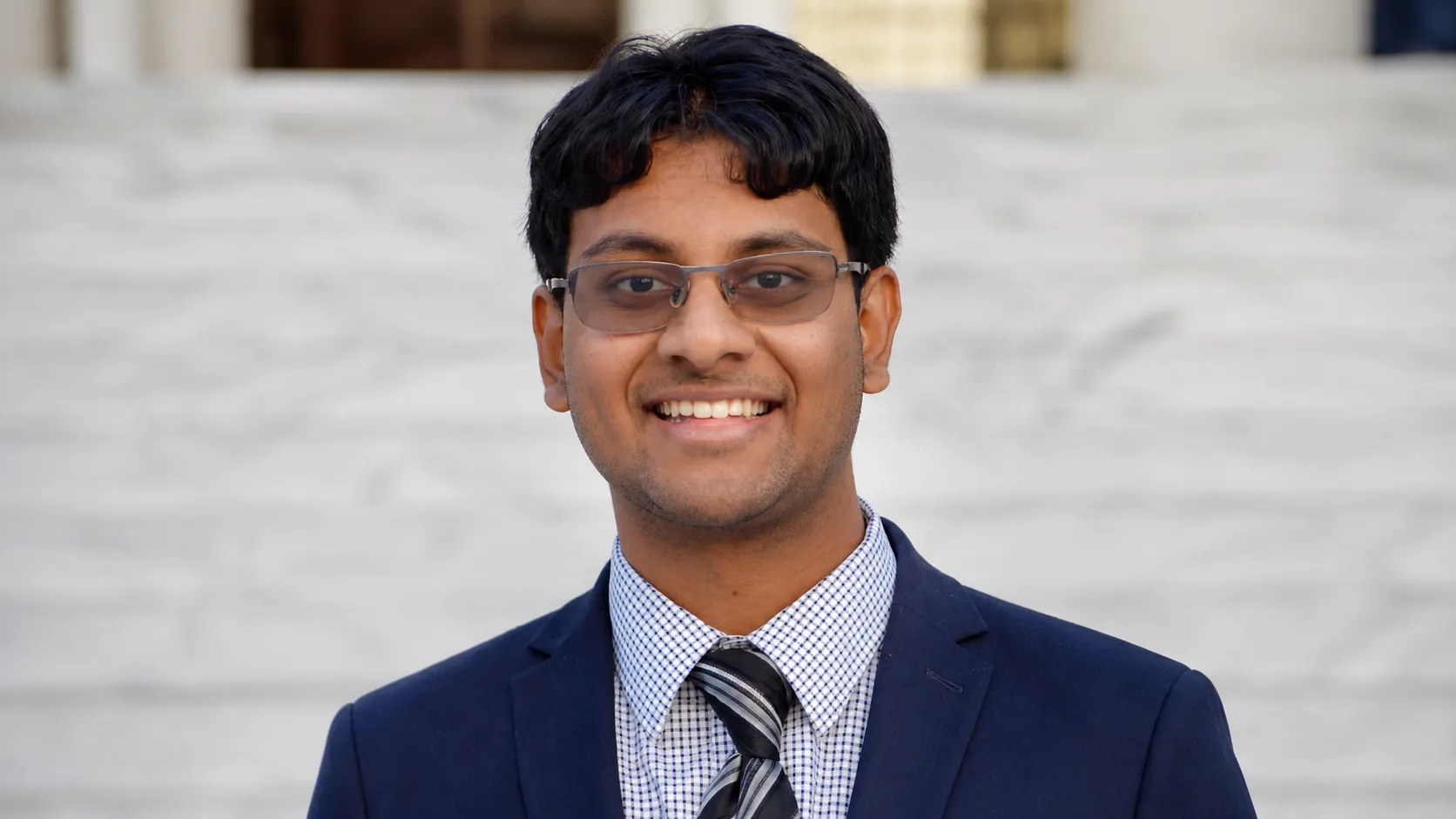
Every summer, a handful of undergraduates walk through the doors of the Center for the Advanced Study of India at the University of Pennsylvania hoping to turn a classroom interest into something closer to fieldwork. This year, one of them is Nikhil Pochana, a member of Penn's Class of 2028, who is spending the season as a 2026 summer research intern with Penn's South Asia Center — the country's first research institution dedicated exclusively to the study of contemporary India.
Pochana, a political science major with a parallel interest in data analytics, arrived at this project by way of an unusual personal history. Raised partly in Montgomery, Alabama, he has spoken previously about how growing up in the American South shaped his early instincts about civic institutions, inequality, and the gap that so often opens between the law as written and the law as experienced by the people it is meant to protect. That instinct has now been redirected toward a subject nearly ten thousand miles away: the everyday reality of transgender rights in India, with a specific focus on Kolkata.
The assignment sits squarely inside the South Asia Center's institutional DNA. Founded in 1992 as the first center in the United States built solely around the study of contemporary India, the Center for the Advanced Study of India has spent more than three decades training scholars, hosting fellows, and producing research that tries to capture India not as a static subject but as a rapidly moving target — a nation whose politics, economy, and social fabric are being renegotiated in real time. Its Department of South Asia Studies traces an academic lineage at Penn stretching back over a century, and its summer research internship program has become a proving ground for undergraduates who want their coursework to collide with the real world before they graduate.
For Pochana, that collision point is India's Transgender Persons (Protection of Rights) Act, 2019 — landmark legislation that followed the Supreme Court of India's own recognition, in the 2014 NALSA judgment, of transgender people's right to self-identify their gender. On paper, the 2019 Act was meant to translate that judicial recognition into enforceable protections: anti-discrimination provisions in education, employment, and healthcare; a mechanism for obtaining a certificate of identity; and welfare measures administered through the Ministry of Social Justice and Empowerment. In practice, legal scholars and advocacy groups inside India have spent the years since flagging a persistent gap between the statute's promises and its delivery.
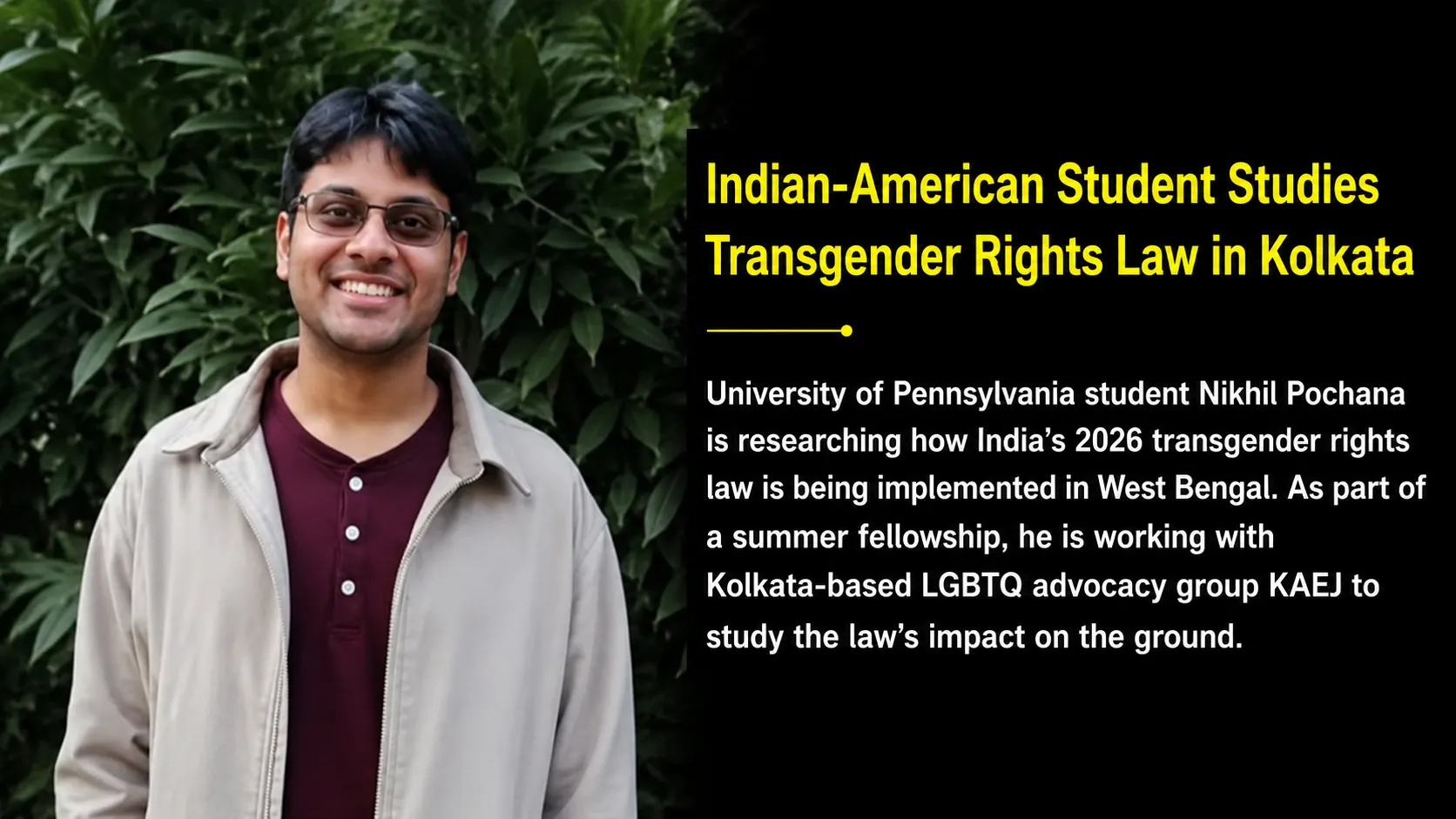
That gap is precisely the terrain Pochana is now mapping. Kolkata, a city with a long and complicated history around gender and sexuality — home to a visible and often marginalized hijra community alongside a newer generation of transgender activists, students, and professionals — offers a dense case study. Research emerging from Indian legal journals in just the past year has underscored how uneven implementation has been: many transgender individuals continue to struggle to access welfare benefits under the Act, to obtain identity documents that reflect their self-identified gender without bureaucratic friction, or to receive care free of discrimination, even where the legal architecture nominally guarantees it. A 2023 scoping review of LGBTQI+ health research in India, published in PLOS Global Public Health, found that most existing scholarship remains narrowly focused on HIV risk among transgender women, with comparatively little data on mental health, chronic disease, or the broader social determinants of health for transgender people across the country — a gap that leaves policymakers making decisions with a badly incomplete picture.
It is that kind of evidentiary vacuum — the space between a headline-grabbing law and the ground-level data needed to actually evaluate it — that summer interns at the South Asia Center are increasingly being pointed toward. The Center's ongoing collaborations with institutions, government agencies, and nonprofits across India give student researchers like Pochana access to a scholarly ecosystem far larger than what a single undergraduate could otherwise reach: faculty steeped in South Asian legal and political history, an active pipeline of visiting scholars, and connections to organizations already doing frontline work on transgender rights in Kolkata and beyond.
Pochana's academic profile suggests why the Center likely saw him as a strong fit. On LinkedIn, he describes himself as someone “seeking to utilize mathematical data analysis techniques to leverage policy and foster social change,” a framing that dovetails with the Center's own methodological bent toward mixed empirical and qualitative work rather than purely doctrinal legal analysis. His prior experience with Penn's PDRI-DevLab, a research initiative focused on development economics and policy, also points to a student who has been building toward exactly this kind of cross-border, data-informed human rights research for some time.
The broader significance of a project like this extends well beyond Pochana's own transcript. India's transgender community numbers in the millions by most estimates, though official counts remain contested and almost certainly undercounted. The country occupies an unusual position globally: it has some of the most progressive judicial language on gender identity anywhere in the world, embedded in a 2014 Supreme Court ruling that predates comparable protections in many Western democracies, and yet implementation on the ground remains inconsistent, under-resourced, and geographically uneven. Comparative legal scholars have increasingly used India as a case study precisely because of that tension — a jurisdiction where the gap between constitutional promise and administrative reality is unusually well-documented and unusually instructive for other developing democracies grappling with similar questions.
For the Indian American community watching from the United States, stories like Pochana's carry a particular resonance. They represent a second generation increasingly choosing to turn its academic and professional tools back toward the subcontinent — not as tourists of their heritage, but as researchers willing to sit with uncomfortable data about a country they feel a stake in getting right. Penn's South Asia Center, and programs like it at peer institutions, have become one of the primary vehicles for that return current, offering structured, credentialed pathways for young Indian Americans to do serious, rigorous work on Indian social policy rather than simply consuming news coverage of it from a distance.
It is, in the end, a small story in scale — one undergraduate, one summer, one research center. But it sits at the intersection of several larger currents reshaping how the Indian diaspora engages with India: a growing appetite among young Indian Americans for substantive, evidence-based engagement with the subcontinent's social policy; an academic infrastructure at American universities increasingly built to support exactly that kind of engagement; and a set of legal and human rights questions in India — around gender, caste, religion, and more — that remain as unresolved, and as urgently in need of rigorous documentation, as ever. Pochana's summer at the South Asia Center is one small but telling data point in that larger pattern.


