From Hyderabad to Orbit: How Skyroot Became India's First Spacetech Unicorn — And Why $44 Billion Is Just Liftoff
The Hook: A Billion‑Dollar Bet on an Indian Rocket
At 2:47 AM on a humid May morning in 2026, a small team of engineers gathered around a computer screen at Skyroot Aerospace's Hyderabad headquarters. They weren't watching a launch — not yet. They were refreshing a Term Sheet from a global investment firm. When the green checkmark appeared, the room erupted.
Skyroot had just become India's first space‑tech unicorn.
The round: $60 million led by Sherpalo Ventures (the early backer of Google) and GIC (Singapore's sovereign wealth fund), with participation from BlackRock. The valuation: $1.1 billion. The message: global capital now believes that Indian private space companies can compete with SpaceX, Rocket Lab, and China's Galactic Energy.
Barely 48 hours later, the Indian government announced a revised Space Policy 2026, further opening the sector to private launch vehicle operators, satellite manufacturers, and ground station providers. The space economy, estimated at $8.4 billion in 2026, is projected to hit $44 billion by 2033, according to ISRO's economic impact assessment. And Skyroot is at the very front of that rocket plume.
The Rocket: Vikram‑1, India's Private Orbital Workhorse
Skyroot's crown jewel is Vikram‑1, a four‑stage orbital rocket named after Dr. Vikram Sarabhai, the father of India's space programme. Unlike the massive, costly rockets built by government agencies, Vikram‑1 is designed to be lightweight, low‑cost, and rapidly deployable.
Key specifications:
Payload capacity: 290‑315 kg to low Earth orbit (LEO)
Height: 20 metres
Propulsion: Fully solid‑fuelled first three stages, liquid‑fuelled fourth stage for precise orbital insertion
Unique feature: The rocket uses carbon‑fibre composite structures and 3D‑printed thrusters, dramatically reducing manufacturing time and cost
The Vikram‑1's maiden launch is scheduled for the coming weeks from Sriharikota (India's primary launch range), subject to final clearances. A successful launch would make Skyroot the first private Indian company to reach orbit — a feat achieved by only a handful of companies globally (SpaceX, Rocket Lab, Virgin Orbit, and a few Chinese players).
But Skyroot is not stopping at Vikram‑1. The company is already designing Vikram‑2, a heavier‑lift vehicle capable of placing 500‑600 kg into LEO, and Vikram‑3, a reusable rocket with a targeted cost per launch of under $5 million — a fraction of SpaceX's Falcon 9 (about $67 million).
The Numbers Behind the New Space Race
Skyroot's unicorn status is not an anomaly. It is the leading edge of a wave.
According to the Indian Space Association (ISpA) and IN‑SPACe (the government's space promotion agency), India now has over 400 active space‑tech startups as of early 2026, up from just 50 in 2020. These startups span:
Launch vehicles (Skyroot, Agnikul Cosmos, Dhruva Space)
Satellite manufacturing (Pixxel, Satellize, Bellatrix Aerospace)
Ground systems and data analytics (GalaxEye, KaleidEO)
In‑space propulsion and services (Manastu Space, Orbital Astronautics)
Funding in the sector crossed $350 million in 2025, and the first half of 2026 has already seen over $200 million — including Skyroot's $60 million, a $30 million round by Agnikul Cosmos, and Pixxel's $25 million Series C.
The government's policy tailwinds are equally powerful:
IN‑SPACe (Indian National Space Promotion and Authorization Centre) acts as a single‑window clearance for private space activities.
The Space Policy 2026 allows private companies to own and operate launch vehicles, satellites, and ground stations, and to offer services globally.
ISRO has committed to sharing its proven technologies (engine designs, testing facilities, launch infrastructure) with startups at nominal fees.
The Competitors: Agnikul, Pixxel, and the Rest
Skyroot is the first to cross the billion‑dollar valuation, but it will not be the last.
Agnikul Cosmos, headquartered at ISRO's incubation centre in Chennai, is developing Agnibaan, a customisable, two‑stage launch vehicle that uses a unique semi‑cryogenic engine. In March 2026, Agnikul raised $30 million at a post‑money valuation of $400 million. The company successfully completed its third sub‑orbital test flight in April and is targeting an orbital launch by Q1 2027.
Pixxel, a Bengaluru‑based satellite imaging startup, raised $25 million in May 2026, bringing its total to over $90 million. Pixxel's constellation of hyperspectral Earth‑observation satellites can detect mineral deposits, crop health, and pollution with unprecedented accuracy. The company has signed contracts with the Indian military, several US agribusinesses, and a Middle Eastern sovereign wealth fund.
Dhruva Space, Bellatrix Aerospace, and GalaxEye have also raised significant rounds in 2025‑2026, each carving out niches in satellite buses, electric propulsion, and synthetic aperture radar (SAR) imaging respectively.
The Global Context: Why India Matters Now
The timing of India's space‑tech boom is not accidental. Three global trends have converged:
Democratisation of launch – The cost of putting a kilogram into LEO has fallen from $20,000 (2000) to under $1,500 (2026), driven by reusable rockets and small‑sat launchers. India's labour and manufacturing cost advantages make it even cheaper.
Commercialisation of Earth observation – Private companies now dominate satellite imaging, weather monitoring, and communications. India's large pool of engineers and scientists can build constellations at 40‑50% of Western costs.
Geopolitical de‑risking – Western and Japanese investors are actively looking for alternatives to Chinese space supply chains. India, with its democratic governance and strong IP laws, is the natural alternative.
The Challenges: Launch Slips, Technical Risk, and Regulatory Hurdles
No startup journey is without turbulence. Skyroot's Vikram‑1 launch has slipped three times since its originally announced 2024 window, due to technical refinements and regulatory approvals. Agnikul's orbital launch target has similarly moved from late 2025 to 2027.
Technical risk remains high. A single launch failure — not uncommon even for established players like SpaceX (which lost two rockets in its early years) — could spook investors and delay the entire ecosystem.
Regulatory processes, while improving, are still more cumbersome than in the US. Obtaining a launch authorisation from IN‑SPACe currently takes 6‑9 months, compared to 30‑60 days for an FAA launch licence in America.
The Global Indian Takeaway
For the Indian diaspora, the space‑tech explosion offers three entry points.
First, invest through specialised funds. Funds like Celesta Capital (which launched a ₹2,000 crore deep‑tech fund) and Unicorn India Ventures (₹1,200 crore for semicon and spacetech) are actively raising. Follow‑on rounds are accessible to accredited investors via platforms like LetsVenture.
Second, build supply chain bridges. Indian spacetech startups need components like radiation‑hardened electronics, advanced sensors, and composite materials — many of which are produced in the US and Europe. Diaspora professionals with supply chain networks can become preferred vendors.
Third, talent placement. Western space companies (SpaceX, Blue Origin, Rocket Lab) are hungry for experienced engineers. Indian spacetech talent is world‑class and underpaid by global standards. A successful placement agency could generate substantial fees while boosting the ecosystem.
The Final Word
The image of a private Indian rocket launching from Sriharikota is no longer science fiction. It is a matter of weeks. When Vikram‑1 lifts off, it will carry not just a payload, but the hopes of 400 startups and the validation of a $44 billion market.
Skyroot's unicorn status is the first chapter of a long story. The next chapters will be written by Agnikul, Pixxel, and dozens of others — and by the global investors smart enough to back them.
The sky is not the limit. It is just the launchpad.
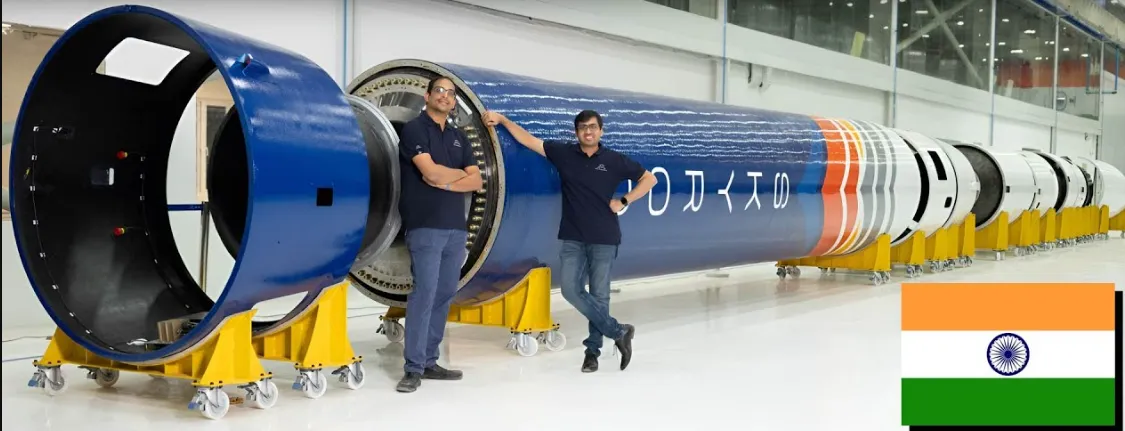
CHART: “India’s Spacetech Ecosystem at a Glance (May 2026)”
Metric | Data | Source |
|---|---|---|
Number of spacetech startups in India | 400+ | ISpA / IN‑SPACe |
Skyroot Aerospace valuation | $1.1 billion (unicorn) | Company announcement |
Skyroot Series C funding | $60 million (led by Sherpalo, GIC) | Entrackr / Inc42 |
India space economy (2026) | $8.4 billion | ISRO economic assessment |
Projected space economy (2033) | $44 billion | ISRO / IN‑SPACe |
Spacetech funding 2025 | ~$350 million | Tracxn |
Spacetech funding H1 2026 | ~$200 million (including Skyroot, Agnikul, Pixxel) | Tracxn |
Agnikul Cosmos latest round | $30 million (March 2026) | Inc42 |
Pixxel latest round | $25 million (May 2026) | Entrackr |
Vikram‑1 payload to LEO | 290‑315 kg | Skyroot technical specs |
Vikram‑1 maiden launch window | Coming weeks (2026) | Company guidance |


