From Farm to Fork: How India's D2C Agritech Startups Are Cutting Out 40 Middlemen
The Hook: The ₹110 Crore Bet on a 21‑Acre Farm
Twenty‑one acres of ancestral land in Pune. Two brothers who quit corporate careers. A mission not to build a brand, but to restore soil that had been degraded by chemical farming.
That was the beginning of Two Brothers Organic Farms (TBOF) . Today, it is one of India’s most celebrated D2C farm‑to‑fork brands — and in 2026, it raised ₹110 crore ($12.5 million) in a Series B round led by 360 One Asset, Rainmatter Investments, and the Narotam Sekhsaria family office, after an additional ₹20 crore infusion in January 2026 took its recent total to ₹130 crore. The brand is now aiming for ₹2,000 crore in annual revenue by 2030.
TBOF’s journey is not a one‑off fairytale. It is the leading story of a structural transformation in how India grows, moves and sells food. The Indian healthy food market was valued at $25.8 billion in 2025 and is projected to reach $59.8 billion by 2034. The Indian agritech market is set to grow from $9 billion in 2025 to $28 billion by 2030, registering a 25% CAGR. And in the first half of 2026 alone, hundreds of millions of dollars have poured into D2C agritech startups — from farm‑to‑fork brands to B2B supply chain platforms to agri‑fintech lenders.
The middlemen who have extracted value from Indian agriculture for centuries are finally being digitally bypassed. And the farmer is finally getting paid.
Two Brothers Organic Farms: From Soil to Scale
TBOF’s brand philosophy is radically simple: clean, traceable, farmer‑first food. What began as a back‑to‑basics farming initiative evolved into a full‑fledged farm‑to‑fork business with strong control across sourcing, processing and distribution.
Its omnichannel strategy is anchored in digital. The brand’s D2C website contributes nearly 50 percent of total revenue, while marketplaces account for an additional 15‑20 percent. Quick commerce platforms are emerging as a key growth lever in urban markets. Offline retail, though currently contributing around 5 percent, is expanding rapidly, with TBOF already present in over 500 stores across India. Meanwhile, international markets contribute nearly 20 percent of overall revenue, adding resilience and diversification.
With total funding now at $25.1 million, TBOF is now venturing into protein atta, low‑GI rice and other clean‑label categories.
WayCool: The B2B Supply Chain Giant
While TBOF conquers the D2C consumer, WayCool plays a different game: building the B2B supply chain backbone for fresh produce.
In March 2026, the Chennai‑based agritech startup raised ₹210 crore (approximately $22.7 million) in a rights issue led by existing investor Lightrock India. This marked the company’s first significant equity raise in nearly four years.
WayCool leverages technology to operate a complex supply chain from soil to sale. It works with over 85,000 farmers via its engagement platform called Outgrow. It sells products such as fresh produce, staples and dairy under seven different labels — including Madhuram, KitchenJi, L’exotique and Freshey’s.
In a capital‑intensive sector where many startups have struggled to achieve unit economics, WayCool’s ability to raise substantial capital from its existing investor speaks to Lightrock’s continued confidence in its B2B agri‑supply chain model.
Pluckk: The Clean‑Label Fresh Produce D2C Brand
If TBOW is rooted in organic values and WayCool in B2B scale, Pluckk occupies the middle ground: a D2C‑first fresh produce brand targeting health‑conscious urban consumers.
In April 2026, Pluckk raised ₹100 crore ($10.8 million) in a Series A1 round led by existing investor Euro Gulf Investment, taking its total funding to $26 million.
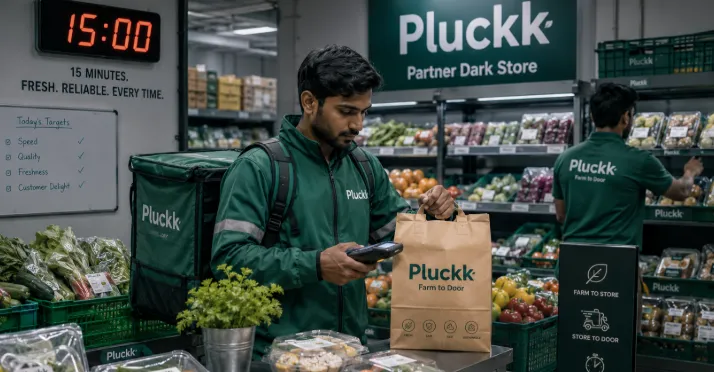
Pluckk operates a “clean‑label” FMCG business selling fruits, vegetables, meal kits, cold‑pressed juices, soups, frozen berries and fruit‑based snacks through a farm‑to‑door concept. Its portfolio spans six core categories and 45 products, with operations in 50 cities through quick‑commerce integrations across six platforms, including Blinkit, Instamart, Zepto and Flipkart Minutes.
The startup claims to have achieved a 25% year‑on‑year growth over the past two years, with an annualised revenue run rate of ₹100 crore in FY25. It delivered 2.4 crore products across 1 crore households in the previous year and is looking to double its distribution over the next year. The fresh capital will be deployed toward technology and product innovation, especially in AI, to identify emerging product trends, automate quality control, optimise supply chain efficiency and even enable nutrition personalisation — as well as to establish an offline retail presence and expand into Tier II locations and international markets.
CEO Pratik Gupta noted, “We are seeing high word of mouth awareness and high repeat rates which are helping us get closer to profitability”.
DeHaat: The Profitable Agritech Platform
While D2C brands capture consumer mindshare, DeHaat has quietly done something that many agritech startups have struggled to achieve: profitability.
In Q1 FY26, DeHaat reported an EBITDA of ₹5 crore to ₹10 crore, turning profitable after years of heavy investment. The startup is now eyeing full‑year profitability in FY26.
The scale behind that profitability is staggering. DeHaat works with 13 million farmers across 120 districts, aggregating approximately 6,000 metric tonnes of produce every single day. The company moved from an operational loss of −₹207 crore in FY25 to EBITDA‑positive in a single quarter — an inflection point that signals the maturation of the agritech sector.
AgroStar: The Farmer‑Facing Digital Marketplace
Not every agritech startup focuses on farm‑to‑fork logistics. Some, like AgroStar, are building digital marketplaces for farmers themselves.
In May 2026, the Pune‑based direct‑to‑farmer mobile‑based retail platform raised $10 million (approximately ₹66.6 crore) in its Series B round, led by Accel Partners, with participation from existing investors IDG Ventures and Aavishkaar Venture Management.
AgroStar claims that over one million farmers are using its platform, which is operational in Gujarat, Maharashtra and Rajasthan. The startup will use the fresh funds to strengthen its data analytics platform and leadership team, as well as expand geographically.
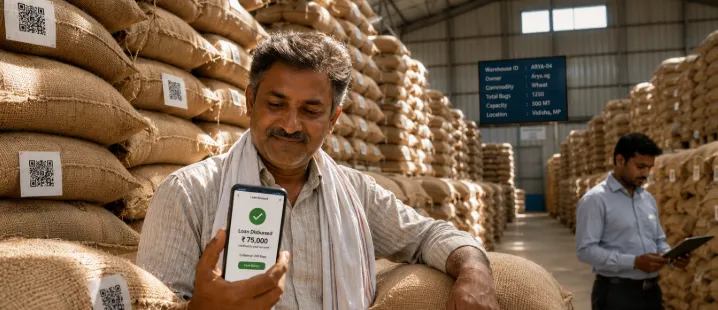
Arya.ag: The Grain Commerce Platform with $3 Billion in Storage
If DeHaat is the farmer‑facing platform and Pluckk the consumer‑facing D2C brand, Arya.ag is the financial and logistical infrastructure for post‑harvest grain management — and it is operating at a scale that rivals global agri‑commodity firms.
In January 2026, the Noida‑based integrated grain commerce platform raised $80.58 million (₹725 crore) in a Series D round led by GEF Capital Partners. About 70% of the amount was raised as primary capital, with existing investors partially divesting via secondary sales.
Arya.ag’s numbers are breathtaking:
Annual storage value: $3 billion worth of grains annually
Annual credit disbursal: $1.5 billion to small‑holder farmers
Warehouse network: 12,000 leased warehouses, aiming for 15,000
Farmer reach: 10 lakh farmers on its platform
Geographic coverage: 60% of all districts in India
Loan disbursal speed: 20 minutes versus 24‑48 hours for traditional banks
In 2025 alone, Arya.ag disbursed ₹2,000 crore through its own balance sheet via its NBFC arm AryaDhan, along with ₹10,000 crore through its 30 partner banks. The average ticket size for loans to individual farmers is ₹10‑12 lakh, while the average interest rate is approximately 12.8‑13%.
The revenue mix is diversified: interest income accounts for 25‑30% of the top line, while storage services rake in around 55‑60%.
The Structural Shift: Cutting Out 40 Middlemen
Traditional Indian agriculture has been plagued by layers of intermediaries — from local aggregators to commission agents (arhatiyas) to wholesale mandi traders to retailers. Each layer takes a cut, leaving the farmer with a fraction of the final consumer price.
The D2C farm‑to‑fork model compresses that chain dramatically. In the TBOF model, the path is: Farmer → TBOF processing → D2C website/marketplaces → Consumer. In the Pluckk model, it is: Farm → Pluckk sorting/packaging → Quick commerce platform → Consumer.
The efficiency gains are profound:
Farmer incomes can increase by 15‑20% by eliminating intermediaries, according to Arya.ag’s data
Consumer prices can decrease by removing wholesaler markups, while quality improves because produce moves faster from field to plate
Food waste — estimated at nearly 40% of total production in India due to poor cold chain infrastructure — is significantly reduced when supply chains are shorter and smarter
Arya.ag’s loan‑against‑warehouse‑receipt model is a particularly elegant intervention: it allows farmers to store their grain after harvest and access collateral‑backed credit immediately, without being forced to sell at a low price to pay off debts. This one innovation has potentially increased farmer earnings by billions of rupees.
The Funding Frenzy: $400 Million and Counting
The D2C farm‑to‑fork sector has attracted substantial institutional capital in the past 18 months. Key transactions include:
Company | Funding | Round | Investor |
|---|---|---|---|
Two Brothers Organic Farms | ₹130 crore ($15M+ total recent) | Series B & additional | 360 One Asset, Rainmatter, Narotam Sekhsaria |
WayCool | ₹210 crore ($22.7M) | Rights issue | Lightrock India |
Pluckk | ₹100 crore ($10.8M) | Series A1 | Euro Gulf Investment |
AgroStar | $10 million | Series B | Accel Partners, IDG, Aavishkaar |
KisaanSay | ₹34 crore ($4M) | Series A | — |
$80.58 million | Series D | GEF Capital Partners |
The message to the market is unambiguous: farm‑to‑fork is not a niche. It is a structural transformation of India’s largest economic sector — agriculture, which employs nearly 50% of the workforce — and institutional capital is taking notice.
The Global Indian Takeaway
For the Indian diaspora, the farm‑to‑fork agritech boom offers three distinct pathways.
First, invest via syndicates and funds. Arya.ag’s Series D, WayCool’s rights issue, and TBOF’s Series B are all signals of a maturing sector. Follow‑on rounds and new entrants offer compelling entry points for accredited investors.
Second, build cross‑border distribution bridges. TBOF already generates nearly 20% of its revenue from international markets. Indian D2C farm‑to‑fork brands need US and European distribution. Diaspora professionals with retail, wholesale or e‑commerce networks can serve as exclusive distributors or marketplace partners.
Third, participate as limited partners in agritech funds. Firms like Lightrock India, which backed both WayCool and DeHaat, and Rainmatter, which backed TBOF, have dedicated agritech investment vehicles. Family offices and diaspora investors can access these funds, gaining diversified exposure to the sector without picking individual winners.
The Final Word
The story of Indian agriculture has always been one of paradox: a nation that feeds over a billion people, yet whose farmers struggle to make a living. The D2C farm‑to‑fork revolution is finally breaking that paradox.
From TBOF’s soil‑restoration mission to WayCool’s B2B supply chain, from Pluckk’s clean‑label produce to AgroStar’s digital farmer marketplace, and from DeHaat’s long‑awaited profitability to Arya.ag’s grain‑based financial infrastructure — the message is consistent: the middleman is being digitally bypassed. The farmer is finally getting paid.
The ₹130 crore bet on a 21‑acre farm in Pune was not a gamble. It was a down payment on a future where Indian agriculture is transparent, efficient and just.
That future is already being harvested.
CHART: “India’s D2C Farm‑to‑Fork Agritech Revolution – At a Glance (2026)”
Company | Latest Funding | Round | Investor(s) | Key Focus |
|---|---|---|---|---|
Two Brothers Organic Farms | ₹130 crore ($15M+) in recent raises | Series B & addition | 360 One Asset, Rainmatter, Narotam Sekhsaria | Farm‑to‑fork D2C organic produce |
WayCool | ₹210 crore ($22.7M) | Rights issue | Lightrock India | B2B agri‑supply chain |
Pluckk | ₹100 crore ($10.8M) | Series A1 | Euro Gulf Investment | D2C fresh produce & clean‑label FMCG |
AgroStar | $10 million | Series B | Accel Partners, IDG Ventures, Aavishkaar | Farmer‑facing digital marketplace |
KisaanSay | ₹34 crore ($4M) | Series A | — | Farm‑to‑fork food brand |
$80.58 million (₹725 crore) | Series D | GEF Capital Partners | Grain commerce & agri‑fintech |
Other Key Metrics:
Metric | Value | Source |
|---|---|---|
Indian healthy food market (2025 → 2034) | $25.8B → $59.8B | IMARC |
Indian agritech market (2025 → 2030) | $9B → $28B (25% CAGR) | Inc42 |
TBOF website share of revenue | ~50% | Indian Retailer |
TBOF stores in India | 500+ | Indian Retailer |
TBOF international revenue share | ~20% | Indian Retailer |
DeHaat EBITDA (Q1 FY26) | ₹5‑10 crore | Inc42 |
DeHaat farmers on platform | 13 million | LinkedIn / Inc42 |
AgroStar registered farmers | 1 million+ | VCCircle |
Arya.ag grain storage value (annual) | $3 billion | Inc42 |
Arya.ag credit disbursed (2025, through partner banks) | ₹12,000 crore total | Inc42 |
Arya.ag warehouse network | 12,000 (target 15,000) | Inc42 |
Arya.ag loan disbursal speed | 20 minutes (vs 24‑48 hours for banks) | Inc42 |


