From Chai to Chains: How a D2C Tea Brand Scaled to 500 Cities Without a Single Store
The Tea Leaf That Travelled 8,000 Miles
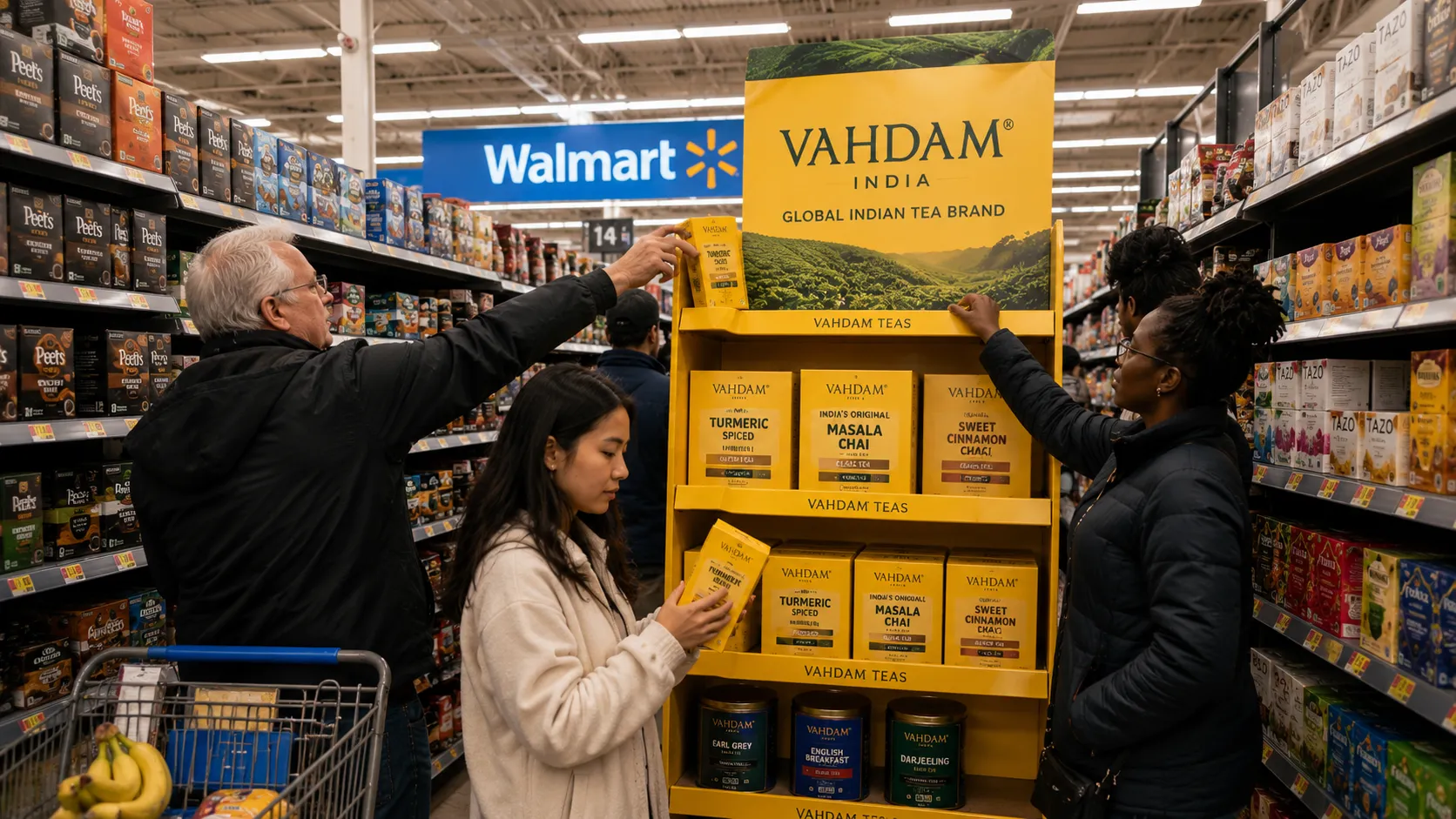
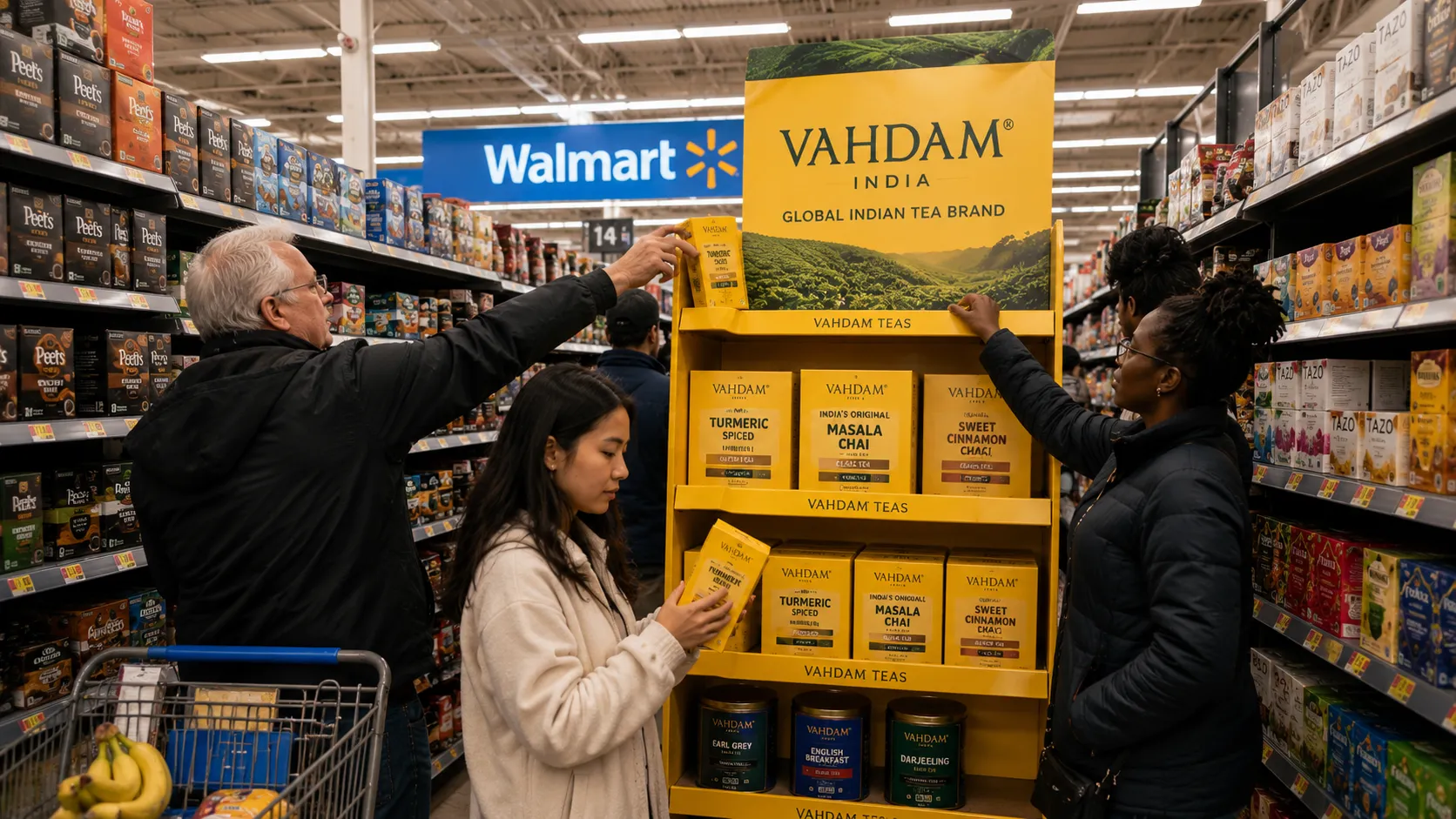
In a Walmart store in suburban Chicago, a customer reaches past a rack of Twinings English Breakfast and reaches for a bright yellow box labeled "VAHDAM — Fresh Indian Teas." The packaging is sleek, the tagline says "From Indian Gardens to Your Cup," and inside are tea leaves harvested from a single-origin estate in Assam.
The journey of that tea leaf began 8,000 miles away, not in a massive corporate plantation, but in a network of 100 small tea gardens across India and Nepal—farmers who once sold their harvest to middlemen at rock-bottom prices, who now command a direct channel to the global consumer.
This is not a fairy tale. It is the story of India's D2C tea revolution—a quiet, caffeinated disruption of an industry that has been brewing the same way for over a century. And at its center is a 33-year-old founder from Delhi who decided that the world deserved better chai.
The Market: A $12 Billion Cup of Tea
To understand the magnitude of the D2C tea opportunity, one must first understand the canvas.
India is the world's second-largest tea producer and one of its largest consumers. The India tea market was valued at approximately $11.86 billion in 2025 and is projected to reach $15.44 billion by 2034, growing at a CAGR of nearly 3%. But the headline number conceals a structural shift: the rise of premiumization.
Consumers are increasingly shifting toward specialty, organic, herbal, and wellness teas, moving away from the dusty, commoditized tea bags that dominated the market for decades. Digital and D2C channels are emerging as the primary vectors for this shift, allowing brands to bypass traditional retail gatekeepers and build direct relationships with tea lovers.
D2C tea startups in India have already attracted over $56 million in funding—more than any other country's tea startups, including the United States and Germany. The message is unmistakable: India is not just drinking more premium tea; it is leading the global D2C tea movement.
The Leader of the Pack: VAHDAM India
If there is a poster child for India's D2C tea revolution, it is VAHDAM India.
Founded in 2015 by a then-23-year-old Bala Sarda, the brand began with a simple premise: eliminate the middlemen between India's tea gardens and the global consumer, and deliver the freshest possible tea directly to the cup. The name "Vahdam" is an anagram of his father's name, Madhav—a tribute to the family's entrepreneurial roots.
What followed was a decade of explosive growth. In the financial year ending March 2026 (FY26), VAHDAM India reported revenue of ₹350 crore ($42 million), representing 31% year-on-year growth, and remained profitable for the second consecutive year. The company has now set its sights on a ₹500 crore run rate ($60+ million) for FY27, with approximately 30% of that revenue expected to come from its fast-growing portfolio of functional herbal supplements—a strategic expansion into high-growth wellness categories.
Perhaps the most remarkable statistic is VAHDAM's geographic distribution. Over 95% of its total operating revenue is generated from exports to key global markets, including the United States, Canada, and Europe. The United States alone accounts for nearly 70% of the brand's revenue.
The Teabox Challenge: A Tale of Two D2C Tea Titans
If VAHDAM is the volume leader, Teabox is the challenger with a different origin story.
Founded in 2012 by Kaushal Dugar, Teabox pioneered the concept of delivering "garden-fresh" tea directly from Darjeeling, Assam, and the Nilgiris to consumers worldwide, bypassing the outdated supply chains that often left tea sitting in warehouses for months before reaching the cup.
The brand caught the attention of Ratan Tata, who invested an undisclosed amount in an early round, giving Teabox instant credibility and a powerful backer. Since then, Teabox has raised $19.2 million in total funding across multiple rounds, including a $7 million Series B round in May 2026 from Singapore-based RB Investments and existing investors.
While Teabox has historically lagged behind VAHDAM in revenue scale, it remains a formidable player in the premium tea segment, shipping directly to customers in the US, Canada, Australia, and Europe. The brand's commitment to freshness—vacuum-packing tea within 48 hours of harvest and shipping within 24 hours of order—has earned it a loyal following among tea connoisseurs worldwide.
The Quiet Achiever: Blue Tea
While VAHDAM and Teabox capture the limelight, Blue Tea has been quietly building a profitable, bootstrapped empire in the herbal wellness segment.
The brand, which appeared on the popular Indian television show Shark Tank, reported a 46% year-on-year rise in operating revenue to ₹37 crore ($4.4 million) in FY25 while remaining profitable. By January 2026, it had already clocked ₹52 crore in revenue, projecting ₹65 crore ($7.8 million) for the full FY26, targeting over 60% year-on-year growth with a sharper focus on quick commerce and distribution expansion.
What makes Blue Tea notable is its low-friction approach to distribution. The brand's own website contributes approximately 50% of India's revenue, with the remainder coming from marketplaces and quick-commerce platforms. Over the next three years, Blue Tea aims to scale to ₹350 crore in revenue, driven by distribution expansion and repeat-led growth rather than discount-heavy strategies.
The Dark Horse: No. 3 Clive Road
For a different flavor of D2C tea entrepreneurship, consider the story of No. 3 Clive Road.
After a two-decade career in economics and finance in the US, Radhika Chopra returned to India to launch a D2C tea brand named after the address where her father was born. The brand is a testament to the power of diaspora-driven entrepreneurship—founded by someone who understood both the Western consumer's palate and the authenticity of Indian tea.
The Logistics Miracle: How D2C Tea Works Without a Single Store
The most astonishing aspect of the D2C tea revolution is what it has achieved without. Without physical retail stores. Without traditional distribution networks. Without middlemen who have dominated the Indian tea trade for centuries.
Instead, these brands have built vertically integrated supply chains that bypass every intermediary. VAHDAM procures its teas directly from approximately 100 plantations across India and Nepal. The tea is packaged at origin within hours of harvest, locking in freshness and flavor that traditional supply chains cannot match.
The tech-enabled supply chain allows VAHDAM to sell single-origin stories and freshness instead of just tea, competing directly on the global stage with legacy brands like Twinings and Tazo. The result is a profitable D2C brand with 90-95% of its revenue coming from global markets—a model that traditional FMCG giants are now scrambling to replicate.
The Shift to Omnichannel: Why "No Stores" Is Becoming "Fewer Stores"
Here is the irony of India's D2C tea revolution: the brands that built their fortunes without a single store are now opening retail doors—not out of desperation, but out of strategic necessity.
VAHDAM India, which started as a purely online D2C brand, is now present in over 7,000 retail stores globally, including major chains like Walmart in the US, Costco in Canada and the UK, and several others across North America and Europe. In the US alone, the brand is available in 2,000+ Walmart stores, as well as 6,500 stores across the US, 550 stores in the UK, 200 stores in Canada, and 30 stores in the UAE.
This is not a retreat from D2C. It is a hybrid evolution. The brand uses its online presence to build community and test new products, then leverages its retail partnerships to scale reach and capture impulse buyers. It is the best of both worlds: the data intimacy of D2C combined with the ubiquity of physical retail.
The Headwinds: Tariffs, Trade Wars, and Volatility
No growth story is without turbulence. For Indian D2C tea brands, the biggest headwind in 2025–2026 has been US tariffs.
In August 2025, the US announced new tariffs on imports from India, impacting tea prices and creating uncertainty for exporters. Teabox, which ships directly to US customers, warned that the new tariffs "will absolutely impact our US customers," though the full extent remained unclear.
VAHDAM, which sources the majority of its revenue from the US, initially expressed concern but remained committed to its revenue targets for FY26. By April 2026, the company weathered the tariff shock, posting a profit and projecting ₹525 crore in revenue for the coming fiscal.
The lesson is clear: the D2C tea revolution is resilient enough to withstand geopolitical volatility—but not immune to it. For Global Indian investors, this means factoring in trade policy risk alongside growth potential.
The Global Indian Takeaway
For the Indian diaspora reading this in Boston, London, or Singapore, the D2C tea story offers three distinct opportunities.
First, as investors: D2C tea startups have already attracted over $56 million in funding, but the sector remains underpenetrated compared to beauty and apparel D2C segments. With premium tea consumption growing at double-digit rates in Western markets, early-stage investments in Indian D2C tea brands could yield significant returns.
Second, as consumers: The tea that fills your local grocery aisle is likely months, if not years, old. Indian D2C brands deliver tea that was harvested weeks ago—a difference in freshness that true tea drinkers can taste. For diaspora professionals hosting client meetings, a cup of garden-fresh Darjeeling is a conversation starter that can't be faked.
Third, as partners: VAHDAM's success in Walmart and Costco demonstrates that Indian D2C tea brands are ready for US retail partnerships at scale. Diaspora professionals with retail connections or distribution networks can serve as bridge-builders, helping these brands navigate local regulations, consumer preferences, and supply chain logistics.
The Final Word
The D2C tea revolution in India is not a niche movement. It is a structural transformation of an industry that has remained unchanged for generations. By eliminating middlemen, compressing supply chains from months to days, and building direct relationships with consumers across 130+ countries, VAHDAM, Teabox, Blue Tea, and a new generation of D2C tea brands have proven that India's oldest beverage is also its newest entrepreneurial frontier.
The next time you reach for a box of tea, look beyond the familiar brands. That bright yellow box bearing a name anagrammed from a father's name might just hold the future of the industry—shipped directly from an Indian garden, without a single store in sight.
The chai has been disrupted. And it tastes better than ever.
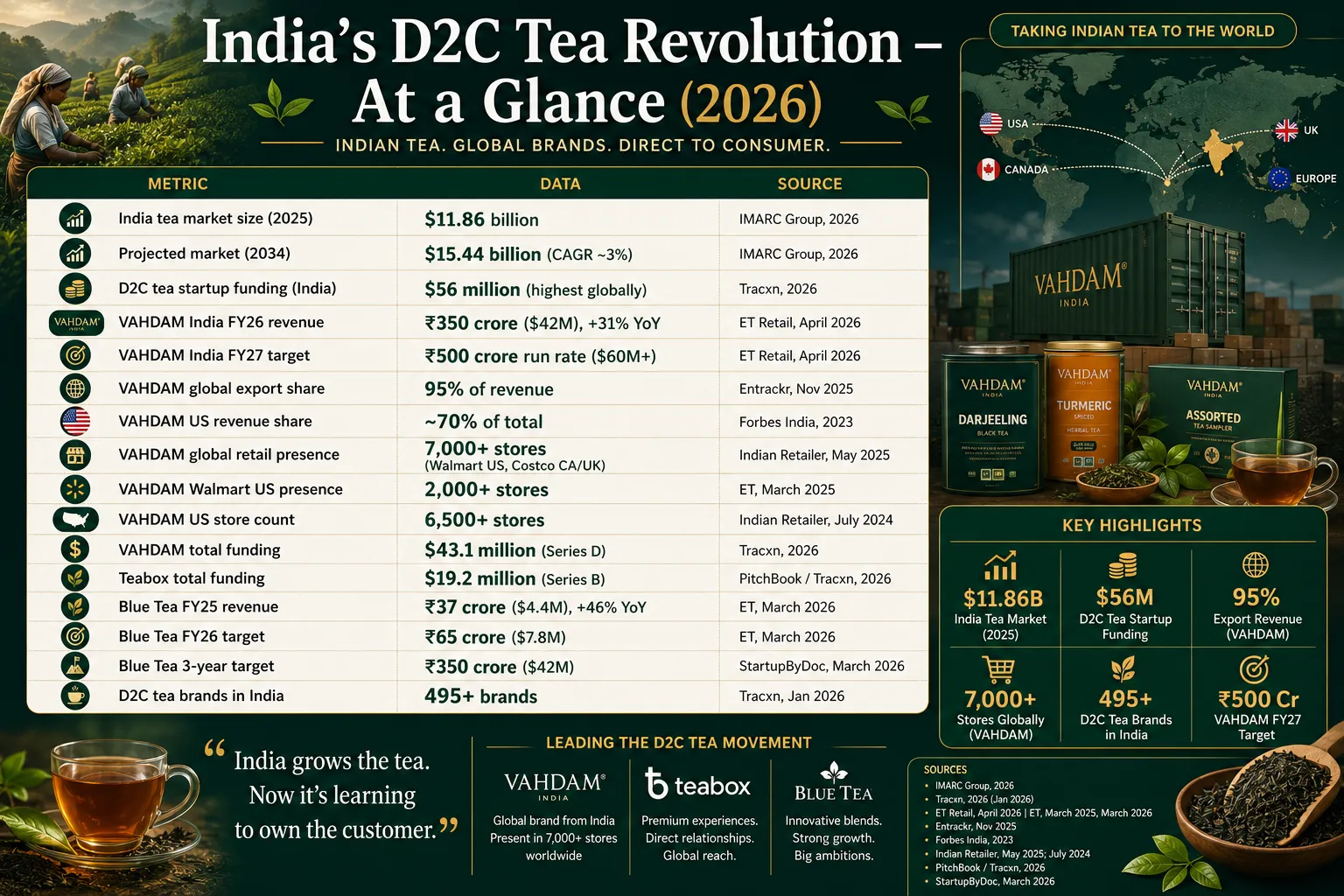
CHART: "India's D2C Tea Revolution – At a Glance (2026)"
Metric | Data | Source |
|---|---|---|
India tea market size (2025) | $11.86 billion | IMARC Group, 2026 |
Projected market (2034) | $15.44 billion (CAGR ~3%) | IMARC Group, 2026 |
D2C tea startup funding (India) | $56 million (highest globally) | Tracxn, 2026 |
VAHDAM India FY26 revenue | ₹350 crore ($42M), +31% YoY | ET Retail, April 2026 |
VAHDAM India FY27 target | ₹500 crore run rate ($60M+) | ET Retail, April 2026 |
VAHDAM global export share | 95% of revenue | Entrackr, Nov 2025 |
VAHDAM US revenue share | ~70% of total | Forbes India, 2023 |
VAHDAM global retail presence | 7,000+ stores (Walmart US, Costco CA/UK) | Indian Retailer, May 2025 |
VAHDAM Walmart US presence | 2,000+ stores | ET, March 2025 |
VAHDAM US store count | 6,500+ | Indian Retailer, July 2024 |
VAHDAM total funding | $43.1M (Series D) | Tracxn, 2026 |
Teabox total funding | $19.2M (Series B) | PitchBook/Tracxn, 2026 |
Blue Tea FY25 revenue | ₹37 crore ($4.4M), +46% YoY | ET, March 2026 |
Blue Tea FY26 target | ₹65 crore ($7.8M) | ET, March 2026 |
Blue Tea 3-year target | ₹350 crore ($42M) | StartupByDoc, March 2026 |
D2C tea brands in India | 495+ | Tracxn, Jan 2026 |


