The Enforcement Directorate's sprawling investigation into the Mahadev Online Book and Sky Exchange illegal betting syndicate has claimed its highest-profile scalp to date, with the arrest of Vikas Garg, the 53-year-old chairman of the Ebix Group, in connection with an alleged money laundering network valued at approximately ₹6,000 crore. Garg was taken into custody in New Delhi under the Prevention of Money Laundering Act, following searches conducted at his residence by an ED team from the agency's Raipur zonal office in Chhattisgarh, where the core investigation into the betting syndicate has been centred.
Garg was subsequently produced before a special court in Delhi, which granted the Enforcement Directorate 24-hour transit custody to transport him to Raipur, where he is expected to face further questioning before a designated court handling Prevention of Money Laundering Act proceedings related to the case. His arrest marks the 14th in the broader Mahadev betting app investigation, an inquiry that has steadily expanded in scope and prominence since it first came to public attention, drawing in a widening circle of businessmen, alleged intermediaries, and — according to the agency's own public statements — high-ranking politicians and bureaucrats in Chhattisgarh, where the illegal betting operation is understood to have originated.
The arrest did not come without warning. Just a week earlier, the Enforcement Directorate had provisionally attached assets worth ₹940.77 crore belonging to Garg, his family members, and various entities the agency alleges were controlled by or linked to him — a move that, in the pattern typical of major PMLA investigations, often precedes a formal arrest by days or weeks as the agency consolidates its evidentiary position. In a statement released through its Raipur zonal office, the ED characterised Garg as central to the alleged laundering operation, accusing him of routing and integrating proceeds of crime through what investigators describe as accommodation entries, foreign investment structures, and complex corporate deal arrangements designed to obscure the illicit origin of the funds.
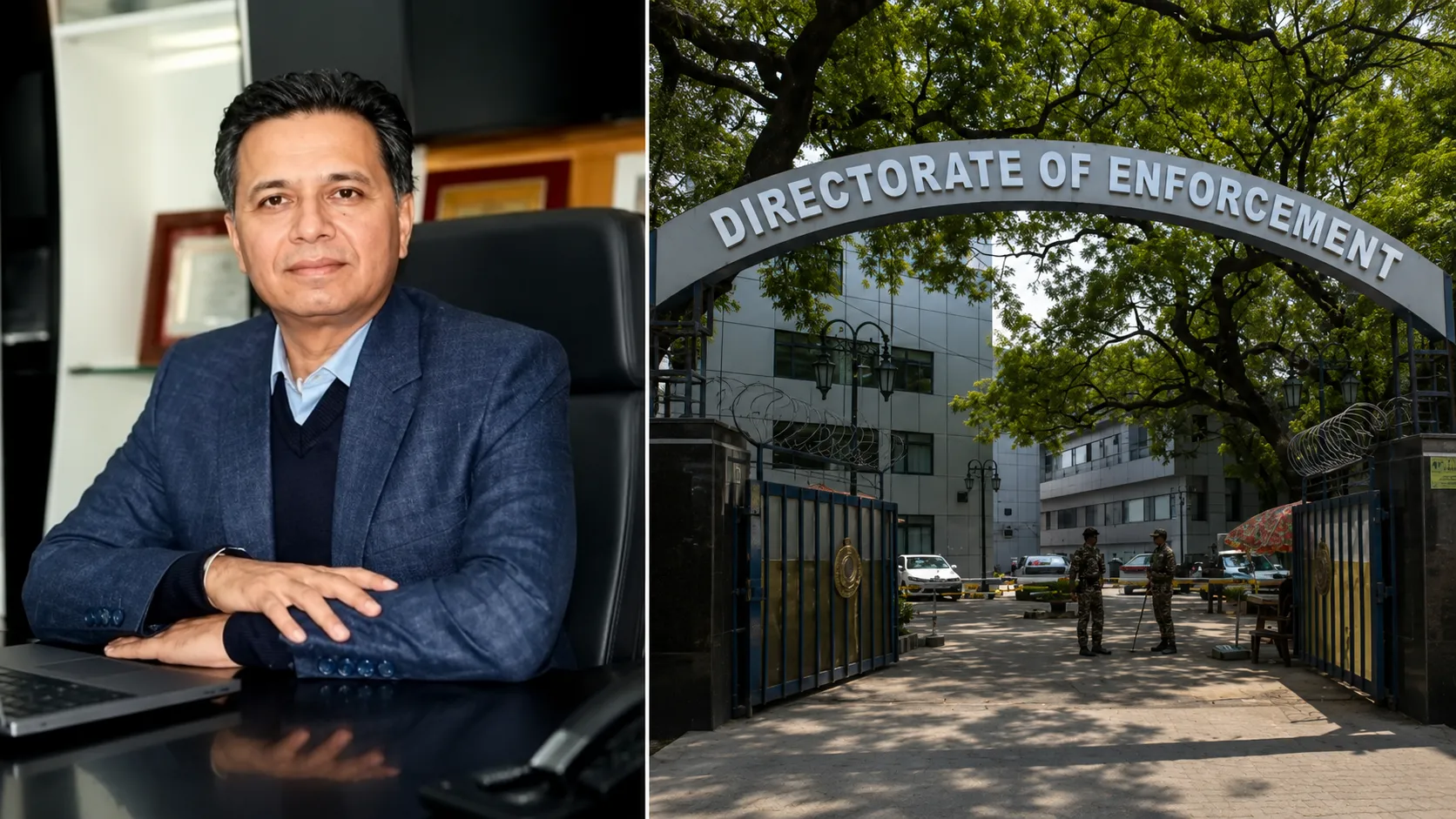
The mechanics of the alleged scheme, as laid out by the Enforcement Directorate, are notably intricate, involving a web of listed companies, offshore investment vehicles, and corporate acquisitions. According to the agency, funds originating from the Mahadev betting syndicate's operations were first moved through a complex hawala network — an informal, largely undocumented system of transferring money across jurisdictions — before being channelled into companies that investigators allege were owned or effectively controlled by Garg. These companies reportedly include Eraaya Lifespaces, EBIX Inc. and its subsidiaries, Vikas Lifecare, Vikas Ecotech, GG Engineering Limited, and Teamo Productions HQ Limited. The ED alleges that a substantial portion of these funds was ultimately deployed by Eraaya Lifespaces specifically to acquire shares in EBIX Inc. and related entities, effectively laundering the proceeds of illegal betting activity into what would, on paper, appear to be legitimate corporate share acquisitions and investment transactions.
Investigators have also pointed to what they describe as a specific mechanism within the broader scheme: approximately ₹175 crore is alleged to have been routed through what the agency terms "accommodation-entry operators" — intermediaries who, for a fee, facilitate the creation of paper transactions designed to give illegitimate funds the appearance of legitimate business income or investment returns. This is a laundering technique that has featured prominently in a number of major Indian financial crime investigations in recent years, and its alleged use here forms a central pillar of the agency's case against Garg.
A particularly significant thread running through the ED's allegations concerns Garg's purported association with H.S. Tibrewal, whom the agency has identified as a key figure connected to the Mahadev betting syndicate and, specifically, as the alleged handler of Sky Exchange's Dubai-based operations. Sky Exchange, alongside Mahadev Online Book, forms the twin pillars of the illegal betting operation at the centre of the ED's broader investigation — both platforms are alleged to have operated from outside India while generating substantial proceeds that were then laundered back into the Indian financial system through networks of shell companies and intermediaries such as those the agency alleges Garg was involved in operating.
This is not Garg's first encounter with Enforcement Directorate scrutiny. The agency had previously questioned him in November 2025 in connection with a separate money laundering case tied to an alleged ₹190 crore customs duty fraud, involving accusations of illegal betel nut imports that were purportedly diverted into the domestic market using forged export documentation to fraudulently claim duty-free import benefits. That earlier investigation, which stemmed from a Central Bureau of Investigation FIR, saw the ED conduct searches at properties linked to Garg and question him for over seven hours, along with several of his employees and business associates. While that case remains procedurally distinct from the current Mahadev-linked arrest, it forms part of a broader pattern of regulatory and law enforcement attention that has increasingly surrounded Garg's business dealings over the past several months.
Garg's public profile extends beyond his corporate role. He is also identified as the national convenor of the Bharatiya Janata Party's economic cell, a political affiliation that has added an additional layer of public and media attention to the case. The BJP has moved to distance itself from the arrest, issuing a statement clarifying that the matter pertains strictly to Garg's personal business dealings and bears no connection to the party itself — a standard clarificatory position typically issued by political organisations when office-bearers or affiliated individuals become subjects of law enforcement action, intended to draw a clear line between an individual's alleged personal conduct and the institution with which they are otherwise associated.

The broader Mahadev Online Book investigation, of which Garg's arrest forms the latest and most prominent chapter, continues to widen in both geographic and jurisdictional scope. The Enforcement Directorate has, alongside its domestic actions, sought to have several individuals connected to the case — including Saurabh Chandrakar, Ravi Uppal, and others identified by the alias Anil Agrawal or "Atul," along with an individual named Shubham Soni — formally declared fugitive economic offenders under India's Fugitive Economic Offenders Act of 2018, a legal mechanism designed to enable the confiscation of assets belonging to individuals who have fled the country to avoid facing criminal prosecution. Notably, Chandrakar, understood to be among the central alleged operators of the Mahadev betting syndicate, was recently detained in Oman, with extradition proceedings now reportedly underway to bring him back to India to face the charges levelled against him.
Taken together, the case illustrates the increasingly aggressive posture Indian financial crime investigators have adopted toward the illegal online betting industry and its associated money laundering infrastructure — an industry that has grown substantially in scale and sophistication in step with the broader expansion of digital payments and offshore-hosted online platforms across India in recent years. For corporate India, and particularly for business leaders whose companies intersect with complex, multi-jurisdictional financial structures, Garg's arrest serves as a pointed reminder of the increasingly granular forensic capabilities Indian enforcement agencies have developed in tracing fund flows across shell entities, offshore structures, and listed company transactions — capabilities that investigators say have been central to unravelling what the ED describes as one of the largest illegal betting and money laundering networks uncovered in India in recent years, with a total alleged proceeds-of-crime figure that now stands at approximately ₹6,000 crore.