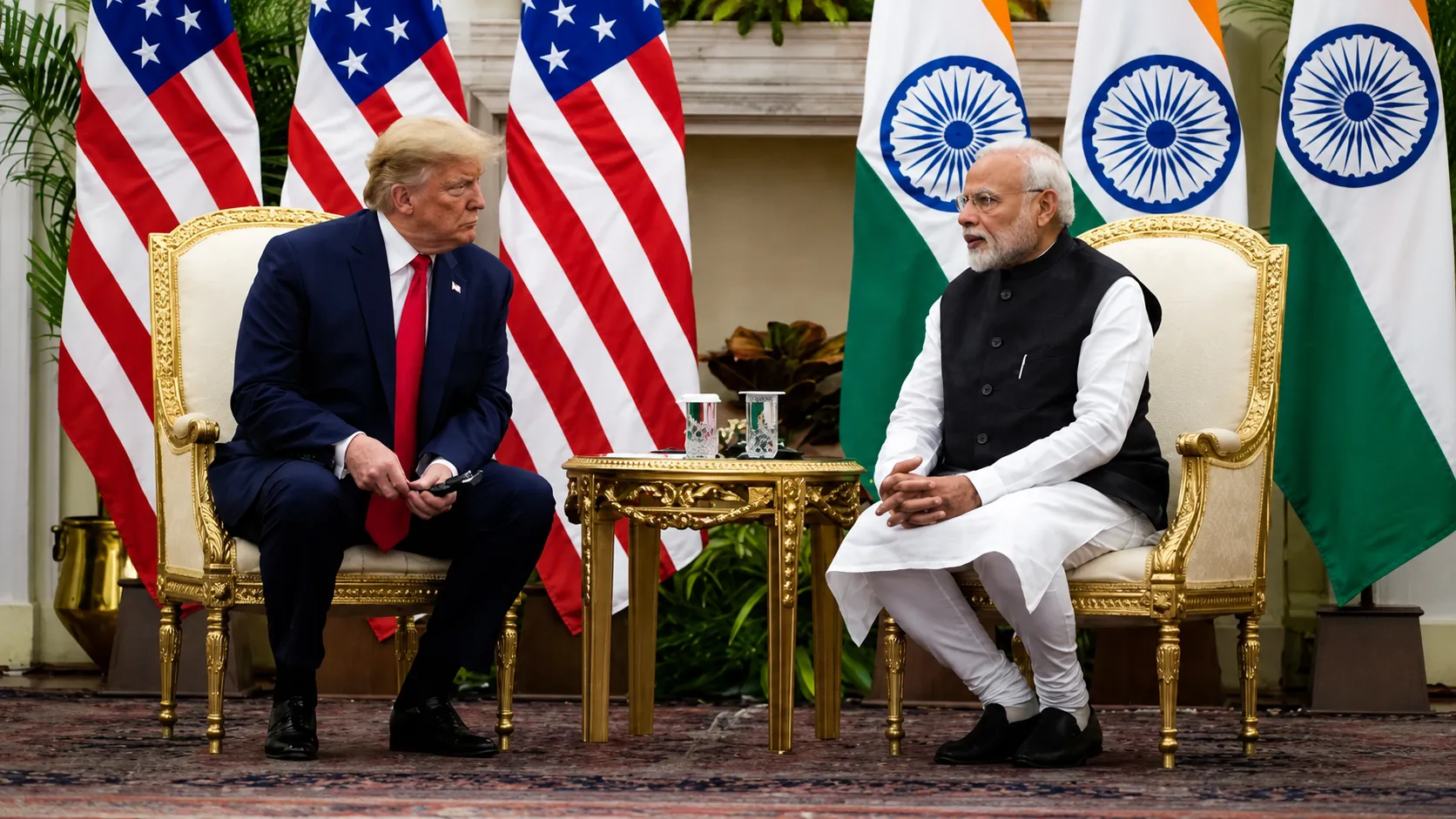
On July 24, 2026, without ceremony or a press conference, the United States government layered a fresh 10 percent tariff onto more than half of India's exports to America — the latest twist in what has become one of the most disorienting trade stories of the decade for Indian industry. For exporters who had only just begun to exhale after a February trade deal slashed duties from a punishing 50 percent to 18 percent, the new Section 301 levy is a reminder that in 2026, nothing about India-US trade is settled for long.
Rewind twelve months and the picture looked far bleaker. On July 31, 2025, Washington announced a 25 percent tariff on Indian goods, effective August 7. Within a week, President Donald Trump piled on an additional 25 percent, explicitly linking the penalty to India's continued purchases of discounted Russian crude oil. By August 27, 2025, the combined tariff on a wide swathe of Indian exports — gems and jewellery, garments, footwear, furniture, industrial chemicals — had reached 50 percent, among the highest rates the US applied to any major trading partner. The New Delhi-based Global Trade Research Initiative (GTRI) warned at the time that India's exports to the US could collapse from $86.5 billion to roughly $50 billion in 2026, with textiles, gems, jewellery, shrimp and carpets facing a potential 70 percent hit and hundreds of thousands of jobs at risk.
Markets felt it immediately. On the eve of the 50 percent tariff taking effect, the BSE Sensex tumbled 849 points, or 1.04 percent, while the Nifty shed nearly 256 points. Foreign institutional investors sold close to ₹6,516 crore of Indian equities in a single session, though domestic institutional investors absorbed much of the selling with purchases of over ₹7,060 crore — a pattern of foreign selling met by domestic buying that would recur throughout the year that followed.
Relief came, unexpectedly, on February 2, 2026. In a bilateral trade agreement announced by President Trump, the US slashed its reciprocal tariff on Indian goods from 25 percent to 18 percent and fully rescinded the additional 25 percent penalty tariff tied to Russian oil. The effective overall tariff rate on most Indian exports fell to roughly 18 percent overnight. In exchange, India committed to moving toward zero tariffs on US goods, eliminating non-tariff barriers, halting purchases of Russian crude, shifting sourcing toward American suppliers, adopting stronger Buy American commitments, and pledging future imports of US products exceeding $500 billion over coming years. Global Trade Research Initiative founder Ajay Srivastava later mapped the entire episode as six distinct phases — the additional tariff burden moving from 0 percent to 10 percent to 25 percent to 50 percent to 25 percent, before settling near 18 percent, and now 10 percent on top — a whiplash timeline that has forced Indian exporters to rebuild pricing models almost every quarter for a year running.
The de-escalation, however, was never total. On February 25, 2026, the US imposed a steep 126 percent duty specifically on Indian solar imports, ring-fencing one high-growth clean-energy export category even as the broader tariff rate eased for most other goods. And on July 24, 2026 — barely a week before this report — Washington added a further 10 percent tariff under Section 301 on non-exempt Indian goods, a category the Indian government estimates covers roughly 55 percent of the country's exports to the US. For many affected product lines, the new charge effectively replaced an expiring 10 percent Section 122 surcharge, which limited the immediate jump in landed costs for American importers. Textile exporters, however, remain acutely exposed: several competing Asian manufacturing hubs are positioned to receive quota-based relief that India has not yet secured, leaving Indian garment and home-textile makers at a structural disadvantage even though headline tariffs have fallen sharply from their August 2025 peak.
The sectors that bore the brunt of the original 50 percent tariff — textiles, leather, gems and jewellery — have not fully recovered even a year on. Industry estimates cited through the tariff saga showed several exporters reporting turnover declines of up to 50 percent at the peak of the crisis, with many redirecting shipments to European and Gulf markets or offering steep discounts simply to retain American buyers. Pharmaceuticals, semiconductors, energy and critical minerals were largely carved out of the punitive tariffs throughout, cushioning India's broader trade balance even as labour-intensive, export-oriented manufacturing absorbed the shock almost entirely on its own.
For investors, the tariff saga has been inseparable from a broader story of foreign capital caution. Even as India's economy continued to expand at a healthy clip — growth for the July-September 2025 quarter came in at an estimated 7.3 percent — foreign portfolio investors pulled close to $17 billion out of Indian equities during the year, according to a Reuters poll of economists, as the lack of visibility on a durable trade settlement kept overseas allocators wary. That overhang weighed on valuations even as domestic institutional investors — mutual funds, insurers, pension money — stepped in as reliable, if not always sufficient, counterweights on the buy side of the market.
Indian companies have responded to the uncertainty in a telling way: by looking outward. Outward direct investment from Indian firms during April-August of the last fiscal year grew 29 percent year-on-year to $10.2 billion, as companies chose to build capacity and diversify supply chains beyond India's borders rather than absorb tariff risk at home. Bank economists tracking the trend described it as a deliberate hedge — Indian companies wanting to become genuine multinationals, expanding abroad partly to insulate themselves from the next round of trade-policy surprises, even as the pace of that overseas investment has begun to moderate now that the initial shock has been absorbed.
The Reserve Bank of India has had to thread its own needle through the volatility. Even as retail inflation cooled to multi-year lows — helped along by falling food prices — creating room for interest-rate cuts, the central bank repeatedly flagged tariff uncertainty as a reason for caution rather than aggressive easing. Governor Sanjay Malhotra, holding the policy stance neutral through parts of the turmoil, described the uncertainty of tariffs as still evolving — language that captured the RBI's broader posture through the crisis: acknowledge the risk, avoid overreacting to any single announcement, and keep monetary policy flexible enough to respond once the picture genuinely clarifies. At the height of the tension late last year, the rupee slid to record lows past 89 to the dollar, a level that has since stabilised somewhat but remains a barometer of how closely currency markets are tracking the tariff headlines.
What makes the current moment particularly delicate is that the July 24 Section 301 tariff arrived just as sentiment on Dalal Street had begun to genuinely improve — the Sensex and Nifty both posting strong weekly gains through late July 2026, foreign investors turning net buyers in the cash segment after weeks of caution, and IT and financial stocks leading a broad-based rally. Whether the new 10 percent duty proves to be a minor irritant layered onto an already-adjusted 18 percent baseline, or the opening move in another escalatory cycle, will likely determine whether that rally has legs through August. Trade negotiators on both sides have shown, over the past year, a consistent willingness to move quickly in either direction — tariffs have gone up in 25-point jumps and come down in single dramatic announcements — which means Indian exporters, and the investors who price their earnings, are likely to be reading trade headlines as closely as quarterly results for the foreseeable future.
For the impactful global Indian community — the diaspora entrepreneurs, NRI investors and cross-border traders who move goods, capital and ideas between India and the United States every single day — this is not an abstract policy story. It shows up in landed costs on shipments from Tiruppur and Surat, in the spreads NRI portfolio managers quote on Indian ADRs, and in the calculus of every mid-sized exporter deciding whether to open a warehouse in Dubai or Rotterdam simply to hedge against the next tariff announcement. The lesson of the past twelve months is that the relationship between the world's oldest and largest democracies remains, for now, a negotiation conducted one press release at a time.
For now, exporters in Surat's diamond markets, Tiruppur's garment clusters and Moradabad's brassware units are doing what they have done for a year: recalculating margins, diversifying buyers, and hoping that whatever the next headline brings, it moves the number down rather than up. The one certainty in India's tariff story through 2025 and 2026 has been its unpredictability — and that, perhaps more than any single rate, is the cost businesses are still learning to price in.
Surat's diamond-polishing industry, which processes roughly nine in every ten diamonds cut and polished worldwide, offers perhaps the starkest illustration of how tariff whiplash translates into human consequences. Trade bodies representing the city's diamond units reported extended factory shutdowns and temporary layoffs at the height of the 50 percent tariff period in late 2025, as US buyers — historically the single largest export market for Surat's polished stones — paused orders while waiting to see whether the tariff would stick or soften. When the February 2026 deal cut the effective rate to 18 percent, order books reportedly began refilling within weeks, only for the July 24 Section 301 addition to reintroduce a fresh round of uncertainty just as the industry's festive-season export cycle, typically its busiest window of the year, was gearing up. Similar patterns have played out in Tiruppur's knitwear clusters and Moradabad's brassware and handicrafts units, both heavily dependent on US retail buyers and both structurally less able than large corporates to absorb tariff shocks through balance-sheet cushioning or geographic diversification.
It is worth placing India's experience in a comparative regional context, since much of the anxiety among Indian exporters and policymakers has centred not just on the absolute tariff rate but on India's rate relative to competing manufacturing hubs. Vietnam, Bangladesh and Indonesia — all significant competitors to India in textiles, footwear and lower-value manufactured goods exports to the US — have at various points through 2025 and 2026 secured more favourable or more stable tariff treatment than India managed to negotiate, a competitive gap that trade economists warn could translate into durable market-share losses even if India's own tariff rate eventually stabilises at a manageable level. This is precisely the anxiety GTRI's Ajay Srivastava and other trade analysts have repeatedly flagged: that a 10 or 15 percentage point tariff disadvantage relative to a competing exporter, sustained over even twelve to eighteen months, can be enough for a global buyer to permanently shift sourcing relationships that took years to build — relationships that do not necessarily migrate back to India even after tariff parity is eventually restored.
The technology and services side of India's export economy has, by contrast, remained comparatively insulated throughout the entire episode, and that divergence has itself become part of the broader economic story. IT services, business process outsourcing and pharmaceutical exports — sectors where India holds structural advantages that are far harder to replicate through tariff policy alone — were largely carved out of the punitive tariff regime at every stage of the 2025-26 escalation and de-escalation cycle, a carve-out that reflects both the genuine difficulty of taxing cross-border services in the same manner as physical goods, and Washington's own dependence on Indian technology talent and pharmaceutical manufacturing capacity for its own economy and healthcare system. The result has been a two-speed India, in trade terms: a services and technology export engine that has continued growing largely undisturbed by the tariff saga, running alongside a manufacturing and labour-intensive export sector that has spent the better part of a year in genuine crisis management mode.
Looking toward the rest of 2026, most trade economists tracking the relationship expect further negotiation rounds rather than a final, settled outcome, given how consistently both governments have shown a willingness to revisit terms whenever domestic political or economic pressures shift. For Indian policymakers, the immediate priority is understood to be securing the kind of durable, legally binding trade framework — as opposed to the executive-order-driven, easily reversible measures that have characterised the relationship so far — that would finally give exporters the multi-year planning certainty needed to make long-term capacity and hiring decisions with confidence, rather than continuing to manage the business one tariff announcement at a time.


