
From $100 Million to $500 Million in Eight Months: Inside the Pentagon's Great AI Acceleration — and the Startup at Its Center
WASHINGTON — May 18, 2026 — In September of 2025, the United States Department of Defense signed a modest agreement with a San Francisco artificial intelligence startup called Scale AI. The contract, valued at $100 million, was structured as a Production Other Transaction Authority — a procurement vehicle designed to bypass the multi‑year acquisition cycles that have historically kept military technology a generation behind the commercial state of the art. It was a pilot, a test, a tentative step toward integrating AI into the operational bloodstream of the world's most powerful military.
Eight months later, that pilot is a pillar. On May 6, 2026, the Pentagon's Chief Digital and Artificial Intelligence Office, or CDAO, expanded the agreement fivefold — from $100 million to $500 million — citing demand across the Department of War that had blown past the original ceiling so rapidly that the procurement vehicle was at risk of exhausting itself before the work was done. "Demand across the Department exceeded the original ceiling," Scale AI said in its announcement, "with DoW components leveraging the vehicle to initiate Project Agreements spanning computer vision, generative AI decision‑support, and data operations."
The expansion is not merely a contract modification. It is the most vivid data point yet in a structural transformation of how the American military buys artificial intelligence — a transformation that has accelerated from tentative pilot programs to enterprise‑wide deployment in less than a year, and that now positions a 29‑year‑old MIT dropout's startup at the center of the Pentagon's AI infrastructure.
The Procurement Vehicle That Changed Everything
To understand why the Scale AI contract matters, it is first necessary to understand the machinery through which it was executed. The Production Other Transaction Authority is not a standard government contract. It is a specialized acquisition instrument specifically designed to bypass the fragmented, multi‑year procurement cycles that have historically made selling software to the Pentagon a multi‑generational exercise in patience.
Under a traditional defense contract, a military component that wants to buy an AI tool must first define its requirements, issue a solicitation, evaluate proposals, negotiate terms, and secure funding — a process that can consume eighteen months before a single line of code is deployed. The Production OTA, by contrast, allows any component across the entire Department of War to route funding to a centralized contracting authority and initiate its own Project Agreement covering any Scale AI product, service, or capability without requiring a new competitive solicitation. The pricing is pre‑negotiated and volume‑based, substantially more favorable than what individual components could negotiate independently. The CDAO co‑funds a portion of the work, further reducing the effective cost to initiating organizations.
The result is a procurement on‑ramp that operates at the speed of a startup rather than the speed of a bureaucracy. And the uptake has validated the architecture. Customers operating under the CDAO OTA now include components from the Army, Navy, and Marine Corps, as well as defense agencies and Office of the Secretary of War offices — demand that spans "both the operational and institutional elements of the Department," according to Scale AI.
The broader context is a Pentagon in the grip of an AI procurement acceleration that has no peacetime precedent. In the same week that Scale's contract expansion was announced, the Pentagon finalized agreements with Nvidia, Microsoft, Amazon Web Services, Google, and Reflection AI to broaden the use of advanced AI technologies across classified military networks. Eight firms have now been approved for AI deployment on classified systems. Defense Secretary Pete Hegseth, in a January 2026 strategy memo, laid out plans to expand AI adoption and strip away what he described as bureaucratic barriers slowing the integration of new technology. The Scale AI contract is the sharpest expression of that directive.
The Founder, The Meta Stake, and The Pivot
Scale AI was founded in 2016 by Alexandr Wang, then a 19‑year‑old who had dropped out of MIT after his freshman year. The company's original business was unglamorous but essential: data labeling. Wang built a workforce of contract workers — eventually numbering in the tens of thousands — who manually annotated the images, text, and sensor data used to train the machine‑learning models that underpin modern AI. OpenAI, Google, Microsoft, and Meta all became customers. The work was tedious, the margins were thin, and the strategic positioning was that of a picks‑and‑shovels supplier to the AI gold rush.
By 2022, Wang had become the world's youngest self‑made billionaire. By 2025, his net worth stood at approximately $3.2 billion. And by June 2025, his company had been transformed by an investment that rewired its ownership structure and its strategic trajectory.
Meta, the parent company of Facebook, invested roughly $14.3 billion for a 49 percent non‑voting stake in Scale AI, valuing the company at more than $29 billion. As part of the deal, Wang departed as CEO to become Meta's Chief AI Officer, leading a new group called Superintelligence Labs. Jason Droege, a veteran technology executive, took over the leadership of Scale AI itself.
The Meta investment was a double‑edged sword. On one hand, it gave Scale the capital base to expand its public‑sector business at the speed the Pentagon's new procurement tempo demanded. On the other, it cost the company its largest commercial customer. OpenAI, concerned about Meta's minority ownership of a key supplier, withdrew its business. Competitors began to suggest that Scale was being marginalized in bidding for data‑labeling contracts.
The response was an accelerated strategic pivot. Droege disclosed in May 2026 that Scale's revenue is expected to surpass $1 billion this year, driven not by data labeling — the company's original business — but by enterprise and government AI applications. The enterprise business has already generated $200 million in annualized revenue, and Droege expects it to surpass data labeling as Scale's largest revenue source within 18 months. The pivot, he argued, was not a reaction to customer rejection but a strategic decision to follow the growth: the data‑labeling market is maturing, while demand from large enterprises and government agencies for AI transformation services is just beginning to open up.
Thunderforge, Golden Dome, and the Data Layer
The $500 million CDAO contract is the financial headline, but it is not the full scope of Scale's defense business. The company is also a participant in the Defense Innovation Unit's Thunderforge program — an initiative to integrate AI into military planning and operations alongside defense‑technology firm Anduril and Microsoft. Thunderforge represents the Pentagon's most ambitious attempt to embed AI agents directly into the decision‑making architecture of the military, moving beyond back‑office automation into the operational chain of command.
Scale is also working on President Donald Trump's Golden Dome homeland defense architecture, a $185 billion missile‑defense project that aims to build a space‑based shield capable of intercepting ballistic, cruise, and hypersonic missiles. The company joins Anduril and Palantir — two of the most prominent defense‑technology firms — as software contributors to what would be the most ambitious defensive infrastructure project since the Cold War.
What distinguishes Scale's role in these programs is its position in the technology stack. Where the hyperscalers — Microsoft, Amazon, Google — provide cloud infrastructure and foundation models, Scale occupies the data‑labeling and decision‑support layer that sits on top. The company's commercial proposition is that the bottleneck holding back operational deployment of AI in military contexts is not model performance — models perform well in benchmarks — but data quality. When the underlying training data is fragmented, mislabeled, or inconsistent with operational reality, model performance degrades in the field, sometimes catastrophically. Scale's argument, and the one the Pentagon appears to have accepted, is that fixing the data layer is what enables reliable deployment.
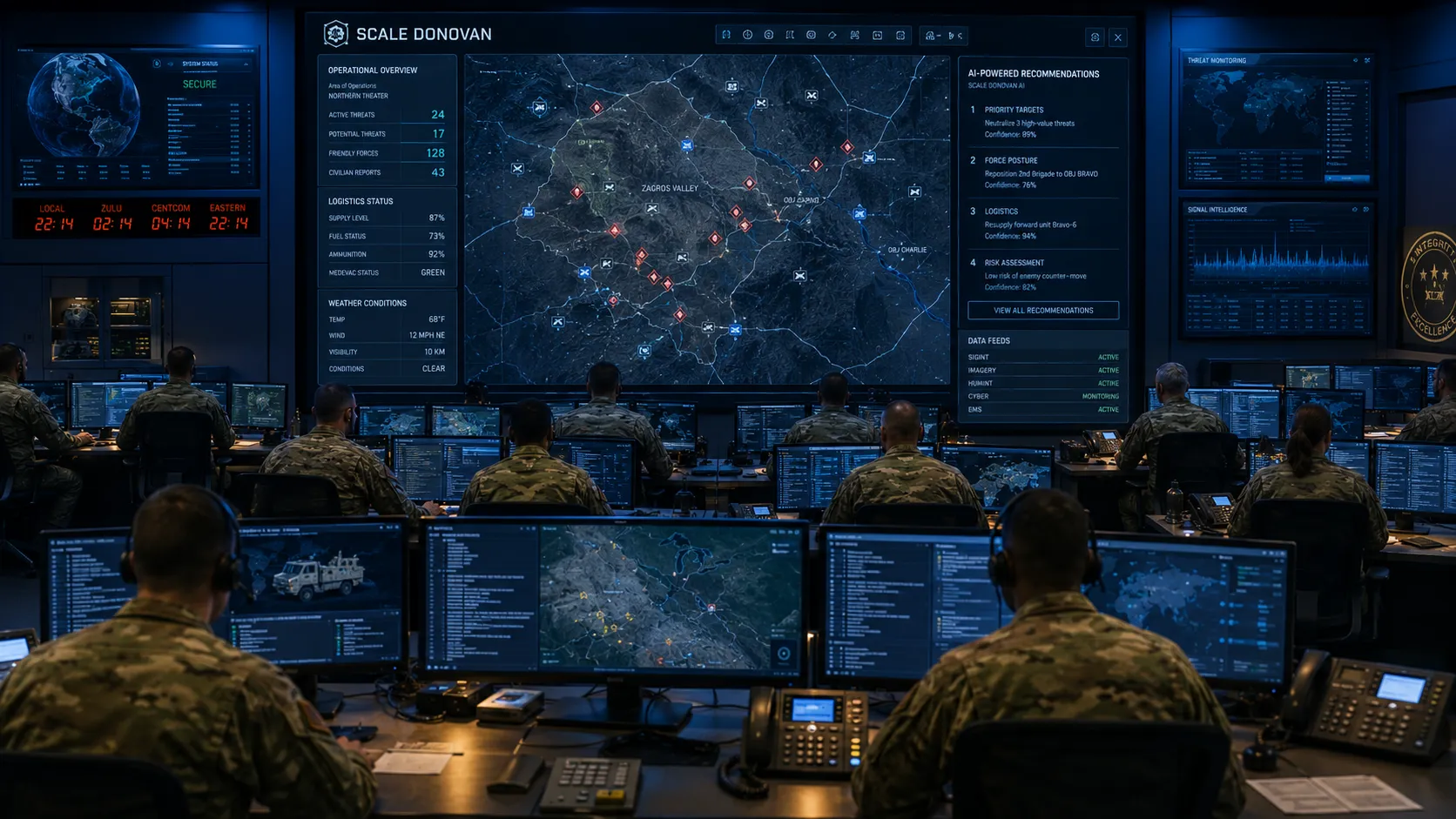
Under the expanded CDAO agreement, Department of War components can access Scale's full AI platform: the Data Engine for building, testing, and deploying computer‑vision models on expert‑labeled, AI‑ready data; the GenAI Platform for fine‑tuning and deploying generative AI models on classified networks; and Donovan, a decision‑making platform built specifically for defense and intelligence operators to turn massive amounts of unstructured data into actionable insights at mission speed. All capabilities are available across NIPR, SIPR, and JWICS networks — the unclassified, secret, and top‑secret communications systems that form the nervous system of American military operations.
The Competitive Landscape
Scale AI's $500 million contract sits inside a defense AI procurement budget that has become structurally large enough to support multiple competing vendors at the half‑billion‑dollar single‑contract level — a threshold that was concentrated in much smaller awards as recently as 2024.
The competitive dynamics are complex and overlapping. The hyperscalers — Microsoft, Amazon, Google — have signed parallel classified‑network deals that give them broad access to military AI integration opportunities. Palantir, the data‑analytics firm that has been embedded in defense and intelligence work for two decades, is competing for overlapping pieces of the Thunderforge and Golden Dome programs. Anduril, the defense‑technology unicorn now valued at $61 billion, is building the hardware and software integration layer for autonomous systems. Reflection AI, a newer entrant, has also secured a classified‑network agreement.
Scale's differentiation within this crowded field is its focus on the data‑quality bottleneck. The company has been positioning specifically around what the industry has begun calling "physical AI" — applications where AI systems are deployed onto autonomous platforms, robotics, and uncrewed military hardware. The data‑labeling foundation that built Scale's original business translates into the same value proposition for those platforms as it has for traditional military AI workflows: reliable deployment requires reliable data, and reliable data requires expert labeling at scale.
The company's defense business is the part of Scale that has been growing fastest. The $500 million contract gives it the financial runway to expand in both the traditional data‑labeling and the physical‑AI directions simultaneously. And the Meta backing, while it cost Scale its OpenAI relationship, provides the capital base to scale public‑sector operations at the tempo the Pentagon's new procurement environment demands.
What This Moment Signals
The Scale AI contract expansion is best understood not as an isolated deal but as a structural signal. The Pentagon's AI procurement budget has crossed a threshold. In 2024, AI contracts were measured in the tens of millions and treated as experimental. In 2025, they crossed into the hundreds of millions. In 2026, a single startup — founded by a teenager, backed by a social‑media giant, and operating a procurement vehicle designed to move at commercial speed — has secured a half‑billion‑dollar commitment after only eight months of performance.
The speed of the expansion is itself the most significant data point. The original $100 million contract was awarded in September 2025. Dan Tadross, who leads Scale's public‑sector business, told Bloomberg that the Pentagon had been "pushing the limits" of the initial agreement within months. "I think this contract is just generally proof that the Department is eager to adopt this technology," Tadross said. By May 2026, the ceiling had been raised fivefold, and the vehicle now supports project agreements spanning computer vision, generative AI, and data operations across every military service.
For the American technology industry, the implications are clear. The Department of Defense is no longer a slow, bureaucratic customer that takes years to adopt new technology. It is now a fast‑moving, well‑funded buyer that can expand a startup's contract by 400 percent in less than a year when the technology proves its value. The procurement infrastructure — the OTAs, the CDAO co‑funding mechanisms, the pre‑negotiated pricing — has been rebuilt to accommodate commercial speed. The vendors that understand this new architecture and position themselves accordingly will have access to a market measured in the hundreds of billions of dollars over the coming decade.
For the broader public, the acceleration raises questions that are only beginning to be asked. The integration of AI into military decision‑making — into the systems that identify threats, plan operations, and coordinate responses — is proceeding at a pace that has outpaced the regulatory and ethical frameworks designed to govern it. Scale AI emphasizes that its platform is designed to help the Department "operationalize its Responsible AI principles, ensuring that as we scale these capabilities, they remain reliable, auditable, and trusted by the warfighter." But the tension between velocity and vigilance is real, and it will intensify as the technology moves from the laboratory to the tactical edge.
The 29‑year‑old who dropped out of MIT to label data is now building the AI infrastructure of American military power. The Pentagon is no longer a customer that takes a decade to adopt new technology. And the $500 million contract that was expanded eight months after it was signed is almost certainly not the ceiling — it is the new floor.


