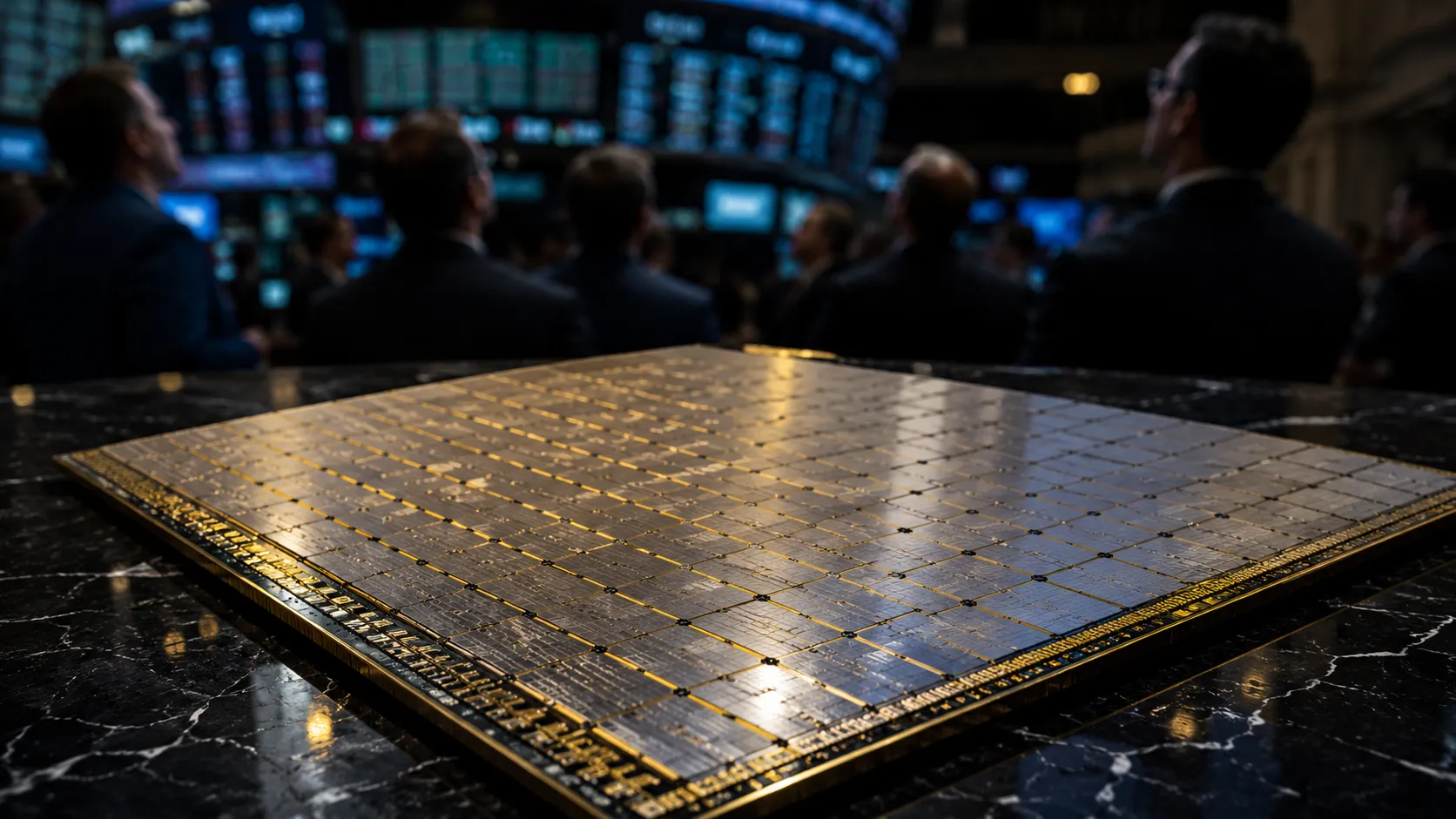
Fire on the Nasdaq: Inside Cerebras' $95 Billion Debut — and the Geopolitical Chip War It Just Ignited
SUNNYVALE, CALIF. — May 18, 2026 — On a Thursday morning in mid‑May, a chip company most Americans had never heard of became worth more than Ford, more than GM, more than any automaker or airline that anchors the Main Street imagination. Cerebras Systems went public on the Nasdaq at $185 per share. By the closing bell, it had surged 68 percent to $311.07, giving it a market capitalization just shy of $95 billion on a fully diluted basis. The $5.55 billion raised made it the largest U.S. technology IPO since Snowflake in 2020. The offering was 20 times oversubscribed.
Cerebras does not build chips the way anyone else does. Its Wafer Scale Engine 3 — the WSE‑3 — is the size of a dinner plate, a single slab of silicon containing 4 trillion transistors across 900,000 AI‑optimized cores. It packs roughly 19 times more computing power than Nvidia's flagship H100 GPU. It is not a chip in the conventional sense. It is a bet, forged in silicon, that the future of artificial intelligence belongs not to armies of small processors but to single, impossibly large ones.
The Chip That Shouldn't Exist
For 40 years, semiconductor wisdom held that chips must be small. The reason is yield: a single dust particle on a silicon wafer destroys whatever chips it touches. Shrink the chip, and most of the wafer survives. Build a chip the size of the entire wafer, and one speck of dust destroys a product worth tens of thousands of dollars. This rule kept wafer‑scale computing a laboratory curiosity for four decades.
Cerebras solved the problem with redundancy. The WSE‑3 is built with spare cores, spare memory blocks, and a routing architecture that bypasses manufacturing defects the way the internet routes around damaged nodes. If a dust particle kills 1 percent of the cores, the chip does not fail — it simply routes around the damage and operates at 99 percent capacity. It is a philosophy borrowed from distributed systems, applied to the most centralized piece of silicon ever manufactured.
The result is a chip that trains large language models faster, using less energy, and with fewer engineering headaches than clusters of GPUs. For AI labs racing to build the next generation of models — Anthropic, OpenAI, xAI — that advantage is worth almost any price. Cerebras generated $510 million in revenue in 2025, up 76 percent year‑over‑year, and returned to profitability with net income of $237.8 million after a nearly $500 million loss the previous year.
The company's architectural advantage is not merely technical. It is strategic. Nvidia sells general‑purpose GPUs — a Swiss Army knife that does everything reasonably well. Cerebras sells a scalpel, optimized for one task — training massive AI models — with extreme efficiency. The scalpel wins when the surgery is large enough. And the surgery is getting larger. AI models are growing at a pace that has outstripped Moore's Law by a factor of ten. Training runs that once took weeks now take months and cost hundreds of millions of dollars. A chip that cuts training time by 30 percent through a fundamentally different architecture is not a commodity. It is a national asset.
The Middle East Connection
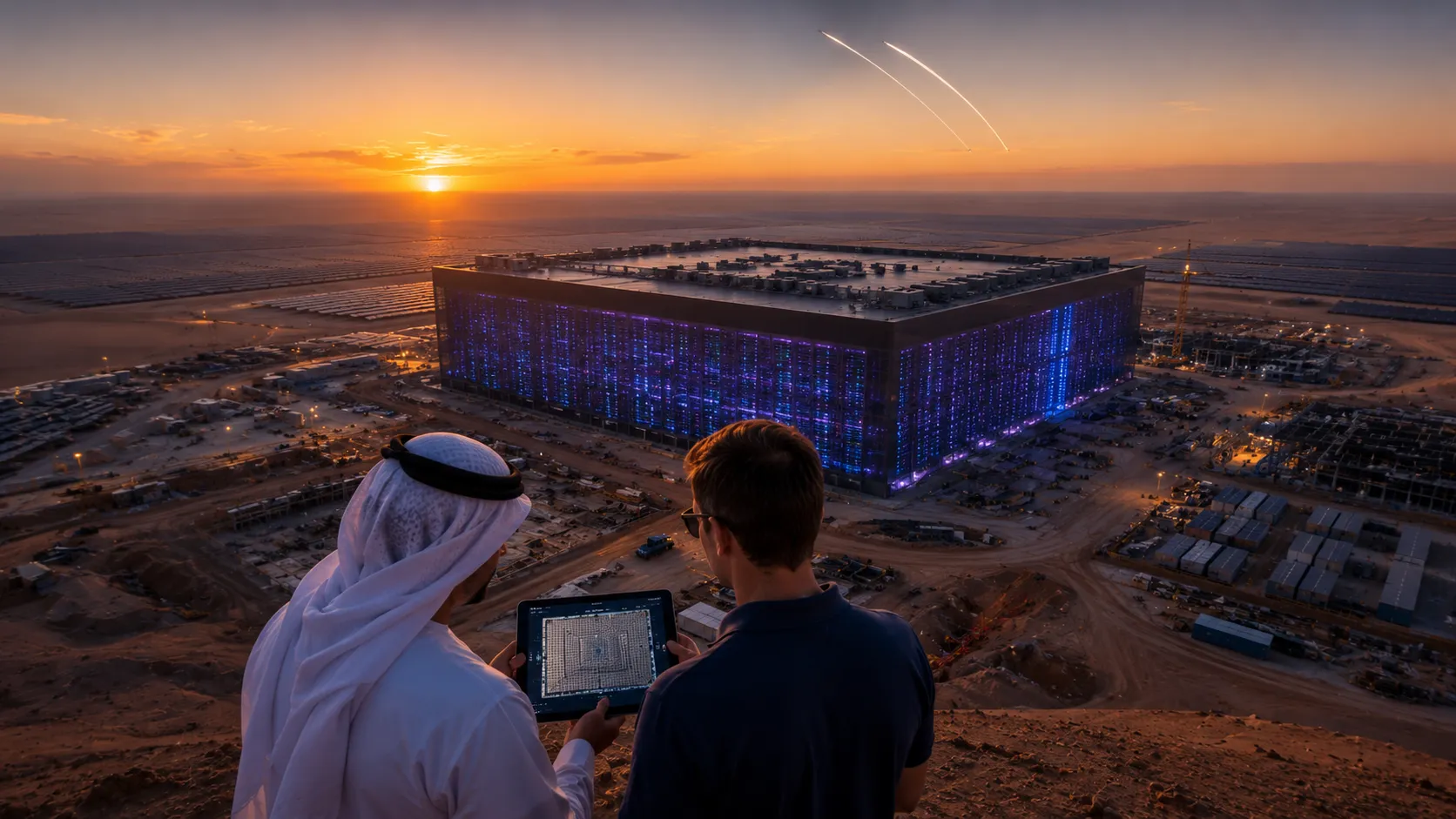
Here is where the story gets complicated. In 2025, Cerebras relied on two customers in the United Arab Emirates for 86 percent of its revenue. That concentration is not an accident. It is the direct result of a deliberate strategy to supply American AI hardware to Gulf states that are building sovereign AI capability — and that have the sovereign wealth to pay for it.
The UAE has invested billions in AI infrastructure through G42, an Abu Dhabi‑based technology conglomerate. Cerebras and G42 have jointly deployed the Condor Galaxy supercomputer series, including Condor Galaxy 3, which pairs 64 Cerebras CS‑3 systems to deliver 8 exaFLOPs of AI compute across 58 million cores. G42 is building a 5‑gigawatt AI campus in Abu Dhabi — the largest AI factory initiative outside the United States — and Cerebras hardware is at its center.


