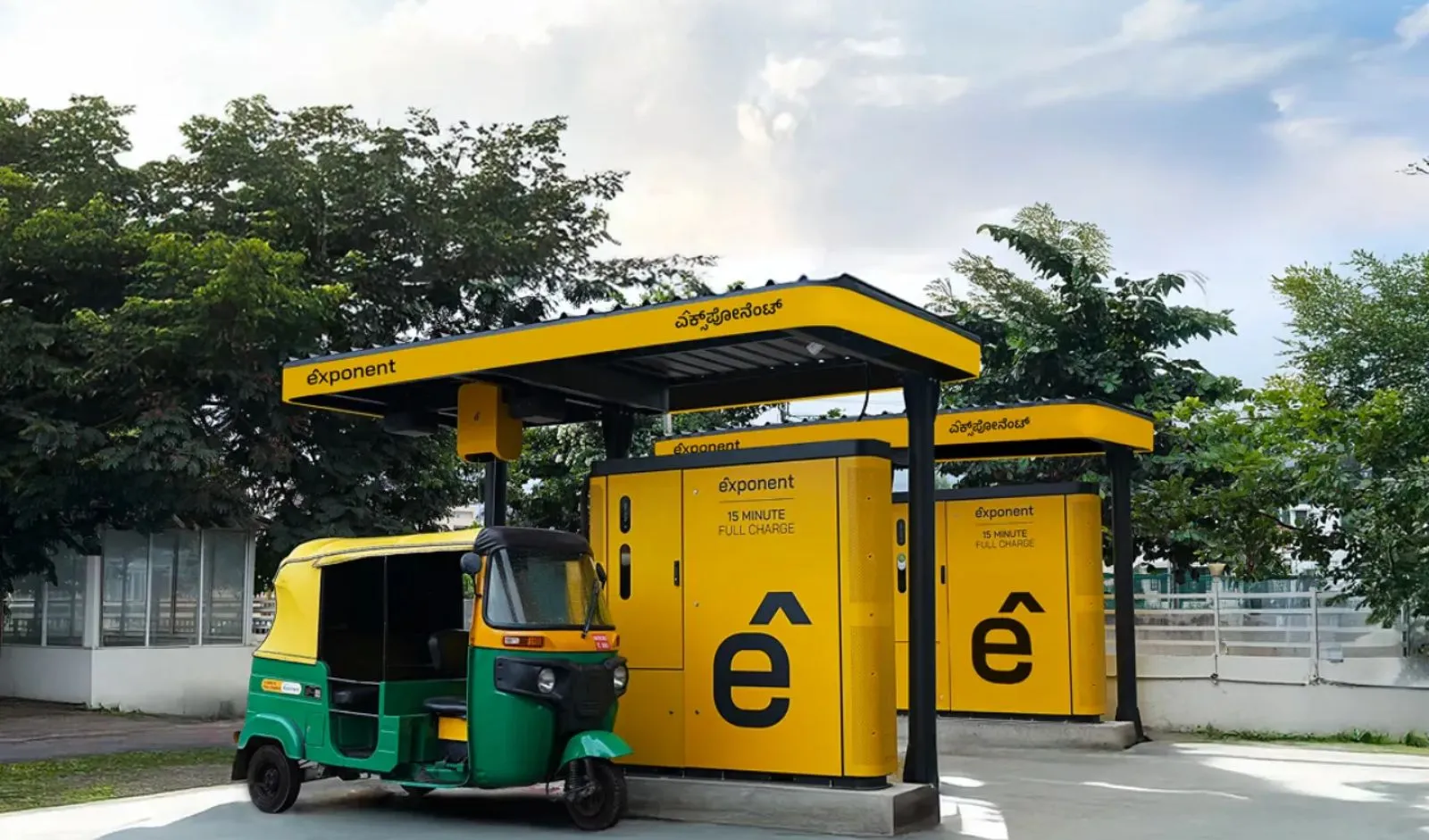
The Whole Industry Was Solving the Wrong Problem. Exponent Energy Built the Right Solution.
Here is the problem with fast charging an electric vehicle: heat. When you push a large amount of current into a battery quickly, the battery gets hot. Heat degrades battery cells — it shortens cycle life, reduces capacity, and in extreme cases causes failures that are difficult to manage safely. The conventional answer has been to build more expensive, more sophisticated battery chemistry that can survive the thermal stress of rapid charging. Silicon anodes. Solid-state cells. Exotic materials that cost more to produce and require infrastructure that India's commercial EV operators cannot afford.
Arun Vinayak looked at this problem from the inside. Before co-founding Exponent Energy, he was Chief Product Officer at Ather Energy — one of India's leading electric scooter brands — where he spent years building premium electric vehicles and watching the same structural ceiling appear every time the commercial EV question came up. Fleet operators needed to charge faster. Faster charging meant more heat. More heat meant more expensive batteries. More expensive batteries meant economics that did not work for the auto-rickshaw driver, the logistics company, or the commercial fleet operator who needed their vehicles moving, not sitting at a charger for four hours.
Vinayak and co-founder Sanjay Byalal — also ex-Ather, with a background at HUL — looked at the problem differently. The industry was trying to make the battery survive the heat of fast charging. What if, instead, you moved the heat somewhere else entirely?
What if you put the thermal management system not inside the vehicle, but inside the charger?
That insight became Exponent Energy. And it is the reason, six years later, the company has raised ₹200 crore in its latest round and is now building what it calls the energy backbone for India's commercial EV transition.
How It Works — the e-Pack and e-Pump Explained
Exponent Energy's technology is a system, not a single component. The system has two parts that only work together — which is both the technical architecture and the business model.
The e-Pack is Exponent's proprietary battery pack. It is built using lithium iron phosphate (LFP) chemistry — the same affordable, widely available battery type used in most commercial EVs. LFP cells are not exotic. They are not expensive. They are the standard battery chemistry for commercial applications because they are durable, thermally stable, and cost-effective at scale. The e-Pack's innovation is not in the chemistry. It is in the cell control architecture — a battery management system that monitors sub-cell temperature and degradation with a resolution that Exponent calls its Virtual Cell Model, using data from thousands of vehicles to get smarter over time.
The e-Pump is Exponent's proprietary charging station. This is where the counter-intuitive insight lives. A conventional fast charger pushes current into a battery and trusts the vehicle's onboard thermal management to deal with the resulting heat. The e-Pump does something different: it actively cools the battery during charging using a heavy-duty HVAC system built into the charger itself — an off-board thermal management system that handles the heat that fast charging generates before it reaches the cells.
The result: a full charge from zero to 100 per cent in 15 minutes, using regular LFP cells, with a 3,000-cycle warranty. That warranty is the commercial statement. Three thousand cycles is the lifetime of a well-used commercial vehicle. The battery does not need to be replaced. The operator does not need to budget for mid-vehicle-life battery replacement. The economics of operating the vehicle change entirely.
The closed system — the e-Pack only rapid charges at an e-Pump, and the e-Pump only works at full performance with an e-Pack — is both a technical necessity and a commercial moat. The thermal management system is calibrated to the battery chemistry and cell architecture of the e-Pack. You cannot swap in a generic battery and achieve the same result. Once a fleet operator buys a vehicle with an e-Pack integrated, they are on Exponent's charging network for the life of that vehicle.
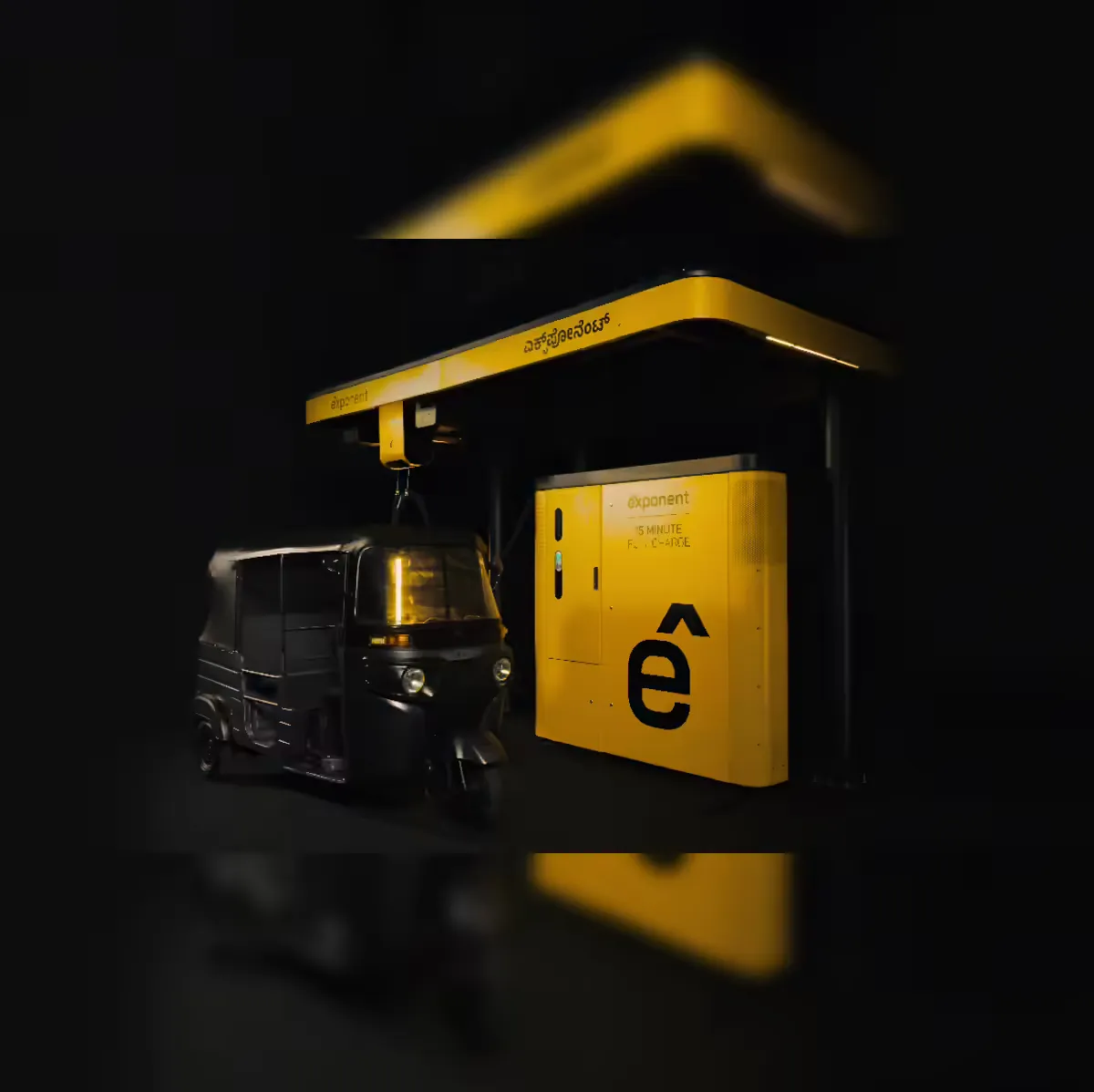
The Business Model — Intel Inside for Commercial EVs
Exponent does not sell vehicles. It sells the energy system that vehicles run on — and it has designed its go-to-market around becoming the embedded intelligence inside its OEM partners' products.
The company works with commercial EV manufacturers — including Montra Electric and Kinetic Green, among others — to integrate the e-Pack directly into vehicles at the factory level. A buyer of a Montra electric three-wheeler does not purchase an Exponent product separately. They buy a Montra vehicle that already has an Exponent e-Pack inside it, then uses Exponent e-Pumps to charge it. The acquisition of that customer happens at zero marketing cost to Exponent, because the OEM relationship does the work.
This is the "Intel Inside" model applied to EV energy: Exponent is the battery and charging technology inside vehicles that carry partner brands' names. As more OEM vehicles hit the road with e-Packs integrated, more charging revenue flows through the e-Pump network. As utilisation rates on e-Pumps increase, the unit economics of the charging stations improve. As the data from thousands of charging sessions feeds back into the Virtual Cell Model, the system becomes better at predicting battery degradation and optimising charging protocols.
The network effects are real and they compound.
By densely clustering its first 100-plus stations in Bengaluru, Exponent eliminated range anxiety for local fleet operators — proving that rapid charging infrastructure, when sufficiently dense, changes operator behaviour. Fleet companies that might have been reluctant to switch from CNG to electric because of charging downtime found that 15-minute charges at stations close enough together made the economics work. That Bengaluru proof of concept is the playbook that the ₹200 crore round is now funding at national scale.
Exponent Oto and Exponent One — Closing the Full Loop
The most significant strategic evolution in Exponent's recent history is the addition of two products that extend the platform well beyond fast charging hardware.
Exponent Oto, launched in late 2025, is a retrofit service that converts existing CNG and LPG auto-rickshaws to EVs in 24 hours. This is a bold strategic pivot: instead of waiting for OEM partners to sell new Exponent-powered vehicles, Oto takes destiny into Exponent's hands by converting the existing base of commercial three-wheelers — hundreds of thousands of CNG autos on Indian roads — directly. The 24-hour conversion promise is the consumer-facing hook. The business logic is that every converted auto becomes a new e-Pack customer, a new e-Pump user, and a new data point in the Virtual Cell Model.
Exponent One, launched earlier in 2026, is a financing and asset management platform. This addresses what Vinayak has identified as the second of the two unsolved problems in commercial EVs — after charging:
Banks are reluctant to finance commercial EVs because the asset — the battery — is unfamiliar and perceived as high-risk. Exponent One uses its own data on battery performance, degradation rates, and resale value to underwrite EV financing in a way that traditional lenders cannot. The fleet operator who cannot get a loan from a bank to buy an Exponent-powered vehicle can get that financing from Exponent One, backed by data that only Exponent has.
The combination of hardware, energy network, retrofit, and financing creates a platform that touches every stage of a commercial EV operator's journey. That is not a charging company. That is a mobility infrastructure company.
The Numbers — Why the Investors Are Paying Attention
The ₹200 crore round announced June 10, 2026 was co-led by 360 ONE Asset — making its maiden EV sector investment — and TDK Ventures, the venture arm of the Japanese electronics group that validates the proprietary nature of Exponent's thermal management IP. The round also included Hitachi Ventures, making its first-ever investment in India's energy sector, alongside returning investors Eight Roads Ventures, Lightspeed India, 3one4 Capital, AdvantEdge VC, and YourNest. The family office of Pawan Munjal — Hero MotoCorp Chairman and CEO — was already on the cap table. Total funding since inception: $65.7 million.
The financial metrics tell a story of a company that is transitioning from proof-of-concept to operational scale. Revenue grew 84 per cent year-on-year to ₹30.2 crore in FY25, from ₹16.4 crore in FY24. Net losses narrowed 66 per cent to ₹65 crore from ₹192 crore in FY24. The combination of accelerating revenue and sharply declining losses is the financial profile that growth investors look for in hardware-intensive businesses: the fixed costs of building the infrastructure base are being absorbed, and the variable economics of energy delivery are beginning to dominate.
The fresh capital is earmarked for expanding into five major logistics hubs nationally — replicating the high-density clustering strategy that worked in Bengaluru, in cities where commercial fleet operators are concentrated and where the utilisation rates on e-Pumps will be highest from day one.
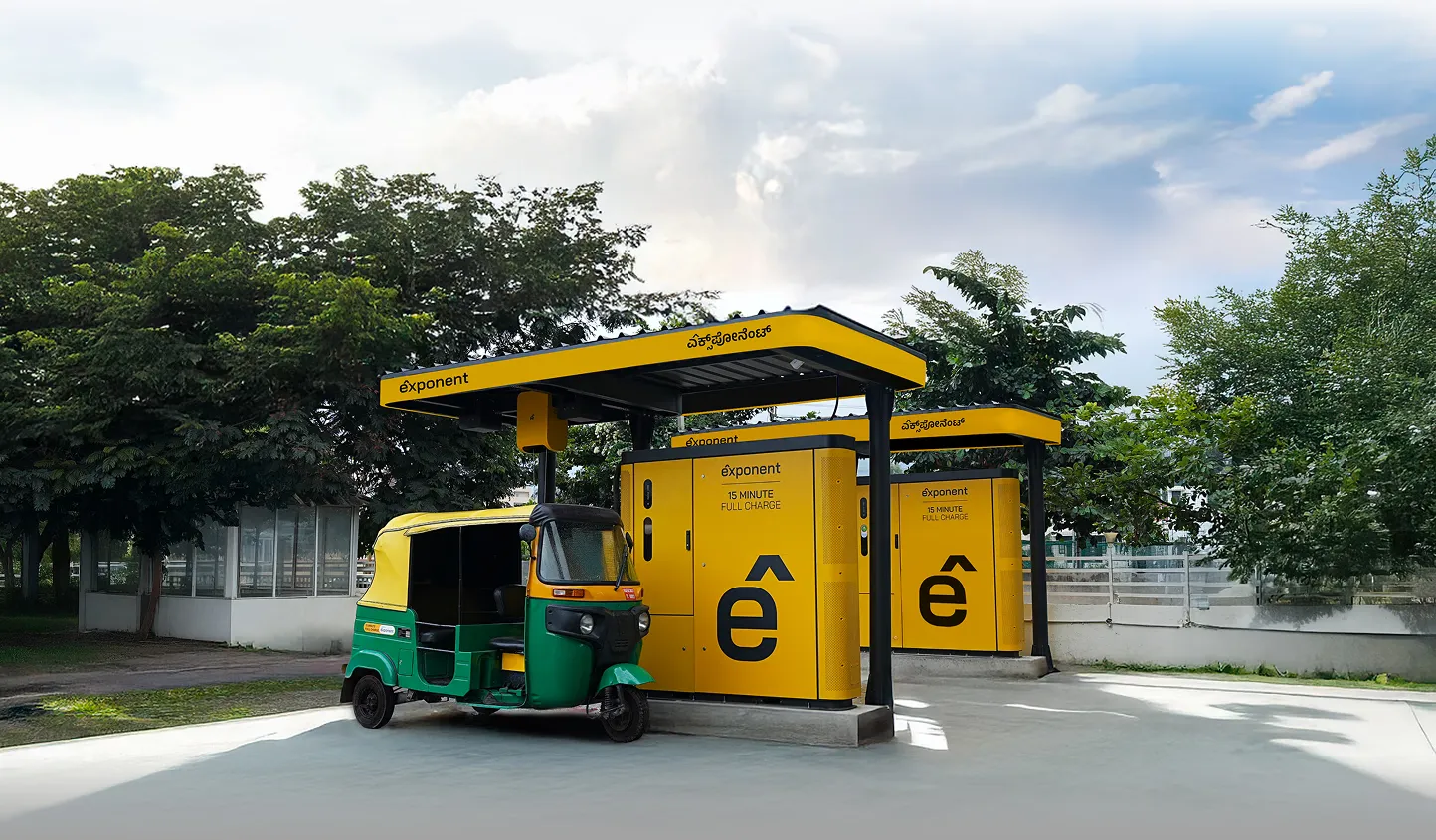
The Problem That Has Always Been the Problem
Charging anxiety is not a technological failure. It is an infrastructure failure — and infrastructure failures are solved by infrastructure investment, not by incremental improvements to battery chemistry.
India's commercial EV market is at an inflection point. The two- and three-wheeler segments are electrifying faster than the four-wheeler market because the economics are more compelling and the charging requirements are more manageable. But even in these segments, the four-hour charge time that most commercial EVs require creates a utilisation problem that fleet operators cannot simply ignore. A vehicle that earns revenue per kilometre driven cannot earn revenue while sitting at a charger.
Exponent Energy's bet is that 15-minute charging changes this equation entirely. A vehicle that charges in 15 minutes at a conveniently located e-Pump is not a vehicle with a charging problem. It is a vehicle with a fuel stop that takes roughly the same time as a full tank of petrol.
That is the bet. The ₹200 crore, the Bengaluru proof point, the OEM partnerships, the Oto retrofit service, the One financing arm — all of it is in service of a single thesis that Arun Vinayak came to at Ather Energy and has spent six years proving: that charging anxiety ends not when batteries get better, but when charging gets faster. And that charging gets faster not by changing the battery, but by changing where the heat goes.


