Most Ice Cream Is Built From Additives. This One Is Built From a Single Rule.
Walk to the freezer section of any Indian supermarket, pick up a tub of premium ice cream, and turn it over. The ingredient list will include emulsifiers — mono and diglycerides of fatty acids, typically labelled E471 and E472. Stabilisers — carboxymethyl cellulose (E466), carrageenan (E407), guar gum (E412). Artificial flavourings, synthetic colourings, and in many products marketed as healthy, a payload of synthetic sweeteners: sucralose (E955), maltitol (E965), erythritol (E968), stevia extract (E960).
These are the ingredients that make commercial ice cream what it is: stable across temperature fluctuations, consistent in texture at mass-manufacturing scale, and cheap enough to produce at the margins that retail requires. They are also what makes commercial ice cream, by any reasonable assessment of ingredient quality, substantially a processed food product.
Barath Akkihebbal and Akash Narain Mittal looked at that ingredient list and drew a single line.
If it has an E number, it does not go in.
That line is ELVN-ELVN's founding principle — the rule that defines what the brand will make and what it will never make. Founded in Bengaluru in 2024, ELVN-ELVN makes two ranges of ice cream: a vegan millet-based range and an A2 Desi cow dairy range. Neither contains E-number additives, refined sugar, synthetic sweeteners, industrial stabilisers, or industrial emulsifiers. What they contain instead is the result of a year of ingredient trials, AI-assisted recipe development, a 10-year research collaboration with one of India's premier food technology institutions, and a commitment to what the founders describe as real ingredients with no shortcuts.
Why These Two Founders — and Why Ice Cream
The founding credentials of ELVN-ELVN are not what the clean-label food industry usually produces. Akkihebbal is not a nutritionist or a food scientist. He is the founder of OfficeSmart, a corporate procurement business in Bengaluru that he has run since 2013, with supply chain and distribution expertise as his professional foundation. He also ran three ice cream parlour franchises, which gave him both category knowledge and the specific irritation of seeing what goes into most commercial ice cream.
His personal motivation was also specific. He has gluten intolerance and lactose sensitivity — conditions that meant most commercially available ice cream was, for him, both theoretically undesirable and practically problematic. Finding something he could eat without concern about additives or his specific sensitivities was harder than it should have been. ELVN-ELVN was the solution he built when he stopped waiting for someone else to build it.
Akash Narain Mittal brings the distribution dimension. His professional background spans a distribution business that has served Nestlé, ITC, and Parle — the kind of experience that tells you exactly how the large-scale food industry is built, what its commercial requirements are, and where its ingredient decisions come from.
Together, the co-founders bring supply chain expertise, category experience, personal motivation, and a detailed understanding of how the food industry actually operates — which makes their decision to build outside its standard operating model more informed than most clean-label founder decisions are.
The Year That Nearly Stopped the Brand
From February 2024 to January 2025, Akkihebbal and Mittal ran what became a year-long ingredient trial process. The YourStory profile of the brand counts approximately 50 distinct ingredient trials before commercial production began. Each trial had a minimum batch run of 90 kilograms. Failed batches were discarded. Early prototypes required 45 minutes out of the freezer before they were soft enough to scoop.
The core technical problem was sugar. In commercial ice cream formulation, refined sugar is not merely a sweetener. It is a structural ingredient that controls the freezing point of the mix, determines the texture of the final product, and affects the rate at which the ice cream melts. Replace the refined sugar with a natural alternative — dates, allulose, monk fruit — and every one of those physical properties changes in ways that require the entire recipe to be rebalanced.
That rebalancing is the work that most clean-label ice cream brands do not fully do. They replace the sweetener but keep the industrial stabilisers and emulsifiers to compensate for the resulting texture problems. ELVN-ELVN was committed to removing the stabilisers and emulsifiers too, which meant the entire technical problem had to be solved from ingredient quality rather than from chemical assistance.
When the natural replacements for traditional additives proved harder to find than expected, the founders turned to AI. They now run a ChatGPT instance trained on their specific recipe context — using it as a formulation research partner to explore ingredient combinations and predict outcomes. As Akkihebbal put it in the YourStory interview: ChatGPT gives a great answer, but you wish it could taste what came out. The AI accelerates the research; the tasting, adjusting, and discarding still happens in the kitchen.
The partnership that emerged from this process is unusual for a brand at this scale. ELVN-ELVN signed a 10-year MOU with NIFTEM-T — the National Institute of Food Technology Entrepreneurship and Management, Thanjavur, one of India's premier food technology research institutions — for continued product development collaboration. A brand with a five-person team and three sold-out batches has a decade-long institutional research agreement. The founders are clearly thinking about the ingredient problem as a long-term technical project rather than a one-time formulation challenge.
What the Ice Cream Is Actually Made From
The MILLET range is the product that most distinctly positions ELVN-ELVN's founding philosophy. It is vegan, dairy-free, and gluten-free, built on a base of Indian millets — jowar, ragi, foxtail, and pearl — with coconut milk as a secondary ingredient. The sweetness comes from a combination of whole dates (the primary sweetener), allulose (a rare sugar found naturally in figs, jackfruit, kiwi, and raisins, with approximately 0.4 calories per gram and near-zero glycaemic impact, FSSAI-approved in 2023), and natural monk fruit extract. No erythritol is used as a carrier for the monk fruit — the brand cites emerging research linking erythritol to cardiovascular risk as the reason for that specific decision.
The six MILLET flavours are Lush Litchi, Mango Tango, Coffee Scenes, Berry Me Up, Cosmic Coconut, and Blackout Fudge. Each uses real fruit or flavour ingredients — real litchi, real mango, real Indian arabica coffee, real berries — without artificial flavouring compounds.
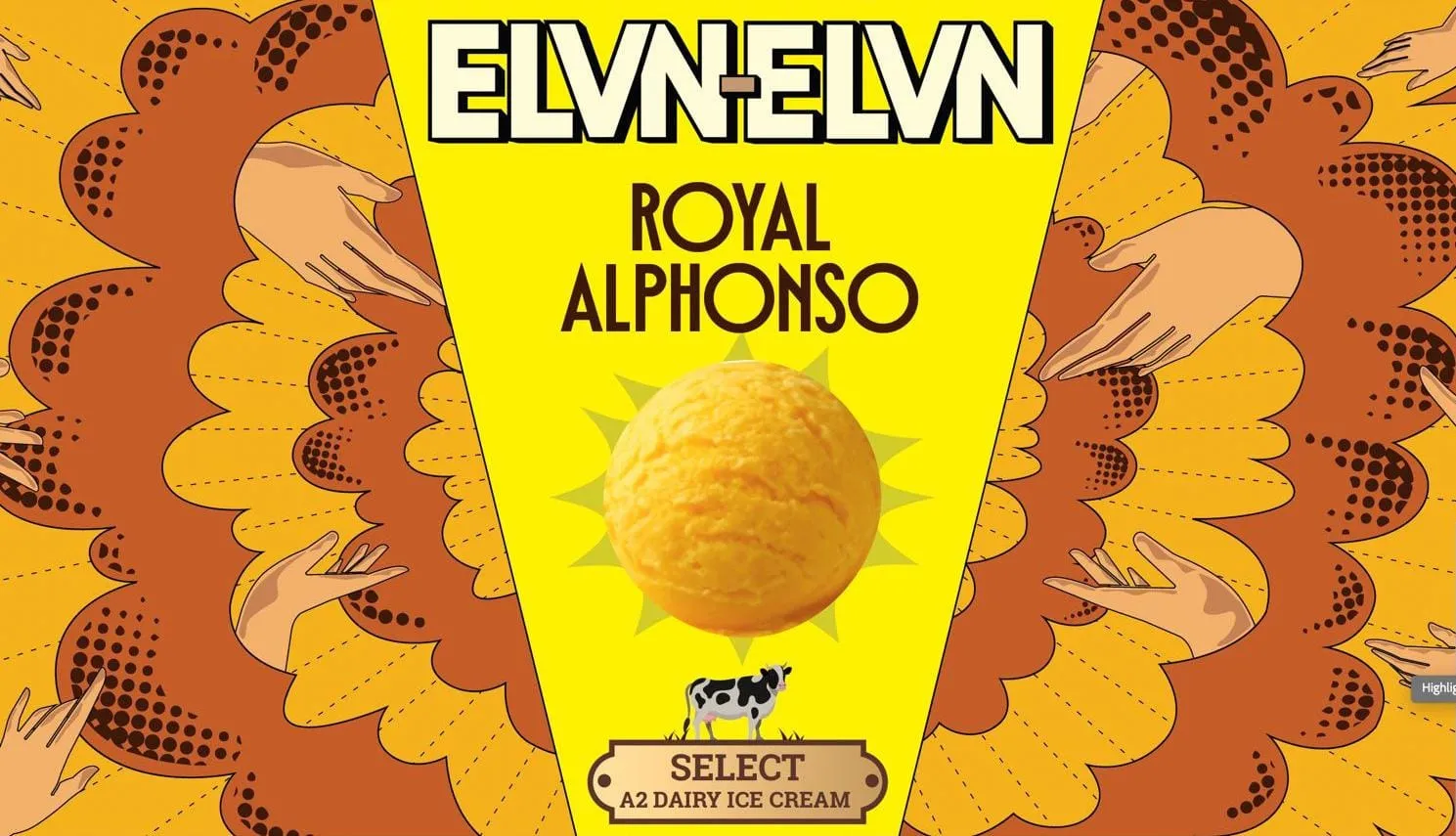
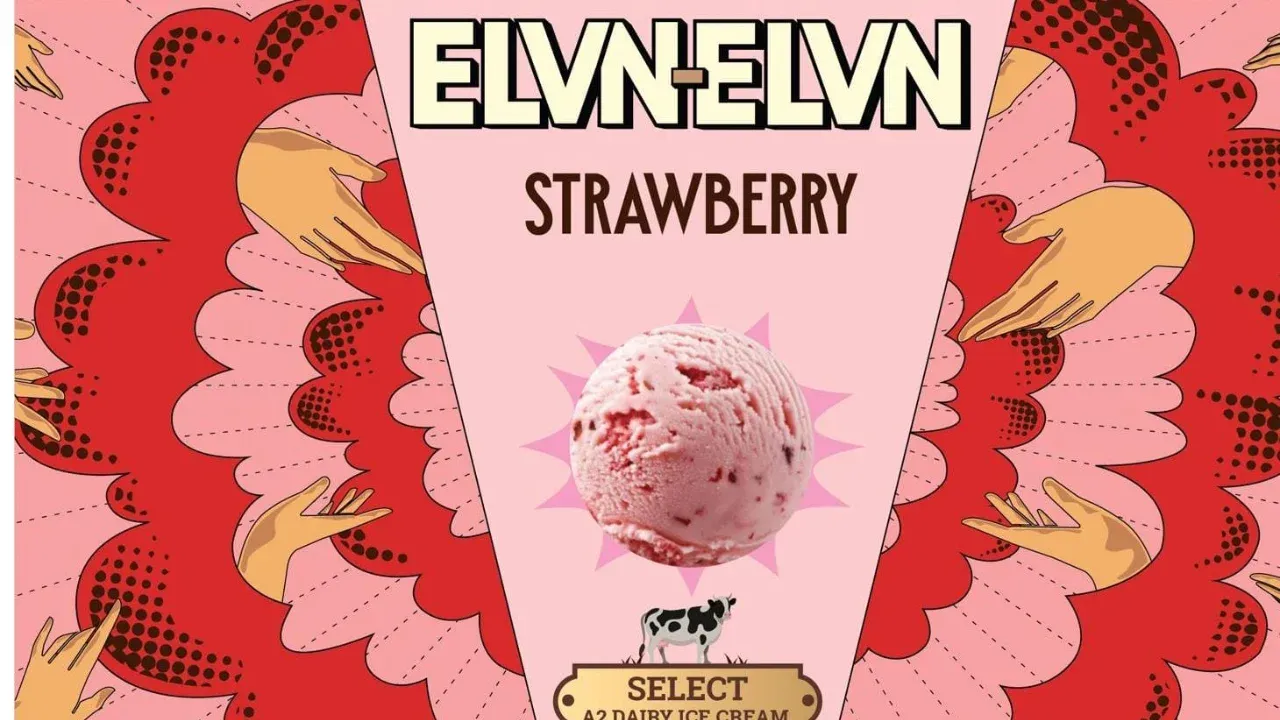
The SELECT range is a dairy ice cream built on A2 Desi cow milk and fresh cream sourced from indigenous-breed farms in Karnataka. A2 milk, produced by Indian indigenous cattle breeds, contains A2 beta-casein protein rather than the A1 beta-casein dominant in most commercial dairy — a distinction that the brand argues is relevant for digestibility, particularly for people with milk sensitivity. SELECT flavours include Strawberry, Pink Guava, Choco Velvet, and Royal Alphonso.
Both ranges are priced at Rs 140 for a 125 ml cup and Rs 400 for a 450 ml pack — accessible premium pricing that sits above mass-market ice cream but below the imported or luxury tier.
The Business So Far — and Where It Is Going
Commercial production began in January 2025. Since then, ELVN-ELVN has sold three batches with a fourth in production, growing at 50 per cent month on month. The team is five people: the two founders, a machinery operator, a delivery person, and an office manager. Distribution runs through five Organic Mandya stores in Bengaluru — a natural fit given Organic Mandya's positioning as a premium, ingredient-conscious retailer — plus two cafés that added ELVN-ELVN after customers specifically requested sugar-free options. The brand is also listed on Ownly, a zero-commission food delivery app operated by Rapido.
The Indian ice cream market was valued at Rs 243.50 billion in 2025 and is projected to reach Rs 639.41 billion by 2034 at a compound annual growth rate of 11.29 per cent, according to IMARC Group. The clean-label segment where ELVN-ELVN competes includes Go Zero, NOTO, Get-A-Way, and The Brooklyn Creamery — all of which have taken different approaches to the same underlying consumer demand for less processed frozen desserts.
What distinguishes ELVN-ELVN's positioning is the severity of its ingredient rule. The no-E-number standard is more demanding than most clean-label competitors apply, and the commitment to removing industrial stabilisers and emulsifiers — not just replacing refined sugar — is the technical challenge that most competitors do not fully address. Whether that severity produces a product that enough consumers will pay the premium for, consistently enough, to build a national brand from a five-person Bengaluru operation is the question that the next 24 months of the company's growth will answer.
The founders have the rule. They have the research partnership. They have the growth trajectory. And they have a product that, by its own account and by independent ingredient analysis, does what most clean-label ice cream claims to do and actually does not.
Real ingredients. No shortcuts. No E numbers. In ice cream, that is harder than it sounds, and rarer than it should be.


