
India has a paradox: millions of unemployed youth and millions of unfilled entry‑level jobs. The gap is not in ambition but in skills – and often in language. Most digital learning is in English, inaccessible to the 70% of Indians who are not fluent. EduBridge, a Pune‑based edtech startup, has built an AI‑powered learning platform that delivers vocational courses in 12 regional languages, including Hindi, Tamil, Telugu, Marathi, Bengali, and Kannada. The company has raised $15 million in Series B funding led by Omidyar Network India, with participation from the Michael & Susan Dell Foundation and existing investor Nexus Venture Partners. The funds will be used to reach 50 million rural youth over the next three years, through a combination of mobile app, community learning centres, and partnerships with state governments.
EduBridge’s platform offers courses in retail, banking and financial services, logistics, healthcare, and digital skills. Each course is designed in partnership with industry employers such as Reliance Retail, ICICI Bank, Amazon, and Apollo Hospitals. The AI engine adapts to the learner’s pace, providing additional explanations, quizzes, and practice exercises. The platform also includes a virtual mentor – a chatbot that speaks in the user’s local language and can answer questions, schedule assessments, and provide career guidance. Since its launch in 2023, EduBridge has enrolled 3 million learners, with a course completion rate of 68% (industry average is 30%) and a job placement rate of 55% within six months of completion.
“India’s workforce development system is broken because it ignores language diversity,” said co‑founder and CEO Sandhya Iyer, a former McKinsey consultant focused on education. “A young woman in rural Bihar may be brilliant, but if she cannot understand the training content in English, she loses the opportunity. EduBridge removes that barrier. We teach in the language she speaks at home, with examples from her community.” The company’s content is developed by a team of instructional designers and subject matter experts, then localised by native speakers. The AI then further personalises the experience based on the learner’s responses and regional dialect.
The Series B round comes as the Indian government pushes for universal skilling under the new National Education Policy 2026 and the updated Skill India Mission. The government has set a target to skill 100 million youth by 2030, and it has partnered with edtech platforms to achieve scale. EduBridge is empanelled with the National Skill Development Corporation (NSDC) and has signed memoranda of understanding with the governments of Bihar, Uttar Pradesh, and Rajasthan to deploy its platform in government‑run Industrial Training Institutes (ITIs) and rural employment centres.
EduBridge will use the funds to expand its AI capabilities, including a “career path prediction” model that analyses a learner’s performance, interests, and local job market data to recommend specific courses and job targets. The company will also launch a “placement guarantee” programme: learners who complete a course with 80% attendance and pass the final assessment will be given three job interviews with partner employers. If not placed within six months, the course fee is refunded. This guarantee is backed by a ₹10 crore ($1.2 million) insurance policy from a leading general insurer.
The technology behind EduBridge is sophisticated. The platform uses a large language model fine‑tuned on 10 million chat logs from Hindi and other regional language speakers, allowing the virtual mentor to understand colloquial expressions and even code‑switching (mixing English and local language). The assessment engine uses natural language processing to evaluate open‑ended answers, not just multiple choice. EduBridge holds a patent for its “multilingual auto‑grader,” which can assess a written answer in any of 12 languages with 92% accuracy compared to a human grader.
Competitors include upGrad, Unacademy, and Coursera, but their vocational courses are typically in English and priced beyond the reach of rural youth (₹10,000‑50,000). EduBridge courses cost ₹1,000‑3,000 ($12‑36) for a three‑month program. The company also offers a “pay‑after‑placement” option: learners pay a nominal registration fee (₹100 or $1.20) and then pay the full fee in 12 monthly instalments after they start working. This model has increased enrolment by 300% in pilot districts.
The social impact is profound. A 2025 study by the Indian Institute of Management Ahmedabad found that only 15% of rural youth were aware of any online skilling platform, and of those, 80% cited language as a barrier. EduBridge’s approach removes that barrier. In a survey of graduates, 72% reported earning an average monthly salary of ₹12,000 ($144) after completing the course, up from ₹4,000 ($48) before. Many were first‑time earners in their families, lifting entire households out of poverty.
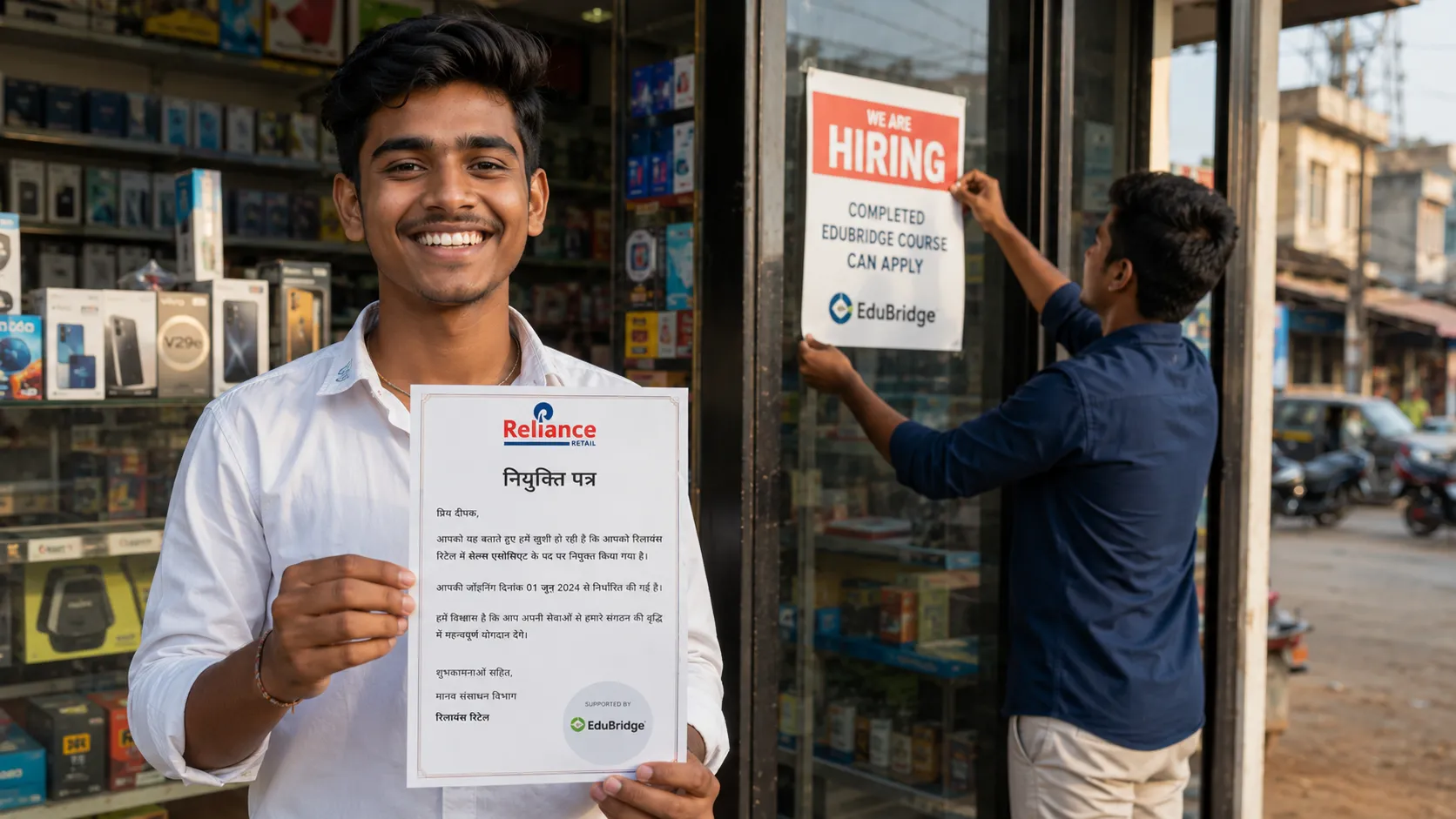
EduBridge’s long‑term vision is to create a “Bharat Stack for skills” – a national infrastructure that connects learners, employers, and training providers through a common API. The startup has already started piloting a digital credentialing system based on blockchain, so that employers can instantly verify a candidate’s skills. It is also working with the government’s e‑Shram portal to identify potential learners based on their demographic and occupational data.
For the 50 million young Indians who will enter the workforce in the next decade, access to quality, language‑appropriate training is the difference between a life of casual labour and a career with dignity. EduBridge is building that bridge, one learner at a time. “We don’t just teach skills,” said Iyer. “We open doors. And we make sure the door is labelled in your language.”


