The Gap Everyone Talks About and Nobody Had Built to Fill
India's climate transition has a financing problem that is specific and structural. The country has committed to net zero by 2070, to 500 gigawatts of renewable energy by 2030, and to substantial EV adoption across its two- and three-wheeler segments. The policy ambition is real, the government support is real, and the market demand is real.
What is also real is the gap between that ambition and the financing infrastructure required to realise it — specifically for the borrowers who are actually driving the transition at the retail level.
The electric rickshaw driver needs ₹1.5 to 2 lakh to buy a vehicle that will reduce his fuel costs from ₹800 a day to close to zero. The family in a Tier 2 city needs ₹2 to 4 lakh to install rooftop solar that will bring their electricity bill down permanently. The small kirana shop needs equipment financing to upgrade to energy-efficient appliances. None of these borrowers are served well by the conventional banking system, which struggles to underwrite small-ticket, first-time loans to individuals and micro-businesses for assets that its credit models do not yet know how to value.
The gap between the green transition India needs and the green financing infrastructure that serves its retail borrowers is the market that Ecofy was built to fill.
On March 14, 2026, Ecofy — India's first and only green-only Non-Banking Financial Company — closed a ₹380.5 crore Series B equity round co-led by British International Investment, the UK government's development finance institution, and Finnfund Digital Access Impact Fund I LP, managed by Finland's development finance institution Finnfund. Existing investors FMO, the Dutch entrepreneurial development bank, and Eversource Capital, the sustainable infrastructure fund that originally established Ecofy, continued their investment.
Four government-backed development finance institutions from three European countries, all backing the same Indian retail green lending startup. That is a specific kind of validation.
What Ecofy Is — and How It Is Different
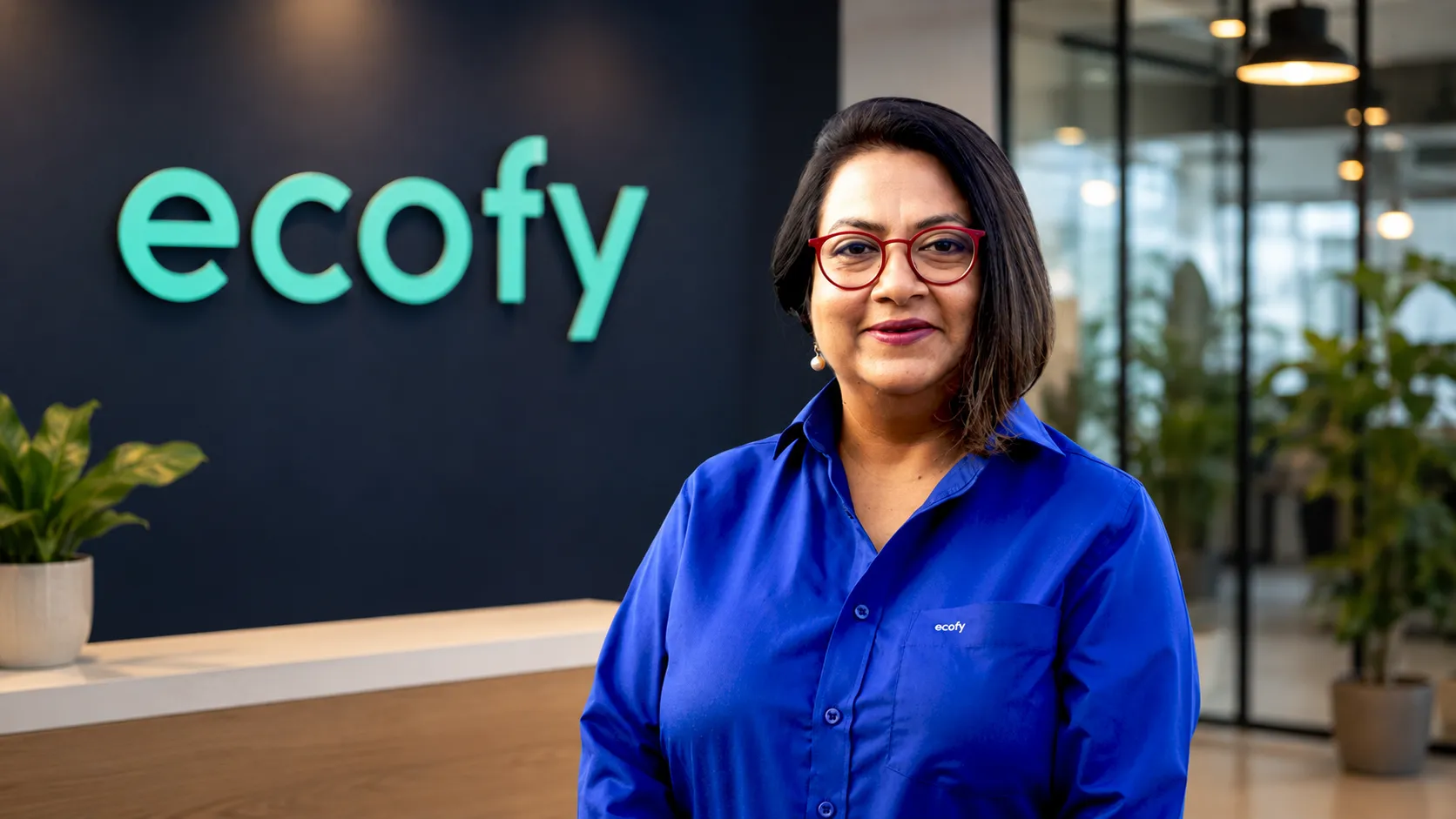
Ecofy was founded in 2022 by Rajashree Nambiar and Govind Sankaranarayanan. The founding credentials are the first thing that distinguishes the company from most climate fintech startups.
Rajashree Nambiar is the Co-Founder, Managing Director, and CEO — a seasoned professional with over 30 years of experience in banking, financial services, and insurance. Her career has been specifically in building and scaling retail lending operations, not in investment banking or technology.
Govind Sankaranarayanan spent 27 years at Tata, including 11 years as Group COO and CFO at Tata Capital, where he was responsible for leading the business to ₹7,000 crore in revenues and ₹65,000 crore in AUM — creating one of Tata's largest businesses with a $10 billion AUM across a wide range of retail and wholesale products. He brings the specific expertise of having built large-scale NBFC operations from the inside.
The founding thesis they built Ecofy around is precise: the mainstream financial system cannot adequately serve retail green borrowers because it was not designed for them, and the green financing market in India is underpenetrated not for lack of demand but for lack of appropriate supply. An NBFC built specifically for green lending, with underwriting models designed for EV and solar assets, with distribution partnerships with OEM manufacturers and dealers, and with the institutional capital from development finance institutions that share its mission, could fill that gap profitably.
The model Ecofy has built combines end-to-end digital loan processing — enabling fast credit delivery to borrowers — with a distribution network of more than 100 OEM partners and over 23 banks and financial institutions as co-lending partners. The product range covers EV financing for two- and three-wheelers (including electric rickshaws), rooftop solar installations, and SME green equipment financing.
The Numbers That Tell the Story
The financial trajectory from inception in 2022 to the Series B close in March 2026 demonstrates the model at work.
AUM reached ₹911 crore by March 2025 — approximately 400 times the AUM at first disbursement in November 2022 — growing through successive DFI capital injections as each round validated the credit quality of the portfolio and enabled the next stage of growth. By the time of the March 2026 funding round, AUM had grown further to ₹1,400 crore, representing approximately 54 per cent year-on-year growth.
The customer base reached 1.25 lakh borrowers — 125,000 individuals and small businesses who have accessed green financing through Ecofy. The ICRA provisional credit rating assigned validates the portfolio quality to institutional standards. The capital adequacy ratio at 50 per cent post-round provides the regulatory headroom for significant further lending growth.
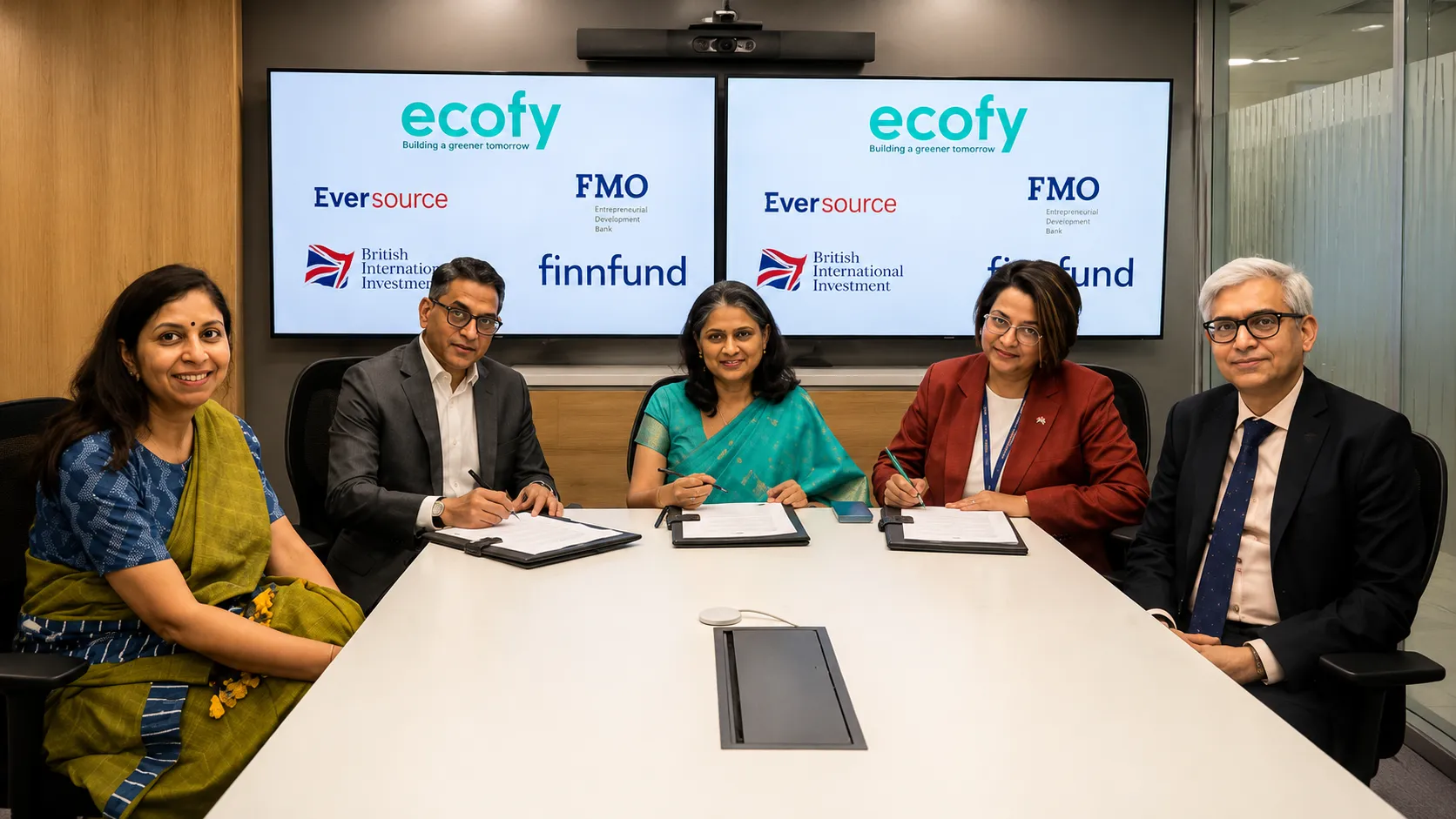
Total equity and debt capital raised now exceeds $52.8 million across all rounds, from what began as founding equity from Eversource Capital through the Series A DFI investments from FMO and IFU (Investment Fund for Developing Countries, Denmark) to the current Series B.
The revenue growth cited in your brief — 4.8x in EV and solar financing — reflects this trajectory. FY24 revenue stood at ₹34.9 crore, a base that the Series B capital is designed to accelerate significantly.
The net loss of ₹42.3 crore in FY25 reflects the investment phase typical of a rapidly scaling NBFC building distribution infrastructure and growing its loan book faster than the interest income from that book fully offsets the operating cost. PAT breakeven is targeted for FY27, at which point the ₹3,500 crore AUM projection would generate approximately ₹300 crore in annual interest income against estimated operating costs of ₹150-200 crore.
Why Development Finance Institutions Are Backing This
British International Investment has committed to directing at least 30 per cent of its new commitments by value to climate finance between 2022 and 2026. Its investment in Ecofy is consistent with that commitment — but the specific reasons for choosing Ecofy over other potential climate finance investments in India are worth examining.
The retail focus is the primary differentiator. Most climate finance in India flows to large-scale renewable energy projects, to corporate energy efficiency programmes, or to large developers. BII, Finnfund, FMO, and Eversource are backing Ecofy because it is doing something that most green finance institutions are not doing: lending to the electric rickshaw driver, the rooftop solar homeowner, the small business buying green equipment. These borrowers represent the mass market of India's green transition — the hundreds of millions of people whose adoption of electric vehicles and solar energy will determine whether India's climate commitments are met.
The Danish DFI IFU's $12.5 million long-term loan facility in a previous round reflects the same logic. Denmark joins UK, Netherlands, and Finland as European DFI partners — four countries whose development finance mandates have all converged on the same Indian retail green NBFC as the most credible vehicle for their climate finance capital.
The VFS investor report notes that Ecofy is the largest green-focused retail NBFC in India by AUM, ahead of sector-specific competitors including Aerem (solar-only), RevFin (EV finance), and Three Wheels United. That leadership position, achieved in three years from founding, is the competitive moat that DFI backing both reflects and reinforces.
What the ₹380 Crore Will Fund
The Series B capital will support expansion across all three of Ecofy's product categories — rooftop solar, electric vehicles, and SME green equipment financing — as the company enters what it has described as its next phase of operations.
An Ather Energy partnership announced in February 2026 exemplifies the OEM partnership model: Ecofy provides financing to Ather customers, removing the upfront cost barrier that prevents many potential EV adopters from making the switch. With 100-plus OEM partners across the EV and solar supply chains, Ecofy's distribution model is built around meeting borrowers at the point of purchase rather than requiring them to navigate a standalone NBFC application process.
The capital adequacy ratio of 50 per cent post-round means that ₹380 crore of equity, at the NBFC's regulatory leverage ratio, can support approximately ₹1,400 to ₹2,000 crore of additional lending capacity — making the equity capital significantly more productive than a pure equity-funded model. The path to ₹5,000 crore-plus total AUM by FY28 is the financial foundation of a potential NBFC listing or strategic transaction.
The Larger Argument
Ecofy's ₹380 crore Series B is a climate story, a financial inclusion story, and a women-in-finance story simultaneously.
The climate story is that India's green transition requires financing infrastructure for retail borrowers — the individuals and small businesses whose aggregate behaviour will determine whether EVs and rooftop solar reach genuine mass adoption. Ecofy is building that infrastructure.
The financial inclusion story is that the same borrowers who have been underserved by the conventional lending system for access to any credit are now being underserved specifically for access to green credit. Ecofy's digital underwriting, OEM partnerships, and green-specific credit models are designed to reach borrowers that a general-purpose NBFC would not serve effectively.
The women in finance story is that Rajashree Nambiar is one of a small number of women leading significant NBFC and fintech operations in India — bringing three decades of BFSI experience to a company addressing one of the most consequential financing gaps in the country.
India's green transition will not succeed if it is only for large companies and large projects. It will succeed when the electric rickshaw driver can afford the vehicle that eliminates his fuel costs, and when the homeowner in Jaipur can afford the solar installation that halves her electricity bill. Ecofy's ₹380 crore says: four governments believe that is possible. The 1.25 lakh customers already served say: it is happening.


