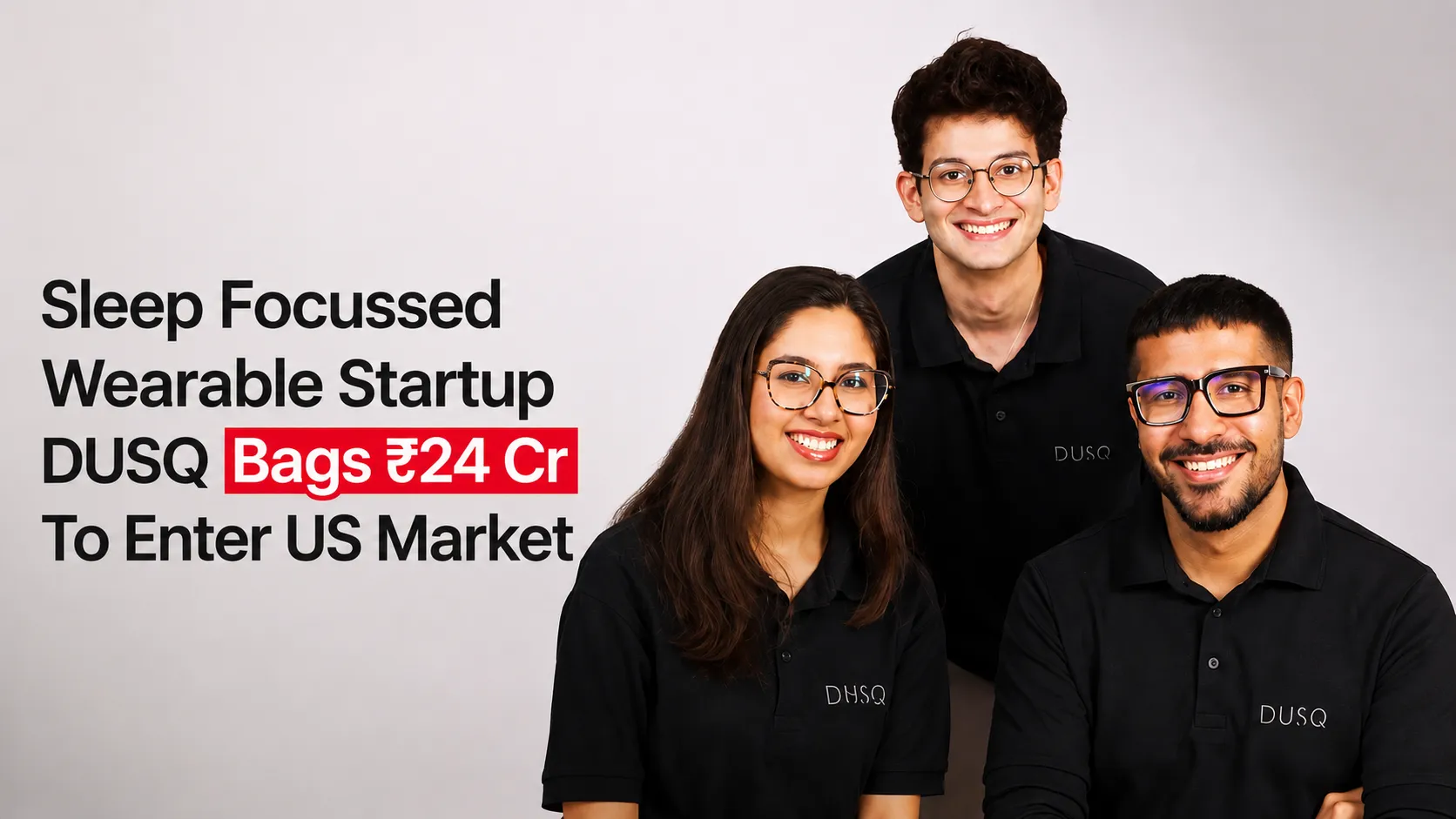
The Sleep Industry Spent a Decade Getting Better at Telling People How Badly They Slept. This Indian Company Is Building Something That Actually Fixes It.
There is a specific frustration that millions of Oura Ring users, Whoop wearers, and Fitbit owners share, and almost none of them talk about directly. The frustration is this: the device works exactly as advertised. The sleep score is there every morning. The deep sleep percentage, the REM cycles, the heart rate variability graph. All of it, precise and detailed and completely useless for the thing they actually needed, which was to sleep better last night.
The tracking category made the industry rich and left the user exactly where they started. The data got better. The sleep did not.
DUSQ is a Bengaluru-founded sleep science company built on a single and confrontational premise: the next frontier of sleep technology is not tracking. It is regulation. Not recording what happened during the night. Changing what happens during it — in real time, at the biological level, while the user is asleep.
On June 9, 2026, DUSQ launched its US Kickstarter campaign. Within the opening days, it crossed $1 million in revenue — becoming the fastest Indian healthtech company in Kickstarter's history to hit that milestone. It surpassed Ultrahuman, whose original Ring campaign raised approximately $500,000 in total, by more than two times. It stands as one of the most significant early validations that a science-first, India-built medtech product can compete directly in the world's most competitive consumer health market.
The US retail rollout is planned for September 2026. The India-based team is hiring across 60-plus open roles in engineering, design, biotech, and growth. And a behind-the-ear device that weighs 12 grams is being shipped to American backers who decided, with their wallets, that they were ready to move past the sleep score.
The Origin — From InnerGize to DUSQ, Through Shark Tank and a Lupus Diagnosis
To understand what DUSQ is, you have to understand what it was before it was DUSQ.
The company was originally launched in 2023 as InnerGize — a stress-focused wearable that gained national visibility in India through Shark Tank India, where it secured investment from all three Sharks. The Shark Tank deal confirmed something important: Indian consumers wanted technology that addressed the physical experience of stress, not just tracked it.
What InnerGize also confirmed, through the research the team conducted and the data they gathered from their early users, was something more fundamental. Stress, in most cases, was not the root problem. It was a symptom. And the root problem — the thing underneath the stress, the thing that made the stress worse and the recovery slower — was sleep.
Specifically, it was the failure of the autonomic nervous system to fully downshift during sleep. Micro-arousals — brief, partial awakenings that splinter deep sleep into fragments — are not visible to the sleeper and are not prevented by any existing consumer sleep technology. They are the gap between eight hours in bed and eight hours of genuinely restorative sleep. They are what no tracker prevents and no supplement stops. And they are what DUSQ was built to address.
Dr. Siddhant Bhargava, co-founder and CEO of DUSQ, is a physician and Forbes 30 Under 30 Asia honoree. His personal conviction about sleep's centrality to health comes from an experience that most medical professionals only know academically. He survived Lupus as a teenager and cancer in his twenties — experiences that shaped his understanding of the relationship between sleep, immune function, and chronic disease in the way that only direct experience can. Sleep is the most intimate thing a human does, he has said publicly. If we are asking anyone to trust us with eight hours of their lives every single night, we have a responsibility to improve that experience, not just hand them a report card.
The company rebranded from InnerGize to DUSQ after a period of intensive research — stepping back from the commercial momentum of the Shark Tank deal to invest in the long-horizon scientific work that the new product category required. DUSQ stands for something specific in the company's internal framing: it is the answer to the question of what happens when you stop building features and start building biological infrastructure.
The Product — What Closed-Loop Sleep Regulation Actually Means
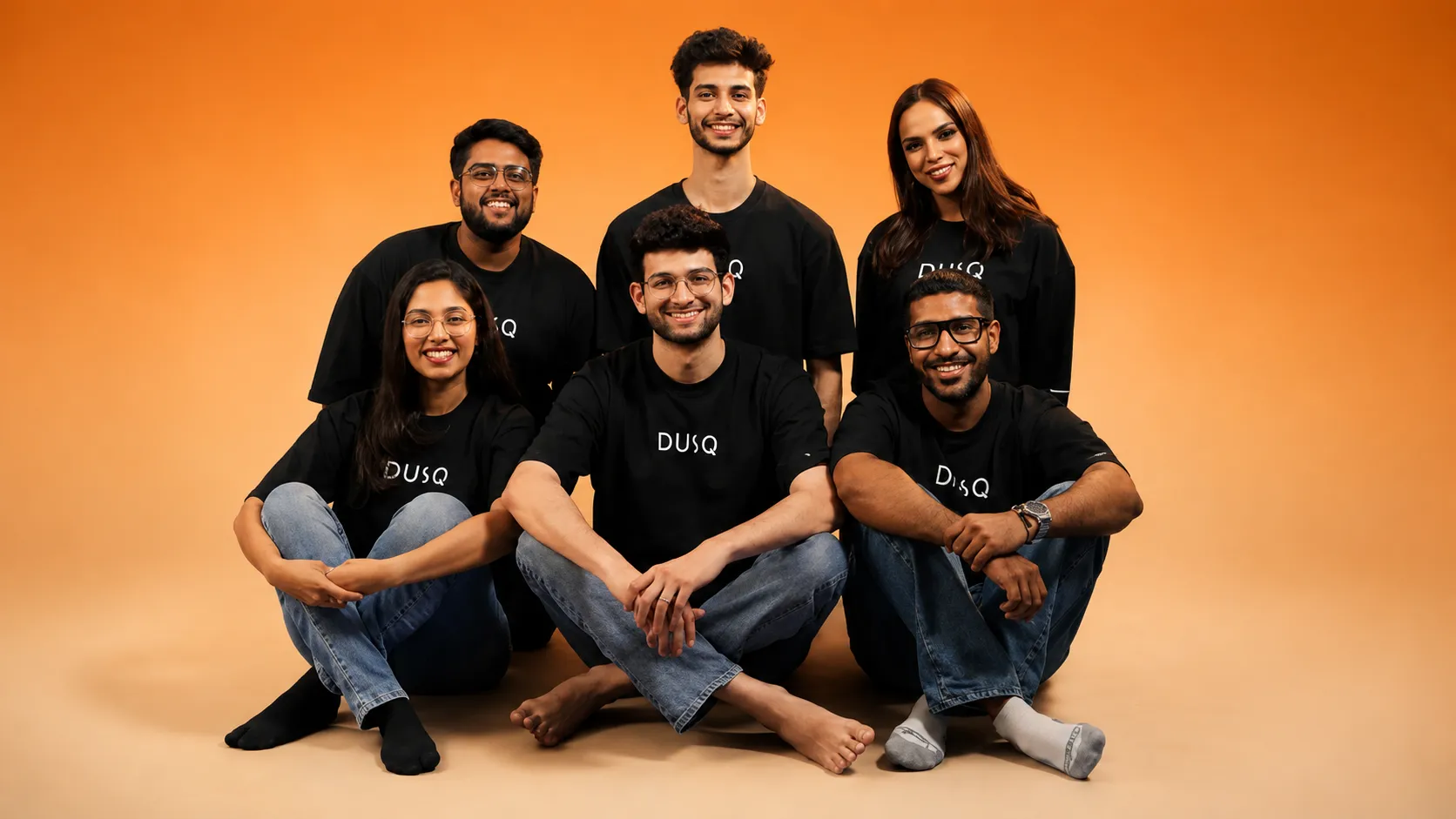
DUSQ's behind-the-ear device is 12 grams and 7.2 millimetres. It is designed to be worn from dusk through the full sleep cycle — not just a pre-bed wind-down routine, but through the entire night while the user sleeps.
The device reads the autonomic nervous system continuously through electrodermal signals. The autonomic nervous system is the part of the nervous system that controls the body's involuntary functions — heart rate, breathing, digestion, and crucially, the transitions between sleep stages. When the device detects a disruption — the signature signal of a micro-arousal beginning — it responds before the disruption completes by delivering adaptive vagus nerve and vestibular nerve stimulation.
Vagus nerve stimulation is an FDA-cleared modality for insomnia — not a novel experimental intervention but an established mechanism with a clinical evidence base. DUSQ's application of it is distinctive: rather than delivering a fixed stimulation pattern at a fixed time (the approach of competitors like Somnee and Pulsetto), DUSQ delivers adaptive stimulation in real time, calibrated to the specific disruption being detected in the specific user's nervous system at that moment.
The result is what the company means by closed-loop: a continuous cycle of sensing, detecting, and responding that operates throughout the night without the user's awareness or participation. Every other sleep device tells you what happened the night before. DUSQ changes what happens during it.
The clinical evidence that the company reports from its double-blind, controlled trials is specific. Thirty-one per cent more deep sleep. Thirty-eight per cent improvement in heart rate variability. Twenty-two per cent fewer night-time awakenings. These are not self-reported outcomes from user surveys. They are trial outcomes from the in-house sleep laboratory that DUSQ has built and operated — a laboratory that has now collected more than 50 million physiological data points across its research programme.
The company holds CDSCO certification in India and uses the FDA-cleared stimulation modality as the basis for its US regulatory positioning.
Sleep Quotient — the Proprietary Metric That Replaces the Sleep Score
Central to DUSQ's product philosophy is a rejection of the sleep score — the numeric summary of the previous night's sleep that Oura, Whoop, Garmin, and every other major tracker uses as its primary output.
The company has described its position on the sleep score with unusual directness: the sleep score is a metric that made the industry rich and left the user exactly where they started. The score describes what happened. It does not create the conditions for anything better to happen.
DUSQ's proprietary Sleep Quotient — SQ — is designed to replace the sleep score with a different kind of measurement. Rather than describing the previous night's sleep, SQ measures the body's current capacity to produce sleep — a leading indicator of recovery quality rather than a lagging description of what occurred.
Building SQ required the full-stack integration of sensor hardware, signal processing, biostatistics, and real-time intervention algorithms that is rare to assemble inside a single startup, and almost unprecedented inside an Indian startup. The company's in-house sleep laboratory is the research infrastructure that made SQ possible.
The Kickstarter Numbers — and What They Signal for Indian Deeptech
The $1 million Kickstarter milestone is significant on two levels simultaneously.
At the company level, it validates that American consumers are willing to pre-purchase an Indian-built hardware medical device at a price point of $229 to $249 (with a planned retail price of $499) based on the science, the clinical data, and the category thesis the company is advancing. That pre-launch validation — more than 2,000 commercial users in India, a US waitlist exceeding 10,000 people before the Kickstarter launch — preceded the Kickstarter itself and seeded the opening day surge.
At the India deeptech level, it is a data point in a category that has had very few data points. India has been the world's outsourcing hub for technology development for three decades. Indian software, Indian engineering talent, and Indian back-end services are embedded in virtually every global technology product. What India has produced far less of is the category of hardware product that carries an Indian brand, is built and clinically validated in India, and sells to American consumers on the merits of its science rather than on the advantages of its price.
DUSQ is doing exactly that. The Kickstarter is being shipped to American backers. The retail rollout planned for September 2026 is a full US market entry. And the 60-plus open roles in India — across engineering, design, biotech, and growth — are being built for a product that has already demonstrated American demand.
Ronak Shah, Growth Advisor at DUSQ, described what the campaign represented from an insider's perspective. He said he had helped scale consumer brands to nine figures in revenue, and had never seen a product where the technology this early actually matched the ambition of the pitch.
The technology actually matches the ambition of the pitch. For an Indian deeptech company going global, that sentence is the milestone that matters most.


