
‘Durandhar’ Duology Becomes First Indian Franchise to Cross ₹3,000 Crore — Redefining the Global Blockbuster
The two‑part action saga, made on a $30 million budget, has earned $362 million worldwide without releasing in China or the Gulf. A third film is set for 2028.
It is the box office story of the year — and almost no one in Hollywood saw it coming.
As of May 26, 2026, the Durandhar duology — consisting of Durandhar (released December 2025) and Durandhar: The Revenge (released March 2026) — has become the first Indian film franchise to surpass ₹3,000 crore at the worldwide box office. The cumulative gross stands at ₹3,019.35 crore, or approximately $362 million USD.
That figure places the two‑film series ahead of every other Indian franchise in history, including the Baahubali duology (₹2,438 crore / $293 million), the Pushpa franchise (₹2,092 crore / $251 million), and even the six‑film YRF Spy Universe (estimated ₹2,830 crore / $340 million).
More remarkably, the Durandhar duology achieved this milestone without a release in China — historically a critical market for large‑scale action films — and with only a token release in Gulf countries, where censors objected to the films’ depiction of mercenary violence.
The milestone has sent ripples through the global entertainment industry, raising questions about the future of non‑English language franchises and the viability of “local‑first” storytelling in an increasingly globalized market.
THE NUMBERS BEHIND THE RECORD
According to data from the Indian box office tracking platform Sacnilk and confirmed by independent trade analysts, the worldwide gross breakdown is as follows:
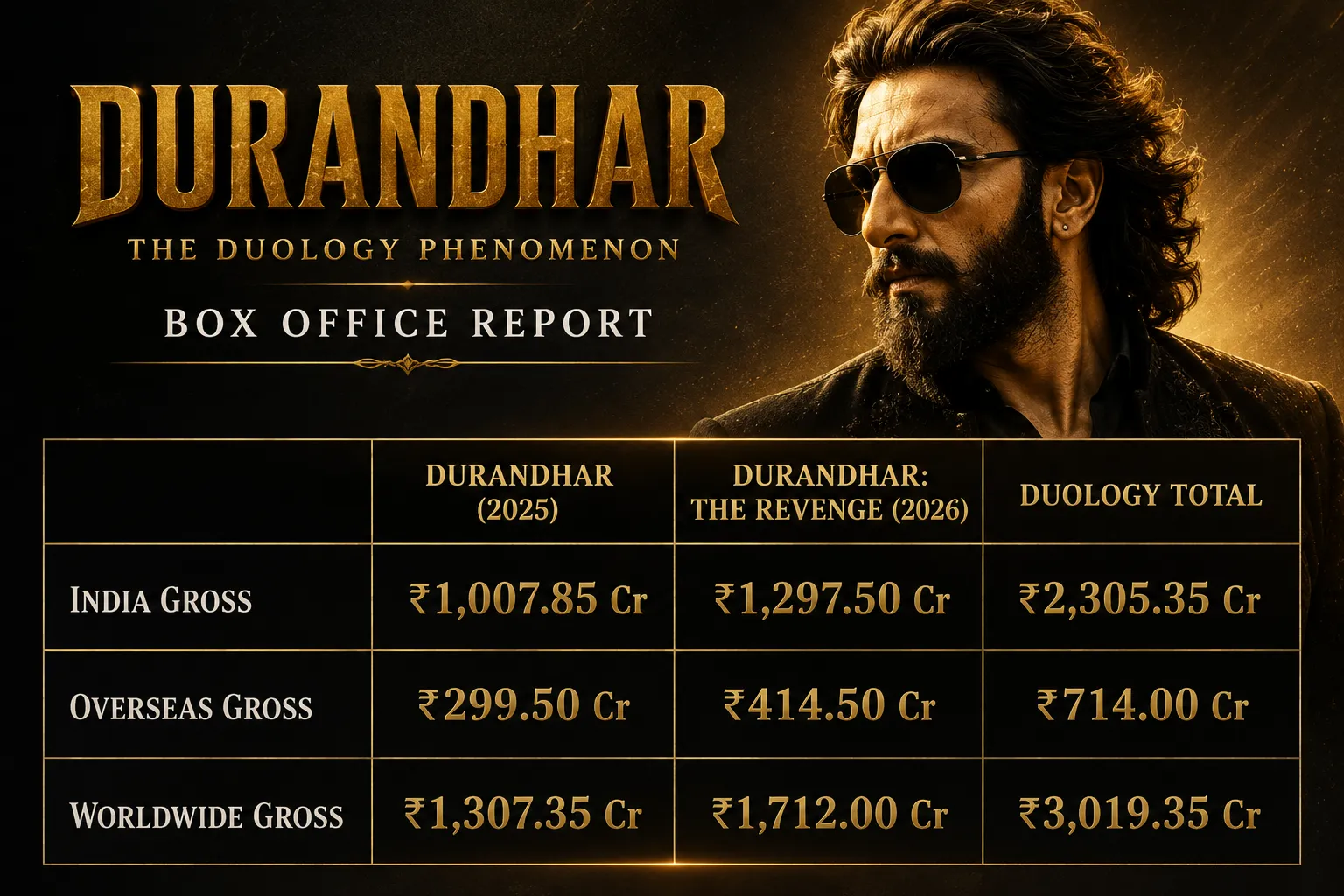
The sequel alone, Durandhar: The Revenge, became the first Hindi‑language film in history to cross ₹1,000 crore net in India (after taxes and exhibitor shares). Its predecessor exhibited an unusual box office pattern: second‑week collections rose by 19.95% over the first week — a rare “slow‑burn” trajectory for an action film, driven almost entirely by positive word‑of‑mouth from tier‑2 and tier‑3 cities such as Indore, Lucknow, Nagpur, and Bhopal.
“This is unprecedented for a Hindi action film,” said trade analyst Komal Nahta in an interview with The Hollywood Reporter. “Most action blockbusters are front‑loaded. They open huge and drop 60% in week two. Durandhar did the opposite. It grew in week two. That only happens when a film becomes a cultural event beyond the opening weekend audience.”
A FRANCHISE BUILT DIFFERENTLY
The Durandhar duology was not planned as a two‑part franchise. Director Aditya Dhar, known for the 2019 war film Uri: The Surgical Strike, originally shot a single 5½‑hour epic. During post‑production, producer Ronnie Screwvala (founder of RSVP Movies) viewed a rough cut and suggested that the material worked better as two separate films.
No additional footage was shot for the sequel. No post‑credits scenes were added to force a franchise connection. The split was purely editorial: a clean break at the emotional midpoint of a single narrative.
In a statement to Indian media earlier this month, Dhar explained the decision:
The films star Raghav Dey, a former martial‑arts instructor with no prior acting experience, in the lead role. The supporting cast includes established Indian actors but no major international stars. Dialogue is approximately 80% Hindi, 15% Bhojpuri, and 5% English — a deliberate choice to reflect the linguistic reality of the film’s rural setting rather than to cater to international markets.
The combined production budget for both films is estimated at ₹250‑255 crore (approximately $30 million USD). By comparison, the average Marvel Cinematic Universe film costs upwards of $200 million. The Durandhar duology’s return on investment — over 1,100% — is among the highest ever recorded for a major franchise.
OVERSEAS PERFORMANCE: MODEST BUT MEANINGFUL
While the vast majority of the duology’s earnings came from India (₹2,305 crore of the ₹3,019 crore total), the overseas gross of ₹714 crore ($85 million) is significant in its own right.
The North American gross stands at $12 million from approximately 650 screens, distributed primarily in multiplexes in New Jersey, Texas, California, and Illinois. The film was not dubbed into English; it played with subtitles only.
“The overseas numbers are actually more impressive than they look,” said media analyst Priya Sharma of Elara Capital. “Most Indian franchises rely heavily on the Gulf market and on diaspora communities. Durandhar had almost no Gulf release and still pulled in $85 million internationally. That suggests genuine cross‑cultural appeal, not just expat nostalgia.”
Notably, the duology achieved this without any significant marketing spend in Western markets. No billboards in Times Square. No cast appearances on late‑night television. The international audience grew organically, driven by social media clips, word‑of‑mouth among action cinema enthusiasts, and positive reviews from international film critics.
WHY HOLLYWOOD IS WATCHING
The Durandhar duology’s success has not gone unnoticed in Burbank and New York. Multiple Hollywood studios have reportedly approached director Aditya Dhar and producer Ronnie Screwvala about an English‑language remake. According to industry sources familiar with the conversations, Dhar has declined all offers to date.
“Some stories belong where they were born,” Dhar said in a recent interview with an Indian publication. “You don’t move a banyan tree to a different forest and expect it to grow the same way.”
The duology also offers a case study in organic franchise building — a model that stands in sharp contrast to Hollywood’s current obsession with “cinematic universes” and interconnected storytelling. The Durandhar films contain no post‑credits scenes, no sequel bait, and no requirement that audiences watch supplementary content (streaming series, animated shorts, etc.) to understand the plot.
“What Dhar has done is remind the industry that audiences still respond to a self‑contained story told well,” said Nahta. “You don’t need a ten‑year plan. You just need a five‑and‑a‑half‑hour story and the courage to split it in the right place.”
WHAT COMES NEXT
A third film, Durandhar: The Final Prophecy, has been announced for a 2028 release. In a rare move for a blockbuster franchise, Dhar has described the third instalment as “smaller, quieter, and more dangerous” — a deliberate de‑escalation of scale.
Netflix has acquired exclusive streaming rights to the first two films for a reported $80 million. The films are expected to premiere on the platform in late 2026, following their theatrical windows in India and international markets.
Meanwhile, the duology’s ₹3,000 crore milestone has already been certified by the Indian box office tracking industry. It is expected to remain the record for at least several years, given that no other active Indian franchise has a film scheduled for release before 2027 that could realistically challenge the mark.
THE BIGGER PICTURE
The Durandhar duology’s success is not merely a box office statistic. It is a signal — to Hollywood, to global streamers, and to filmmakers everywhere — that audiences are hungry for stories that do not apologize for their cultural specificity.
For years, the conventional wisdom in the international film industry has been that non‑English language films must be “translated” for global audiences: softened violence, added English dialogue, international star cameos, and a soundtrack designed for Western radio. The Durandhar duology did none of those things. It remained stubbornly, unapologetically Indian. And the world came anyway.
“We didn’t make an Indian film for the world,” Dhar said. “We made an Indian film for India. And the world came anyway.”
As of May 27, 2026, that statement is no longer an aspiration. It is a verified box office fact.


