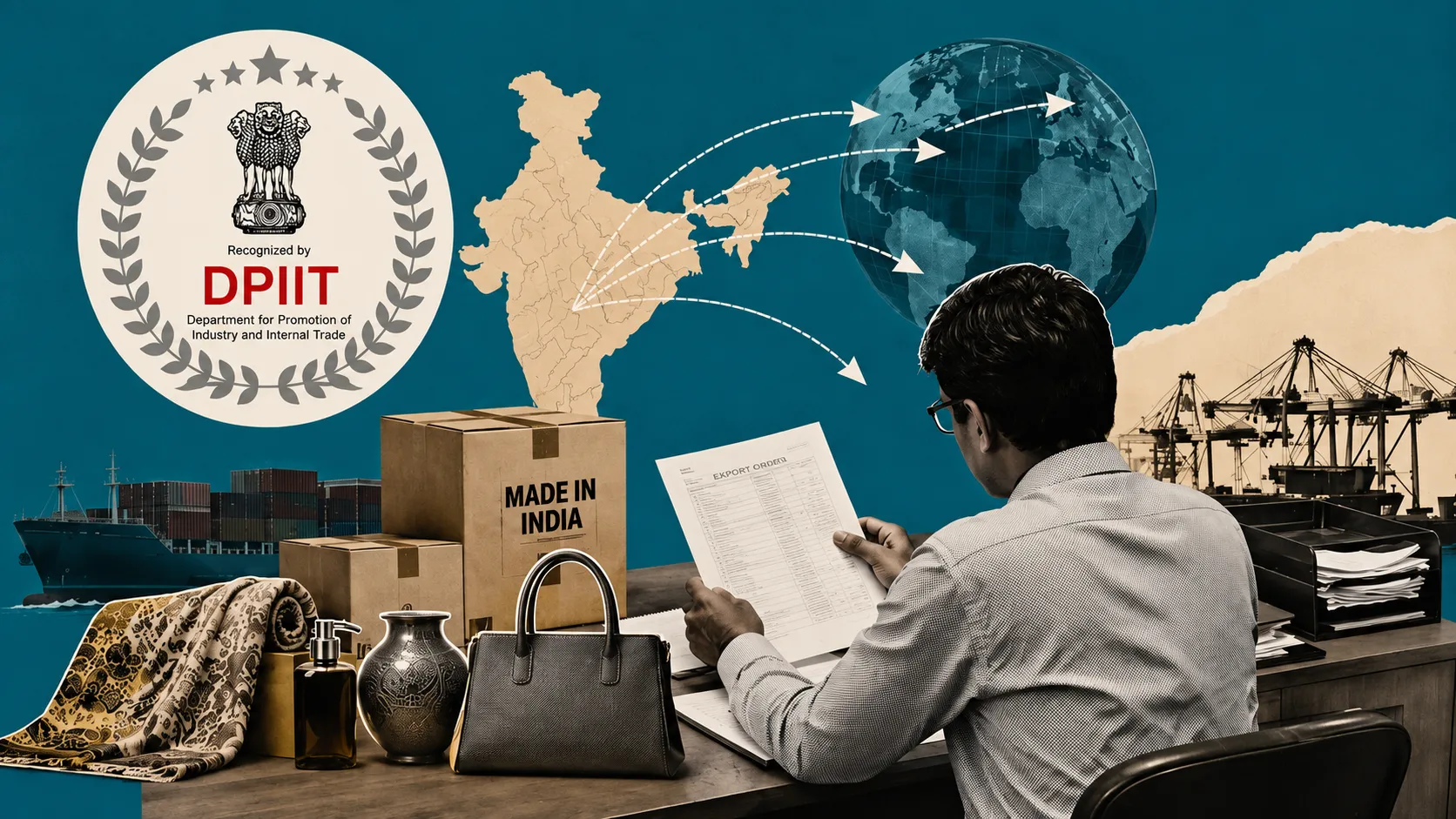
New Delhi, July 31, 2026 — In a policy shift that has drawn considerably less mainstream attention than its potential significance warrants, India's Department for Promotion of Industry and Internal Trade (DPIIT) has opened a carefully calibrated new door within the country's notoriously restrictive foreign direct investment framework for e-commerce. Under Press Note 3 of 2026, issued in the final week of July, foreign-funded e-commerce companies are now permitted to operate inventory-based business models — that is, models in which the platform itself owns and directly sells goods to consumers — but exclusively when those goods are manufactured or produced in India and are being sold for export to international markets.
This is, by design, a narrow and precisely targeted liberalisation rather than a broad opening of India's e-commerce sector to foreign-owned inventory-based retail. The long-standing restriction preventing foreign-invested e-commerce platforms from owning inventory for domestic sale to Indian consumers remains firmly in place, continuing to protect India's vast ecosystem of small and medium domestic retailers from what policymakers have historically viewed as potentially disruptive foreign-owned inventory-led competition. What has changed is a specific, carefully bounded exception: when the goods in question are Indian-made and destined for export rather than domestic sale, foreign e-commerce platforms can now own that inventory directly.

The legal mechanics of the change
The amendment operates through a targeted insertion into India's Consolidated FDI Policy, permitting an e-commerce entity to engage in an inventory-based model of e-commerce exclusively for the export of goods or products manufactured or produced in India, in accordance with the country's Foreign Trade Policy 2023, its associated Handbook of Procedures, and the Foreign Exchange Management (Export of Goods and Services) Regulations of 2015. Critically, the notification explicitly clarifies that the existing restrictions on both the inventory-based model generally and business-to-consumer e-commerce specifically continue to apply in full for any goods intended for the domestic Indian market — the new provision applies solely and exclusively to the export channel.
This surgical precision in how the exemption has been drafted reflects a deliberate policy balancing act: DPIIT officials have framed the change explicitly in terms of facilitating greater exports through easier and increased access to global markets for Indian sellers, rather than as any broader relaxation of India's historically protective stance toward foreign ownership within its domestic retail sector — a sector that remains politically sensitive given the scale of employment generated by India's traditional retail trade ecosystem, encompassing millions of small shopkeepers and traders whose interests have consistently shaped India's e-commerce FDI policy since the sector's regulatory framework was first established.
Who stands to benefit
The most immediate and obvious beneficiaries of this policy change are the large, foreign-invested e-commerce platforms already operating extensively in India, chief among them Amazon and Walmart-owned Flipkart, both of which have reportedly lobbied for exactly this kind of export-focused carve-out for an extended period. These platforms, which already maintain substantial operational infrastructure, logistics networks and seller relationships within India, are now positioned to build dedicated, inventory-owned export operations specifically designed to source India-made products and channel them into international markets through their existing global e-commerce platforms and customer bases spanning the United States, Europe and other major consumer markets.
Amazon has, according to industry reporting, articulated an ambitious target of reaching as much as $80 billion in cumulative India-origin export sales through its platform by 2030, a goal that this specific policy change should meaningfully support by allowing the company greater operational control over sourcing, inventory management and quality assurance for export-bound Indian products, compared to the more constrained marketplace-only model under which it had previously been required to operate for all categories of e-commerce activity within India, including exports.
Beyond the large multinational platforms themselves, Indian manufacturers and exporters across categories including handicrafts, garments, gems and jewellery, and various other consumer goods categories with genuine export market potential stand to benefit from what the policy change effectively represents: an expanded, more efficient sales channel to reach international buyers, backed by the substantial marketing reach, logistics capability and customer trust that established global e-commerce platforms bring to bear, compared to the more limited reach many individual Indian exporters, particularly smaller manufacturers, have historically been able to achieve independently in accessing international consumer markets directly.
The compliance challenge
Even as the policy change has been broadly welcomed by industry, trade policy analysts have flagged a genuine practical implementation challenge: enforcing a clean, verifiable separation between export-destined inventory, now eligible for foreign ownership, and domestically-sold inventory, which remains subject to the existing foreign ownership restrictions. The Global Trade Research Initiative (GTRI), a prominent trade policy think tank, has specifically characterised this bright-line distinction as difficult to monitor in practice, raising legitimate questions about how effectively Indian regulators will be able to verify, on an ongoing basis, that inventory nominally designated for export genuinely reaches international markets rather than being diverted, in whole or in part, into India's domestic retail market in circumvention of the continuing restrictions on foreign-owned domestic inventory sales.
This compliance and enforcement challenge will likely fall substantially to customs and foreign exchange regulatory authorities, who will need to develop robust verification mechanisms — potentially including detailed shipment tracking, export documentation requirements, and periodic compliance audits — to ensure the export-only exemption is not exploited as a backdoor mechanism for foreign platforms to effectively operate inventory-based domestic retail in violation of the policy's core restrictive intent. How effectively these enforcement mechanisms are designed and implemented will likely determine whether this reform achieves its intended export-promotion objective without inadvertently undermining the broader domestic retail protection framework that Indian policymakers have consistently sought to preserve across successive iterations of e-commerce FDI policy.
The timing: trade talks and export ambitions converge
The timing of this policy change is not coincidental. It arrives even as India and the United States continue working through their own unresolved bilateral trade negotiations, and as the Indian government has articulated ambitious longer-term targets for overall e-commerce-facilitated export growth — reportedly aiming for total e-commerce exports in the range of $200 billion to $300 billion by 2030, a figure India currently falls well short of by a considerable margin. Against this backdrop, easing the specific regulatory friction that had previously constrained large e-commerce platforms' ability to build dedicated, efficient export-focused operations represents a relatively low-cost, targeted policy lever for the government to pull in pursuit of its broader export growth ambitions, compared to the more complex and politically fraught terrain of broader bilateral tariff negotiations.
What happens next
For affected e-commerce platforms, the practical work of building out compliant, export-focused inventory-based operations under the new policy framework is likely to unfold gradually over the coming months, as companies work through the operational, logistics and compliance infrastructure required to take advantage of the new provision while remaining clearly within its defined boundaries. Indian exporters and manufacturer associations, meanwhile, are likely to closely monitor how effectively this new channel translates into genuinely improved export market access and sales volumes over the coming fiscal year — the ultimate test of whether this carefully calibrated policy change delivers the kind of tangible export growth benefit that its drafters at DPIIT have explicitly identified as its core policy objective.
Comparing this reform to India's broader e-commerce FDI journey
India's e-commerce FDI policy has evolved through several distinct phases since the sector first began attracting significant foreign investment in the early 2010s. Early policy iterations permitted 100% FDI under the automatic route for the marketplace model of e-commerce, in which the platform functions purely as a facilitator connecting third-party sellers with consumers, while maintaining a firm prohibition on FDI in the inventory-based model, reflecting policymakers' consistent concern about protecting India's vast network of small domestic retailers from potentially disruptive foreign-owned inventory-led competition.
This most recent export-focused carve-out represents the first meaningful exception to that longstanding inventory-model prohibition, and its careful, narrowly bounded design — limited exclusively to export-destined goods rather than any broader relaxation — suggests policymakers remain committed to preserving the core protective logic of the original framework even while creating targeted flexibility where doing so serves a clearly identified national economic interest, in this case, export promotion, without meaningfully compromising the underlying policy objective of shielding domestic retail from foreign-owned inventory competition.
Sector-specific opportunities beyond the obvious players
While large horizontal e-commerce platforms like Amazon and Flipkart represent the most obvious beneficiaries of this policy change, sector analysts point to potentially significant opportunities for more specialised, category-focused export platforms as well, particularly within categories where India has strong manufacturing capability and growing international demand, including handwoven textiles, artisanal handicrafts, and specialty food products. Smaller, specialised e-commerce platforms focused specifically on facilitating exports within these niche categories may find this policy change opens a previously unavailable operating model, potentially attracting fresh foreign investment interest into what has historically been a comparatively under-capitalised segment of India's broader export ecosystem, even as the largest horizontal platforms are likely to capture the bulk of near-term volume growth given their existing scale and international market reach.
Logistics and fulfilment implications
Beyond the FDI policy mechanics themselves, the practical execution of export-focused inventory-based e-commerce depends heavily on efficient cross-border logistics and fulfilment infrastructure — an area where India has historically faced meaningful bottlenecks compared to more established global export hubs. Platforms seeking to build out compliant, inventory-owned export operations under the new policy framework will need to invest significantly in warehousing, quality control and international shipping logistics specifically calibrated for export markets, a capital and operational commitment that may favour the largest, most well-resourced platforms in the near term, even as growing interest in dedicated export-logistics infrastructure across India's major ports and logistics hubs could, over time, help lower these barriers for a broader range of participants seeking to take advantage of the new export-focused inventory ownership provision.
How this compares internationally
India's carefully bounded approach to liberalising e-commerce FDI specifically for exports offers an interesting point of comparison against how other major economies have historically regulated foreign ownership within their own e-commerce and retail sectors. Several countries maintain considerably more liberal foreign ownership rules for e-commerce generally, having concluded that the benefits of foreign capital and operational expertise in retail outweigh the protective case for restricting foreign-owned inventory models. India's continued insistence on preserving restrictions for domestic-facing e-commerce, even while carving out this specific export exception, reflects a policy philosophy that treats protection of domestic small retailers as a distinct and higher-priority objective than pure economic efficiency or foreign capital attraction — a stance that has remained broadly consistent across successive Indian governments over the past decade and a half, even as the specific mechanics of e-commerce FDI policy have been periodically refined.

Small exporter access and inclusion concerns
A further dimension worth watching as this policy is implemented concerns how effectively its benefits reach India's smaller, less digitally sophisticated manufacturers and artisans, as opposed to being captured predominantly by larger, already export-oriented manufacturing businesses with existing relationships to major e-commerce platforms. Industry bodies representing smaller manufacturers and traditional craft-based export categories have called for complementary government support measures — including digital onboarding assistance, quality certification support and working capital access — to ensure that this new export channel genuinely broadens participation in India's export economy, rather than simply providing an incremental efficiency gain for exporters who were already well-positioned to access international markets through other channels prior to this specific policy change.
The bottom line for India's export ambitions
Ultimately, this DPIIT reform represents one incremental, carefully targeted piece within India's much broader and more complex export promotion strategy, sitting alongside the ongoing India-US trade negotiations, various sector-specific export incentive schemes, and continued infrastructure investment aimed at improving the country's overall trade competitiveness. Its ultimate success will be measured not by the elegance of its regulatory drafting, but by whether it produces a measurable, sustained increase in India-origin export volumes flowing through e-commerce channels over the coming several years — a test that will only become clear as implementation data accumulates over subsequent reporting periods.


