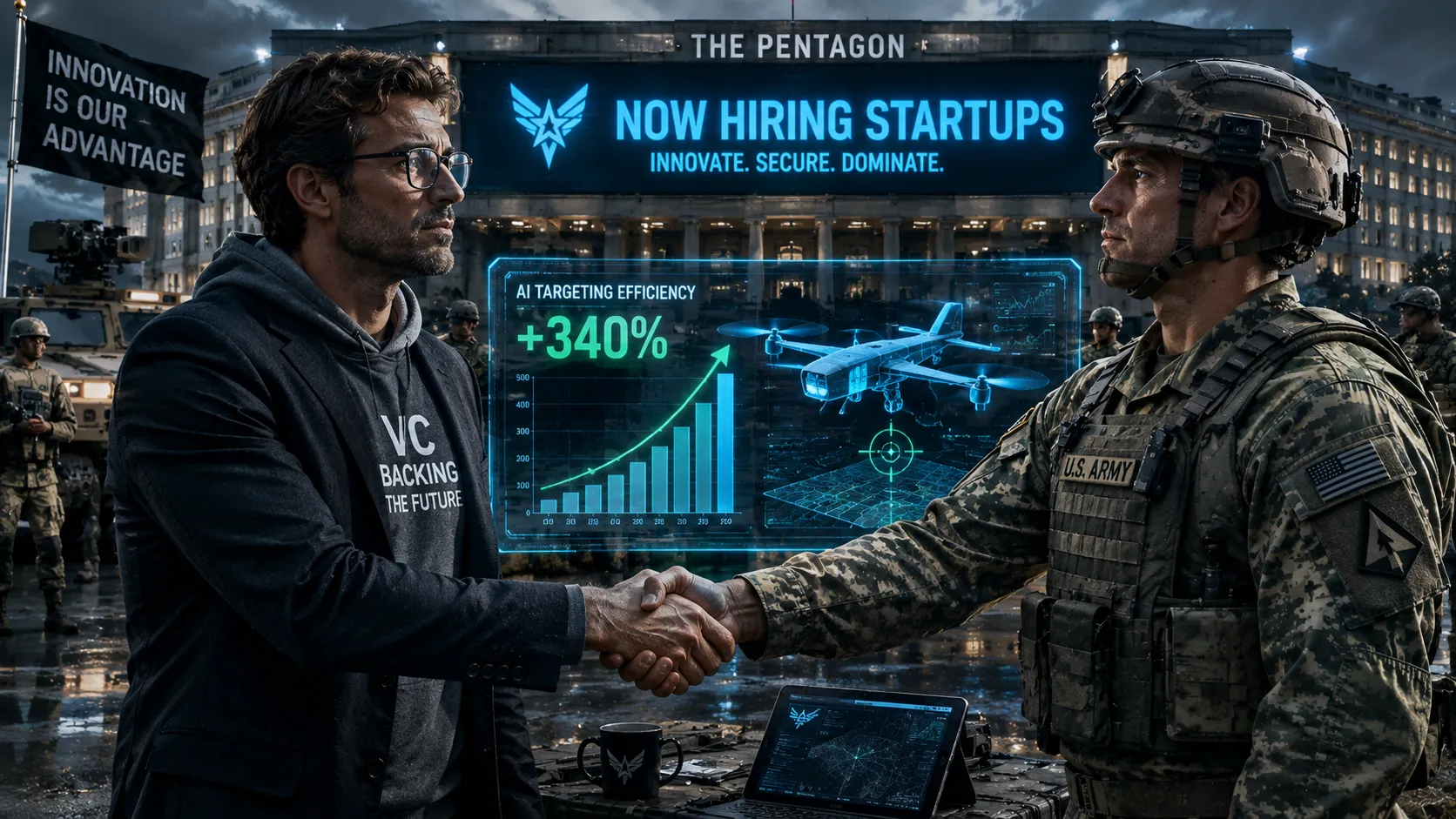
DEFENSE TECH GOES MAINSTREAM
Why VCs are no longer afraid of the Pentagon – and how a new generation of startups is building weapons for the 21st century
WASHINGTON, D.C. – For decades, there was an unwritten rule in Silicon Valley: don't do defense.
The Pentagon was slow, bureaucratic, and morally suspect. Top engineers wanted to change the world with social media and self‑driving cars, not missiles and drones. Venture capitalists who funded weapons makers were seen as pariahs.
That rule has been incinerated.
Over the past three years, defense tech has gone from taboo to table stakes. A new generation of founders – many of them veterans, many of them AI engineers, and many of them simply fed up with building advertising algorithms – is pouring into the sector. And VCs are following with checkbooks wide open.
The numbers are staggering. According to PitchBook, defense tech startups raised $45 billion in 2025 – up 300% from 2021. The number of active defense tech VC funds has quadrupled. And the poster child, Anduril, is preparing a $1.5 billion round at a $10 billion valuation.
"The stigma is gone," says Trae Stephens, co‑founder of Anduril and a partner at Founders Fund. "We realized that the world is dangerous, that technology is changing warfare, and that the old defense contractors cannot keep up. Somebody has to build the future. It might as well be us."
The Old Guard vs. The New Breed
To understand the defense tech boom, you have to understand what came before.
The traditional defense industry – Lockheed Martin, Raytheon, Boeing, Northrop Grumman – is built on a model of cost‑plus contracts. The government pays for development, plus a guaranteed profit margin. There is little incentive to be fast, cheap, or innovative. A new fighter jet takes 20 years and $100 billion. A new missile system takes a decade.
The new breed of defense startups is doing the opposite. They build commercial‑off‑the‑shelf technology – drones, sensors, AI – and adapt it for military use. They move in months, not decades. They charge fixed prices, not cost‑plus. And they are eating the incumbents' lunch.
"The old contractors are like mainframe computers," says Shannon Clark, a partner at Lux Capital who focuses on defense. "The new startups are like iPhones. They are faster, cheaper, and more adaptable. The Pentagon is finally realizing that."
The Big Three: Anduril, Shield AI, and Palantir
While dozens of startups are entering the defense space, three stand out as the market leaders.
1. Anduril (Costa Mesa, California) – The AI Defense Giant
Anduril, founded by Palmer Luckey (Oculus VR) and a team of former Palantir executives, builds autonomous systems for border security, base defense, and counter‑drone operations. Its signature product is the Lattice AI platform, which fuses data from thousands of sensors – cameras, radars, drones – into a single, real‑time battlefield picture.
The company has won major contracts with U.S. Customs and Border Protection, the Marine Corps, and the Air Force. Its drones have been deployed along the southern border and in the Middle East.
"We are not building weapons to kill people," says Luckey, in a rare interview. "We are building sensors to see the battlefield, drones to patrol without risking lives, and AI to make split‑second decisions. The goal is to deter conflict, not start it."
Anduril is now preparing a massive Series G round, expected to close this summer at a $10 billion valuation – up from $8 billion in 2024. The company is also rumored to be considering an IPO in 2027.
2. Shield AI (San Diego) – The Autonomous Flight Leader
Shield AI builds Hivemind – an AI pilot that can fly any aircraft, from quadcopters to F‑16s, without GPS, communications, or human intervention. The company's drones have been used in special operations missions in Ukraine and the Middle East.
"We are building the brains for the future of flight," says Brandon Tseng, Shield AI's co‑founder and a former Navy SEAL. "The pilot of the future is software. That software can be in a $500 drone or a $50 million fighter jet. The architecture is the same."
Shield AI recently raised a $200 million Series E at a $2.7 billion valuation, led by US Innovative Technology Fund. The company is profitable and expects to triple revenue in 2026.
3. Palantir (Denver) – The Veteran Turned Mainstream
Palantir is not a startup – it went public in 2020 – but it is the godfather of defense tech. The company's software platforms, Gotham (for government) and Foundry (for commercial), are used by every branch of the U.S. military, as well as allies in NATO and Ukraine.
Palantir's stock has soared 400% since 2023, making it one of the most valuable defense tech companies in the world. The company is now pivoting to AI‑powered targeting and autonomous mission planning.
"The old way was to collect data for months, then analyze it for weeks, then make a decision," says Shyam Sankar, Palantir's CTO. "Our way is to fuse every sensor, every satellite, every human report – in real time – and give a commander a clear answer. That is the difference between winning and losing."
The Newcomers: HawkEye 360, Epirus, and Saronic
Beyond the giants, a second wave of startups is attacking specific niches.
HawkEye 360 (Herndon, Virginia) uses a constellation of small satellites to detect radio frequency emissions anywhere on Earth – from illegal fishing vessels to jamming devices to enemy radar. The company just won a $150 million contract from the Space Force.
Epirus (Torrance, California) builds directed energy weapons – essentially, microwave cannons that can disable drone swarms without firing a bullet. The company has raised over $300 million and is now in production for the Army.
Saronic (Austin, Texas) builds autonomous surface vessels – robotic boats that can patrol harbors, hunt mines, and even launch missiles. The company emerged from stealth with a $100 million Series B and is already being compared to Anduril.
"Defense tech is not a monolith," says Raj Shah, a partner at Shield Capital and a former Air Force intelligence officer. "There are dozens of sub‑verticals – space, cyber, autonomous ground vehicles, directed energy, electronic warfare. Each one is a multi‑billion‑dollar opportunity."
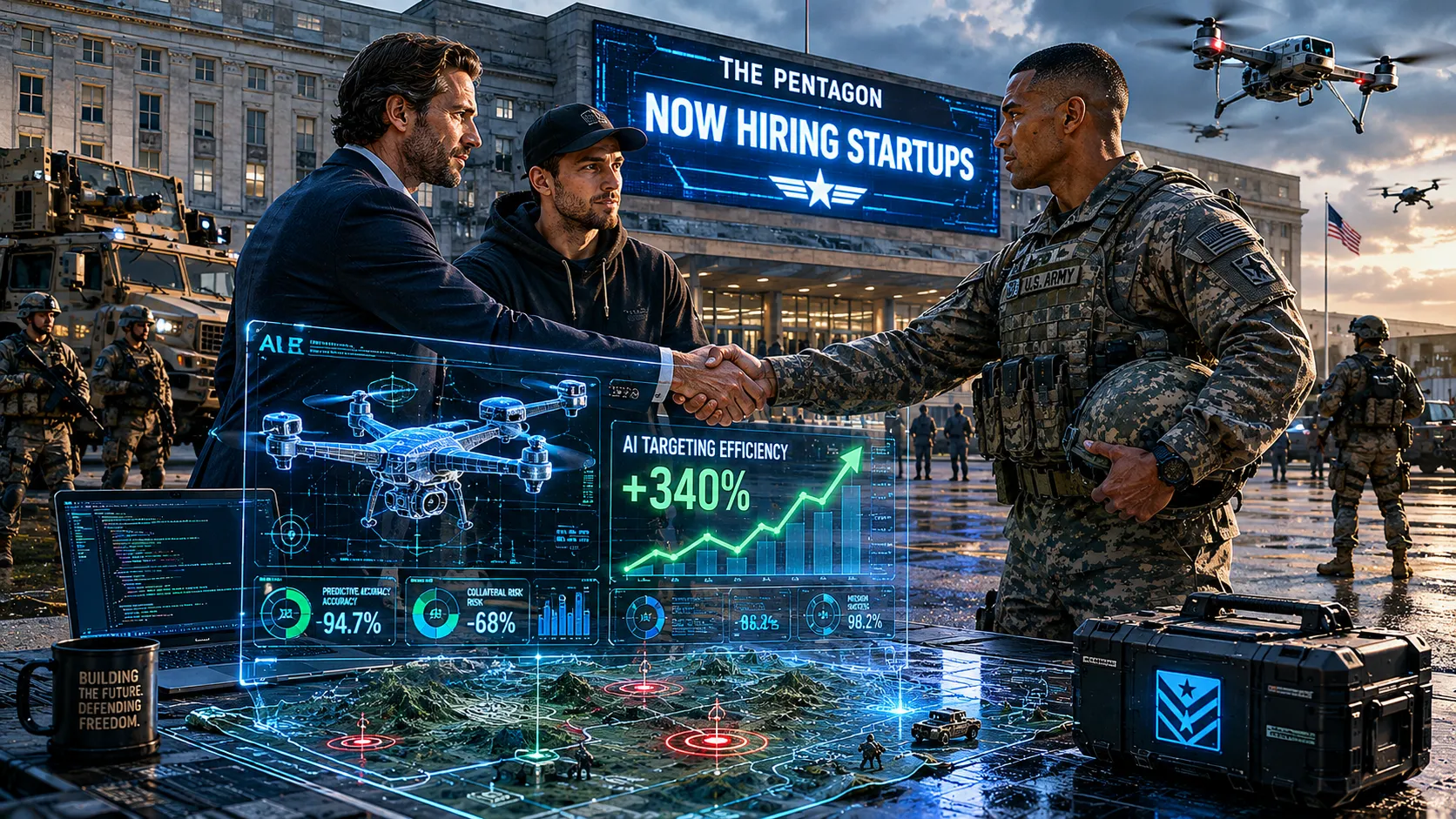
The Pentagon Wakes Up: Acquisition Reform
The defense tech boom would not be possible without a parallel shift inside the Pentagon.
For decades, the Department of Defense's acquisition process was a nightmare for startups. Multi‑year contracts, endless paperwork, security clearances, and the infamous DFARS (Defense Federal Acquisition Regulation Supplement) made it nearly impossible for a small company to sell to the military.
That is changing. The Pentagon has launched several initiatives to streamline procurement:
DIU (Defense Innovation Unit): A small organization that fast‑tracks commercial tech for military use. DIU contracts can be awarded in months, not years.
AFWERX (Air Force): A similar program focused on the Air Force, with over $1 billion in contracts awarded to startups.
SOFWERX (Special Operations): The most agile of all, with decisions made in weeks.
"The Pentagon has realized that if they do not buy from startups, the Chinese will," says Michael Brown, former director of DIU and now a partner at Shield Capital. "The acquisition system is still broken, but it is better than it was. And it is getting better every year."
The Moral Debate: Should VCs Fund Weapons?
Despite the boom, defense tech remains controversial. Many venture capitalists – especially those with ESG mandates or impact funds – refuse to invest in weapons makers. Some universities restrict defense research. And some employees walk out in protest.
"The question is not whether defense tech is moral," says Alex Karp, CEO of Palantir. "The question is whether you prefer that the technology be built by democratic societies with civilian oversight, or by autocracies without it. I know my answer."
Others disagree. Pranav Rastogi, a former VC who now runs a climate fund, says: "I cannot justify funding a missile that might kill a civilian, no matter how efficient the AI. There are plenty of ways to make money that do not involve weaponry."
The debate is unlikely to be resolved. But for now, the money is flowing. And the founders are not apologizing.
The Bottom Line: A New Military‑Industrial Complex
The old military‑industrial complex – Lockheed, Boeing, Raytheon – is not going away. But it is being joined by a new one: faster, cheaper, more agile, and built on software and AI, not steel and aluminum.
Anduril, Shield AI, Palantir, and dozens of smaller startups are proving that you can build cutting‑edge defense technology without a 20‑year development cycle. They are attracting top talent from Silicon Valley, top money from venture capital, and top customers from the Pentagon.
"The defense tech moment is real," says Anduril's Stephens. "And it is just beginning. The wars of the future will be won by software, autonomy, and speed. That is what we are building. And we are building it right here, right now."
In the new defense establishment, the uniform is a hoodie. The weapon is an algorithm. And the battlefield is anywhere with an internet connection.


