SEO Title: Deepinder Goyal's Temple Doubles Valuation To $375 Million, Launches ESOP Liquidity Programme
Meta Description: Healthtech startup Temple, founded by Deepinder Goyal, has doubled its valuation to $375 million and launched its first employee stock ownership liquidity programme.
---
There is a particular kind of milestone in a startup's life that rarely makes for a splashy funding announcement, yet often matters more to the people actually building the company than any headline valuation figure: the moment early employees get to convert paper wealth into something they can actually spend. Temple, the wearable health technology startup founded by Deepinder Goyal after he stepped down as CEO of Eternal, has just reached that moment — and the manner in which it got there tells a broader story about where India's startup ecosystem is placing its bets, and how it is choosing to treat the people building those bets from the inside.
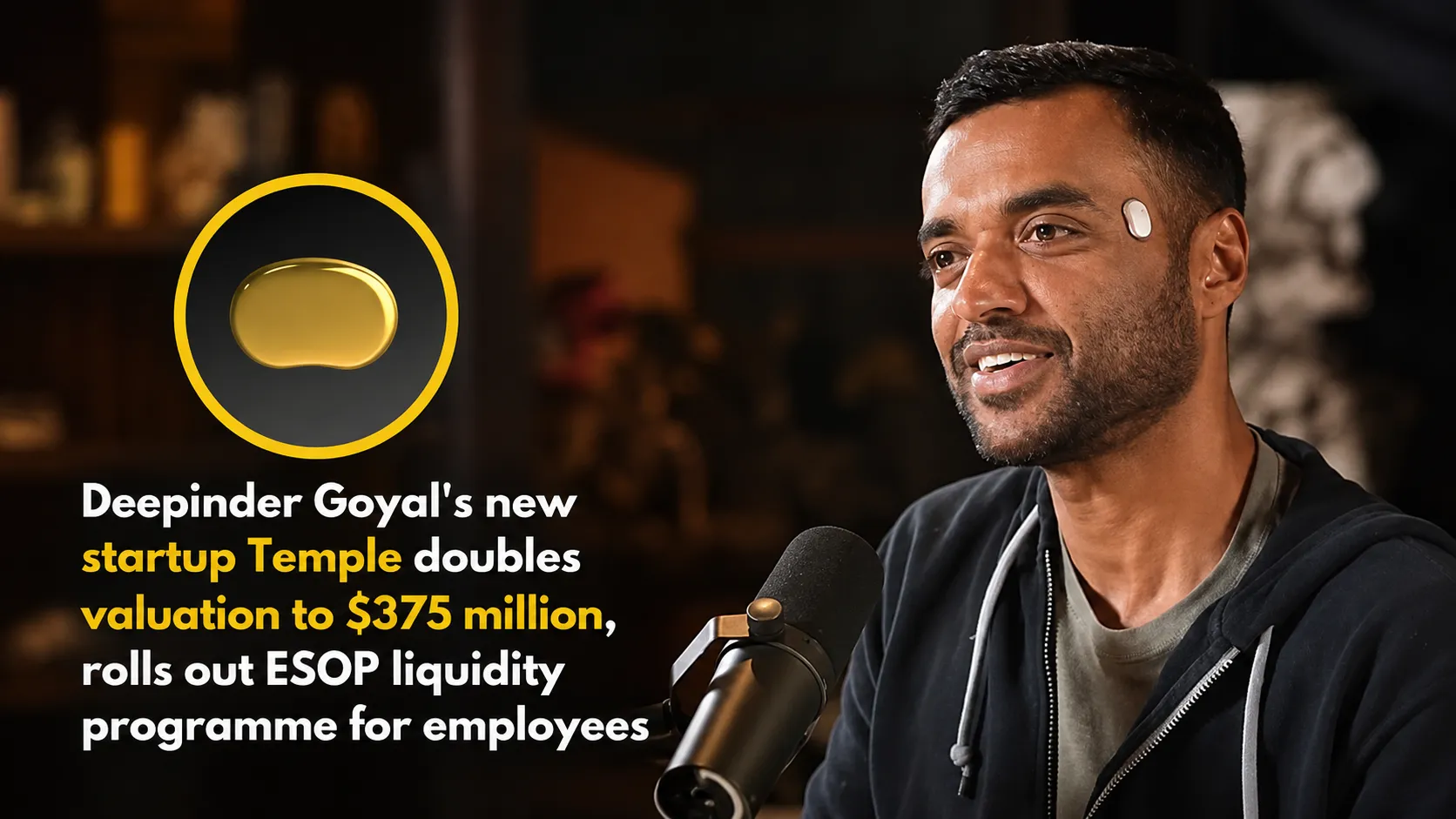
Temple has nearly doubled its valuation to $375 million following a secondary share transaction, and has simultaneously launched its first employee stock ownership plan (ESOP) liquidity programme, allowing select early employees to sell a portion of their vested stock options. The valuation jump comes just months after Temple raised $54 million in a seed round announced in February 2026, at which point the company was valued at approximately $190 million — meaning its implied worth has grown by roughly 97% in under six months, a pace that, even by the standards of India's fastest-moving startup sectors, stands out.
What Temple Is Actually Building
Temple is developing a lightweight wearable device designed to be worn on the side of the forehead, positioned by the company as a "precision instrument" that measures what it describes as "Entropy" — a metric intended to capture the metabolic and sympathetic demands being placed on the human body in real time. It is worth being clear that these are claims and framings made by Temple itself about its own product; the device is currently available only through an early-access programme, and the startup has not yet launched commercially, with that broader rollout expected within the next year, subject to continued product validation and development.
The healthtech and wellness wearable category Temple is entering has become an increasingly crowded and closely watched segment globally, driven by consumer interest in continuous, passive health monitoring that goes beyond the step-counting and heart-rate tracking offered by mainstream smartwatches. Temple's specific bet — that there is a meaningful, differentiated product opportunity in measuring metabolic and stress-related physiological signals through a forehead-worn form factor, rather than the wrist-worn devices that dominate the category — represents a genuinely novel hardware and sensor design choice, one that carries both the upside of potential differentiation and the downside risk that comes with pursuing a less-proven product form factor.
Inside The ESOP Liquidity Programme
According to an internal memo reviewed by Moneycontrol, approximately 20 of Temple's estimated 200 to 220 employees are eligible to sell up to 25% of their vested employee stock options under the new liquidity programme, with participation entirely optional for those who qualify. The programme values the company at the same $375 million figure established through the underlying secondary transaction — notably a higher valuation than the level at which many early-stage ESOP liquidity events are typically priced, since such programmes are often conducted at a discount to a company's last formal funding round valuation, reflecting the illiquidity and uncertainty premium usually associated with private company shares outside of a full financing round.
"Before we close our next round, I want some of this value to reach the people who created it," Goyal reportedly wrote in the internal memo, according to the Moneycontrol report. In a separate comment on the programme, Goyal was quoted as saying employees would have the option to sell up to 25% of their vested ESOPs at the $375 million valuation, while emphasising that "this is completely optional" — language that underscores an intent to give employees genuine choice about their own financial decisions rather than pressuring participation in the liquidity event.
The memo reportedly also referenced interest from outside investors at a valuation of $500 million as Temple considers a further funding round, suggesting the current $375 million secondary transaction — and the associated employee liquidity event — may function partly as an interim milestone ahead of an even larger valuation step-up in Temple's next formal capital raise, rather than representing the company's near-term ceiling.
Why ESOP Liquidity Events Are Becoming More Common In India
Temple's move fits within a broader and increasingly visible pattern across India's startup ecosystem in 2026. According to data compiled by Entrackr, nine startups had collectively bought back ESOPs worth more than $270 million so far this year, including companies such as BrowserStack, Innovaccer, CoinDCX, Unacademy, Tractor Junction, Emversity, Cashfree Payments, Plum and Kratikal. Travel fintech startup Scapia separately announced an ESOP buyback worth ₹20 crore.
This proliferation of employee liquidity events reflects a maturing recognition within India's startup ecosystem of a structural problem that has persisted for years: employee stock options are only valuable to the extent an employee can eventually convert them into cash, and for a private, unlisted company, that conversion has traditionally required waiting for either an IPO or an acquisition — events that can take a decade or more to materialise, if they happen at all. For a talented engineer or product manager choosing between a startup offering equity-heavy compensation and a larger, more established company offering higher guaranteed cash pay, the promise of eventual equity value has historically been discounted heavily precisely because of that liquidity uncertainty.
ESOP liquidity programmes, by allowing employees to realise a portion of that value years before any eventual exit event, directly address that discount — making equity-heavy compensation packages meaningfully more attractive to the experienced talent that competitive startups need to recruit and retain, particularly as India's startup ecosystem competes not just against other domestic startups but increasingly against large technology companies and, in some cases, opportunities abroad that offer more straightforward cash compensation.
Temple's Backing And What It Signals
Temple has attracted funding and backing from a notably prominent set of investors and individuals, including Peak XV Partners, Steadview Capital, and Vy Capital among institutional backers, alongside prominent angel investors including Paytm founder Vijay Shekhar Sharma and CRED founder Kunal Shah. That investor roster — a mix of established venture funds with strong track records in Indian consumer and technology investing, alongside individual angels who are themselves highly successful founders — suggests a level of insider confidence in Goyal's ability to build a second major company, following his prior track record at Eternal (formerly Zomato).