DiasporaLeaders5 MIN READ

Connecticut Makes History: Governor Lamont Signs India Trade Commission Into Law

State Senator Sujata Gadkar-Wilcox, Connecticut's first Indian-origin lawmaker, calls Senate Bill 132 ‘an important milestone’ for the state and its South Asian community

By Aravind Kumar · Author3 August 2026
Connecticut Makes History: Governor Lamont Signs India Trade Commission Into Law

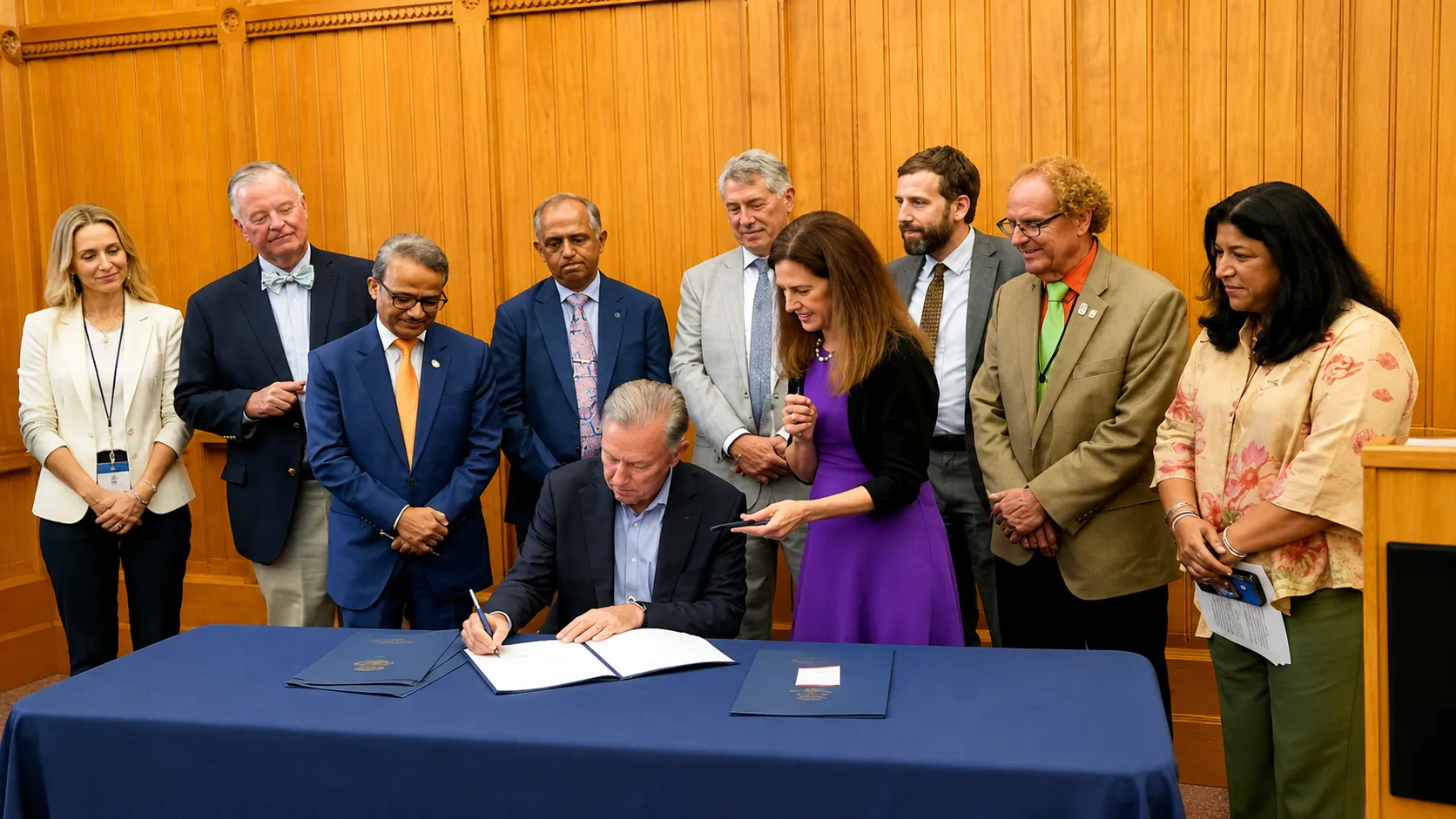
HARTFORD, CONN. — In a ceremony rich with symbolism and substance, Connecticut Governor Ned Lamont signed Senate Bill 132 into law at the State Capitol on July 30, formally establishing the Connecticut-India Trade Commission — a body that will shape the state's economic, educational and cultural relationship with India for years to come. News of the signing reverberated through the Indian American community over the first weekend of August, as diaspora organizations, elected officials and diplomats hailed it as one of the most consequential state-level moves for U.S.-India ties this year.

The bill, now codified as Public Act 26-78, creates a permanent commission tasked with promoting long-term collaboration between Connecticut and India across five pillars: trade, technology, higher education, infrastructure and the arts. Its membership will draw from a wide cross-section of stakeholders — legislative and gubernatorial appointees, representatives of the state's higher education institutions, chamber of commerce members, and, notably, leaders from Connecticut's Indian American community itself, ensuring the diaspora has a formal, structural voice in shaping the relationship rather than a purely ceremonial one.

At the center of the ceremony was State Senator Sujata Gadkar-Wilcox, who represents Connecticut's 22nd District and became, with this legislation, both the architect and the face of a policy moment two decades in the making for the state's South Asian community. A university professor by profession and the first Indian-origin senator ever to serve in Connecticut — as well as the first South Asian woman elected to the state Senate — Gadkar-Wilcox described the bill signing as a culmination of years of advocacy work inside and outside the statehouse.

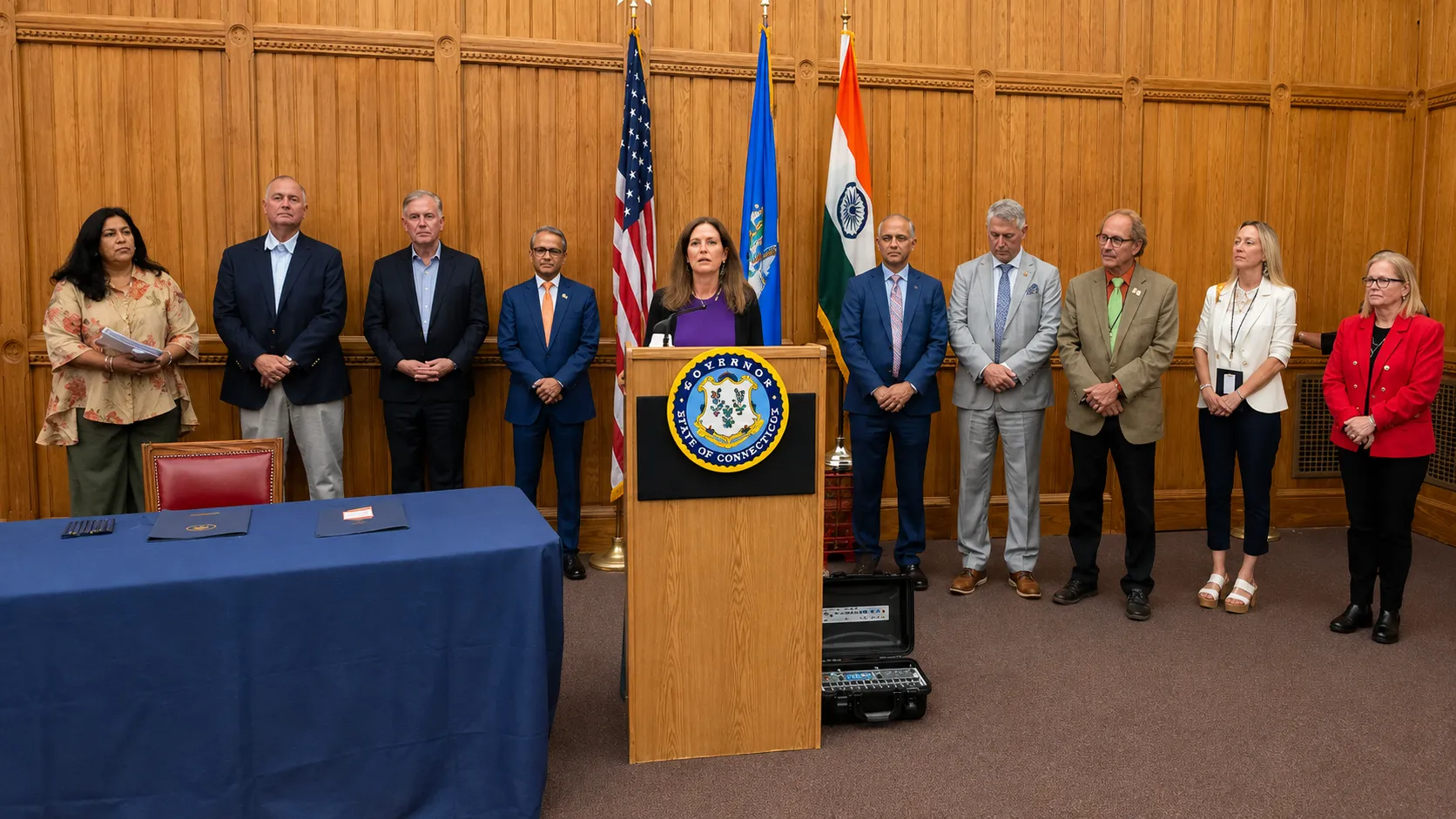
“I was honored to join Governor Lamont, Lt. Governor Susan Bysiewicz, the Consul General of India Ambassador Binaya Srikanta Pradhan, my good legislative colleagues, and members of Connecticut's South Asian community for the bill signing of Senate Bill 132, establishing the Connecticut-India Trade Commission and the launching of GOPIO's chamber of commerce,” Gadkar-Wilcox said following the ceremony.

The senator was careful to frame the commission's purpose beyond dollars and cents. “Senate Bill 132 is more than a trade policy,” she said in a video posted to Instagram documenting the signing. “It's a recognition of deep cultural, educational, social and business ties between the United States and India.” For a diaspora community that has often had to translate its economic contributions into political capital piecemeal — through individual campaign donations, community fundraisers, or informal advocacy — the creation of a standing, statutory commission represents something structurally different: an institutionalized channel through which Indian American voices in Connecticut can shape state policy on an ongoing basis.

Gadkar-Wilcox's own biography lent the ceremony added resonance. “As the daughter of Indian immigrants, this moment is especially meaningful,” she said. “This commission will strengthen our ties with India, one of the world's strongest and rising economies, in order to expand local economic opportunities for manufacturing, technology education, the arts, and green energy.” She added that the legislation “acknowledges the history and many contributions of the South Asian community across our state and creates new avenues for meaningful collaboration going forward.”

As the daughter of Indian immigrants, this moment is especially meaningful. This commission will strengthen our ties with India, one of the world's strongest and rising economies.
State Sen. Sujata Gadkar-Wilcox

image.png

The timing of the commission's creation is notable. It arrives at a moment when U.S.-India trade relations have been through a turbulent stretch — marked by tariff disputes, visa policy shifts and recalibrated diplomatic messaging over the past year — before settling into a period of relative stabilization earlier in 2026. Against that backdrop, state-level initiatives like Connecticut's offer a complementary, more insulated track for building economic ties: one less subject to the swings of federal trade policy and more rooted in durable institutional relationships between universities, chambers of commerce and local industry.

Reflecting on her own path to the Senate floor, Gadkar-Wilcox situated the achievement within a broader arc of representation. “I'm here not just as a senator from the 22nd District, but as the child of Indian immigrants and the first Indian senator ever to serve in Connecticut and the first South Asian woman in the Senate,” she said. “With this bill, we're signaling that Connecticut is open for meaningful collaborative enterprise and meaningful global partnerships that will enhance our local economy.”

For the broader Indian American community watching from outside Connecticut, the bill signing is being read as a potential template. State-level trade commissions focused on India have precedent in a handful of other states, but the explicit, statutory inclusion of Indian American community leaders as commission members — rather than merely consultative stakeholders — is being cited by diaspora advocacy groups as a meaningful structural upgrade worth replicating elsewhere.

The ceremony at the State Capitol was not staged as a solitary legislative event. It was deliberately paired with the launch of the Connecticut chapter of the Global Organization of People of Indian Origin (GOPIO) Chamber of Commerce and Industry, underscoring how closely intertwined the legislative and grassroots tracks of diaspora advocacy have become. Consul General Binaya Srikanta Pradhan, representing the Government of India, joined Gov. Lamont in inaugurating the chamber alongside GOPIO's national and international leadership — signaling that New Delhi, too, views these state-level commissions as a meaningful complement to federal-level diplomacy.

What happens next will determine whether Senate Bill 132 becomes a genuine engine of economic activity or remains a well-intentioned framework. The commission's first order of business, according to those familiar with its formation, will be identifying priority sectors — likely including advanced manufacturing, biotechnology, clean energy and higher-education partnerships — where Connecticut-based institutions and Indian counterparts can move quickly from memoranda of understanding to concrete investment and exchange programs.

For Connecticut's Indian American community — a population that has grown steadily over the past two decades through the technology, healthcare, higher-education and finance sectors clustered around Hartford, Stamford and New Haven — the commission is being described less as an endpoint and more as a beginning: formal recognition, at last, of a community whose economic and civic footprint in the state has long outpaced its representation in the rooms where policy gets made.

TagsConnecticut IndiaIndian Diaspora USASujata Gadkar-WilcoxNed LamontIndian AmericansTrade CommissionGOPIOUS India RelationsSouth Asian AmericaImpactful Global Indian

Reader reviews

Sign in to rate and review this article.
Loading reviews…

