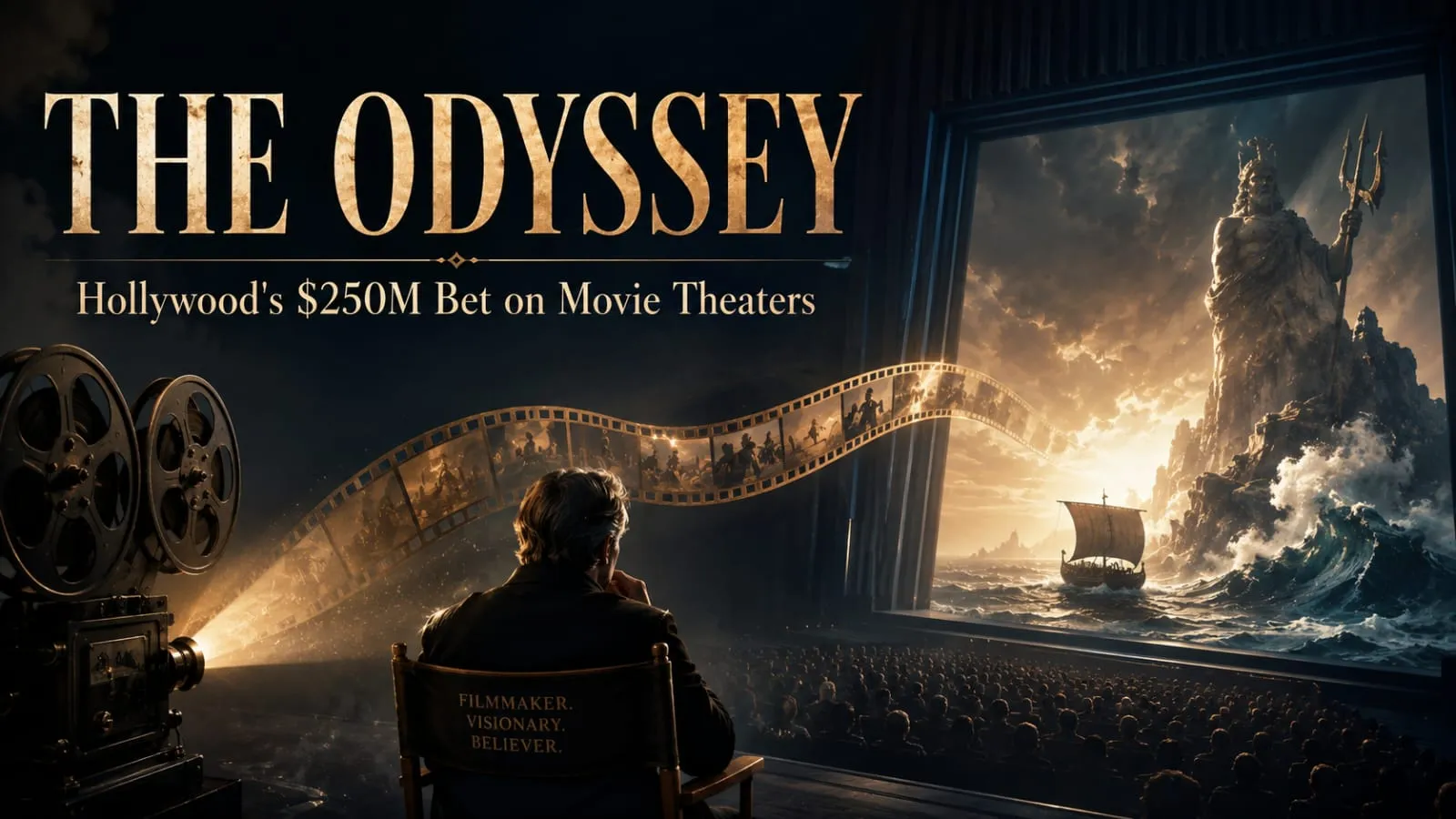
Christopher Nolan's The Odyssey: Hollywood's $250 Million Bet on the Future of the Movie Theater
On July 17, 2026, Christopher Nolan's The Odyssey will arrive in theaters. But the story of this film is not really about Odysseus. It is not even about Nolan, though he is its architect. This is a story about the future of an entire industry. At a moment when streaming services have trained audiences to expect new movies in their living rooms, Nolan and Universal Pictures are making a quiet but devastating argument: the movie theater is not dying. It just forgot how to be essential. And The Odyssey is their $250 million attempt to remind the world what only a cinema can deliver .
The One-Year-Out Ticket Sale That Changed Hollywood
On May 20, 2026, something unprecedented happened. Universal Pictures began selling tickets for The Odyssey — exactly one year before its release date . Not a week before. Not a month before. A full 365 days. For the first time in Hollywood history, tickets went on sale for a film that had not even finished shooting.
The offer was initially limited to a select few: only 16 IMAX 70mm theaters in the United States, six in Canada, two in the United Kingdom, one in Australia, and one in the Czech Republic . These are the venues equipped with the massive film projectors required to screen Nolan's preferred format. More locations are expected to be added as theaters upgrade their equipment over the coming months .
The business logic here is surgical. By putting tickets on sale a year out, Nolan and Universal are not just selling seats. They are making a statement: this is not a movie you decide to watch on a whim. This is an event you plan your calendar around. In an era of endless streaming choice, scarcity and anticipation have become the most valuable marketing currencies.
The $250 Million Question: Why This Film, Why Now?
The Odyssey carries a reported production budget of $250 million — the largest of Nolan's entire career . The film is described as "a mythic action epic shot across the world using brand new IMAX film technology," bringing Homer's ancient Greek poem to IMAX screens for the first time . The cast assembled for this ambition is staggering: Matt Damon, Tom Holland, Anne Hathaway, Zendaya, Lupita Nyong'o, Robert Pattinson, and Charlize Theron .
But the budget is only half the story. The other half is the bet behind it. Universal is gambling that audiences will not just watch The Odyssey — they will pilgrimage to see it. That audiences will pay premium prices. That they will drive past their multiplex to the one IMAX 70mm theater in their state. That they will choose a 15-minute preshow and a 3-hour runtime and uncomfortable stadium seating over their own couch.
This is not sentimentality. It is arithmetic. After Oppenheimer grossed nearly $1 billion worldwide — a three-hour black-and-white period drama about a physicist — Nolan proved that his name alone can fill seats . Oppenheimer did not have superheroes. It did not have a franchise. It had Nolan, and it had the promise of an experience that could not be replicated on a laptop. The lesson was not lost on Universal. They are now betting that same formula can scale to an epic poem about a wandering Greek king.
The IMAX Advantage: Why Format Is the Real Star
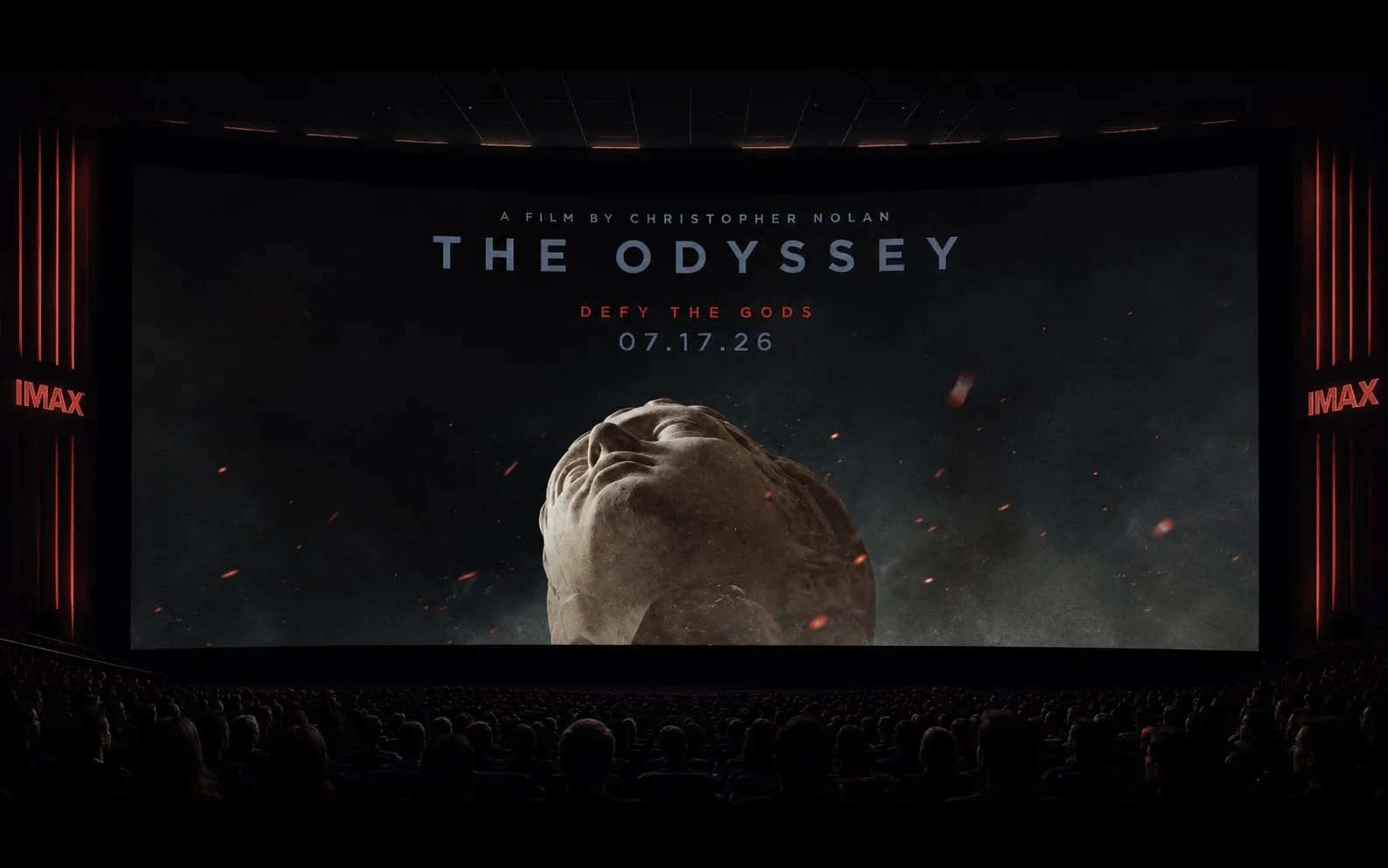
For Nolan, IMAX 70mm is not a gimmick. It is the lungs of the movie . The second trailer for The Odyssey, released on May 5, 2026, was cut entirely from IMAX 70mm footage — showcasing the scale, texture, and weight that only large-format film can capture . The footage favors "action that favors weight, speed, and physical consequence," shaped to bloom in the clarity of IMAX's towering screens .
The business case for IMAX is ruthlessly simple: premium screens generate premium revenue. IMAX tickets cost significantly more than standard admission. In 2026, when global cinema chains are struggling to maintain foot traffic against streaming, those higher margins are not a bonus — they are survival. According to market reports, the global movie theater market is projected to grow from $82.43 billion in 2025 to $86.2 billion in 2026, a CAGR of 4.6% , driven largely by premium format expansion .
But here is the tension that defines 2026. There are only 16 IMAX 70mm theaters in the United States . For The Odyssey to succeed, those screens must operate at capacity for weeks. And they must face down direct competition from Spider-Man: Brand New Day (July 31, 2026), which carries a $275 million production budget plus $200 million in marketing and is chasing a $1.3 billion global target . Two weeks apart. Two blockbusters. A limited number of premium screens. The result is not a box office battle. It is a screen war.
The Streaming Debate: Could The Odyssey Work on Netflix?
In early 2025, Netflix's Chief Content Officer Bela Bajaria made a provocative claim: Oppenheimer would have been just as successful if Netflix had released it . Her argument was that Netflix's 260 million subscribers, combined with a "qualifying theatrical run" and aggressive marketing, could have replicated the film's cultural impact without a traditional exclusive window.
It is a claim that Nolan himself would likely dispute. The director has been famously protective of theatrical exhibition , releasing Tenet in the middle of the COVID pandemic rather than send it to streaming . For Nolan, the cinema is not a distribution channel. It is the medium itself.
The debate matters because it frames the existential question of The Odyssey. If Netflix is right — if even a $1 billion phenomenon like Oppenheimer could have been a streaming hit — then Nolan's entire model is nostalgia, not strategy. But if The Odyssey succeeds on a scale that streaming cannot replicate, it will prove that theatrical exhibition still has a moat that Silicon Valley cannot cross. Premium spectacle. Shared experience. The ritual of leaving home. These are things Netflix cannot deliver, no matter how many subscribers it has.
The Year of the Screen Bottleneck
The Odyssey does not exist in a vacuum. It arrives in a year when the global film industry faces a structural crisis: a massive bottleneck for premium screens .
The numbers are stark. There are approximately 1,700 IMAX screens worldwide . That sounds substantial until you consider the number of $200 million-plus films scheduled for 2026. Dune: Part Three (December 18, 2026), with a $200 million budget , is aiming for a billion-dollar global run . Avengers: Doomsday carries a $400 million production budget plus $300 million in marketing — a $700 million hurdle before a single ticket is sold . And Ramayana, the Indian two-part epic with a combined budget exceeding ₹4,000 crore , is banking on international IMAX screens to reach its breakeven point because India itself has fewer than 30 IMAX theaters .
Every one of these films needs premium screens. There are not enough to go around. Release dates are being fought over like territory. Theaters are forced to choose which blockbuster gets the biggest auditorium. And audiences, faced with too many "must-see" films, may simply stay home.
Into this bottleneck steps The Odyssey. Its July 2026 release date — two weeks before Spider-Man — gives it a crucial head start. But if the film stumbles, the IMAX screens will not wait. They will pivot to the next $250 million spectacle .
What Success Looks Like
Industry analysts have projected The Odyssey to gross between $1.2 billion and $1.5 billion worldwide . This projection rests on several pillars: Nolan's post-Oscar prestige, the all-star cast, the universal recognition of Homer's story, and the promise of new IMAX technology . To reach those numbers, The Odyssey must perform not just in North America but globally — in China, in Europe, in markets where mythic epics have historically had mixed results.
But the real measure of success is not just box office. It is whether The Odyssey can do for 2026 what Oppenheimer did for 2023: convince a generation raised on streaming that the cinema is still the best place to watch a story. If it works, it will send a signal to every studio: invest in spectacle. Invest in IMAX. Invest in directors with vision. The streaming wars will not kill the movie theater. They will force it to become something better: indispensable.

The Final Frame
Christopher Nolan has spent his career making films that demand to be seen on the biggest screen possible. The Odyssey is the most extreme version of that philosophy. A $250 million epic shot with new IMAX technology, sold a year in advance, opening in a handful of premium theaters that can actually show it properly.
This is not a film. It is a stress test for the question that has haunted Hollywood for a decade: can cinemas still create must-watch events in the streaming era? If The Odyssey succeeds, it will prove that the answer is yes — and that Nolan, more than any other director, holds the blueprint. If it fails, it will be held up as proof that even the most ambitious theatrical evangelist cannot reverse the tide of habit.
On July 17, 2026, the world will find out. But the bet has already been placed. And the stakes have never been higher.


