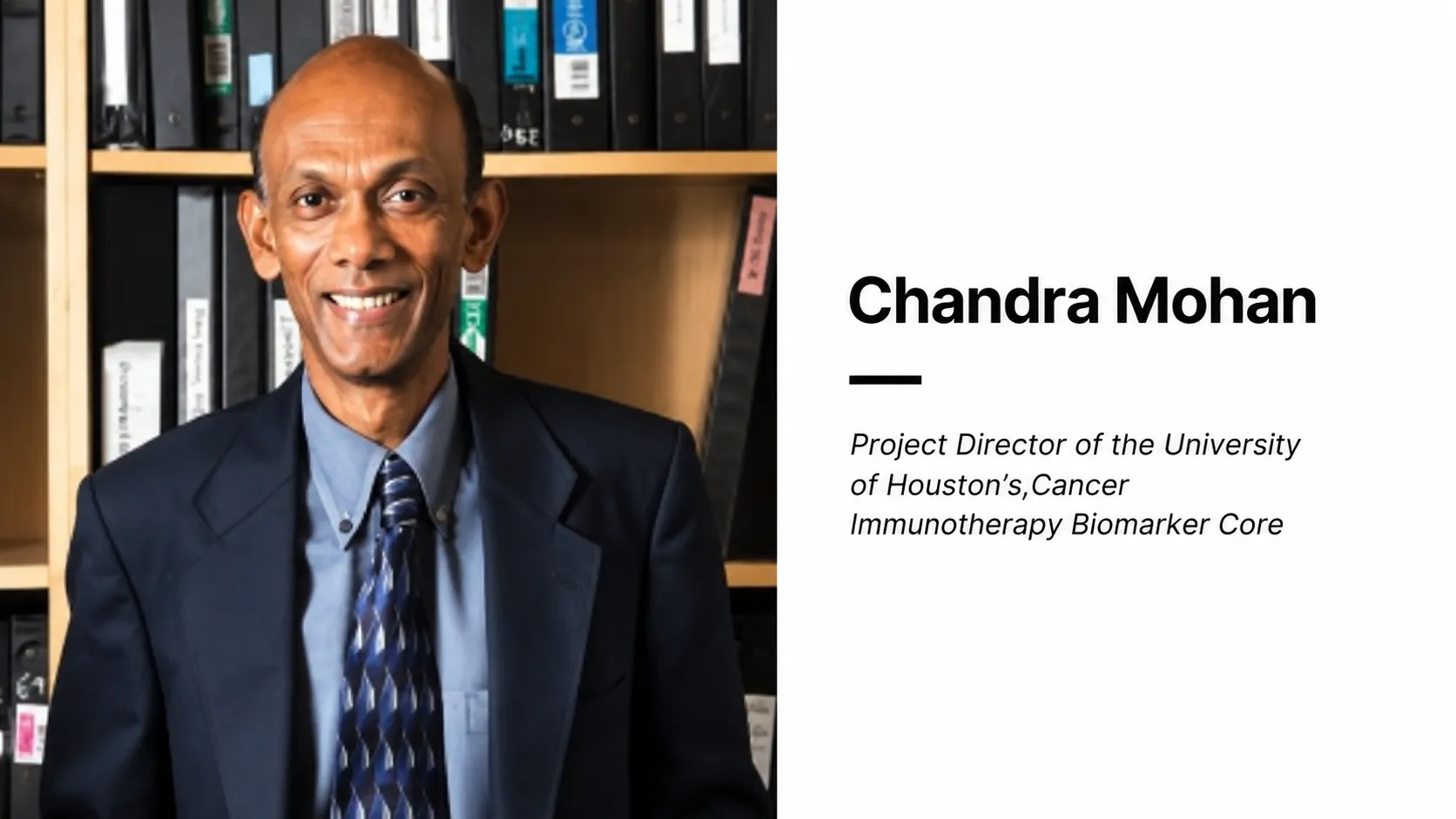
By the time most patients with lupus, rheumatoid arthritis, or related autoimmune conditions receive a diagnosis, the disease has typically already done lasting damage — organ inflammation, tissue scarring, and irreversible harm accumulated silently in what researchers call the “pre-disease” phase, long before symptoms become severe enough to bring a patient into a doctor's office. A newly funded, decade-long research initiative led by an Indian American bioengineer at the University of Houston aims to change that timeline entirely.
Chandra Mohan, the Hugh Roy and Lillie Cranz Cullen Endowed Professor of Biomedical Engineering at the University of Houston, has secured a $4 million grant from the National Institutes of Health to launch a longitudinal study identifying the earliest biological triggers of autoimmune diseases — work aimed squarely at the group of conditions researchers collectively call Systemic Autoimmune Rheumatic Diseases, or SARDs, which includes lupus, rheumatoid arthritis, Sjogren's syndrome, and systemic sclerosis and currently affects more than 30 million people worldwide.
The premise driving Mohan's project is straightforward but has proven stubbornly difficult to act on in clinical practice: these diseases are chronic and, in most cases, incurable, leaving patients to manage a lifetime of unpredictable flares, systemic inflammation, and the ongoing risk of organ damage as their own immune systems mistakenly attack healthy tissue. Currently, most SARDs are diagnosed only after symptoms have become severe enough to be clinically obvious — by which point, in many cases, irreversible tissue damage has already occurred. Mohan's NIH-funded project is explicitly designed to intervene earlier, focusing research attention on the “pre-disease” phase in an effort to identify biological markers that could eventually allow physicians to detect autoimmune disease risk, and potentially intervene, well before a patient ever develops clinical symptoms.

That ambition sits at the center of a broader shift now underway at the federal level in how autoimmune disease research is prioritized and funded. The NIH released its inaugural NIH-Wide Strategic Plan for Autoimmune Disease Research for fiscal years 2026 through 2030 earlier this year — the first cross-institute strategic framework of its kind for the field — explicitly acknowledging that autoimmune disease research has historically been significantly underfunded relative to the prevalence and rising incidence of these conditions in the population. According to the plan, direct healthcare costs associated with autoimmune diseases now surpass $100 billion annually in the United States alone, and while many autoimmune diseases occur more frequently in women, researchers have found that men who develop these conditions often experience more severe symptoms and, in some cases, face higher mortality risk. Autoimmune disease prevalence, the strategic plan notes, is rising faster than genetics alone can explain, and these conditions frequently cluster within individuals and families — patterns that have pushed NIH toward exactly the kind of cross-cutting, mechanism-focused research initiative that Mohan's grant now represents.
Mohan's own path to this research frontier began far from Houston. He completed his formal medical training at the National University of Singapore, earning his Bachelor of Medicine and Bachelor of Surgery degree before completing residency training in pathology and rheumatology at Singapore General Hospital — clinical grounding that gave him direct exposure to autoimmune rheumatic disease patients years before he moved into laboratory science. He then relocated to the United States to pursue advanced research training, completing a doctoral thesis focused on the cellular immunology of lupus at Tufts University in Boston, followed by a postdoctoral fellowship at Northwestern University Medical School in Chicago — a research pedigree that bridges clinical rheumatology practice and fundamental cellular immunology in a way relatively few investigators in the field can claim.

That combination of clinical and laboratory training has shaped the translational orientation of Mohan's research program at the University of Houston, where, before securing this NIH grant, he had already built a substantial reputation within Texas's biomedical research community for work connecting basic immunological mechanisms to clinically actionable insights about lupus and related diseases. His endowed professorship — the Hugh Roy and Lillie Cranz Cullen Chair in Biomedical Engineering — places him within one of the university's most prestigious faculty designations, reflecting an institutional investment in exactly the kind of long-horizon, high-risk biomedical research that a decade-long longitudinal study of pre-disease biology represents.
The scientific stakes of that long-horizon approach are considerable. Longitudinal studies designed to track biological changes in patients years before disease onset are notoriously difficult and expensive to run — they require sustained funding commitments, careful cohort recruitment and retention over many years, and the kind of institutional patience that shorter grant cycles rarely accommodate. The NIH's decision to back a ten-year study with $4 million in funding signals a level of confidence in Mohan's research design and track record that few early-career investigators would be positioned to secure, and reflects the broader strategic pivot the NIH's new autoimmune disease framework is attempting to drive across the field: away from studying autoimmune diseases only after they manifest, and toward the far harder but potentially far more consequential work of understanding, and eventually intercepting, the biology that precedes them.
If successful, the kind of pre-disease biomarker identification Mohan's study is designed to produce could eventually reshape clinical practice for millions of patients — shifting rheumatology from a discipline that primarily manages disease after diagnosis toward one capable of identifying at-risk individuals during the pre-disease window and intervening before organ damage accumulates. That shift, if it materializes over the coming decade, would represent precisely the kind of paradigm change the NIH's new strategic plan for autoimmune disease research was explicitly designed to catalyze — and it places an Indian American bioengineer, trained across three continents and grounded in both clinical rheumatology and fundamental immunology, at the center of one of the federal government's most significant new bets on how that change might actually be achieved.


