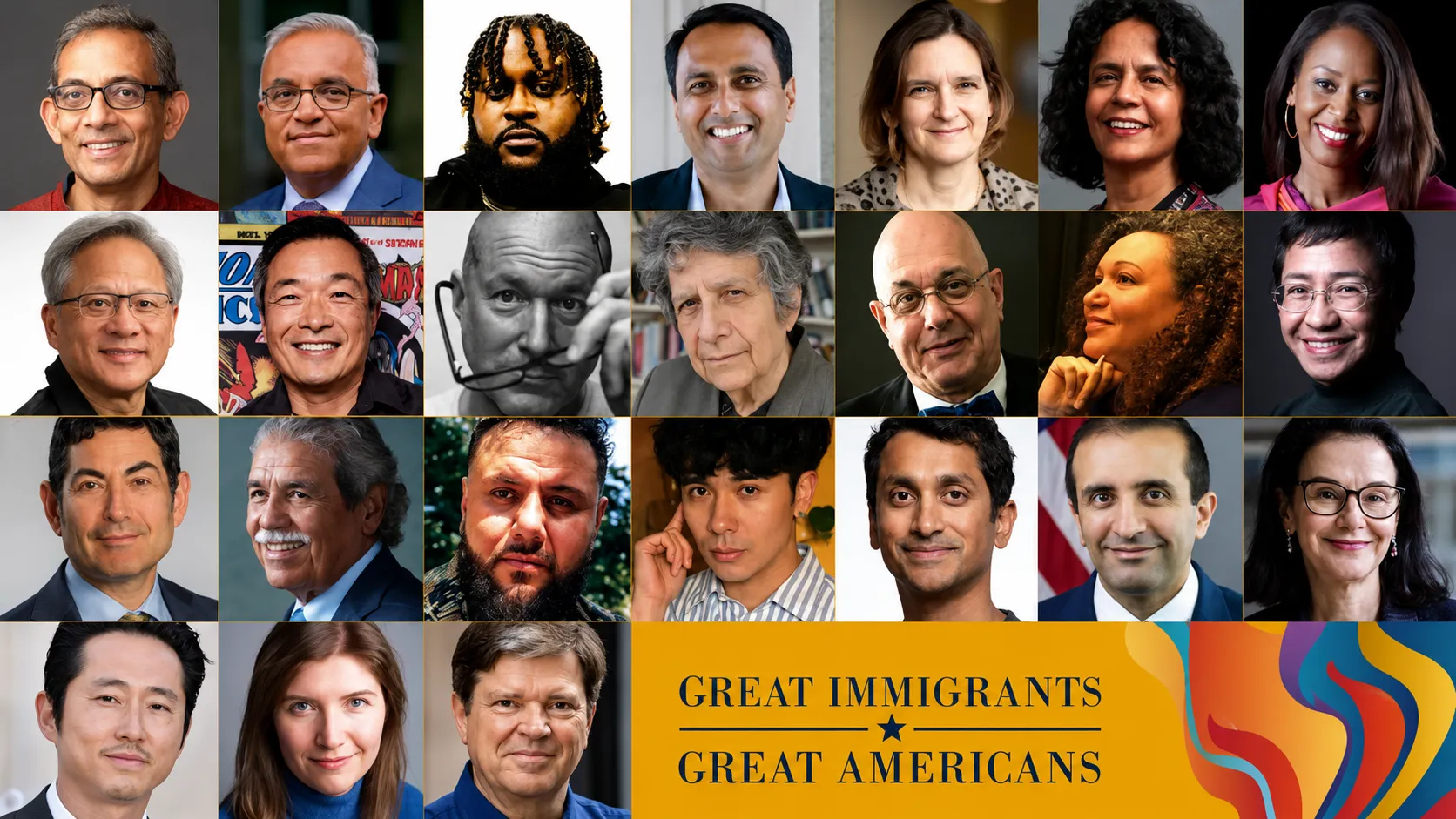
Every year since 2006, the Carnegie Corporation of New York has published a list intended to make a simple, deliberately unsubtle point: that immigrants who become naturalized American citizens go on to make outsized, disproportionate contributions to the country that admitted them. The list, called Great Immigrants, Great Americans, typically appears each Fourth of July, timed to land alongside the country's own celebration of independence. In 2026, that timing carries unusual weight — the announcement coincides with the 250th anniversary of the signing of the Declaration of Independence, and Carnegie has used the milestone to select twenty-five naturalized citizens from twenty-one countries, a class meant to stand as a kind of representative snapshot of what immigration has contributed to America across two and a half centuries.
Four of this year's twenty-five honorees are of Indian origin, spanning fields as varied and wide-ranging as biotechnology, medicine, psychology, and technology. Their inclusion continues a now well-established, long-running pattern: Indian-origin professionals have appeared on Carnegie's list with striking regularity since the program's founding, a track record that has turned the list into something like an informal, ongoing register of Indian-American achievement across American public and professional life.
A List Built to Make a Point
It is worth understanding what the Great Immigrants list is actually designed to do, because its purpose shapes how its selections should be read. Unlike a purely journalistic ranking of wealth or fame, the Carnegie list exists explicitly to counter a particular kind of political and cultural narrative — one in which immigration is framed primarily as a burden, a security risk, or a drain on public resources — by presenting, each year, a curated set of individual stories demonstrating the opposite: naturalized citizens who have gone on to found companies, cure diseases, win Nobel Prizes, lead major institutions, and otherwise contribute to American life in ways that a purely restrictionist account of immigration would struggle to explain away.
That explicit, values-driven framing matters for understanding why the list has featured Indian-origin honorees so consistently over the years. India has, for decades, sent a disproportionately large share of highly educated, professionally accomplished immigrants to the United States relative to its population, driven by a combination of America's own immigration policy priorities — which for years favored skilled workers in science, technology, engineering, and mathematics — and India's own enormous higher education system producing far more qualified graduates in those fields than its domestic economy could fully absorb. The Great Immigrants list, by design, tends to surface exactly the kind of high-achieving professional immigrant story that this particular migration pattern has produced in large numbers over the past half-century.
Reshma Kewalramani's Unconventional Path
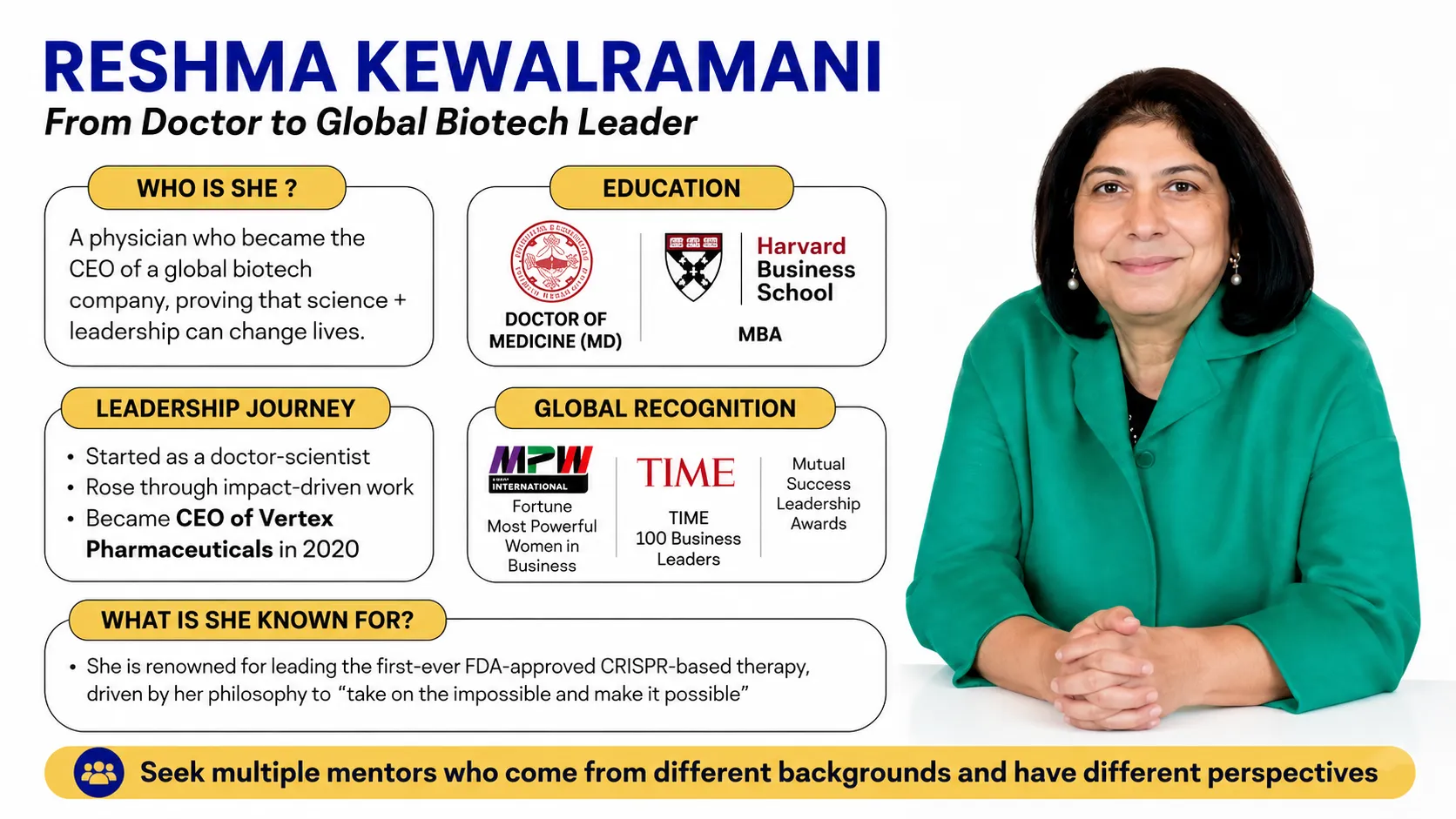
Among this year's four Indian-origin honorees, Reshma Kewalramani's story stands out for the way it departs from the more familiar technology-founder or technology-executive template that dominates popular narratives of Indian-American success. Born in Mumbai, she moved to the United States with her family at the age of eleven — young enough that her formative education happened almost entirely within the American school system, a detail that distinguishes her path from executives who arrived as adults already trained in India's engineering institutions.
Kewalramani went on to complete a combined undergraduate and medical degree at Boston University, training initially as a transplant nephrologist — a physician specializing in kidney transplantation, one of medicine's most demanding and technically exacting subspecialties. That clinical training eventually carried her into corporate biotechnology leadership, a transition that reflects a broader pattern among physician-executives: clinical expertise increasingly serving as a pathway into pharmaceutical and biotech leadership roles, where deep medical knowledge provides a genuine strategic advantage in an industry where scientific and regulatory judgment can matter as much as conventional business acumen.
The Company Kewalramani Keeps
Kewalramani's induction adds her name to a Carnegie honor roll that has, over the years, come to read like an informal census of Indian-American achievement across an unusually wide range of fields. Past honorees have included Abhijit Banerjee, the Nobel laureate economist recognized for his work on global poverty alleviation; Ashish Kumar Jha, the public health expert who became a prominent voice during the COVID-19 pandemic; Gita Gopinath, the economist who rose to a senior leadership position at the International Monetary Fund; Kamlesh Lulla, a NASA researcher; Vivek Murthy, who served as United States Surgeon General; and Shantanu Narayen, the longtime chief executive of Adobe. Sundar Pichai, Alphabet's chief executive, has also appeared among past honorees, placing the Google leader's name alongside economists, physicians, and public health officials rather than solely among a roster of fellow technology executives.
That breadth is precisely the point the Carnegie list is designed to make, and it is worth dwelling on how unusual this range actually is. A single honor roll spanning a Nobel Prize-winning development economist, a former Surgeon General, a NASA space scientist, one of the world's most recognizable technology CEOs, and now a biotech chief executive who trained as a kidney transplant physician describes a diaspora whose contribution to American public life cannot be reduced to any single professional archetype, however tempting that reduction might be for the sake of a tidier narrative.
Why the 250th Anniversary Timing Matters
The decision to time this year's announcement to America's 250th anniversary of independence is not incidental. A quarter-millennium of national history offers Carnegie an unusually long lens through which to make its underlying argument: that immigration has been a constant, generative feature of American life since the country's founding, not a recent or contested departure from some earlier, more homogeneous version of the nation. Placing this year's twenty-five honorees, several of Indian origin, within that two-and-a-half-century frame recasts their individual achievements as part of a continuous national story rather than as a separate, parallel narrative running alongside the country's official self-understanding.
That framing carries particular resonance for the Indian-American community specifically, because the bulk of Indian immigration to the United States is a comparatively recent phenomenon, driven largely by the Immigration and Nationality Act of 1965, which eliminated national-origin quotas that had previously restricted immigration from Asia. In historical terms, large-scale Indian immigration to America is barely six decades old — a small fraction of the 250 years Carnegie's anniversary framing spans. Being formally woven into that longer national narrative, rather than treated as a recent addition to it, represents a meaningful form of symbolic inclusion for a community whose presence in the country, however consequential, remains historically young relative to many other immigrant groups being simultaneously honored on the same list.
What Recognition Like This Actually Accomplishes
It would be easy to dismiss an honor like the Great Immigrants list as symbolic in the least consequential sense of that word — a pleasant but ultimately inconsequential form of recognition that changes nothing material about immigration policy, public attitudes, or the daily experience of immigrant communities in the United States. That dismissal, however, underestimates how narrative and symbolism actually function in shaping durable public attitudes over time. Immigration policy debates in the United States are driven substantially by competing narratives about who immigrants are and what they contribute, and a consistent, decades-long institutional effort to publicize a counter-narrative — one built on specific names, specific achievements, and specific contributions rather than abstract statistics — plays a genuine role in shaping how those debates unfold, even if that role is diffuse and difficult to measure precisely.
There is also a more direct, less abstract form of value in this kind of recognition: its effect on younger members of the same immigrant communities watching from the sidelines, absorbing lessons about which futures feel achievable long before they are old enough to articulate those lessons in so many words. A Mumbai-born child arriving in the United States at eleven years old, as Kewalramani did, absorbs an enormous number of implicit signals about which paths are considered legitimate, achievable, and celebrated within her new country. A Carnegie Corporation honor roll that includes a transplant nephrologist turned biotech CEO, alongside a Nobel-winning economist and a NASA scientist, quietly expands the range of futures that the next generation of young immigrants might consider realistic for themselves — a function that operates independently of whatever direct policy impact the list itself may or may not have, but that may well prove to be its most durable, most consequential, and most quietly transformative effect over the long run, long after this particular anniversary class has faded from the news cycle and its members have moved on to the next chapters of their still-unfolding careers.
A Pattern That Extends Beyond Any Single List
The Carnegie list's 2026 Indian-origin honorees did not emerge in isolation. The same broader moment — America's 250th anniversary, a growing appetite for institutional recognition of immigrant achievement — has also produced parallel honors this year, including the American Academy of Arts and Sciences' induction of ten Indian-origin fellows into its own 2026 class, a separate recognition spanning fields from ubiquitous computing research to gender-equity advocacy in technology. Taken together, these overlapping honor rolls describe a year in which American institutions, across a range of different traditions and purposes, converged on a similar observation: that the Indian diaspora's contribution to American public life in 2026 is broad enough, and consequential enough, to warrant recognition across multiple, entirely independent selection processes within the same twelve-month period.
That convergence matters more than any single list on its own. A single honor can be read as an isolated data point, however impressive. Multiple, independently constituted honor rolls reaching similar conclusions within the same year, evaluated by entirely different selection committees using entirely different criteria, describe something closer to a genuine pattern — evidence that the range and depth of Indian-American achievement has reached a scale where it is now being recognized simultaneously, and independently, by institutions with very different founding missions and very different definitions of what counts as a contribution worth celebrating.
For Kewalramani and her fellow honorees, the recognition arrives as one moment within much longer careers still very much in progress. For the broader Indian-American community, the significance runs somewhat differently: another data point in an accumulating record, spread across an ever-widening range of institutions and fields, that continues to complicate any narrower, more predictable story of what Indian-origin success in America is supposed to look like.
The Twenty-One Countries Standing Alongside India
It is also worth situating India's four honorees within the fuller context of this year's list, which draws its twenty-five members from twenty-one different countries — a deliberate breadth meant to reinforce the Carnegie Corporation's underlying argument that American immigration, and American achievement built on the back of it, is a genuinely global phenomenon rather than one dominated by any single sending country. India's four honorees represent one of the larger national contingents on this year's list, a reflection of the sheer scale of skilled Indian immigration to the United States over the past several decades relative to most other sending countries, but they share the stage with naturalized citizens whose origins span Latin America, Africa, East Asia, and Europe, each bringing a distinct migration story and a distinct set of contributions to the same broader anniversary framing.
That international breadth matters for how the Indian-origin honorees' recognition should be read. Rather than standing as evidence of some uniquely Indian talent for American assimilation and achievement, their presence on a list spanning twenty-one countries situates Indian-American success within a much larger, genuinely global story about what skilled and determined immigrants from anywhere in the world have consistently been able to build once given the opportunity to do so within the American system. The four Indian-origin names on this year's list are best understood not as a self-contained Indian success story, but as one especially prominent thread within a far larger tapestry the Carnegie Corporation has spent two decades methodically weaving together, one anniversary class at a time, twenty-five names and twenty-one countries at a time, each new class adding a little more evidence to an argument the organization has been quietly making since 2006.


