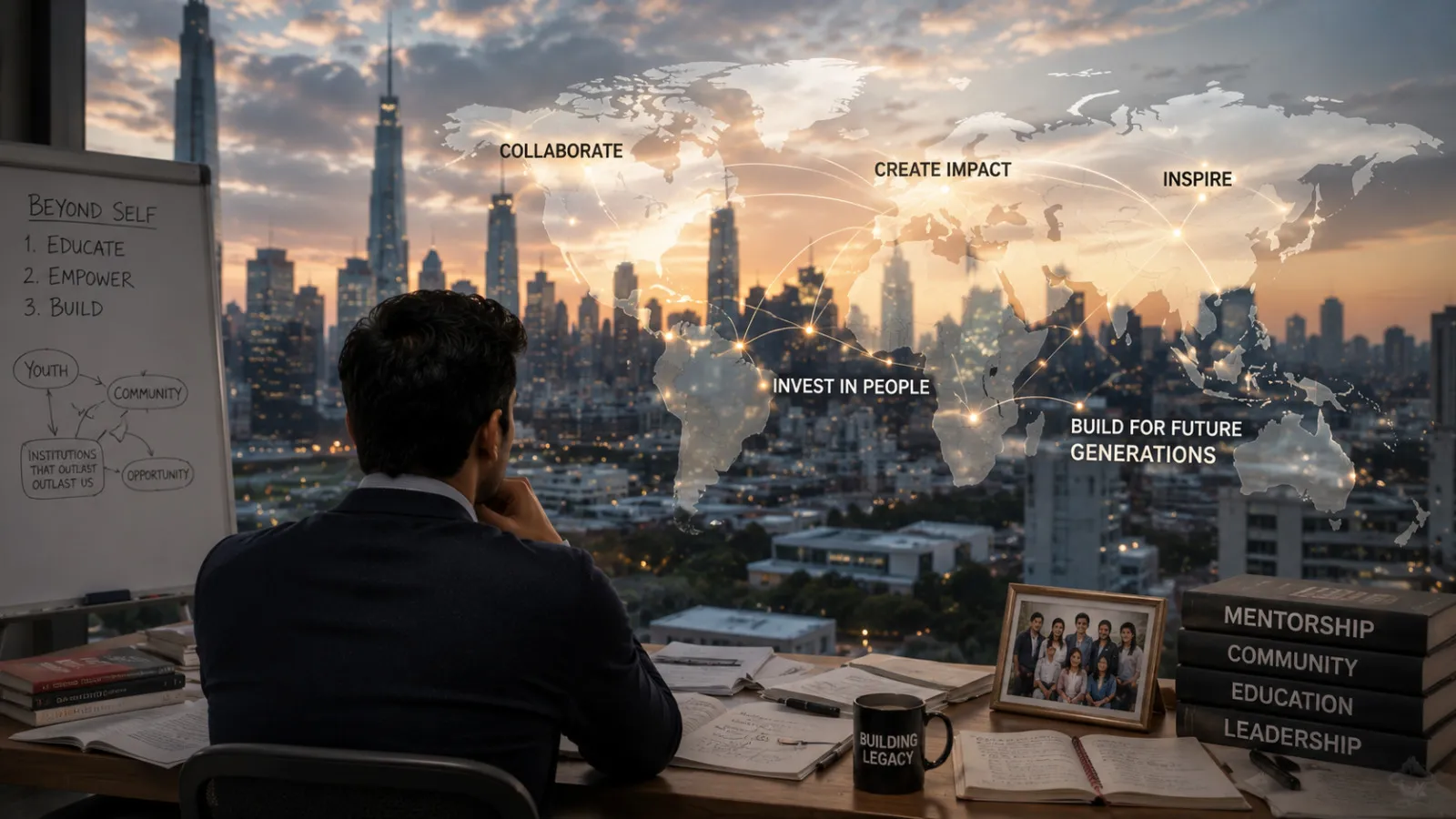
The most successful immigrant community in America is also, by some measures, the least institutionalised.
That claim requires qualification, because there are Indian American institutions — Indian American Impact, which has been building political infrastructure since 2016; Indiaspora, which convenes diaspora leaders around philanthropy and civic engagement; the India Philanthropy Forum, which is building the UK-India corridor for social investment; dozens of regional cultural organisations and professional associations. These exist, they matter, and the people who built them deserve credit for doing so.
But the gap between the scale of Indian American achievement and the scale of Indian American institutional infrastructure is wide enough to deserve a direct and honest look. A community that has produced 11 Fortune 500 CEOs, that accounts for 71 per cent of all US H-1B visas, that received $137 billion in remittances from the global Indian diaspora in 2024, and that has a combined economic footprint measured in the hundreds of billions — that community does not yet have the institutional presence that its human capital and financial resources would seem to make possible.
The question is why. And the answer is not flattering.
The Survey That Named the Moment
The Carnegie Endowment for International Peace's 2026 Indian American Attitudes Survey — a nationally representative poll of 1,000 Indian American adults conducted between November 2025 and January 2026 — is the most systematic portrait of where the community stands that has been produced in recent years.
<cite index="67-1">One year into Trump's second term, large majorities of Indian Americans disapprove of his job performance, including his handling of the domestic economy, international economic policy, and immigration.</cite> <cite index="67-1">At the same time, Indian Americans have experienced a marked uptick in online hate speech and discrimination. One independent report documented a worrying surge in anti-Indian content on X (formerly Twitter) in late 2025, identifying the United States as an 'epicenter of anti-Indian digital racism.'</cite>
<cite index="67-1">Indian Americans have increasingly found themselves in the center of and, at times, targeted in national political conversations.</cite>
A community that is politically engaged, experiencing discrimination, and increasingly visible in national discourse is a community that needs institutional infrastructure: the think tanks to shape the policy narrative, the advocacy organisations to mobilise the political response, the legal funds to address the discrimination, and the media organisations to document and amplify the community's perspective. Most of that infrastructure is either nascent or absent.
The Comparison That Explains the Gap
The most instructive comparison for the Indian American institutional gap is not with the Black American or Latino American communities — both of which built their institutional infrastructure under conditions of explicit legal exclusion that created a different kind of organisational urgency. The more instructive comparison is with the American Jewish community.
American Jews represent approximately 2 per cent of the US population. Their institutional infrastructure is extraordinary: AIPAC, J Street, the American Jewish Committee, the Anti-Defamation League, Hillel, dozens of significant foundations and endowments, university chairs and centres in Jewish studies across major research institutions, multiple major media organisations, and a dense network of community organisations that operate across every major American city. The infrastructure reflects generations of investment — investment that was motivated, in part, by the experience of exclusion and the understanding that individual achievement, however impressive, does not translate automatically into community protection.
Indian Americans are approximately 1.5 per cent of the US population. Their institutional infrastructure, while growing, does not yet have the depth or the breadth that their numbers, their education levels, or their economic resources would suggest. The Indian American Impact Fund, founded in 2016 by Deepak Raj and former Kansas State Representative Raj Goyle, is building political infrastructure — <cite index="60-1">dedicated to building Indian American political power, investing in candidates, and mobilising voters.</cite> It is doing important work. It is also doing it without the decades of accumulated capacity that comparable organisations in other communities have built.
The reasons for this gap are multiple and worth naming without blame.

The Reasons the Gap Exists
The first reason is historical timing. Indian American immigration at scale is relatively recent — the 1965 Immigration Act opened the door, and the flow of highly skilled professionals accelerated through the 1980s and 1990s. The first generation arrived focused on building individual economic security. The second generation is the first that has had the luxury of asking what comes after economic security — and institution building is the answer that is beginning to emerge, but it takes time.
The second reason is internal fragmentation. The Indian American community is not one community. It is dozens of communities organised by regional origin, by language, by religion, by caste, by immigration wave, and by political orientation. The Telugu Association of North America and the Punjabi Cultural Society and the Tamil Cultural Federation are all Indian American institutions, but they serve overlapping and sometimes competing constituencies. Building a single institutional voice from that diversity is harder than it sounds, and the attempts to do so have often run into the same fault lines that divide the community internally.
<cite index="54-1">Like Bill Gates in the 1990s, up until recently Indian Americans were focused on other priorities. Once they made sufficient progress on those, turning to philanthropy as an expression of the Indian notion of seva (selfless service) was natural, and perhaps inevitable.</cite> The timing parallel is imperfect but the logic is real: institution building requires the prior existence of individual surplus — surplus time, surplus capital, surplus attention — that the first generation of Indian Americans was directing elsewhere.
The third reason is the political complexity of a community that is itself politically complex. <cite index="53-1">Indian Americans are finding themselves at the crossroads of this debate. They are leveraging their dual identity to initiate dialogue, promote understanding, and strengthen ties between the two nations.</cite> But dual identity creates dual obligations, and the community's political energy has often been absorbed by navigating the tension between Indian political sensibilities and American ones rather than directed toward building durable American institutions.
What Institution Building Actually Requires
The shift from career building to institution building is not simply a matter of redirecting philanthropic dollars. It is a shift in how the most accomplished members of a community understand their obligations to it.
Career building asks: what can I achieve? Institution building asks: what can I build that will serve this community after I am done building it? The first question is answered individually. The second is answered collectively, over time, with the patient understanding that institutions take decades to become what their founders imagined them to be.
The Indian American community has the human capital to build world-class institutions across every domain: policy, education, media, philanthropy, political organisation, legal advocacy, cultural production. The resources exist. The talent exists. What has been slower to develop is the collective will — the recognition that individual achievement, however extraordinary, does not by itself produce community power.
<cite index="54-1">The need and the opportunity for impact are real. India has some of the world's most effective nonprofits working in education, vocational training, and livelihood development.</cite> The same observation applies to the Indian American community in the United States: the need for institutional infrastructure is real, the opportunity to build it has never been greater, and the people capable of building it have already demonstrated in their professional lives that they know how.
The question is whether they will apply that capacity to the harder, slower, less personally rewarding work of building things that will last beyond their own careers.
Career building produced the 11 Fortune 500 CEOs. Institution building will determine what the community they are part of looks like in twenty years. It is a different kind of work. It is also, ultimately, the more consequential kind.


