"Burn It All": The Sugarcane Farmer Who Stood at the Edge of Ruin—And the Wife Who Whispered "Vinegar"
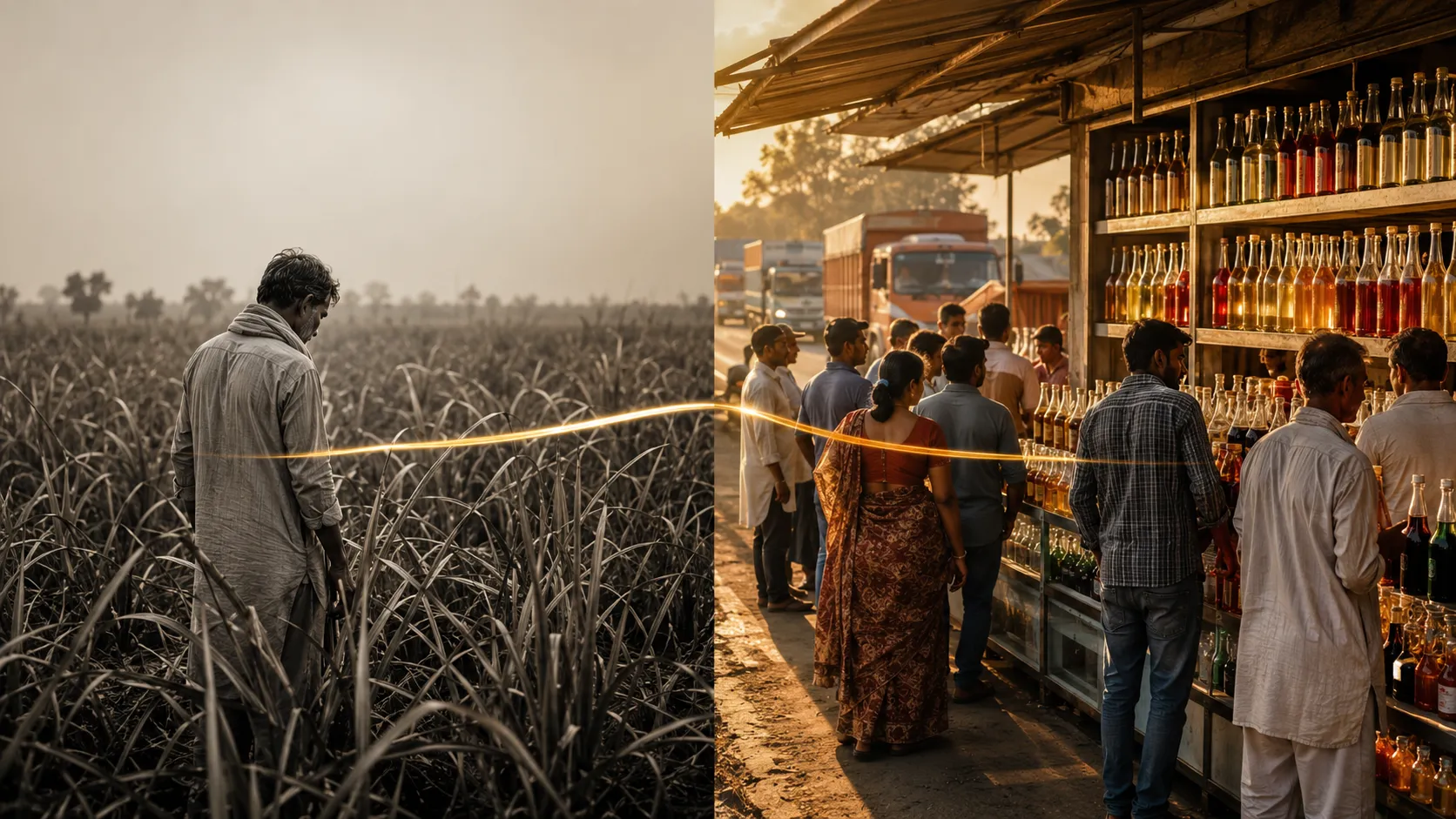
BASTI DISTRICT, UTTAR PRADESH — May 26, 2026 — There is a moment in every story of ruin when the person at the centre of it stops fighting. Not because they are weak, but because the arithmetic of survival has turned against them and no amount of effort can change the numbers. For Sabhapati Shukla, that moment arrived in 2003, in a sugarcane field in a village called Macha, in the Basti district of eastern Uttar Pradesh. He stood among the stalks he had planted, irrigated, and watched over for months, and he calculated that the price the market would pay for them was less than the cost of harvesting them. He was in debt. He had a wife and children to feed. He had a loan of ₹50,000 from a local bank—money he had borrowed to start the farm, money that was now gone, absorbed into a crop that was worth less than nothing. "I won't sell at this rate," he told his wife Shakuntala. "I'd rather burn my crop than sell it."
Shakuntala Devi did not panic. She did not cry. She did not tell her husband that everything would be fine. She made a suggestion that must have sounded, in that moment, like madness. "I need sugarcane juice," she said. "For what?" Sabhapati asked. "To make vinegar." She had learned the traditional method from her mother—a slow, patient fermentation that took five months and produced a vinegar that tasted like nothing available in any market. She had never made it commercially. She had never sold a single bottle. But she knew the process, and she believed that if they could not sell their sugarcane, they could at least transform it into something that would not perish in the field. Sabhapati, who had nothing left to lose, brought her 70 to 80 kilograms of sugarcane juice. She poured it into large drums. No chemicals. No boiling. No shortcuts. Just time.
Today, 22 years later, Shukla Ji Sirka is one of India's largest traditional vinegar brands. It generates annual revenue exceeding ₹1 crore with net profits of ₹40 to ₹45 lakh. It sells over 60 products—sugarcane vinegar, jamun vinegar, apple vinegar, grape vinegar, spiced masaledar sirka, pickles, and jaggery—from a roadside outlet on the Basti-Lucknow highway that handles ₹60,000 in daily sales, supplemented by ₹12,000 to ₹15,000 in daily online orders. The business employs six men and ten women permanently, with up to 50 additional workers during peak season. Its products reach customers across Uttar Pradesh, Bihar, Maharashtra, Punjab, Bengal, Delhi, Haryana, and Madhya Pradesh. The vinegar that began as a wife's desperate idea has become the economic backbone of an entire region—with 50 to 60 shops now lining a 10-kilometre stretch of the Basti-Gorakhpur highway, all selling sirka, all descended from the single batch that Shakuntala fermented in her kitchen.
The Accident That Broke Everything
The story of Shukla Ji Sirka does not begin with sugarcane. It begins with a road accident that nearly killed Sabhapati Shukla and destroyed the life he had built.
He was born in Keshavpur village, Basti district, into a relatively well-off family. Two of his brothers held government jobs, which reduced the financial pressure at home and allowed Sabhapati to pursue his own path. Unable to settle into farming initially, he took up contract work—construction projects, labour contracts—which soon flourished. Money flowed in. Recognition followed. He married Shakuntala, and together they began building a life that seemed, by the standards of rural Uttar Pradesh, secure and promising.
Then came the accident. Sabhapati was returning from work when his vehicle crashed. His back was badly injured. He was bedridden for months. He could not sleep on his back; turning in bed caused unbearable pain as clothes stuck to his wounds. Though his body slowly healed, his business collapsed completely. Contracts slipped away. Contacts vanished. Savings were exhausted on medical treatment. The man who had once been a successful contractor was now, in his forties, staring at a future that contained nothing but debt, disability, and the diminishing hope that he would ever recover what he had lost.
With children growing up and expenses mounting, Sabhapati turned to sugarcane farming in 1984, encouraged by Shakuntala. He worked tirelessly, often alongside the labourers he employed. But when harvest season arrived, despair returned. The market offered prices so low that selling the crop meant losses. "I won't sell at this rate," he said one day, throwing his towel aside in frustration. Shakuntala worried about household expenses and the children's education. Sabhapati, angry and helpless, spoke of burning the crop. It was at this moment—the lowest point of a life that had already been through the lowest point—that Shakuntala remembered something her mother had taught her.
The Five-Month Miracle
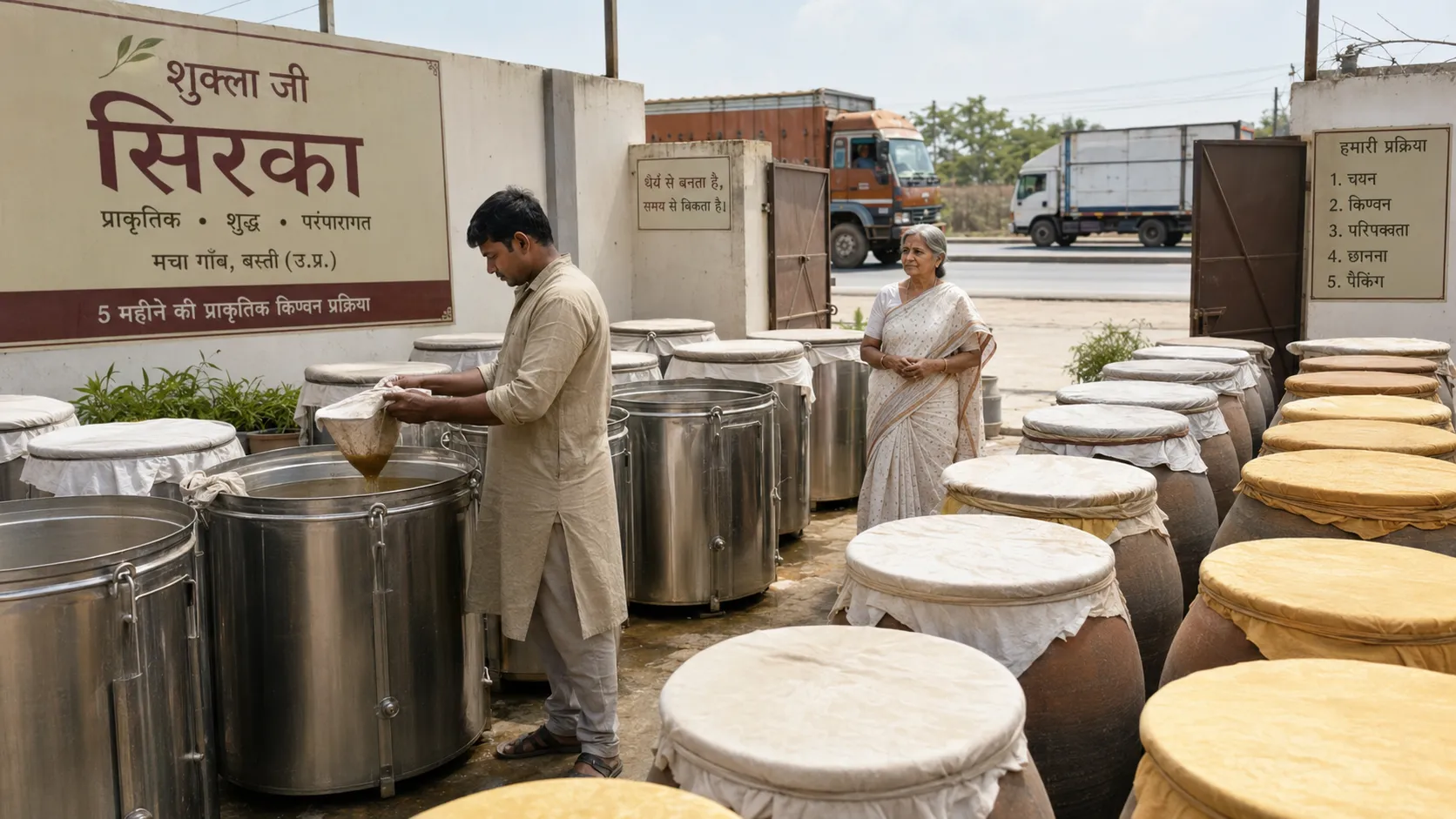
The traditional method of making sugarcane vinegar is not complicated, but it is unforgiving. It requires patience, cleanliness, and a willingness to let nature do what nature does, on nature's timeline, without interference. Shakuntala had learned it as a girl, watching her mother fill large drums with fresh sugarcane juice, cover them with cloth, and place them in the sun. Over five months, the juice would ferment—slowly, silently, without any additives or accelerants. The sugar would turn to alcohol, and the alcohol would turn to acetic acid. What emerged was a vinegar that was alive: complex, balanced, and entirely unlike the synthetic, chemically produced vinegars that dominated the market.
Shakuntala's first batch was small—70 to 80 kilograms of sugarcane juice, poured into whatever drums the household could spare. She filtered it every month, removing impurities as the fermentation progressed. She added nothing: no chemicals, no preservatives, no artificial colours. The process was exactly what her mother had taught her, and the result was exactly what she remembered from her childhood. Sabhapati, who had agreed to the experiment with the fatalism of a man who had run out of alternatives, tasted the vinegar and realised that his wife had created something remarkable.
The first bottles were shared with neighbours. Some mocked them. Others praised the taste. A few were taken to a shop in Faizabad, run by a trader named Ajay Vaidya. After tasting it, Vaidya said: "This is real vinegar. Everything in the market today is chemical-based." The bottles sold out within days. Sabhapati and Shakuntala had found their product. What they needed now was a market.
The early years were punishing. Sabhapati began selling vinegar from a roadside stall on the Basti-Lucknow road. Initially, days passed without a single sale. Doubt returned. The couple had poured what little they had left into a product that nobody seemed to want. But gradually, customers stopped. Hawkers began buying in bulk. Nearby villages took notice. Sabhapati was approached by people who told him about chemical shortcuts—additives that would speed up the fermentation from five months to five days, preservatives that would extend shelf life, synthetic acids that would mimic the taste of real vinegar at a fraction of the cost. He tried them once. The product spoiled. He returned to the slow, traditional process and never looked back. That decision—the refusal to compromise on the five-month fermentation—became the foundation of the brand. "I was sure of never letting the quality of the vinegar dip," he said. "That is our USP. No matter what changes the business undergoes, the quality will remain the same."
The first year, the couple produced close to 40 litres of vinegar. The next year, production increased exponentially to nearly 1,000 litres. By the third year, they had surpassed 2,000 litres. "Those who laughed at me in the beginning for attempting something new and different were suddenly singing my praises, wanting to join hands with me," Sabhapati recalled. The roadside stall became a permanent outlet. The permanent outlet became a brand. And the brand—Shukla Ji Sirka—began to spread along the highway, one bottle at a time.
The Highway Empire
The most remarkable dimension of the Shukla Ji Sirka story is not the revenue or the profit. It is the ecosystem that has grown around it. What began as a single roadside stall has become a regional industry. Fifty to 60 shops now line a 10-kilometre stretch of the Basti-Gorakhpur highway, all selling sirka, all descended—directly or indirectly—from the batch that Shakuntala fermented in her kitchen.
The Shukla family's success drew others into the trade. Relatives, neighbours, and even families from different castes—Upadhyays, Tripathis, Mishras—began producing and selling vinegar along the same highway. Remarkably, many of them chose to operate under the Shukla Ji Sirka name, a testament to the brand equity that Sabhapati and Shakuntala had built. "Even Upadhyay, Tripathi and Mishra families joined the trade but everyone named their shop as Shukla Ji Sirka as our brand was established," said Shree Prakash Shukla, the couple's youngest son, who now manages the business with his four brothers. The family has since registered the trademark to distinguish the original from the imitators.
The business has also bridged the caste divide that defines so much of rural Uttar Pradesh. The Times of India reported that the vinegar trade has "bonded Shuklas and Yadavs"—two communities that have historically been separated by the rigid hierarchies of the region. The economics of vinegar, it turns out, are more powerful than the sociology of caste. A family that produces good sirka will find customers, regardless of their surname, and the highway that connects Basti to Gorakhpur has become a corridor of commerce that transcends the divisions of the village.
The local economy has diversified alongside the vinegar trade. In addition to sirka, residents of Macha, Keshavpur, and Khatam Sarai villages now produce pickles, jaggery, ghee, and other cottage-industry products. The fermentation economy has created jobs for workers who would otherwise have migrated to cities in search of employment. Sabhapati employs six men and ten women on a permanent basis, and up to 50 additional workers during the peak season. On average, each worker takes home between ₹8,000 and ₹10,000 per month—a meaningful income in a region where alternative employment is scarce. "My aim has always been to try and grow the village," Sabhapati said. "I was never in favour of leaving and do not want others to leave as well."
The business has also been recognised under the Uttar Pradesh government's One District One Product (ODOP) programme, which has identified vinegar as Basti's notified product. Through the programme, Sabhapati secured a ₹50 lakh loan facilitated by the District Industries Centre, which included a ₹10 lakh subsidy component. The capital allowed him to expand production capacity, improve infrastructure, and scale the business from a cottage operation into a professional enterprise. The ODOP recognition has also brought institutional credibility to a product that was once dismissed as a desperate housewife's experiment.
The Five Sons and the Second Generation
The most strategically significant dimension of Shukla Ji Sirka's future is not the current revenue or the ODOP recognition. It is the second generation. Sabhapati and Shakuntala have five sons, all of whom are now involved in the business. The youngest, Shree Prakash Shukla, is 23 years old and has become the public face of the brand—handling the digital payments infrastructure, managing the trademark registration, and speaking to journalists about the family's journey.
"Since the time I have been of an age where I understand what is happening, I have seen papa work very hard," Prakash told The Better India. "I remember the times when he was mocked. He never let any of that come in the way of his hard work. He was like a horse with blinkers, his sight was only on the outcome." The son's words carry the weight of someone who has witnessed, from childhood, the transformation of his family's fortunes. "There was a time when people would think multiple times before lending us even Rs 100. Even then, papa never gave up."
The business has undergone GST registration under the Samadhan Yojana, which allows businesses with an annual turnover under ₹1.5 crore to pay tax at a fixed rate—a regulatory framework that has formalised the enterprise and enabled it to accept digital payments from customers who increasingly do not carry cash. The highway that connects Lucknow to Gopalganj via Ayodhya, Basti, and Gorakhpur brings a steady stream of travellers past the Shukla Ji Sirka outlet, and many of them—truck drivers, families on pilgrimage, wholesale buyers—now pay through UPI rather than cash. The second generation has ensured that the business keeps pace with the digitisation of the Indian economy, even as the product itself remains rooted in a fermentation process that has not changed in generations.
The family has also expanded the product line significantly. What began as a single variety of sugarcane vinegar now encompasses over 60 products: grape vinegar, apple vinegar, jamun (Java plum) vinegar, spiced masaledar sirka tempered with mustard oil, garlic, cumin seeds, red chilies, and coriander seeds, along with pickles and jaggery. One litre of vinegar is priced at ₹50 and can be delivered to any part of India via speed post. The family plans to make their products available on various online retail platforms in the coming months, extending their reach beyond the highway that has been their marketplace for two decades.
The elder brothers—Ved Prakash Shukla among them—manage the production, the logistics, and the growing network of wholesale buyers who purchase vinegar in bulk and carry it onward to other districts and states. The division of labour among the five sons mirrors the division of labour between their parents: some handle operations, some handle commerce, some handle the future. The family that was once on the brink of ruin now has a succession plan.
What This Signals
The Shukla Ji Sirka story is not primarily about vinegar. It is about the structural fragility of the Indian agricultural economy—and about what happens when a family refuses to accept that fragility as fate.
For decades, the Indian farmer has been told that his prosperity depends on factors beyond his control: the monsoon, the market price, the minimum support price announced by the government. The farmer who grows sugarcane sells it to a sugar mill or a middleman at a price that is determined by forces he cannot influence. If the price is good, he survives. If the price is bad, he burns his crop—or, increasingly, he burns himself. The cycle is as old as Indian agriculture, and it has consumed millions of families who had no way to escape it.
Sabhapati Shukla was almost one of them. He stood in his field in 2003, ready to destroy the crop that had destroyed him, and he was saved not by a government scheme, not by a corporate buyer, and not by a bank loan, but by his wife's memory of her mother's kitchen. Shakuntala Devi did not have a business plan. She did not have a marketing strategy. She had a traditional skill—the ability to ferment sugarcane juice into vinegar—that had been passed down through generations of women who had never thought of it as a commercial asset. The skill was not valuable until the market made it valuable, and the market made it valuable because Sabhapati and Shakuntala refused to compromise on the quality that made their product different from every synthetic alternative.
The result is a business that has not only saved a family but transformed a region. The 50 to 60 shops that line the Basti-Gorakhpur highway, the hundreds of workers who earn their livelihoods from the fermentation economy, and the thousands of customers who travel from neighbouring states to buy authentic sirka are all downstream of a single decision: a wife telling her husband not to burn the crop, because she could make something from it. The ₹1 crore in annual revenue is the market's judgment that the decision was correct. The ₹40 to ₹45 lakh in annual profit is the evidence that quality, maintained over decades, can build a business that no amount of marketing can replicate.
Sabhapati Shukla is no longer the farmer who stood at the edge of his field, ready to destroy everything. He is the founder of one of India's most successful traditional vinegar brands, the patriarch of a family business that has been passed to the second generation, and the quiet, persistent embodiment of a truth that Indian agriculture has spent decades learning: that the only way to escape the commodity trap is to stop selling commodities. The field that was almost burned is still there, somewhere in Basti district. But the crop it produces is no longer sold by the kilogram. It is fermented for five months, bottled as Shukla Ji Sirka, and sold at a premium that reflects the patience, the quality, and the wife who whispered the word that changed everything: "Vinegar."


