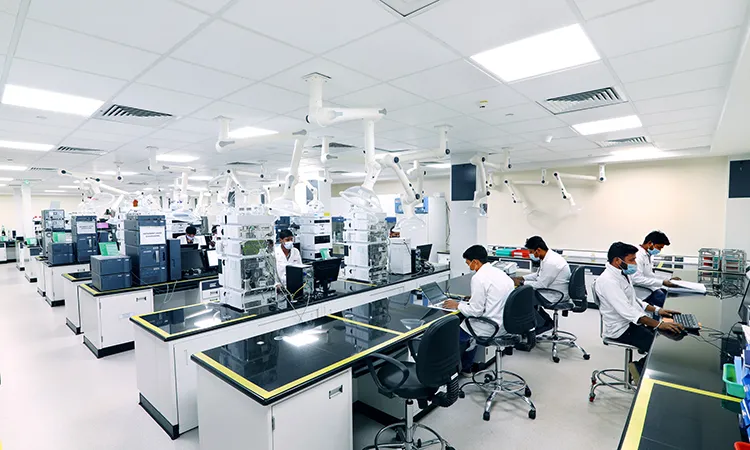
Biocon Biologics' $5.5 Billion Vision: How India's Monoclonal Antibody Revolution Is Taking on the World
The $5.5 Billion Bet That Changed Indian Biotech
When Kiran Mazumdar-Shaw started Biocon in a rented garage in 1978, she was a 25-year-old with a degree in brewing and a dream of making enzymes. Few would have predicted that nearly five decades later, she would be at the helm of a $5.5 billion biosimilars empire, preparing to take on the world's largest pharmaceutical companies.
In March 2026, Biocon completed the integration of its wholly-owned subsidiary, Biocon Biologics Ltd (BBL), into the parent company — a consolidation valued at approximately $5.5 billion. The integration, achieved through a share swap priced at ₹405.78 per share, unifies a pipeline of 28 molecules including 11 co-developed with global partner Mylan under one roof.
This is not an incremental corporate reshuffle. It is the signal that India's biologics industry has entered a new era — one where Indian companies do not just manufacture for global giants but develop, patent and export their own monoclonal antibodies and biosimilars to the world's most regulated markets.
The Patent Cliff: A $59 Billion Opportunity
What is driving this urgency? A $59 billion patent cliff.
According to CRISIL, between 2024 and 2028, branded drugs worth approximately $192 billion will lose patent protection globally — $133 billion from small molecules and $59 billion from biologics. For each blockbuster biologic that goes off-patent, there is an immediate opportunity for biosimilar manufacturers to launch lower-cost versions. And Indian companies — with their manufacturing cost advantages, regulatory experience and English-speaking workforce — are perfectly positioned to capture this wave.
Biocon Biologics has already proven its ability to compete on the global stage. The company was the first from India to receive USFDA approval for a biosimilar (Ogivri™, a biosimilar to Herceptin for breast cancer) and has since expanded its footprint to 120+ countries. The company's pipeline includes biosimilars for blockbuster drugs in diabetes, oncology and immunology — therapeutic areas that together account for nearly 40% of global pharmaceutical revenues.
The Capital Surge: Goldman Sachs, True North and the ₹4,500 Crore QIP
Investors have taken notice. In 2026 alone, Biocon Biologics has attracted three separate private equity cheques.
In January, True North invested ₹536.25 crore ($75 million) at a pre-money valuation of $3 billion. In July, Tata Capital Growth Fund agreed to invest ₹225 crore. And in May, Goldman Sachs made a capital infusion of ₹1,125 crore ($150 million) at a post-money equity valuation of $3.94 billion.
To fund the integration and the Viatris payout, Biocon launched a ₹4,500 crore Qualified Institutional Placement (QIP) in January — one of the largest equity raises by an Indian pharma company in recent years. The QIP will be used primarily to pay Viatris $400 million in cash along with a share swap, repay acquisition debt, and drive growth capex.
Biopharma SHAKTI: The Government's $X Billion Bet
The private capital surge is being matched by public policy ambition. In early 2026, the government launched Biopharma SHAKTI (Strategy for Healthcare Advancement through Knowledge), a program designed to position India as a global hub for biologics and biosimilars manufacturing.
The scheme complements existing initiatives like the Production Linked Incentive (PLI) for pharmaceuticals and the Research Development and Innovation (RDI) scheme, which companies like Biocon have already leveraged to build global-scale facilities. The goal: make India the world's most cost‑competitive, high‑quality biologics manufacturing destination.
This matters because biologics manufacturing is fundamentally different from small‑molecule generic drugs. Where a generic pill can be produced in standard reactors, monoclonal antibodies require complex cell-culture systems, million-litre bioreactors and specialised purification trains that only a handful of countries have mastered. By focusing on this capability, India is moving up the pharmaceutical value chain.
The Monoclonal Antibody (MAb) Pipeline
Biocon Biologics' MAb capabilities are particularly strategic. In 2026, the company received approval to manufacture the cancer drug Bevacizumab (a biosimilar to Avastin) at its new multi-product monoclonal antibody drug substance facility in Bengaluru. The facility is part of a broader expansion that includes dedicated lines for insulins, GLP-1 peptides and novel biologics.
Beyond biosimilars, Biocon has successfully launched two novel biologics in India: Nimotuzumab for head and neck cancer, and Itolizumab for psoriasis. This dual capability — both copy‑exact biosimilars and innovative novel molecules — positions Biocon uniquely among emerging market pharma companies.
The Global Indian Takeaway
For the diaspora, India's biologics boom offers three clear pathways.
First, invest in listed leaders. Biocon's QIP is closed, but its equity remains accessible on Indian exchanges. Dr. Reddy's, Lupin and Zydus also have significant biosimilar pipelines. These are not speculative bets — they are established companies with revenue, profits and global regulatory approvals.
Second, participate in biotech venture capital. Funds like Eight Roads Ventures and BioAngels are actively backing early-stage Indian biotech. The Biopharma SHAKTI scheme has also created co‑funding opportunities for diaspora investors through the RDI program.
Third, build cross‑border R&D partnerships. Indian biologics companies need access to US and European clinical trial infrastructure, regulatory consulting and commercial distribution. Diaspora professionals with experience at the FDA, EMA or major pharma companies can serve as strategic advisors — earning equity, board seats or consulting fees.
The Final Word
The integration of Biocon Biologics is not the end of a story. It is the beginning.
For decades, Indian pharma was synonymous with generic pills — low‑margin, high‑volume, undifferentiated. The biologics revolution changes that calculus. Monoclonal antibodies are complex, high‑margin and deeply protected by patents — but when those patents expire, the companies that can manufacture at global quality standards capture exceptional value.
India now has the manufacturing capacity, the regulatory track record and the policy support to be that manufacturer. Biocon's $5.5 billion consolidation is the proof of concept. The patent cliff is the catalyst. And the $59 billion opportunity is the prize.
The revolution is biological. And it is being brewed in Bengaluru.
CHART: “India's Biologics & Biosimilars Leap – At a Glance (2026)”
Metric | Value | Source |
Biocon Biologics integration valuation | $5.5 billion | Businessworld |
Biocon pipeline size | 28 molecules (11 co‑developed with Mylan) | VCCircle |
Biocon countries with commercial presence | 120+ | ZoomInfo |
Biocon QIP size (January 2026) | ₹4,500 crore | NDTV Profit |
True North investment (Biocon Biologics) | ₹536.25 crore ($75M) | VCCircle |
Goldman Sachs investment (Biocon Biologics) | ₹1,125 crore ($150M) | VCCircle |
Tata Capital Growth Fund investment | ₹225 crore | VCCircle |
Biocon Biologics post‑money valuation (Goldman deal) | $3.94 billion | VCCircle |
Biologics patent expiry opportunity (2024‑2028) | $59 billion | Crisil |
Total patent expiry opportunity (incl. small molecules) | $192 billion | Crisil |
Global MAb biosimilar market (2025 → 2032) | $15.9B → $47.5B (16.1% CAGR) | Research report |
India biosimilars market CAGR (2026‑2033) | 21.3% | Grand View Research |
India immunology drugs market (2024 → 2030) | $2.65B → $3.98B (7.08% CAGR) | TechSci |
India monoclonal antibodies market (2024 → 2030) | $208.6M → $287.9M (5.72% CAGR) | TechSci |
India pharmaceutical exports (FY26) | ₹2.86 lakh crore+ | ChemIndia Digest |


