
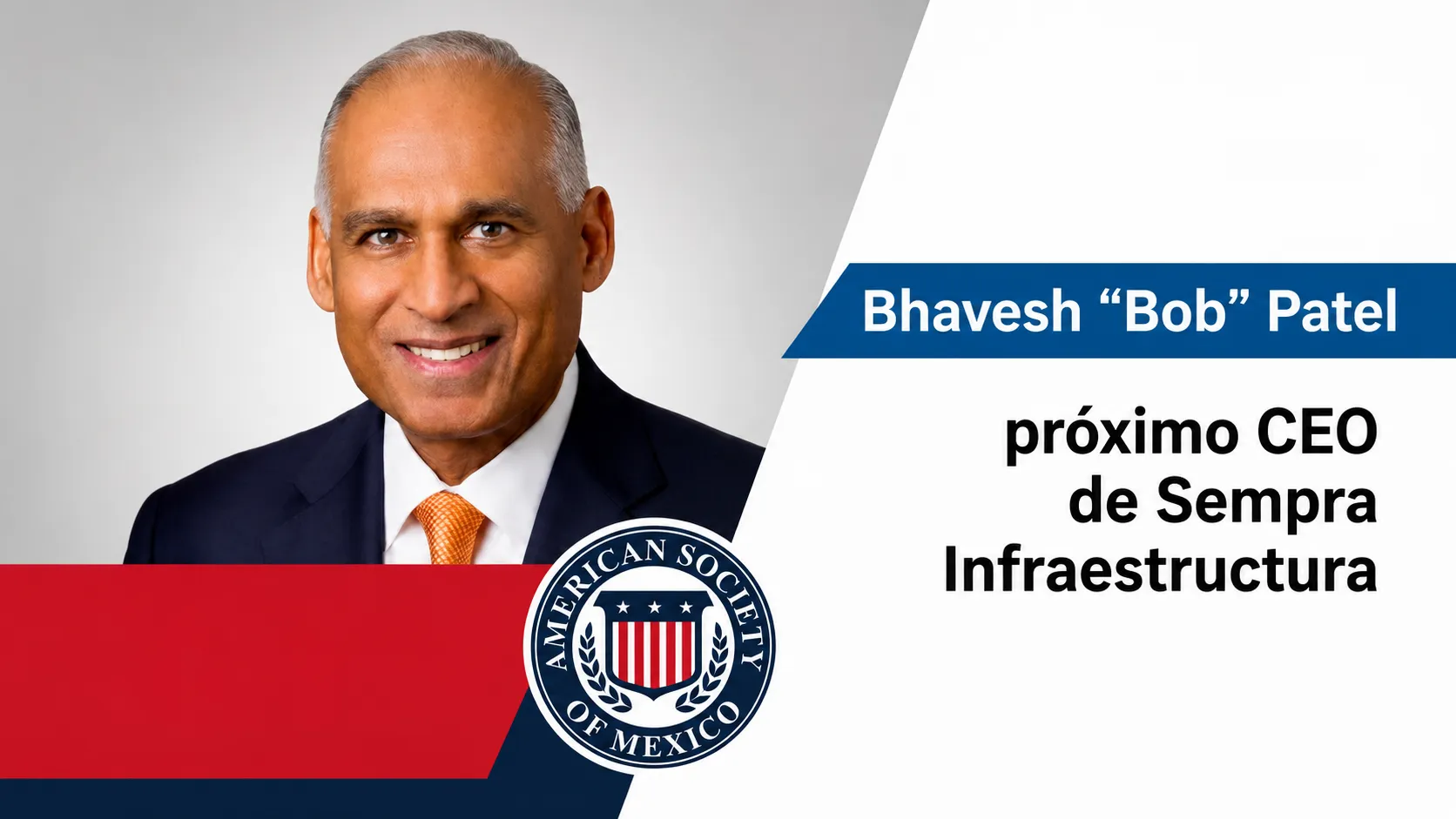
Energy infrastructure leadership changes rarely generate the kind of attention that a technology CEO appointment or a rich-list ranking does, and Bhavesh “Bob” Patel's arrival as incoming chief executive of Sempra Infrastructure has, true to form, unfolded with considerably less fanfare than it perhaps deserves given the scale of what the company actually does. Sempra Infrastructure develops, builds, and operates natural gas and liquefied natural gas infrastructure connecting North American production to global export markets, positioning it at the center of one of the most strategically significant corners of the modern energy economy: the physical infrastructure that determines whether energy actually reaches the markets that need it, regardless of how much gets produced upstream.
Patel's appointment did not arrive in isolation. It coincides with KKR, the private equity giant, taking a major ownership stake in the company — a combination of events that is considerably more significant when read together than either would be read separately. Leadership transitions and major ownership changes happening in close proximity rarely reflect coincidence; they typically signal a coordinated strategic repositioning, with new capital and new operational leadership arriving together to execute a specific vision for the company's next phase.
Why KKR's Capital and Patel's Leadership Are Arriving Together
Private equity firms taking major stakes in infrastructure businesses typically bring more than capital; they bring a specific investment thesis about how the underlying asset should be managed, expanded, or repositioned to generate the kind of returns their own investors expect. KKR's decision to take a major ownership stake in Sempra Infrastructure specifically, rather than pursuing opportunities elsewhere in the crowded energy infrastructure investment landscape, reflects a judgment that the company's existing asset base and growth trajectory offer genuine upside — a judgment that private equity firms of KKR's scale and sophistication do not make lightly, given the enormous due diligence resources such firms typically deploy before committing capital of this magnitude.
Patel's specific selection as the executive to lead that next phase matters as much as the capital itself. Private equity-backed leadership transitions frequently bring in executives with a demonstrated track record of the specific kind of operational discipline and growth execution the new ownership is betting on, rather than simply promoting an internal candidate through ordinary succession planning. That KKR and Sempra's board settled on Patel specifically suggests his background and track record align closely with whatever strategic vision is driving the broader investment, a signal worth taking seriously given how much scrutiny a firm of KKR's sophistication applies before committing to a specific leadership choice at this level.

The Strategic Stakes of North American LNG
To understand why this leadership and ownership transition matters beyond the company itself, it helps to understand the strategic position North American liquefied natural gas exports currently occupy in global energy markets. Following years of geopolitical disruption to traditional energy supply routes, particularly affecting European gas markets, North American LNG has emerged as one of the most consequential swing sources of global gas supply, with infrastructure capacity — not simply production capacity — often functioning as the binding constraint on how much gas can actually reach international buyers seeking to diversify away from more geopolitically exposed suppliers.
That infrastructure bottleneck is precisely the business Sempra Infrastructure operates in: not extracting gas from the ground, but building and operating the liquefaction facilities, export terminals, and pipeline connections that turn domestically produced natural gas into a tradeable, exportable commodity capable of reaching buyers in Europe, Asia, and beyond. Expanding that infrastructure capacity requires enormous, multi-year capital commitments, precisely the kind of long-horizon investment that private equity capital, structured with appropriately patient return expectations, is well suited to provide relative to public equity markets that often demand faster, more visible quarterly returns and can grow impatient with the multi-year timelines large infrastructure projects inevitably require.
What the Role Actually Demands
Leading a company at this particular strategic intersection — private equity ownership, critical energy infrastructure, and a global market environment where energy security has become an explicit government and investor priority — requires a specific blend of operational and strategic skills. Patel will need to manage relationships with a sophisticated new institutional owner whose return expectations and governance involvement typically differ meaningfully from a purely public-market shareholder base, while simultaneously executing on the kind of large-scale infrastructure development projects that unfold over many years and carry substantial execution risk at every stage, from permitting and construction through to long-term commercial contracting with buyers on other continents who each bring their own regulatory and commercial complexities to the negotiating table.
That combination of institutional investor management and long-horizon infrastructure execution is precisely the kind of challenge that tends to reward executives with prior experience navigating both private equity ownership structures and capital-intensive industrial operations, rather than executives whose careers have been built entirely within public companies or within less capital-intensive sectors of the economy.
An Indian-Origin Executive in an Unusual Industry
It is worth situating Patel's appointment within the broader trajectory of Indian-origin professionals in the American energy sector specifically, a corner of the economy that has historically drawn less attention from diaspora-focused coverage than technology, medicine, or finance. Energy infrastructure requires a specific blend of engineering credibility, capital markets fluency, and regulatory relationship management that takes decades to build, and the relatively small number of Indian-origin executives who have reached the top of major energy infrastructure companies reflects both the smaller overall talent pipeline into the sector historically and the sheer length of time required to accumulate the kind of credibility this role demands.
Patel's rise to lead Sempra Infrastructure adds another data point to a broader, still-developing pattern: Indian-origin executives increasingly reaching the top of industries considerably removed from the technology sector that has dominated popular narratives of Indian-American executive achievement for the past two decades. Energy infrastructure, unlike software or even consumer goods, is an industry defined by enormous physical capital requirements, multi-decade asset lifecycles, and deep technical expertise in engineering, construction, and commodity markets — a very different professional foundation than the software engineering background that has produced most of the more famous Indian-origin technology CEOs.
That distinction matters for understanding the genuine breadth of the diaspora's current executive footprint. Energy infrastructure leadership requires navigating regulatory approval processes across multiple jurisdictions, managing relationships with sovereign and institutional buyers on multi-decade supply contracts, and overseeing construction projects that can run into the tens of billions of dollars — a fundamentally different skill set than the product and platform management expertise that defines top technology leadership. An executive capable of operating at this level in energy infrastructure specifically demonstrates a form of achievement that technology-centric coverage of Indian-origin executive success routinely overlooks, simply because it does not fit the more familiar template.
What Success Would Look Like
Whether Patel's tenure ultimately validates KKR's investment thesis will likely become clear only over a multi-year horizon, given the long-cycle nature of infrastructure development and the multi-year contracts that govern LNG export commitments. Early signals worth watching include whether the company announces new capacity expansion projects, how quickly any such projects move through permitting and into construction, and whether Sempra Infrastructure succeeds in securing new long-term offtake agreements with international buyers seeking to diversify their own energy supply away from more geopolitically exposed sources. Each of those milestones typically unfolds over a period of years rather than quarters, meaning early assessments of Patel's tenure will necessarily rely on directional signals — project announcements, financing commitments, regulatory approvals — rather than the kind of quarterly earnings performance that provides faster feedback in less capital-intensive industries.
A Bet on Energy Security as a Durable Investment Theme
Beyond the specifics of this single leadership transition, the broader pattern it reflects deserves attention: private equity capital continuing to flow into North American energy infrastructure at a moment when energy security has become an explicit strategic priority for governments across multiple continents, not simply an abstract economic consideration left to market forces alone. KKR's stake in Sempra Infrastructure, and its confidence in Patel's leadership to execute against that opportunity, reflects a broader institutional investment thesis that North American LNG export capacity will remain a durable, strategically important asset class for years to come, regardless of shorter-term fluctuations in global energy prices.
For Patel personally, the appointment represents the culmination of a career built specifically for this kind of moment: an executive whose background evidently combines the operational credibility that a sophisticated private equity owner demands with the strategic judgment required to navigate an increasingly consequential corner of global energy infrastructure. Whatever specific announcements follow in the coming months, his elevation to this role, alongside KKR's simultaneous capital commitment, marks a genuine vote of confidence in both the underlying business and the executive now tasked with proving that confidence justified.
Energy infrastructure companies of Sempra's scale also occupy an unusual position at the intersection of private commercial interest and public strategic concern, since the reliability and capacity of LNG export infrastructure directly affects allied nations' energy security calculations in ways that purely private consumer or technology businesses rarely need to consider. That dimension of the role means Patel's success will be measured not only by KKR's own return expectations but implicitly by how well the company's expanded capacity serves broader energy security goals that extend well beyond any single shareholder's balance sheet, a responsibility that comes with genuine reputational and strategic weight attached to the position.
The Broader Private Equity Playbook in Energy Infrastructure
KKR's move into Sempra Infrastructure fits within a broader pattern that has defined private equity's growing appetite for energy infrastructure assets over the past several years. Traditional infrastructure investment used to be dominated by utilities, pension funds, and sovereign wealth vehicles seeking stable, long-duration returns from regulated or contracted assets. Private equity firms have increasingly moved into that same territory, drawn by the combination of predictable long-term cash flows from multi-decade supply contracts and genuine upside potential as global energy demand patterns shift in response to geopolitical realignment, decarbonization pressure, and the emergence of new large buyers, particularly across Asia, seeking to diversify their own energy import sources away from any single supplier or region.
That combination of downside protection through long-term contracts and upside potential through capacity expansion is precisely the risk-return profile private equity firms like KKR are built to pursue, and it explains why energy infrastructure has become an increasingly crowded and competitive space for private capital deployment over the past several years. Sempra Infrastructure's specific appeal within that broader competitive landscape likely rests on its existing asset base, its established relationships with buyers and regulators, and — increasingly, following this leadership transition — the specific operational track record Patel brings to executing the next phase of growth that justifies the premium KKR was evidently willing to pay for its stake.
Navigating a Politically Sensitive Sector
Energy infrastructure leadership, unlike many corners of the technology or consumer sectors, requires constant engagement with a politically charged and often unpredictable regulatory environment. LNG export terminal permitting alone has become a genuinely contested political issue in the United States, with different presidential administrations taking sharply different approaches to how quickly, and under what environmental review standards, new export capacity gets approved. An executive leading a company like Sempra Infrastructure must navigate that shifting regulatory terrain skillfully, maintaining productive relationships across changing political administrations while continuing to advance multi-year infrastructure projects that require regulatory certainty over a timeline considerably longer than any single administration's term in office.
That political dimension adds a layer of complexity to Patel's new role that a purely operational or financial reading of the KKR investment might understate. Success in this position requires not only sound engineering and commercial judgment but also the kind of institutional credibility and relationship management that allows a company to keep large infrastructure projects moving forward across a political environment that can shift meaningfully every few years, a skill set considerably closer to statecraft than to conventional corporate management in less politically exposed industries, and one that will be tested repeatedly over the course of his tenure as administrations change and regulatory priorities shift accordingly.


