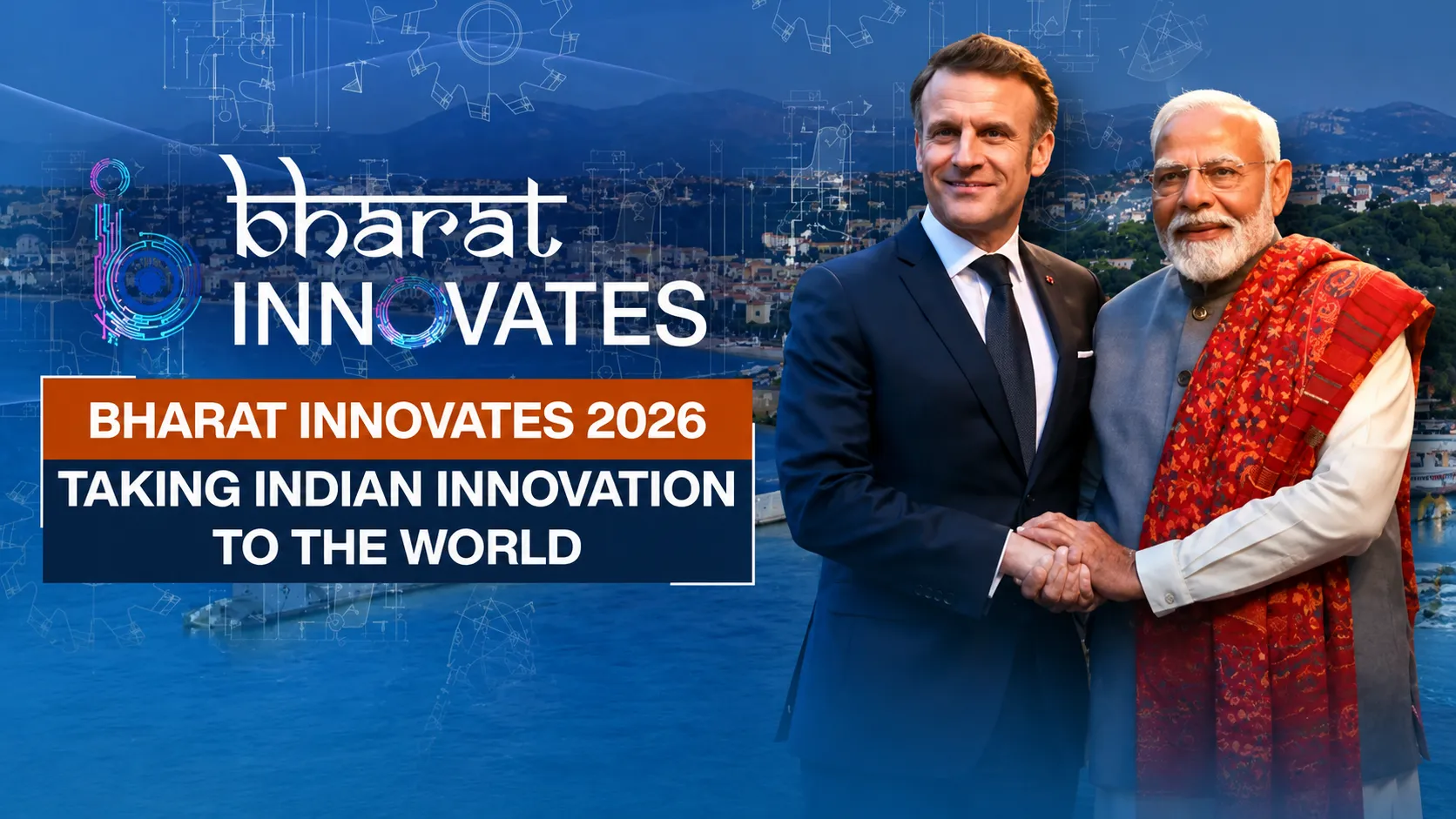
'Bharat Innovates' Takes Over Nice
Modi and Macron just launched a three‑day conclave connecting 120 Indian deep‑tech startups with global investors. The message to the world: India is done being just a services back office.
On the French Riviera, between the yachts and the palm trees, something unexpected is happening.
The red carpet is still there. The luxury boutiques are still open. The billionaires are still sipping rosé on their decks. But for three days in mid‑June, the centre of gravity in Nice has shifted from leisure to leverage — from the old economy of holidaymakers to the new economy of deep‑tech disruptors.
Prime Minister Narendra Modi and French President Emmanuel Macron on Sunday jointly inaugurated 'Bharat Innovates 2026' in Nice — a three‑day conclave bringing together 120 Indian deep‑tech startups, over 15 leading higher education institutions including the premier IITs, and venture capital funds from around the world. The event, running from June 14 to June 16, marks a crucial milestone in the ongoing India‑France Year of Innovation and underscores a rapidly expanding tech partnership between the two nations.
Diplomatic observers view it as a critical launchpad for India to showcase its deep‑tech capabilities to a global audience, attract international funding, and secure vital partnerships in emerging technologies. The message, repeated in every speech and every panel, is simple: India is done being just a services back office.
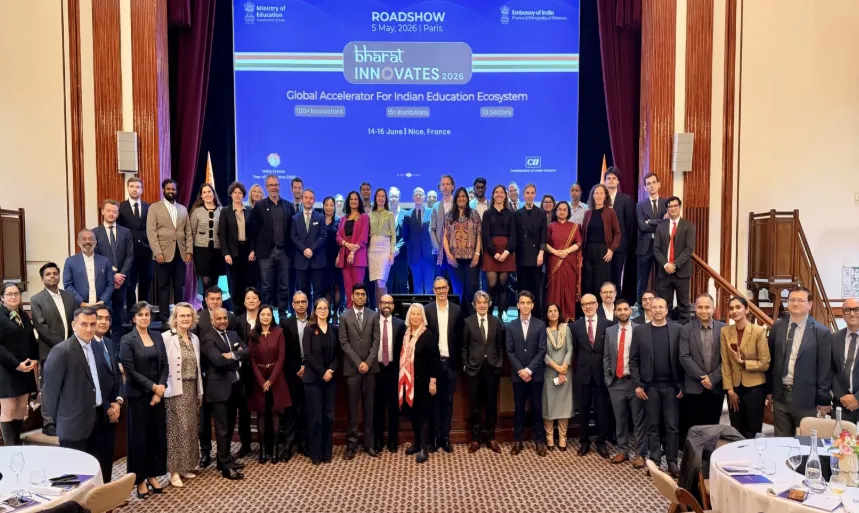
What's on Display
The showcase is formidable.
IIT Madras is presenting cutting‑edge innovations across Hyperloop technology, 5G/6G, port automation, lab‑grown diamonds, and a low‑compute indigenous AI ecosystem — 15 startups and five major research projects in total. IIT Bombay is demonstrating advancements in semiconductor design, quantum computing algorithms, and medical devices. IIT Delhi has brought its electric vehicle powertrain technology and water purification systems. Other IITs and NITs are showcasing innovations in space technology, defence, biotechnology, healthcare, and climate solutions.
The conclave will spotlight innovations across seven identified "missions": advanced computing, semiconductors, space technology, defence, biotechnology, healthcare, and climate solutions. Each mission has dedicated pavilions, with startups and research groups presenting working prototypes, not just PowerPoint slides.
"This is not a trade fair," said a senior official from India's Ministry of Electronics and Information Technology, who is travelling with the delegation. "This is a statement of capability. We are showing the world what Indian scientists, engineers, and entrepreneurs can build when given the right support."
Prior to the launch, Modi interacted with leading venture capitalists, global investors, and innovation ecosystem leaders, including OYO CEO Ritesh Agarwal and Indian entrepreneur Ronnie Screwvala. The discussions focused on funding, market access, and cross‑border collaboration — the practical mechanics of turning Indian deep‑tech into global products.
The India‑France Strategic Partnership
The Nice conclave is not an isolated event. It is the latest expression of a deepening strategic relationship between India and France, two nations that have found common ground on everything from defence to climate change to technology.
Earlier this year, the two countries elevated their bilateral ties to a 'Special Global Strategic Partnership' — a designation that signals an unusually close alignment of interests. France is already India's second‑largest arms supplier, after Russia. French companies are deeply embedded in India's nuclear energy, aerospace, and infrastructure sectors. And now, technology has joined the list.
"For France, India is a counterweight to China," a European diplomat based in Paris said. "For India, France is a gateway to Europe and a reliable partner in a world of unreliable alliances. Deep‑tech is the natural next frontier."
The Nice leg of Modi's visit also features the first bilateral summit between Modi and Macron since the elevation of the partnership. The two leaders are expected to sign several agreements in the areas of semiconductor collaboration, AI research, and space exploration — building on India's successful Chandrayaan‑3 and France's expertise in satellite technology.
After the conclave, Modi will head to Slovakia for a historic bilateral visit — the first by an Indian prime minister — before returning to France for the high‑stakes G7 Summit in Evian. At the G7, India has been invited as a guest country, a recognition of its growing economic and geopolitical heft.
The Startups to Watch
Of the 120 startups at Bharat Innovates, a handful have already generated significant buzz among investors.
Aether Dynamics, a Bengaluru‑based startup, is demonstrating a 6G base station prototype that uses AI to optimise spectrum usage. The technology, developed in collaboration with IIT Madras, could dramatically reduce the cost of 5G and 6G deployment in dense urban environments. Several European telecom operators have expressed interest.
NanoHealth, a Hyderabad startup, has developed a portable diagnostic device that can detect dozens of diseases from a single drop of blood, using AI to analyse results in under 10 minutes. The device, which costs less than $500, is being evaluated by French aid organisations for use in sub‑Saharan Africa.
TerraForm, a Pune‑based climate tech startup, is presenting a carbon capture system that uses waste heat from industrial plants to capture CO₂, which is then converted into building materials. The company has already signed a memorandum of understanding with a French cement manufacturer.
SpaceArc, a Chennai startup spun out of IIT Madras, is showcasing a small satellite propulsion system that uses water as fuel. The system, which has been tested in low Earth orbit, could make satellite propulsion dramatically cheaper and safer. French space agency CNES has expressed interest in a joint development agreement.
"The quality of Indian deep‑tech has improved enormously in the past five years," said a partner at a Paris‑based venture capital firm who attended the opening day. "We used to see incremental innovations — slightly better apps, slightly cheaper hardware. Now we're seeing fundamental breakthroughs in materials, algorithms, and systems. That's what we invest in."
The Investor Pipeline
The conclave is structured not just as a showcase but as a deal‑making engine. Each day features curated investor‑startup matchmaking sessions, where founders pitch to pre‑selected venture capital funds, corporate venture arms, and family offices.
More than 200 investors have registered for the event, including Sequoia Capital, Accel, SoftBank, Tiger Global, and several European and Middle Eastern sovereign wealth funds. The India‑France Innovation Fund, a €200 million vehicle established in 2025, is also participating, with a mandate to invest in cross‑border deep‑tech ventures.
"European investors have historically underweighted India," said the partner. "They knew IT services, they knew back‑office outsourcing. They didn't know deep‑tech. That's changing. This conclave is accelerating that change."
The government has also organised reverse buyer‑seller meets, where large French corporations — Airbus, Thales, Sanofi, L'Oréal — meet with Indian startups to explore commercial partnerships. These meetings are not about investment; they are about procurement, licensing, and co‑development.
"Investment is important, but revenue is more important," an Indian official said. "If a French company buys an Indian startup's technology, that's validation. That's a reference. That's worth more than a term sheet."
Beyond the Riviera Glitz
For all the glamour of the French Riviera setting, the stakes of Bharat Innovates are serious and long‑term.
India's deep‑tech ecosystem has grown rapidly over the past decade, but it remains underfunded relative to the United States, China, and even Europe. Indian venture capital firms have historically preferred software‑as‑a‑service and consumer internet startups — businesses with quick scaling paths and predictable revenue models. Deep‑tech, with its longer development cycles, higher capital requirements, and uncertain regulatory pathways, has been a harder sell.
The government has tried to fill the gap. The Startup India initiative, the Fund of Funds, and the various PLI schemes have all directed capital toward deep‑tech. But the amounts are small compared to the needs.
"The government can't fund every startup. That's not its job," said the Indian official. "Its job is to create the conditions for private capital to flow. That means policy stability, infrastructure, talent, and — most importantly — market access. That's what Bharat Innovates is about. Market access."
France is a market. Europe is a market. The global supply chains that run through France — aerospace, defence, pharmaceuticals, luxury goods — are markets. If Indian deep‑tech can crack those markets, the returns will be substantial.
The China Shadow
Underlying the excitement in Nice is an unspoken factor: China.
For decades, European companies looked to China for deep‑tech innovation. Chinese AI, Chinese semiconductors, Chinese biotech. The relationship was not just commercial; it was structural. European supply chains were built around Chinese components, Chinese manufacturing, Chinese R&D.
That is changing. Geopolitical tensions, intellectual property concerns, and supply chain disruptions have made Europe wary of over‑dependence on China. The search for alternatives has begun — and India is the most obvious candidate.
"India is not China. It's not trying to be China," the European diplomat said. "But it is large, it is democratic, it is increasingly aligned with European values, and it has a rapidly improving technology ecosystem. For European companies looking to de‑risk, India is the natural hedge."
The Modi government has been explicit about this opportunity. The 'China plus one' strategy — diversifying supply chains away from China — has been a central theme of Indian economic diplomacy for years. Bharat Innovates is the latest expression of that strategy, applied not to manufacturing but to deep‑tech.
"China is 10 to 15 years ahead of India in deep‑tech," the Indian official conceded. "We are not pretending otherwise. But we are growing faster. And in a world that wants alternatives, faster growth matters."
The Bottom Line
Bharat Innovates is not a trade fair. It is not a diplomatic photo opportunity. It is a deliberate, strategic, well‑funded attempt to reposition India in the global technology hierarchy — from a nation that executes other people's ideas to a nation that originates its own.
The evidence on the ground in Nice is promising. The startups are real. The technologies are real. The investor interest is real. But the journey from promising prototype to global product is long, expensive, and uncertain. Many of the startups at Bharat Innovates will fail. Some will be acquired. A few will become giants.
For India's deep‑tech ecosystem, the message from Nice is clear: the world is watching, the world is interested, and the world is ready to invest. The rest is up to the entrepreneurs, the engineers, and the policies that support them.
For Modi and Macron, standing side by side on the Riviera, the conclave is a moment of shared ambition. For the 120 startups, it is a moment of opportunity. For India, it is a moment of transition — from the back office to the front lines of global innovation.


