Beyond the Silver Screen: Inside Ranveer Singh's $170 Million Brand Empire
From Ajmal Perfumes to Jindal Stainless, Bollywood's ultimate showman is redefining celebrity branding in India.
MUMBAI — April 2026
In a country where celebrity endorsements are a cultural institution, Ranveer Singh has quietly ascended to a throne of his own making. Not the throne of a king in a Sanjay Leela Bhansali epic—though he has worn those crowns too—but something arguably more durable: the throne of India's most strategic celebrity brand architect.
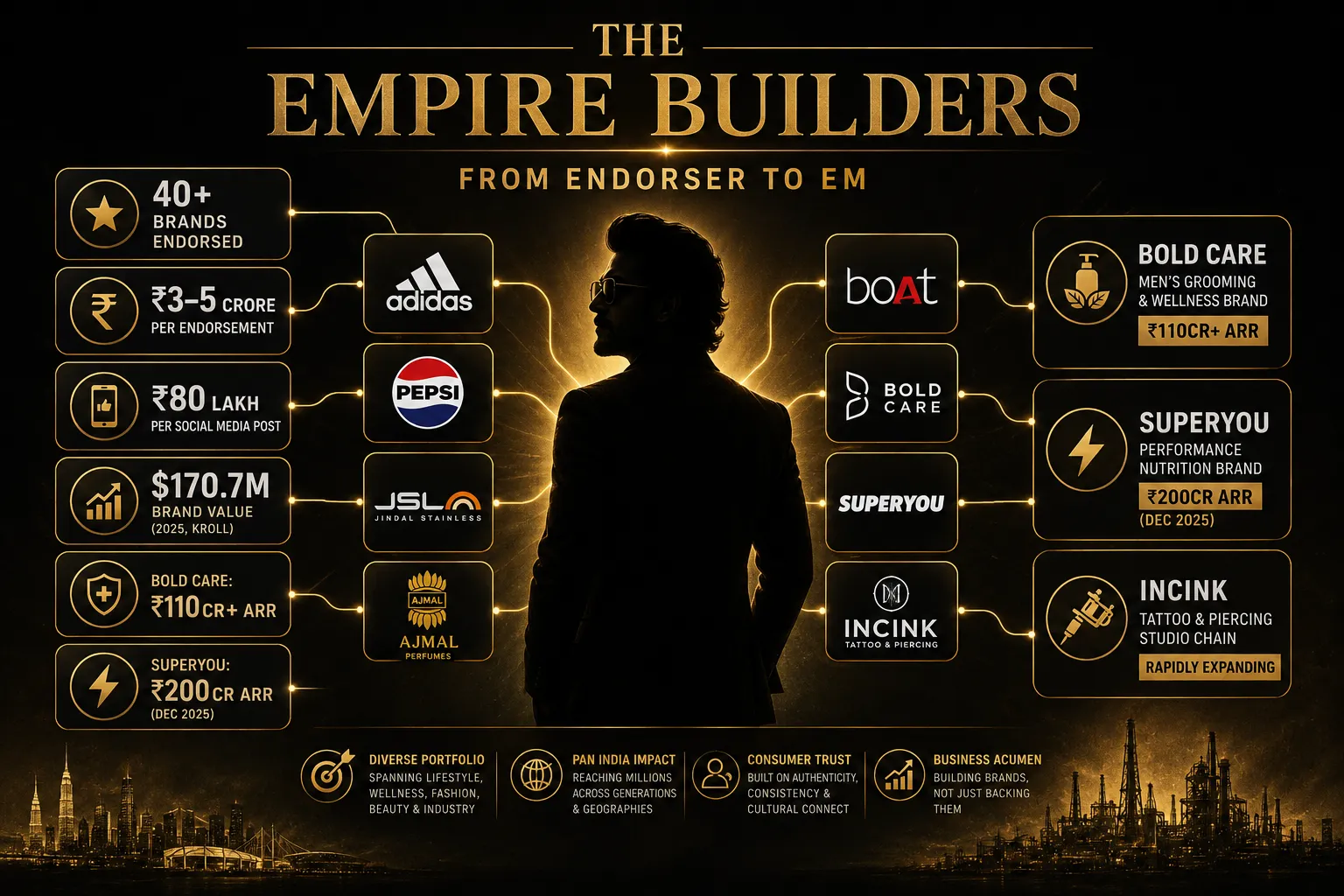
At 40, Singh presides over an endorsement portfolio of more than 40 brands, a net worth estimated between ₹350 crore and ₹400 crore (approximately $40–47 million), and a brand valuation of $170.7 million, securing him the second spot on Kroll's 2025 Celebrity Brand Valuation report, trailing only cricketer Virat Kohli. For each endorsement deal, he commands between ₹3 crore and ₹5 crore, while a single sponsored social media post fetches around ₹80 lakh ($95,000).
But the story is not about the numbers. It is about how Singh has transformed himself from a mere brand ambassador into a stakeholder, a co-founder, and—most ambitiously—a conduit for India's own creative and industrial aspirations.
The Fragrance of Power
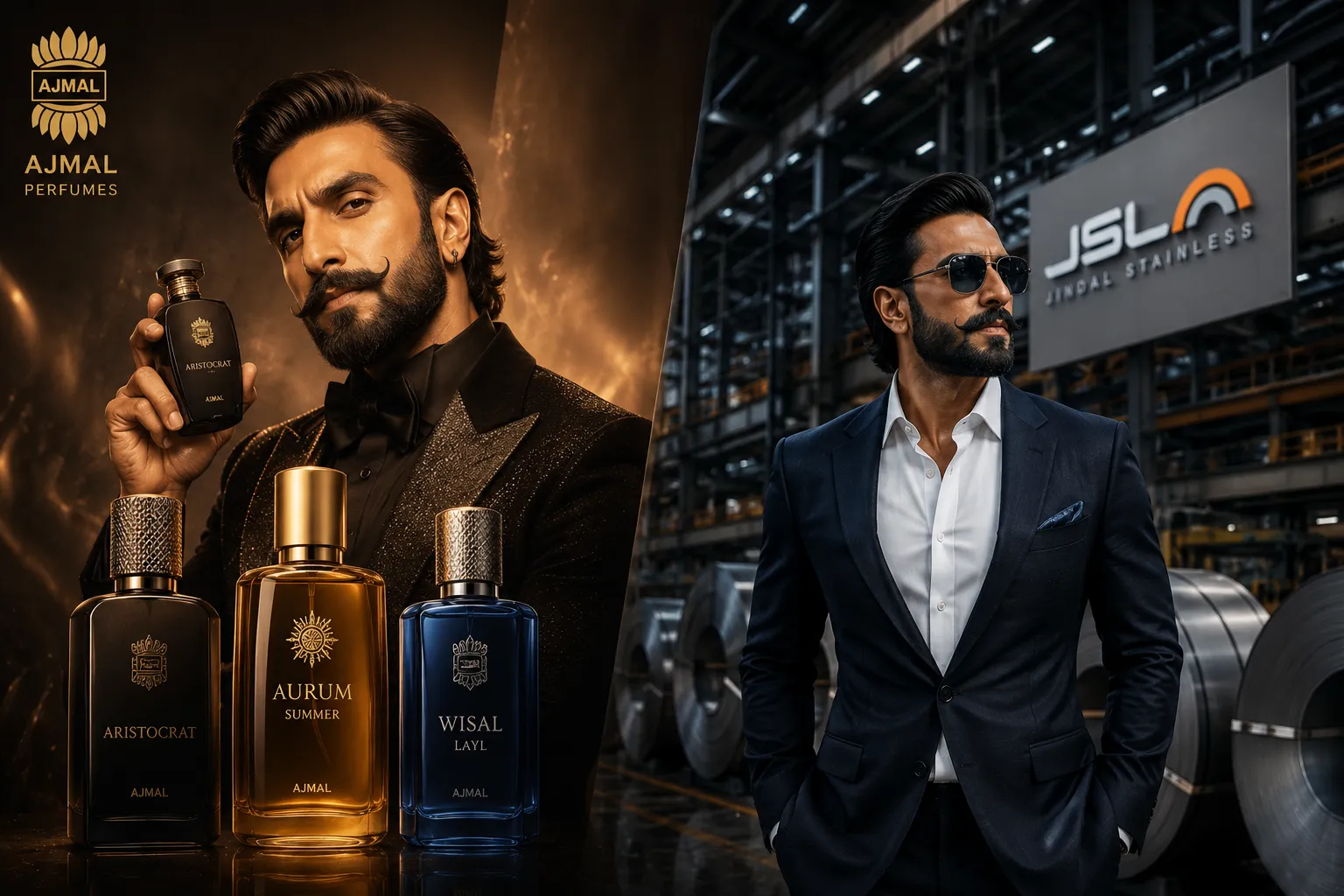
On March 19, 2026, Ajmal Dubai, the UAE-based fragrance house with 75 years of perfumery heritage, announced Singh as its brand ambassador for the "Your Unseen Power" campaign. The collaboration features three iconic fragrances—Aristocrat, Aurum Summer, and Wisal Layl—and takes over more than 575 PVR screens nationwide.
"Ajmal Dubai stands for heritage, craftsmanship and the idea that fragrance is an extension of personality, which is something I connect with personally," Singh said in the company's press release.
The appointment marks a passing of the torch: Singh succeeds Saif Ali Khan, who had held the role previously. It is a classic celebrity endorsement play, but one that reinforces Singh's carefully cultivated persona of confident, self-expressive masculinity. Abdulla Ajmal, CEO of the Ajmal Group, put it succinctly: "Ranveer Singh is more than a face for Ajmal Dubai; he shares our vision for self-expression and creativity."
Stainless Steel Meets Stardom
In April 2026, just weeks after the Ajmal announcement, Jindal Stainless Limited named Singh its first-ever brand ambassador. For a company that reported an annual turnover of ₹40,182 crore in FY25 and is ramping up to 4.2 million tonnes of annual melt capacity by FY27, this is a significant departure: Jindal Stainless had never before onboarded a celebrity endorser.
"We have always believed that the most powerful thing about a person is what cannot always be seen," says a company spokesperson. The partnership will see Singh headlining campaigns across television, digital, and social media platforms, aligning his "dynamic personality and strong connect with audiences" with the company's ethos of "durability and innovation."
Stainless steel, the company notes, has been integral to India's defining moments of progress—from Vande Bharat sleeper trains to the BrahMos defence project and the Chandrayaan-3 lunar mission. By placing Singh at the center of this narrative, Jindal Stainless is betting that his high-performance persona can make industrial materials relatable to a mass audience.
The Architecture of a Brand Ecosystem
Marketing experts describe Singh's endorsement portfolio not as a random assortment but as a "brand ecosystem"—carefully curated to reflect his high-energy, bold, and aspirational yet relatable persona. His roster includes Adidas, Pepsi, Manyavar, Puma India, Nykaa Man, Flipkart, Berger Paints, Thums Up, Nivea Men, Head & Shoulders, Kotak Mahindra Bank, JBL, and—notably—Ching's Secret, for which he recently starred in a blockbuster-style advertisement directed by Atlee.
Beyond domestic brands, Singh has positioned himself as a global ambassador for the Premier League, the NBA, and Yas Island in Abu Dhabi, leveraging his international stardom to appeal to a wider demographic. This cross-sector appeal—spanning FMCG, sportswear, finance, technology, and now heavy industry—is not accidental. It reflects a deliberate strategy to embed himself into as many facets of Indian consumer life as possible.
Equity Over Endorsement
But Singh has understood what many of his peers have only recently begun to grasp: a brand ambassador can be replaced; a stakeholder cannot. While endorsements bring in quick money, his long-term wealth strategy lies in equity and ownership.
In 2023, he became co-owner of Bold Care, a sexual wellness startup that has since achieved an annual recurring revenue of over ₹110 crore, growing month-on-month. "My investment was aimed at destigmatising discussions around sexual health in India," Singh has said.
In November 2024, he co-founded SuperYou, a protein-first snacking brand with entrepreneur Nikunj Biyani. Within months, SuperYou achieved a ₹100 crore annual run rate and later raised ₹63 crore in a Series B funding round led by V3 Ventures, with participation from Zerodha's Nikhil Kamath. The company claimed an annual recurring revenue of ₹200 crore as of December 2025.
He acquired a 50% stake in packaged foods company Elite Mindset in 2024 and launched Rangeela Vodka, a premium alcohol brand, signaling his intent to build lifestyle brands that resonate with his personality. His investment portfolio also includes early stakes in boAt (the audio and wearables brand) and SUGAR Cosmetics.
He is co-owner of the Indian team in the eISL (Electronic Indian Super League), tapping into India's rapidly growing esports market—a space most Bollywood stars have yet to enter.
The Deepika Factor
Singh does not operate alone. Alongside his wife, actor Deepika Padukone—who is currently the richer partner, with higher earnings from global luxury endorsements and her skincare business 82°E—the couple has jointly invested in brands such as Epigamia and Bellatrix Aerospace. Their combined brand power and financial acumen make them arguably India's most formidable celebrity-investor couple.
The Creative Entrepreneur
Before he was an actor, Singh was a copywriter. He has studied the semiotics of advertising and retains a flair for ideation and consumer behavior. "I don't claim to know it all when it comes to business, but I do have a sharp eye for good prospects and opportunities," he told Fortune India. "I have a flair for ideation and a knack for understanding consumer behaviour, and how to position a product effectively."
This background informs his hands-on approach. He is known to contribute to branding, product decisions, and even taste-testing in his ventures. In 2019, he co-founded IncInk Records, a music label supporting homegrown hip-hop talent from smaller towns, helping mainstream a genre that Bollywood had long overlooked.
The Bigger Picture
Singh's rise as a brand architect coincides with India's broader ambitions in the creative economy. The government's recent push for the AVGC sector, the ₹250 crore Content Creator Labs, and the WAVES summit all point toward a future where Indian creativity is not merely outsourced but owned. Singh embodies this shift: a homegrown talent who commands global brand fees while investing back into Indian startups, Indian artists, and Indian industries.
His brand value, pegged at over $170 million in 2025, may have dipped from its 2022 peak of $181.7 million (when he toppled Virat Kohli as India's most valued celebrity), but his strategic pivot from endorser to equity partner suggests a different metric of success. He is not merely selling his face; he is building an empire.
What This Means for Global Brands
For international brands looking to enter or expand in India, the Singh playbook offers a clear template: authenticity, breadth, and ownership. He is not a hired face for a single campaign; he is a long-term partner who brings creative input, cultural resonance, and—increasingly—equity to the table. His ability to span categories from luxury perfumes to industrial stainless steel demonstrates a versatility that few global celebrities can match.
As India's consumer economy continues to expand—with a projected middle class of 600 million by 2030—the value of a celebrity who can speak to aspiration and relatability simultaneously will only grow. Singh has positioned himself at the intersection of both.
The Bottom Line
Ranveer Singh's brand empire is not an accident of fame. It is a calculated, multi-decade project of persona management, strategic partnership, and genuine business acumen. From the scent of Ajmal's Aristocrat to the heft of Jindal's stainless steel, he has become the common thread running through India's consumer imagination.
In an era where celebrity is abundant but trust is scarce, Singh has done something remarkable: he has made himself indispensable.


