Beyond the Screen — How Indian Stars Are Quietly Building Billion‑Dollar Investment Portfolios
The Friday Flop That Doesn’t Matter Anymore
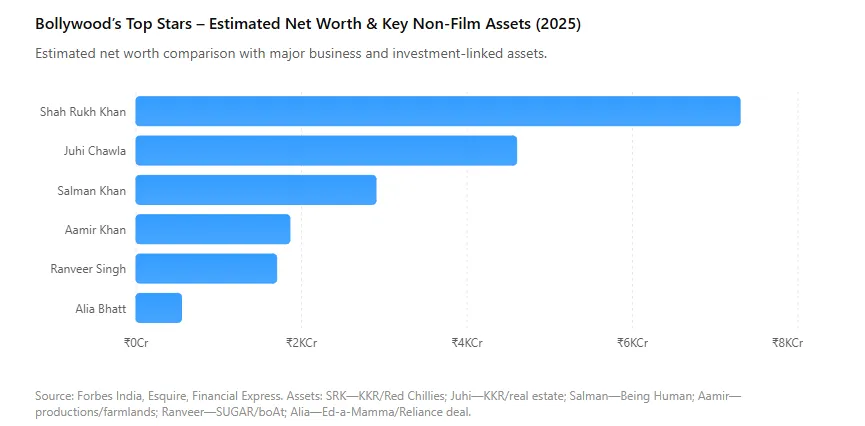
In 2018, Shah Rukh Khan delivered a film called Zero. It cost over ₹200 crore to make and earned barely ₹100 crore worldwide. By any standard, it was a disaster. Yet, a few months later, Forbes India estimated SRK’s net worth at ₹4,200 crore. How? Because his production company Red Chillies Entertainment, his IPL team Kolkata Knight Riders (KKR), his Dubai-based investments, and his family office’s startup portfolio kept printing money while the film tanked.
This is the new reality of Bollywood. Stars have realised that acting is a high-risk, low-ROI business compared to equity investing. One flop can erase months of work, but a well-timed investment in a startup or real estate can compound for years.
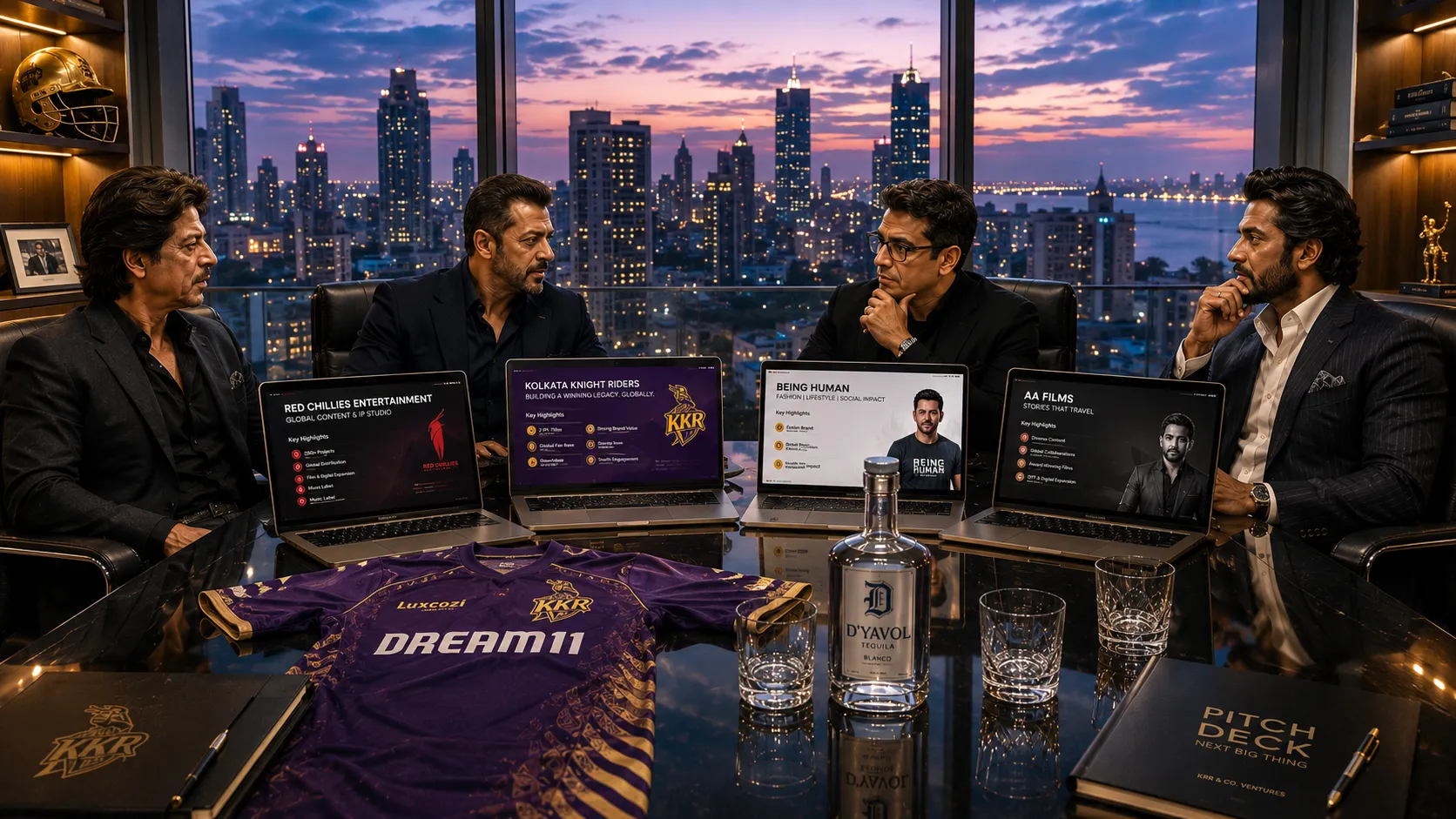
Today, every A-list star has a family office. They hire investment bankers, chartered accountants, and fund managers. They attend startup pitch meetings. They take board seats. They are no longer just faces on a brand’s Instagram post—they are owners.
Shah Rukh Khan: The Baadshah of Diversification
SRK’s portfolio is the most studied in Bollywood. According to a Financial Express analysis, his family office has deployed over ₹1,000 crore across more than a dozen companies. The investments span:
Technology & Media: Red Chillies Entertainment (VFX, production), Red Chillies VFX (one of India’s largest visual effects studios), and Meerkat (a video streaming app for sports highlights).
Health & Wellness: Numi, a health-tech venture focused on medical tourism and telemedicine.
D2C & Retail: Nourish (a health food brand), MirrAR (augmented reality try-on technology for jewellery).
Edutainment: KidZania India (the indoor theme park chain), where SRK is a key investor.
Real Estate: Multiple properties in Dubai, London, Alibaug, and Delhi, apart from the iconic Mannat in Bandra.
Cricket & Sports: Kolkata Knight Riders (IPL), which alone is valued at over ₹3,800 crore.
In 2024, SRK’s family office co-invested ₹100 crore with Ashika Group in a new media venture. His son Aryan Khan launched a premium tequila brand, D’Yavol, in partnership with Radico Khaitan. The SRK brand is no longer just a person—it’s an institution.
Juhi Chawla: The Quiet Billionaire Who Started Early
While SRK grabs headlines, Juhi Chawla has quietly built a net worth of ₹7,790 crore, according to Esquire. How? She married industrialist Jay Mehta, but she didn’t just sit on his wealth. She co-owns the Kolkata Knight Riders (with SRK and Mehta). She invested in real estate at the right time. She backed several tech startups early, including the now-defunct but profitable-at-exit social media platform.
Juhi also owns a significant stake in Red Chillies Entertainment. She has never been a flashy investor—no reality shows, no investment pitch events—but her portfolio is one of the most diversified in Bollywood. Her lesson: start early, stay quiet, and let compounding do the work.
Salman Khan: The Mass-Market Investor with a Different Strategy
Salman Khan doesn’t invest in startups. He builds them. His biggest bet is Being Human—a clothing, accessories, and perfume brand that donates a portion of its profits to charitable causes. Being Human is now a ₹1,200 crore brand, operating across 100+ stores in India and overseas.
Salman also has a chain of gyms, a production house (SKF), and a real estate portfolio that includes a massive farmhouse in Panvel and an apartment in Bandra. His investment thesis is simple: own brands that his fan base—the masses—will buy. He doesn’t need edtech or fintech. He needs t-shirts, perfumes, and gym memberships.
Aamir Khan: The Method Actor Investor
Aamir Khan takes as much time to pick an investment as he does to pick a script. His most notable investment is the production company Aamir Khan Productions, which has produced blockbusters like Dangal, PK, and Laal Singh Chaddha. But beyond films, he invested in a chain of organic farms, a water conservation startup, and a health food brand.
Aamir also owns a significant stake in the streaming platform that releases his films. He negotiated a profit-sharing deal for Laal Singh Chaddha that gave him a slice of the OTT revenue. He is known to be one of the most meticulous negotiators in Bollywood.
The New Guard: Ranveer, Deepika, and the Rise of the Celebrity VC
The younger generation is taking it even further. Ranveer Singh has equity in SUGAR Cosmetics, boAt, and Bellatrix Aerospace (a space-tech startup!). Deepika Padukone started her own brand 82°E, a skincare and wellness range, and has personally invested in Noto, a consumer goods platform, and Epigamia.
Alia Bhatt launched her own children’s brand, Ed-a-Mamma, and sold a majority stake to Reliance Retail, pocketing an estimated ₹150 crore. She also runs a production house, Eternal Sunshine Productions, which is backing young content creators.
These stars don’t just endorse—they negotiate equity. A typical celebrity deal today includes: a fixed fee, a performance bonus, and an equity stake in the company. Some even get board observer seats.
The Economics: Why Celebrity Investment Makes Sense for Startups
Why do startups give equity to celebrities? Because the math works. A brand that pays ₹5 crore to a celebrity for a one-year endorsement may see a 10% bump in sales. But a brand that offers 2% equity to a star who becomes a genuine advocate can see their valuation triple when the star promotes them on social media.
Take SUGAR Cosmetics. After Ranveer Singh invested, the brand’s social media reach exploded. His Instagram posts featuring SUGAR products generated millions of views. The company’s valuation jumped from ₹1,500 crore to ₹2,800 crore in two years—far more than the cost of the equity he received.
Similarly, boAt’s association with multiple cricketers and Bollywood stars turned it into a lifestyle brand. When celebrities wear boAt headphones in their Instagram reels, it drives aspirational demand among millions of followers.
Risks and Critiques
Celebrity investing isn’t without risk. Many stars have lost money on bad bets. Hrithik Roshan’s clothing brand HRX took years to become profitable. Several actors invested in now-defunct startups that promised quick returns. The key difference is that the smarter ones treat investing as a long-term play, not a get-rich-quick scheme.
There’s also a critique that celebrities get unfair access to deals. A startup might offer a celebrity equity at a discount just for the publicity, shutting out other investors. The debate over whether this distorts the market continues.
The Future: Bollywood’s Wealth Engine
As of 2026, the combined net worth of Bollywood’s top 10 actors is estimated at over ₹50,000 crore. A significant portion of that comes from non-film activities. The trend is only accelerating. Younger stars are being taught financial literacy early. Managers now pitch not just films but also investment opportunities.
The box office may still be the heartbeat of Bollywood, but the wealth engine runs on something else: smart, diversified, long-term investing.
.