Beyond Chips: How ₹2,000 Crore in Fresh Deep Tech Funds Is Betting on India's Quantum, Semicon and Space Future
The ₹2,000 Crore Question
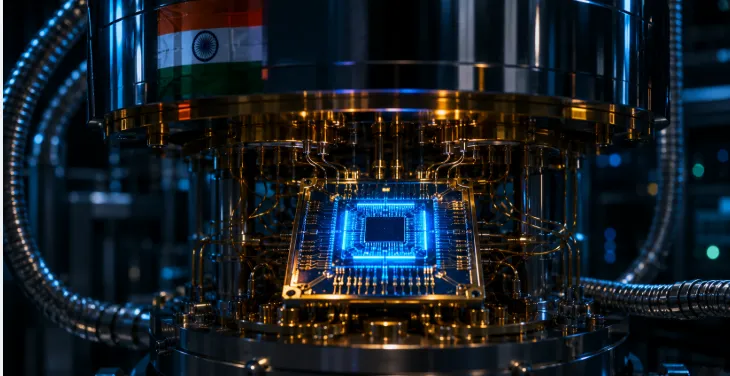
What do a quantum computer, a reusable rocket and a 3nm chip have in common? They are all technologies that India has historically imported. And they are all technologies that a new wave of patient, risk‑hungry Indian capital is now betting on.
In the first half of 2026, a series of deep tech fund announcements sent a clear signal to the global innovation ecosystem: India is no longer just a market for software and services. It is becoming a builder of foundational, IP‑driven technologies that will define the next two decades.
The numbers are eye‑watering:
IIT‑Madras & Unicorn India Ventures: ₹600 crore fund for early‑stage deep tech.
Celesta Capital: ₹2,000 crore India‑focused deep tech fund (planned).
Unicorn India Ventures (Fund III): ₹1,200 crore for semicon, spacetech, AI infrastructure.
Chiratae Ventures: $10 million for five deep tech startups via Sonic DeepTech.
Government of India (National Quantum Mission): Actively supporting quantum startups with grants and infrastructure.
This is not seed funding. This is patient, institutional capital backing technologies that take a decade to mature. And it is coming at exactly the right moment, as global supply chains fragment and India positions itself as a trusted alternative to China for high‑tech manufacturing and R&D.
The IIT‑Madras – Unicorn India Ventures ₹600 Crore Fund
The most significant academic‑industry partnership in Indian deep tech history was announced in February 2026. IIT‑Madras joined hands with Unicorn India Ventures to launch a ₹600 crore (approx. $72 million) deep tech venture capital fund, with support from the Department of Science and Technology (DST) and Office of the Principal Scientific Adviser to the Government of India.
Unlike generalist funds, this vehicle is exclusively focused on IP‑led, capital‑efficient startups in semiconductors, quantum computing, robotics, spacetech, artificial intelligence, and defence technology. The fund will invest in companies emerging not just from IIT‑Madras but from incubation centres across the country.
Anil Joshi, Managing Partner of Unicorn India Ventures, captured the philosophy: “Deep tech is not for the faint‑hearted. It takes 7–10 years to build a semiconductor company. But the moats are unbreachable once you succeed. This fund is designed to stay the course.”
The fund will make 20‑25 investments over its lifecycle, with ticket sizes ranging from ₹2 crore to ₹20 crore per startup. It will also provide access to IIT‑Madras’s world‑class testing labs, clean rooms and mentorship networks – a critical advantage for hardware‑heavy startups that cannot rely on cloud infrastructure alone.
“Deep tech companies are not meant to scale like social media apps. They require patience, infrastructure and a long‑term vision. That is exactly what this fund provides.” — Professor V. Kamakoti, Director, IIT‑Madras, February 2026
Celesta Capital's ₹2,000 Crore India Bet
If the IIT‑Madras fund is a deep tech seedling, Celesta Capital is planting a forest. In March 2026, the Silicon Valley‑headquartered venture firm – founded by former Apple executives and semiconductor veterans – announced plans to launch a ₹2,000 crore (approx. $240 million) India‑focused deep tech fund.
Celesta already has a strong India track record. It backed Steradian Semiconductors (acquired by Reliance), Tata Elxsi and several other deep tech successes. The new fund will target semiconductor design, advanced manufacturing, spacetech, and AI infrastructure.
What makes Celesta’s move notable is its timing. While global VC firms have pulled back from late‑stage tech, Celesta is doubling down on early‑stage deep tech in India – a contrarian bet that signals confidence in India’s engineering talent and growing domestic market for high‑tech products.
The fund is expected to be operational by Q1 2027, with a first close targeted for late 2026.
Unicorn India Ventures Fund III: ₹1,200 Crore for Semicon, Spacetech and AI Infra
Even before the IIT‑Madras partnership, Unicorn India Ventures was already scaling its deep tech ambitions. In late 2025, the firm announced Fund III with a target corpus of ₹1,200 crore (approx. $144 million) , focusing on semiconductor design, spacetech, AI infrastructure, and climate tech.
Fund III will back approximately 30‑35 startups with investments ranging from ₹5 crore to ₹40 crore per company. The firm has already made several investments from this fund, including a leading semiconductor startup and a spacetech company that are currently in stealth mode.
Unicorn India Ventures has been one of the most consistent deep tech backers in the country, with earlier funds investing in companies like NubeGo (EV charging), GenY Medium (AI marketing) and SmartCoin (fintech). Fund III represents a deliberate pivot toward deeper, more capital‑intensive technologies.
Chiratae Ventures' Sonic DeepTech: $10 Million for 5 Startups
Not to be outdone, Chiratae Ventures – one of India’s oldest and most respected VC firms – announced a $10 million commitment to five deep tech startups through its Sonic DeepTech program in April 2026. The program is designed to identify and scale early‑stage companies in robotics, computer vision, advanced materials, and semiconductor design.
Unlike traditional VC, Sonic DeepTech combines equity investment with hands‑on operational support, including help with patent filing, regulatory navigation, and global customer acquisition. The first cohort of five startups is expected to be announced by September 2026.
Chiratae’s move is significant because the firm has historically been known for consumer internet and SaaS investments (Flipkart, FirstCry, Lenskart). Its deliberate shift into deep tech signals that even generalist VCs now see fundamental IP as the next growth engine.
The Government's Quantum Push: National Quantum Mission
No deep tech ecosystem can thrive without government backing. India’s National Quantum Mission (NQM) , launched in 2023 with a budget outlay of ₹6,003 crore (approx. $720 million) over eight years, is already bearing fruit.
The mission focuses on four verticals:
Quantum Computing – building quantum processors with 50‑100 physical qubits.
Quantum Communication – developing quantum key distribution (QKD) networks.
Quantum Sensing & Metrology – for defence, healthcare and geological exploration.
Quantum Materials & Devices – indigenous fabrication of cryogenic systems, control electronics.
In 2025‑2026, the NQM has supported 25+ quantum startups through grants of up to ₹2 crore each, access to government labs, and mentorship from institutions like IISc, IIT‑Bombay, IIT‑Madras and C-DOT. Several of these startups are now in advanced discussions with VCs for follow‑on funding.
Additionally, the India Semiconductor Mission (ISM) , approved with ₹76,000 crore ($9 billion) in incentives, has approved 12 semiconductor units as of May 2026, covering fabrication, ATMP/OSAT, compound semiconductors and advanced packaging. This creates a massive downstream market for deep tech startups working on chip design, EDA tools, and semiconductor materials.
The Deep Tech Startup Examples (Stealth but Real)
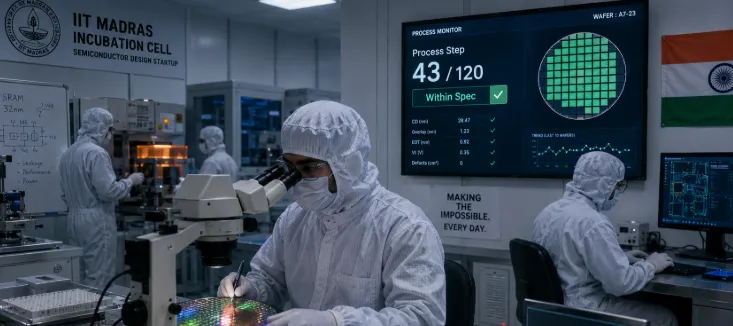
While many deep tech startups remain in stealth (for good reason – patents and trade secrets), a few have emerged:
QpiAI (Bengaluru): Building a full‑stack quantum computing platform and has raised $4.5 million.
BosonQ (Indore): Developing quantum algorithms for logistics and drug discovery.
Sigma Quantum (Mumbai): Focused on quantum random number generators for cybersecurity.
Mentorix (IIT‑Madras incubated): Semiconductor design tools (EDA) for analog chips.
Satellize (Hyderabad): Building satellite propulsion systems and has raised $5 million.
These are the leading edge of a pipeline that will only accelerate as the new deep tech funds become operational.
Why Patience Matters: The 7‑Year Horizon
Deep tech is not for every investor. Unlike a D2C brand that can hit ₹100 crore revenue in three years, a semiconductor startup might take 5‑7 years to produce its first revenue-generating chip. A quantum computing startup might not see commercial revenue for a decade.
But the payoffs are disproportionately large. Once a deep tech company establishes a patent portfolio, a unique manufacturing process or a first‑mover advantage in a nascent field, its moat is nearly impossible to cross. Acquisitions in deep tech often happen at 5‑10x revenue or 50‑100x initial investment – far exceeding typical SaaS multiples.
The new wave of Indian deep tech funds is structured precisely for this timeline. The IIT‑Madras – Unicorn India Ventures fund, for example, has a 10‑year life with two possible one‑year extensions. Celesta’s fund is expected to have a similar horizon.
The Global Indian Takeaway
For the diaspora, the deep tech surge offers three distinct opportunities.
First, invest as a limited partner (LP). The new deep tech funds are raising from institutional and family offices. While individual minimums are high (typically ₹1‑5 crore), syndicates and feeder funds are emerging. This is a way to gain exposure to a diversified portfolio of frontier technologies without picking individual winners.
Second, mentor and advise. Deep tech founders desperately need experienced operators who have scaled hardware or scientific companies. Diaspora professionals with backgrounds in semiconductor fabs, aerospace, quantum research or robotics can add immense value – and earn equity or advisory fees.
Third, build cross‑border R&D partnerships. Indian deep tech startups need access to global research ecosystems. A diaspora professional can facilitate collaborations between Indian startups and US/European universities, national labs or corporate R&D centres.
The Final Word
The ₹600 crore IIT‑Madras fund, the ₹2,000 crore Celesta fund, the ₹1,200 crore Unicorn India Ventures Fund III, and Chiratae’s Sonic DeepTech – these are not isolated announcements. They are a coordinated signal that Indian capital is finally ready for the long game.
For decades, Indian innovation was synonymous with IT services and, later, consumer internet. The next decade will be defined by quantum processors, indigenous chip design, reusable rockets and AI infrastructure built in India for the world.
The patient capital is now flowing. The labs are being equipped. The startups are emerging from stealth.
The deep tech revolution is no longer coming. It is already here.
CHART: “India’s Deep Tech Funding Surge – At a Glance (2026)”
Fund / Program | Corpus | Focus Areas | Status |
|---|---|---|---|
IIT‑Madras + Unicorn India Ventures | ₹600 crore (~$72M) | Semiconductors, quantum, robotics, spacetech, AI, defence | Launched Feb 2026 |
Celesta Capital India Fund | ₹2,000 crore (~$240M) | Semiconductor design, advanced manufacturing, spacetech, AI infrastructure | Planned (operational Q1 2027) |
Unicorn India Ventures Fund III | ₹1,200 crore (~$144M) | Semiconductor design, spacetech, AI infrastructure, climate tech | Active (first close late 2025) |
Chiratae Ventures Sonic DeepTech | $10M for 5 startups | Robotics, computer vision, advanced materials, semiconductor design | Announced April 2026 |
National Quantum Mission (Govt) | ₹6,003 crore (~$720M) over 8 years | Quantum computing, communication, sensing, materials | Active; 25+ startups supported |
India Semiconductor Mission | ₹76,000 crore (~$9B) incentives | Semiconductor fabs, ATMP, compound semiconductors, packaging | 12 units approved as of May 2026 |
Key Startups (Examples):
Startup | Location | Focus | Known Funding |
|---|---|---|---|
QpiAI | Bengaluru | Full‑stack quantum computing | $4.5M |
BosonQ | Indore | Quantum algorithms for logistics, drug discovery | Early stage |
Sigma Quantum | Mumbai | Quantum random number generators | Grant‑funded |
Mentorix | IIT‑Madras | EDA tools for analog chips | Incubated |
Satellize | Hyderabad | Satellite propulsion systems | $5M |
Sources: IIT‑Madras press release, Celesta Capital announcement, Unicorn India Ventures, Chiratae Ventures, DST, India Semiconductor Mission, Tracxn


