There Is a Better Way to Build Consumer Brands. Three Founders from the Heart of India's Digital Economy Just Raised ₹42 Crore to Build It.
The conventional playbook for building a consumer brand in India looks like this. Identify a product category. Develop a product. Build a brand identity. Spend aggressively on performance marketing and influencer campaigns to acquire customers. Optimise the funnel. Raise more capital when customer acquisition costs rise. Repeat.
The playbook works — up to a point. It works until the performance marketing channels get competitive and expensive. It works until the brand identity becomes indistinguishable from the fifty other brands running the same playbook in the same category. It works until the product development cycle falls behind what consumers are actually asking for, because the consumer insight process was too slow and too expensive to run continuously.
BCT Ventures was founded on the conviction that there is a structurally better way to build consumer brands — one where artificial intelligence is embedded across every stage of the value chain, from the identification of market opportunity through product development and formulation to distribution, growth, and the continuous optimisation of every marketing decision.
On July 2, 2026, the company officially launched operations alongside the announcement of ₹42 crore in seed funding led by 3one4 Capital.
Who Built It — and Why Their Backgrounds Matter
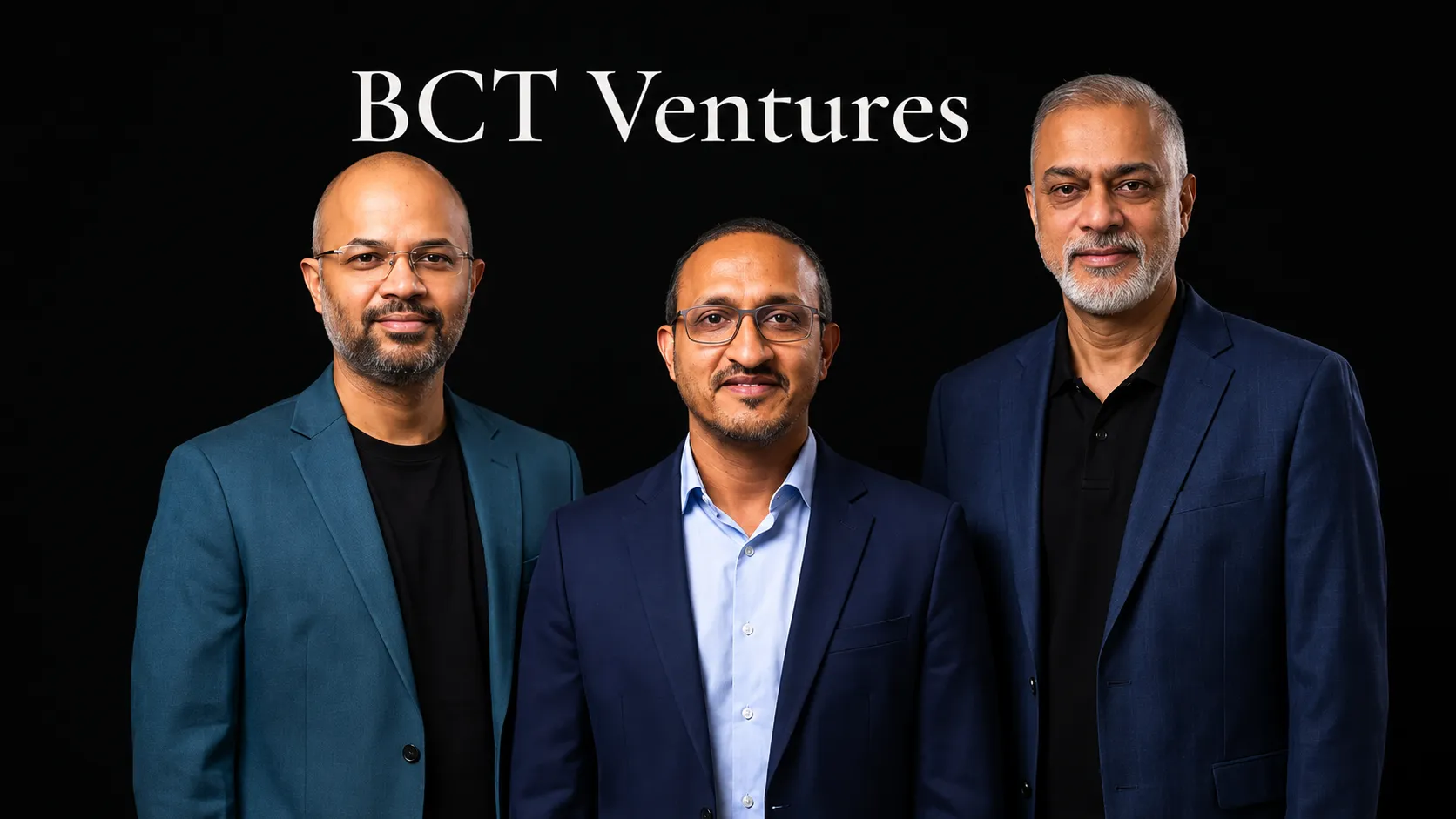
BCT Ventures was co-founded by Kashyap Vadapalli, KV Ravi Shekhar, and Anubhav Sonthalia. The specific companies they came from are not incidental background. They are the argument for why this founding team can build what it is claiming to build.
The founding team's combined experience spans Google, eBay, Pepperfry, Vedantu, WPP, Sokrati, and Dentsu — the companies that have collectively defined how digital marketing, consumer e-commerce, and performance growth work in India. This is a team that has spent its careers at the intersection of data, consumer behaviour, and the mechanics of building audiences and converting them into customers. They know, from direct experience, where the conventional consumer brand playbook breaks down — and they have built BCT Ventures specifically to replace the parts that break.
Anubhav Sonthalia articulated the founding thesis in terms that name the ambition precisely: "At BCT Ventures, we've built an AI-native operating system that helps us make better decisions at every stage, from identifying opportunities to launching and scaling brands. We believe this is how the next generation of consumer companies will be built."
An operating system. Not a brand. Not a marketing agency. Not a single product. The claim is that BCT Ventures is building the underlying decision-making infrastructure — the system — that consumer brand building should run on, and then using that system to build multiple brands rather than one.
The Three AI Engines — What They Do and Why They Matter
BCT Ventures' operating thesis rests on three proprietary AI engines that replace or significantly augment the highest-cost, highest-uncertainty stages of the conventional consumer brand development process.
Nucleus handles product development. It translates practitioner expertise — the clinical knowledge of the doctors, nutritionists, and health experts who partner with BCT Ventures — alongside AI-based market analysis into product development decisions. The claim is that Nucleus can identify what products consumers in a given category actually need, what formulations will work, and what differentiation will be sustainable — before the expensive and time-consuming traditional product development process begins.
Resonance handles audience development and consumer insights. It builds the practitioner-led audiences — the communities of health professionals and their patients that form the distribution backbone of BCT Ventures' brands — and gathers consumer insights through AI-driven workflows that are faster and more continuous than conventional survey-based or focus group-based research. In a category like nutrition and wellness, where consumer needs and scientific understanding are both moving quickly, the ability to gather and act on consumer insights in near-real-time is a genuine competitive advantage.
Meridian handles growth. It manages the marketing functions — creative testing, media buying, return-on-ad-spend optimisation — that consume the largest share of most consumer brand budgets and where the difference between a brand that grows profitably and one that burns through capital chasing customer acquisition is often the quality of the marketing decisions being made. Meridian replaces the human judgment that currently makes those decisions (imperfectly, expensively, and at limited speed) with AI-driven optimisation that is faster, cheaper, and continuously learning.
Together, the three engines replace the three most expensive and most uncertain stages of the conventional consumer brand development process with AI-driven systems that get better with every brand BCT Ventures builds through them.
Why Nutrition and Wellness First
BCT Ventures' choice of nutrition and wellness as its launch category is specific and well-argued.
India's nutrition and wellness market is shifting from generic products to practitioner-backed, protocol-led solutions. Urban Indian consumers are increasingly moving away from the mass-market supplements that fill pharmacy shelves and toward products recommended by doctors, nutritionists, and health professionals whose credibility they trust. This shift creates a specific market structure: the distribution channel is practitioner-led, meaning the brands that win are the ones that practitioners actually recommend, and the products that practitioners recommend are the ones that have genuine clinical backing rather than marketing-led claims.
BCT Ventures' model — building brands around protocol-led products and practitioner-owned distribution — is specifically designed for this market structure. The AI engines power the product development and growth; the practitioners provide the clinical credibility and the distribution network. The combination addresses the two things that most consumer nutrition brands are weakest at simultaneously: genuine product efficacy and trusted distribution.
India's nutrition and wellness market was valued at approximately $164 billion in 2025 and is projected to reach $257 billion by 2034. The nutritional supplements segment specifically is growing at approximately 8 per cent annually. The opportunity is large, the market is shifting toward the product and distribution model that BCT Ventures is building for, and the timing — as India's healthcare system shifts its emphasis from curative to preventive care — is creating demand that is structural rather than cyclical.
Why 3one4 Capital Led the Round
3one4 Capital manages ₹2,300 crore in committed capital and has backed companies including Licious, Darwinbox, and KukuFM. Its portfolio carries over $11 billion in enterprise value with five unicorns and over $2.47 billion in follow-on equity raised. It has been ranked by Preqin as India's top-performing VC for two of its funds.
Anand Batra of 3one4 Capital framed the investment thesis at the model level rather than at the category level: "BCT Ventures is building a new operating model for consumer brand creation, embedding AI across insight, product development, distribution and growth from day one."
The emphasis on "day one" is the investment logic. 3one4 is not backing a brand that is retrofitting AI onto a conventional operating model. It is backing a company that was designed from the ground up to be AI-native — a company where the absence of AI would be the absence of the core capability rather than the absence of a feature.
The timing of the investment reflects 3one4's broader conviction about where AI is going in the Indian consumer market: not as a tool that improves existing processes but as an infrastructure layer that enables entirely new operating models that were not possible before. BCT Ventures is building one of those new operating models. The ₹42 crore seed is the capital that funds the proof.
The Larger Ambition
BCT Ventures is launching in nutrition and wellness, but the stated intention is not to be a nutrition and wellness company. It is to be an AI-native consumer brands platform that uses nutrition and wellness as its first proof point, and then applies the same operating thesis to other underserved consumer categories where trusted education, product depth, and repeatable growth infrastructure can create category-leading brands.
The venture studio model — building multiple brands through a shared operating infrastructure — produces a fundamentally different economics from the single-brand consumer company. The AI engines, the practitioner network, the data accumulated across brands, and the growth infrastructure all become more valuable with every additional brand that runs through them. The second brand benefits from what the first brand taught the system. The tenth brand benefits from what the first nine taught it.
This is the compounding logic that makes the AI-native venture studio thesis compelling as an investment — not just the quality of any single brand it builds, but the cumulative improvement of the operating system that builds them.
BCT Ventures launched on July 2, 2026. The operating system is live. The first brands are being built. And 3one4 Capital has given it ₹42 crore to demonstrate that the next generation of consumer companies will be built differently from the last.


