
It Took Years to Earn. It Could Be Gone in a Court Filing.
For most people who have gone through the process of becoming a naturalized American citizen, the journey is measured in years and sacrifice. Years of waiting, years of paperwork, years of maintaining legal status, years of demonstrating the kind of presence and intention and clean record that the naturalization process demands. The oath of allegiance, when it finally comes, is not a bureaucratic formality for most people who take it. It is the conclusion of a chapter that consumed a significant part of their adult life.
On June 8, 2026, the United States Department of Justice announced that it was moving to take that away from 17 people.
The announcement — framed as the latest and largest round of what officials are describing as a historic denaturalization campaign — targeted 17 naturalized US citizens across multiple states, accused of concealing serious crimes or providing false information when they applied for citizenship. The offences alleged range from healthcare fraud and financial crimes to sexual abuse of children, drug trafficking, and immigration fraud. Acting Attorney General Todd Blanche was direct in the language he used:
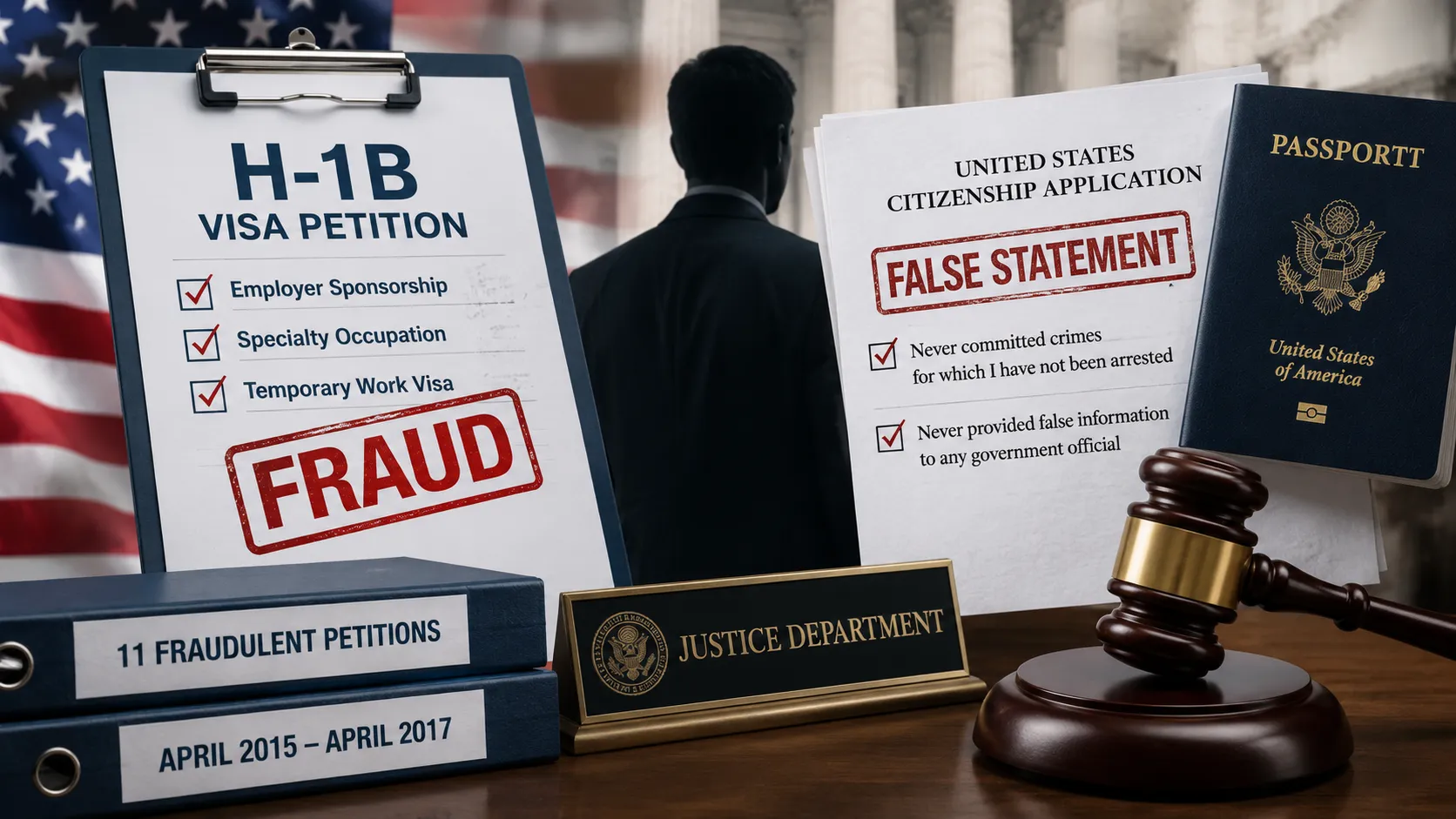
Among the 17 is Neeraj Sharma, 50, a native of India and the former owner and chief executive officer of Magnavision LLC, a staffing company based in New Jersey.
Who Is Neeraj Sharma and What Is He Accused Of
Sharma's case, as laid out in a civil complaint filed in the US District Court for the District of New Jersey, concerns the H-1B visa programme — the same visa category that has been at the centre of months of political controversy in the United States, particularly as it relates to Indian tech workers.
According to the DOJ, Sharma signed and submitted 11 fraudulent H-1B visa petitions with US Citizenship and Immigration Services between April 2015 and April 2017. The petitions, prosecutors allege, falsely claimed that the foreign workers being sponsored would be employed by a global financial institution. The applications allegedly included forged letters bearing the signatures of executives at that institution — documents that did not authorise the use of their names and were fabricated to make the petitions appear legitimate.
Sharma applied for US citizenship in 2017 — a period during which, according to the government, the fraudulent conduct was ongoing. In his citizenship application and subsequent interview with a USCIS officer, prosecutors allege he swore under oath that he had never committed crimes for which he had not been arrested, and had never provided false information to a government official. Both of those statements, the DOJ contends, were false.
Under the Immigration and Nationality Act, naturalized US citizenship can be revoked if it was illegally procured or obtained through the concealment of a material fact or wilful misrepresentation. The government's denaturalization action against Sharma rests on the claim that he obtained his citizenship fraudulently — that the oath he swore was a lie at the moment he swore it.
The case is a civil denaturalization action, not a new criminal prosecution. The DOJ's legal argument is that citizenship obtained through fraud was never legally valid, and the court action is to have it formally revoked.
The Scale of What Is Actually Happening
The Sharma case is important in its own right. But it is the broader campaign it sits within that carries the larger significance.
From 1990 to 2017 — a 27-year period — the US Department of Justice filed approximately 300 denaturalization cases in total. That is roughly 11 cases per year. For most of that period, the tool was reserved for a specific category of offenders: Nazi war criminals, human rights violators, national security threats, and individuals who had concealed the most serious criminal records imaginable. It was used sparingly, with real deliberation about the gravity of stripping someone of a citizenship they had earned.
The Trump administration began expanding the use of denaturalization in its first term. In the second term, the escalation has been categorical. Internal US Citizenship and Immigration Services guidance — reported by the New York Times — asked field offices to supply the Office of Immigration Litigation with 100 to 200 denaturalization cases per month heading into fiscal year 2026. That is not 11 per year. It is potentially 1,200 to 2,400 per year.
In May 2026, the DOJ announced 12 denaturalization cases, described at the time as the largest such announcement in years. A month later, that number became 17. The DOJ has identified 384 foreign-born Americans it is currently seeking to denaturalize, and officials have said they are pursuing the highest volume of denaturalization referrals in the programme's history.
Assistant Attorney General Brett Shumate instructed DOJ lawyers to "prioritize and maximally pursue denaturalization proceedings in all cases permitted by law and supported by the evidence." The word "maximally" is doing significant work in that sentence.
What the Law Actually Allows
The legal framework for denaturalization has existed since the Immigration and Nationality Act was codified. A naturalized citizen can lose their citizenship if:
The citizenship was illegally procured — meaning the person was not actually eligible for naturalization at the time it was granted. Or if it was procured through concealment of a material fact or wilful misrepresentation — meaning the person lied about something that, had the truth been known, would have resulted in denial of the application.
This is the legal basis the DOJ is using in the current campaign. In Sharma's case, the argument is that he lied on his citizenship application about not having committed crimes — a lie, the government argues, that was material to the outcome because USCIS would not have granted naturalization had it known about the alleged visa fraud.
Critically, this means the government does not need to secure a new criminal conviction to pursue denaturalization. These are civil proceedings. The standard of proof is preponderance of the evidence — more likely than not — rather than the beyond-reasonable-doubt standard of criminal prosecution. A person who was never criminally charged, or who was charged and acquitted, can still face civil denaturalization proceedings based on the same underlying conduct if the government believes it can meet the civil standard.
Immigration law experts and human rights organisations have raised concerns about this. The use of civil denaturalization for cases that do not involve the most serious offences — war crimes, terrorism, large-scale organised violence — represents a significant expansion of what the tool was historically reserved for. Once citizenship is revoked, the individual's status reverts to whatever it was before naturalisation, which in many cases means they could face deportation.
Why This Matters Specifically for the Indian Diaspora
The political and numerical context makes this a story with specific implications for Indian Americans and the broader Indian diaspora in the United States.
India is consistently among the top five countries of origin for people who become naturalised US citizens. In fiscal year 2024, India was one of the top five source countries for the 818,500 people who became citizens. Asian immigrants as a group naturalise at higher rates than other immigrant groups — 63 per cent hold citizenship compared to 52 per cent across all foreign-born residents in 2023.
The H-1B visa programme, which is directly implicated in the Sharma case, is the primary legal pathway through which tens of thousands of Indian nationals enter the US workforce each year, predominantly in technology and professional services. The programme has been at the centre of intense political debate throughout 2025 and 2026, with some factions of the Republican party calling for its curtailment and others — particularly within the tech industry — defending it as essential to American competitiveness.
The combination of a denaturalization campaign targeting immigration fraud, a political environment that has heated around H-1B specifically, and a data profile that puts Indian-origin naturalized citizens at significant statistical representation within the target population is not incidental. It is the specific intersection that makes the Sharma case more than an isolated fraud prosecution.
Researchers who track organised hate targeting Indian Americans have noted throughout 2025 and 2026 that the political rhetoric around H-1B visas has served as an entry point for broader anti-Indian sentiment that extends well beyond policy debate. The denaturalization campaign, while presented as a law enforcement matter, is arriving in a cultural context that makes its implications feel — to many Indian-origin Americans — like something larger than any individual case.
What the 17 Cases Tell You About the Direction of Travel
Looking at the 17 cases announced on June 8 as a group tells you something important about where this campaign is headed.
The offences covered span an enormous range: sexual abuse of minors, healthcare fraud, wire fraud, bank fraud, immigration fraud, drug trafficking, identity fraud. Some of the individuals targeted were previously convicted of serious violent crimes and are now additionally facing denaturalization. Others — including Sharma — face denaturalization proceedings on the basis of civil fraud allegations without the same level of underlying criminal resolution.
That range matters. The initial framing of denaturalization campaigns tends to emphasise the most extreme cases — the sex offenders, the drug traffickers, the people whose offences are so serious that the public finds it difficult to object to stripping their citizenship. Those cases create the political and legal precedent. The question — the one that immigration lawyers and civil liberties organisations are watching most carefully — is what happens to the category of cases that follows.
When the USCIS is being asked to supply 100 to 200 cases per month, and when the current pipeline already contains 384 identified targets, the cases that fill that volume will necessarily be less extreme than the ones used to establish the framework. That is how enforcement expansions work in every domain: the tool is justified by the hardest cases and then applied to progressively less clear-cut ones.
The Sharma case — an Indian-origin businessman accused of civil visa fraud who obtained citizenship in 2017 — sits somewhere in the middle of that spectrum. It is not a case involving violence or child abuse. It is a case involving systematic fraud in the immigration system, which the government argues poisoned the citizenship that followed it.
Whether you view that case as a clear application of existing law or as a concerning expansion of the denaturalization tool depends partly on what you believe the tool is for — and partly on whether you trust the government's stated commitment to applying it only where the evidence is strong and the legal theory is sound.
The Question That the Campaign Leaves Open
The DOJ's press release announcing the 17 cases concluded with the acting attorney general's statement that citizenship is a privilege and that the department maintains a zero-tolerance policy for its abuse. That framing — citizenship as a privilege — is doing significant legal and political work.
For the millions of naturalized Americans who went through the process with complete honesty, who disclosed everything they were required to disclose, who waited their years and paid their fees and swore their oath and meant every word of it: the citizenship they hold is not a contingent privilege that can be revisited whenever the political winds shift. It is a legal status that they earned and that the law protects.
The cases where someone actively lied to obtain that status — concealed serious crimes, submitted forged documents, deliberately misrepresented material facts — are cases where the law already provides a remedy. The question the current campaign raises is not whether that remedy should exist. It is how broadly it will be applied, by whom, on what evidence, and with what process.
Neeraj Sharma will have his day in civil court. The government will have to prove its case. The court will decide. That is how it is supposed to work.
What is less clear — and what the 100-to-200-cases-per-month guidance makes urgently relevant — is whether every one of the hundreds of cases coming down the pipeline will receive the same rigour of process. Because in the cases where the government is wrong, the person who loses is not just a defendant. They are a citizen.


