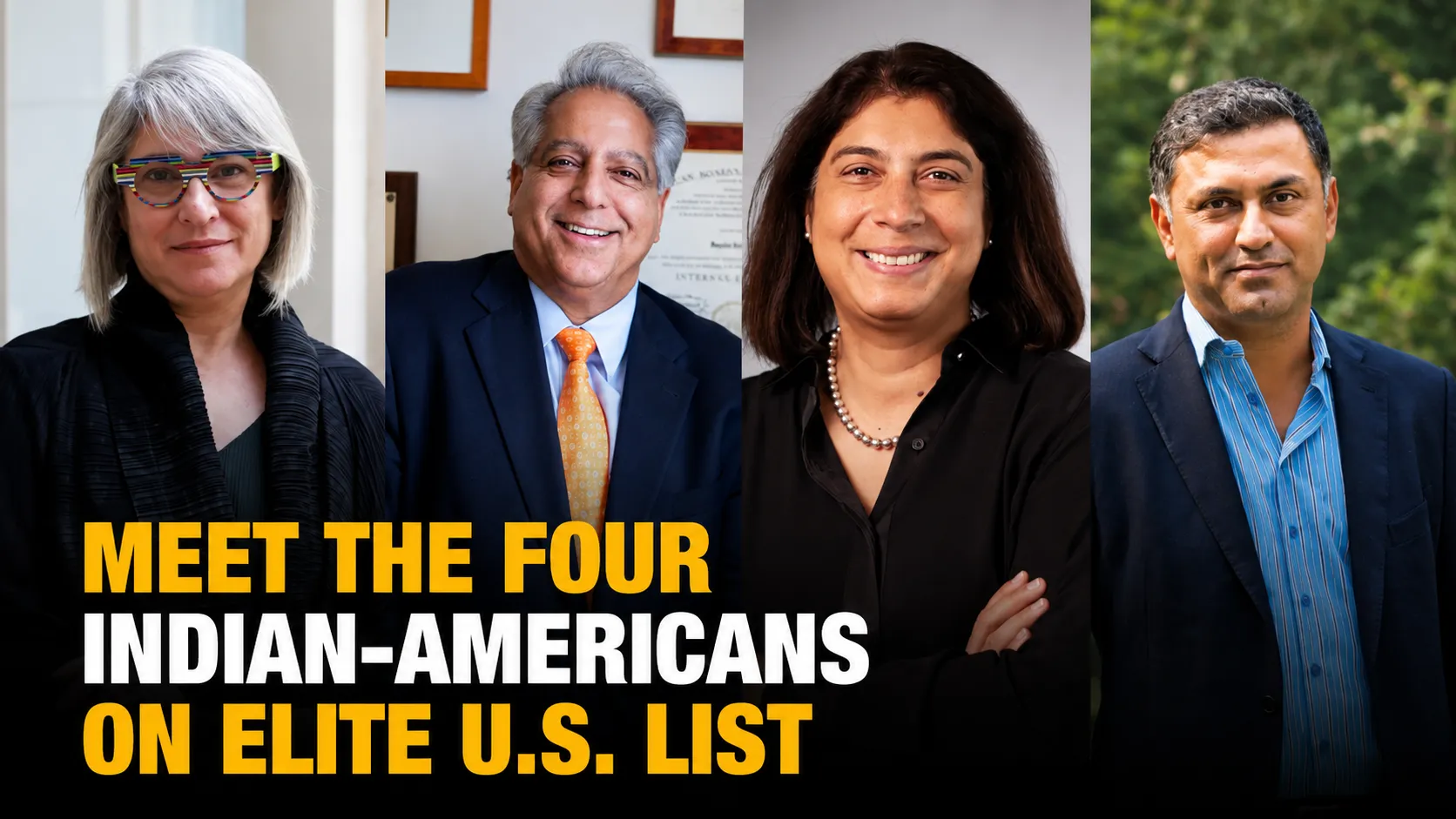
As the United States prepares to mark the 250th anniversary of its founding, the Carnegie Corporation of New York has released its 2026 class of Great Immigrants, Great Americans honourees, a list that has, for more than a decade, celebrated naturalised US citizens whose achievements have shaped the country's civic, cultural, and economic life. This year's class includes 25 honourees drawn from 21 countries, and among them are four leaders of Indian origin whose careers span biotechnology, enterprise technology, psychology, and cybersecurity — a cross-section that underscores just how deeply Indian-American professionals have woven themselves into the fabric of American innovation and public life.
The Great Immigrants initiative, now in its second decade, was established by the Carnegie Corporation as a direct extension of its founder Andrew Carnegie's own immigrant story. Carnegie, who arrived in the United States from Scotland as a young boy and went on to build one of the great American industrial and philanthropic legacies, envisioned the foundation bearing his name as a permanent testament to the transformative power of immigration. Each year around the Fourth of July, the Corporation selects a class of naturalised citizens whose achievements across business, science, medicine, the arts, and public service reflect that same transformative arc — and this year's slate, coinciding with America's semiquincentennial, carries particular symbolic weight. Among the four Indian-origin honourees, Reshma Kewalramani's story stands out for the distance it traverses — from Mumbai, where she was born, to the upper ranks of American biotechnology leadership. Kewalramani moved to the United States with her family at the age of 11, a transition that placed her, like so many immigrant children, at the intersection of two cultures during her formative years. She went on to complete a combined undergraduate and medical degree at Boston University, an academically demanding path that set her on a trajectory toward a career in medicine before she pivoted into the biotechnology industry, where she has since risen to become one of the sector's most prominent chief executives. Kewalramani's early medical career centred on transplant nephrology, a demanding subspecialty focused on the care of patients with kidney failure and those undergoing kidney transplantation. That clinical grounding — direct, hands-on experience with patients facing some of medicine's most complex and high-stakes treatment decisions — has often been cited by colleagues as a defining influence on her subsequent approach to biotechnology leadership, bringing a patient-centred sensibility to an industry frequently criticised for prioritising shareholder returns over patient outcomes. Her recognition in the 2026 Great Immigrants class places her alongside a small number of physician-executives who have successfully bridged clinical medicine and corporate biotechnology leadership at the highest levels. The three other Indian-origin honourees in this year's class round out a picture of remarkably diverse professional achievement. One built a career in ubiquitous computing and health technology, developing accessible and low-cost health monitoring tools that have extended diagnostic and monitoring capabilities to populations and settings that would otherwise lack access to sophisticated medical technology — work that sits at a compelling intersection of engineering innovation and public health equity. Another has made significant contributions to psychology, an area of academic and clinical practice where Indian-American representation has historically been less visible than in engineering or medicine, adding an important dimension to this year's class. The fourth honouree has built a career in cybersecurity, an industry that has become increasingly central to national security and economic resilience as digital infrastructure underpins virtually every sector of the American economy. This year's Indian-origin honourees join a list of previous Great Immigrants recipients that reads like a roll call of some of the most consequential Indian-American figures in recent public life. Nobel laureate economist Abhijit Banerjee, whose work on global poverty alleviation earned him the 2019 Nobel Memorial Prize in Economic Sciences, has previously been honoured, as has Ashish Kumar Jha, the public health expert who played a prominent role in the United States' COVID-19 pandemic response coordination. Economist Gita Gopinath, who has held senior roles at the International Monetary Fund, and NASA researcher Kamlesh Lulla have also featured among past classes, alongside former US Surgeon General Vivek Murthy, whose tenure spanned two separate presidential administrations and made him one of the most visible Indian-American public health figures in the country's history. Perhaps the two most widely recognised names among past Indian-origin Great Immigrants honourees are Shantanu Narayen, the longtime chairman and chief executive of Adobe, and Sundar Pichai, chief executive of Google and its parent company Alphabet. Both men have become, in many respects, the default reference points whenever American media discuss the outsized representation of Indian-origin executives at the helm of the country's most valuable technology companies — a phenomenon that has been the subject of extensive academic and journalistic analysis over the past decade, examining everything from India's engineering education pipeline to distinctive patterns of professional mentorship within the Indian-American business community. The timing of this year's Great Immigrants announcement, arriving as it does during the lead-up to celebrations marking 250 years of American independence, has imbued the list with additional resonance. Carnegie Corporation officials have described the anniversary year's class as a deliberate effort to showcase the full breadth of immigrant contribution to American life at a moment when the country is engaged in broader public reflection on its founding values and subsequent evolution. For the four Indian-origin honourees specifically, their inclusion arrives against the backdrop of an Indian-American community that has grown to become one of the most economically successful and professionally accomplished immigrant populations in modern American history, with median household incomes and educational attainment levels that consistently rank among the highest of any ethnic or national-origin group in the country.
That success has not been achieved without its own complicated history. Indian immigration to the United States accelerated dramatically following the Immigration and Nationality Act of 1965, which abolished the restrictive national-origin quota system that had severely limited immigration from Asia for decades. The subsequent waves of Indian immigrants — many arriving initially as graduate students and skilled professionals under employment-based visa categories — laid the foundation for the community's current demographic and economic profile. Kewalramani's own family migration story, arriving when she was eleven years old, reflects a slightly different but equally significant pattern: family-based immigration that brought children to the United States during their critical developmental years, allowing them to complete their education entirely within the American system while retaining strong cultural ties to India. For the broader Indian-American community, recognitions like the Great Immigrants list serve a function that extends beyond individual honour. Community organisations and diaspora advocacy groups have increasingly pointed to such lists as evidence supporting broader arguments about the economic and social value of skilled immigration — arguments that have taken on particular political salience in recent years amid ongoing national debates over immigration policy, employment-based visa categories including the H1B programme, and pathways to permanent residency and citizenship for skilled foreign workers. Each Indian-origin name added to a list like Carnegie's Great Immigrants becomes, in this context, both an individual recognition and a data point in a larger, ongoing public conversation about the role of immigration in American economic competitiveness. The four honourees' fields of expertise — biotechnology, health technology, psychology, and cybersecurity — also reflect broader shifts in where Indian-American professional achievement has been concentrating in recent years. While technology and engineering have long been the most visible and heavily chronicled arenas of Indian-American success, driven by the community's strong representation in computer science and engineering graduate programmes, this year's Great Immigrants class illustrates a broadening of that footprint into biomedical research, clinical psychology, and public health-adjacent fields — sectors where the community's contributions have historically received comparatively less mainstream media attention despite their considerable significance. For Reshma Kewalramani specifically, the Great Immigrants recognition adds to a growing list of honours that have accompanied her rise through the biotechnology industry's senior leadership ranks. Her trajectory — from a childhood arrival in the United States, through a demanding combined medical education, into clinical nephrology practice, and ultimately to the chief executive suite of a major biotechnology enterprise — has been held up by diaspora professional networks as a particularly compelling example of the kind of multi-decade, cross-disciplinary career arc that has become increasingly common among the most accomplished members of the Indian-American community. As America's 250th anniversary celebrations continue throughout the year, the Carnegie Corporation's 2026 Great Immigrants class will likely feature prominently in broader public commemorations of the immigrant contribution to American life. For the four Indian-origin honourees, and for the community they represent, the recognition arrives at a moment when Indian-American achievement across nearly every sector of American professional life has become so consistent and so widely distributed that it has, in many respects, become an unremarkable and expected feature of the country's leadership landscape — a testament, diaspora observers note, to just how thoroughly the community has integrated into the highest levels of American institutional life over the six decades since the immigration reforms of the mid-1960s first opened the door to large-scale Indian migration to the United States. Looking beyond this year's specific honourees, the Great Immigrants list has, over its now more than decade-long history, become something of a barometer for tracking the evolving contours of Indian-American professional achievement. Early classes of the award skewed heavily toward technology and finance, reflecting the sectors where the first waves of post-1965 Indian immigrants and their children achieved their most visible successes. The gradual broadening of recognised fields — into biotechnology, public health, psychology, cybersecurity, and beyond — mirrors the broader maturation of the Indian-American community itself, now spanning multiple generations and an increasingly diverse range of professional specialisations, from the clinical frontlines of American medicine to the boardrooms of its most consequential technology companies. The Carnegie Corporation's selection process for the Great Immigrants list itself deserves some attention, as it illustrates the particular criteria the foundation applies when identifying honourees each year. Rather than relying on a public nomination process, the Corporation's own research staff and advisory network identify candidates based on a combination of professional achievement, civic contribution, and the degree to which an individual's personal story illustrates the broader themes of opportunity and integration that the foundation seeks to highlight. This curatorial approach means that inclusion on the list carries a particular kind of institutional validation, distinct from more commercially oriented recognition programmes, and helps explain why the list has retained its credibility and prestige within immigrant communities over more than a decade of continuous publication.
For the biotechnology sector specifically, Kewalramani's recognition arrives at a moment of considerable industry-wide attention to leadership diversity at the chief executive level. Despite decades of steady progress in diversifying the broader biotechnology and pharmaceutical workforce, the industry's most senior executive ranks have historically remained less diverse than the scientific and clinical talent pools from which that leadership is theoretically drawn. Kewalramani's rise to chief executive leadership, and her subsequent recognition through a platform as prominent as the Carnegie Great Immigrants list, has been cited by industry diversity advocates as a meaningful data point in ongoing conversations about pathways to executive leadership within biotechnology specifically, a sector where immigrant scientists and physicians have long constituted a disproportionately large share of the research and clinical workforce without always translating that representation into commensurate executive leadership. The cybersecurity honouree among this year's Indian-origin class similarly reflects broader dynamics reshaping that industry. As cyber threats targeting critical infrastructure, financial systems, and government networks have grown both in frequency and sophistication, cybersecurity has emerged as one of the most strategically significant sectors within the broader American technology and national security ecosystem. Indian-origin professionals have built an increasingly prominent presence within cybersecurity leadership over the past decade, spanning roles within major technology companies, specialised cybersecurity firms, and government agencies responsible for national cyber defence — a trend that this year's Great Immigrants recognition helps illustrate at the individual level. For diaspora organisations tracking Indian-American achievement across the full breadth of American professional life, the release of each year's Great Immigrants class has become something of an annual ritual, generating extensive coverage within Indian-American media outlets and community publications that closely track and celebrate the accomplishments of individuals from the broader diaspora community. This year's class, coinciding as it does with the milestone 250th anniversary of American independence, has generated particularly extensive coverage, with community publications framing the recognition not merely as individual achievement but as a broader statement about the depth and durability of the Indian-American community's contribution to the nation's ongoing story — a narrative arc that spans from the first significant waves of post-1965 immigration through to the present day, when Indian-origin leaders occupy some of the most consequential positions across American business, science, medicine, and public life. The health technology honouree's work in developing accessible, low-cost monitoring tools also speaks to a broader trend within Indian-American innovation: a persistent focus on affordability and accessibility that some observers trace back to the community's own formative experiences navigating healthcare systems, both in India and during the early years of the American immigrant experience. This orientation toward frugal, accessible innovation — sometimes described within Indian business and technology circles using the Hindi-derived term 'jugaad,' broadly referring to resourceful, low-cost problem-solving — has repeatedly surfaced as a distinguishing characteristic of Indian-origin innovators across sectors ranging from health technology to financial services, and this year's Great Immigrants recognition of exactly this kind of accessibility-focused health innovation reinforces that broader pattern. As the four honourees prepare to be formally recognised at Carnegie Corporation events accompanying the broader America 250 commemorations throughout the year, their individual stories will likely feature prominently in the kind of extended profile coverage that has become a hallmark of the Great Immigrants programme's public communications strategy, offering the broader American public — and not merely diaspora-focused media — deeper insight into the specific pathways, challenges, and achievements that brought each honouree to their current positions of professional distinction. For an Indian-American community that has, over the six decades since the immigration reforms of the mid-1960s, become one of the most consistently high-achieving immigrant populations in modern American history, this year's Great Immigrants class serves as both a celebration of individual accomplishment and a broader marker of just how thoroughly that success story continues to unfold across an ever-widening range of professional fields.
Finally, it is worth situating this year's recognitions within the specific historical moment of America's 250th anniversary itself. Anniversary years of this magnitude tend to prompt broader national reflection on questions of identity, belonging, and the ongoing evolution of what it means to be American — reflections in which the immigrant experience, and specifically the experiences of more recent immigrant communities such as Indian-Americans, occupy an increasingly central place. The Carnegie Corporation's decision to spotlight naturalised citizens specifically during this anniversary year, rather than limiting its historical commemoration to figures from the country's founding era, reflects a deliberate institutional choice to frame American identity as a continuously unfolding, ever-expanding story — one in which this year's four Indian-origin honourees, alongside their fellow honourees from twenty other countries, represent simply the latest chapter in a much longer and still actively developing national narrative.