America Is About to Have Two Stock Markets for the Same Company: Inside the SEC's $15.1 Billion Tokenized Stock Gamble
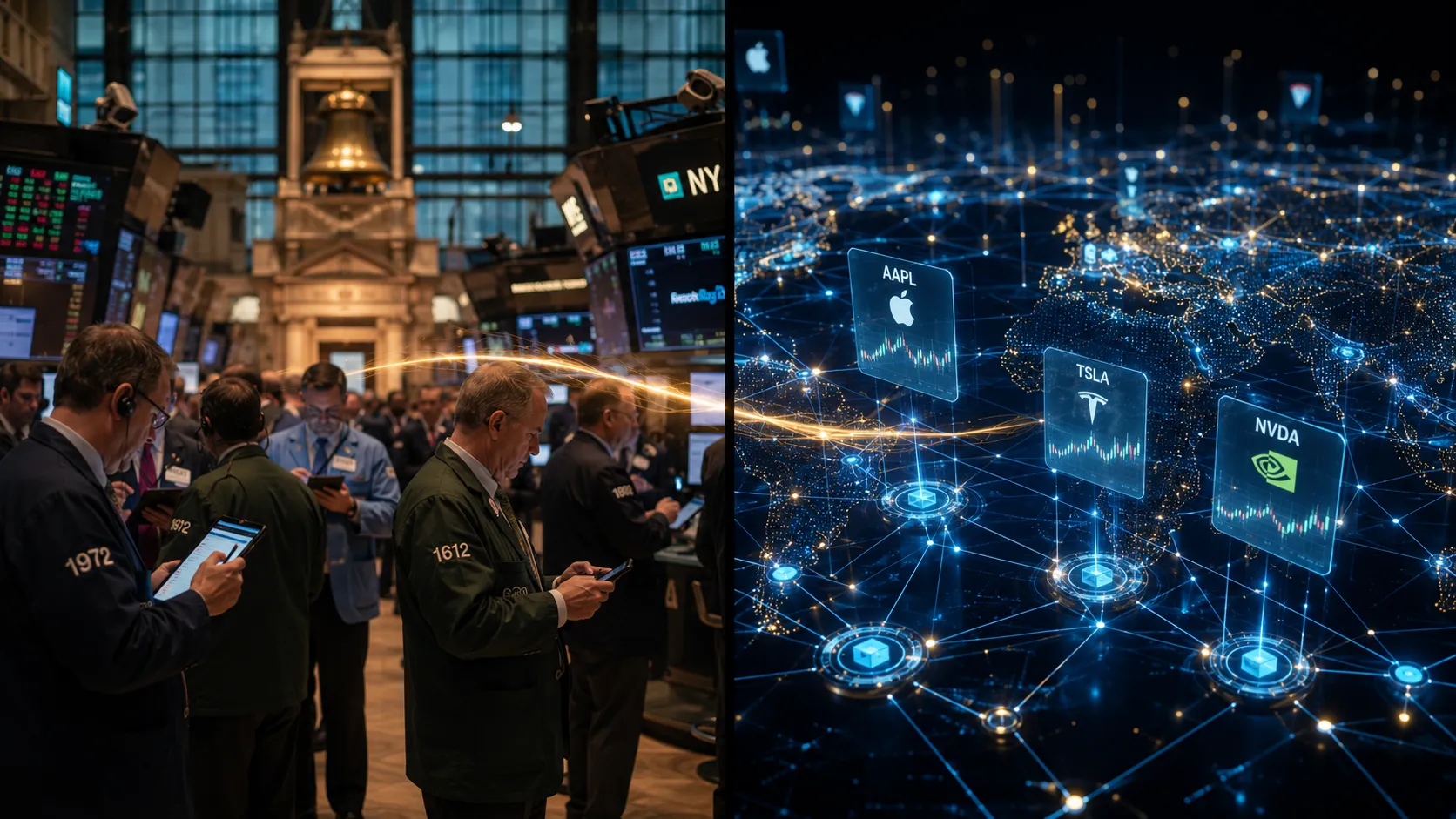
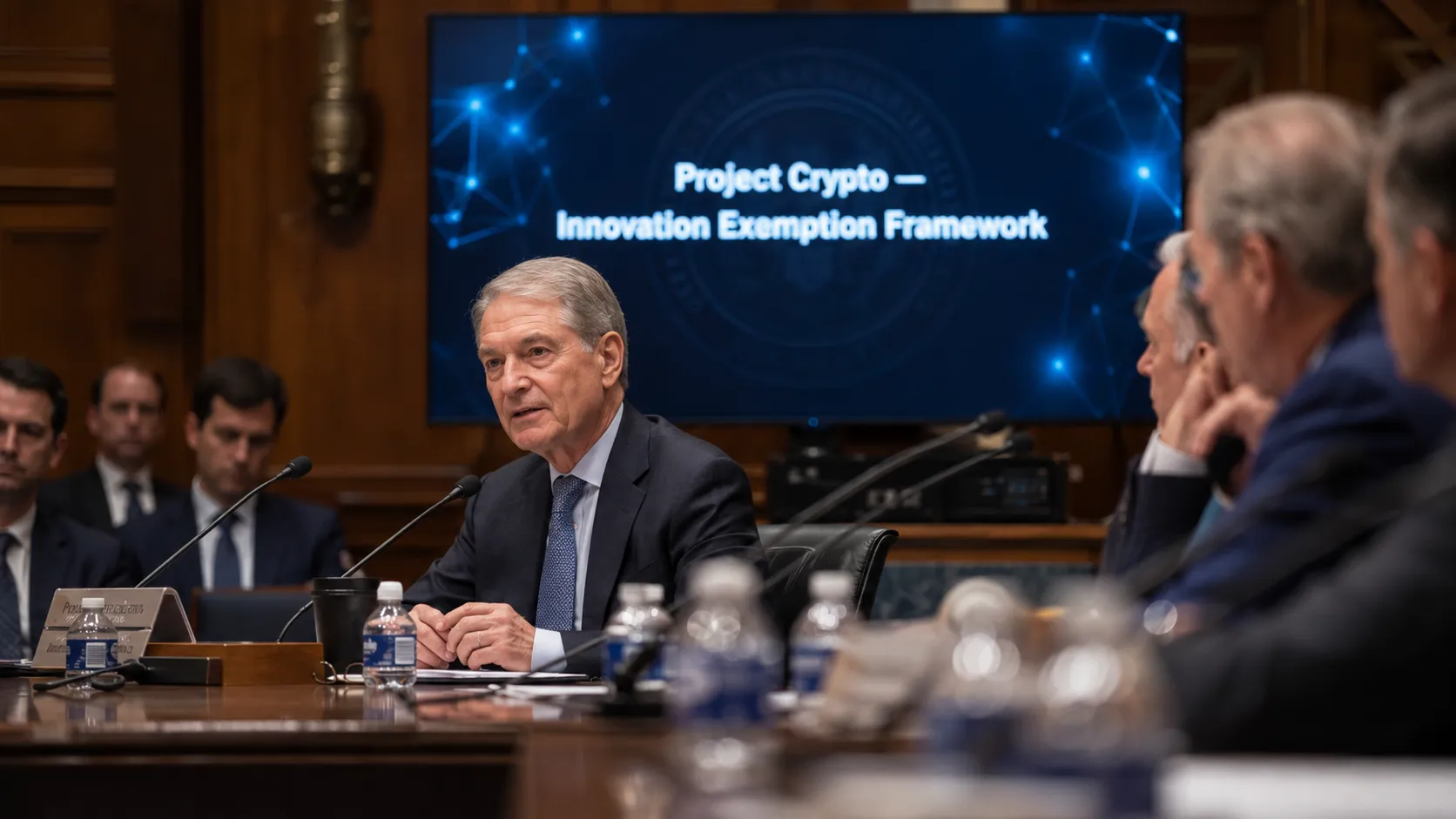
WASHINGTON — May 22, 2026 — Sometime this week, the U.S. Securities and Exchange Commission is expected to publish a document that will do something no American financial regulator has ever done. It will create a legal framework for two parallel stock markets to trade the same shares of Apple, Tesla, and Nvidia—one running on the century-old infrastructure of the New York Stock Exchange, the other on crypto rails that settle instantly, operate 24 hours a day, and require no permission from the companies whose shares they track. The document is called an "innovation exemption," and it is the most significant regulatory experiment in the structure of American equity markets since the creation of the SEC itself in 1934.
The numbers explain why the moment has arrived. Tokenized stock spot trading hit $15.1 billion in the first quarter of 2026, surpassing the entire second half of 2025 combined. This is not a pilot program or theoretical adoption—capital is already flowing at scale into tokenized equities, with or without regulatory clarity. The SEC's framework arrives to meet a market that has already voted with its wallets. ONDO, a tokenized-asset platform, surged 16 percent on the news. The question is no longer whether tokenized stocks have market validation. The question is whether the traditional infrastructure that has governed American equity trading for nearly a century can coexist with a parallel system built on fundamentally different principles.
The framework—part of SEC Chair Paul Atkins's "Project Crypto"—represents a decisive bet by the Trump administration that the future of securities trading belongs not to a single, unified market but to a dual-track system. On one track, Wall Street institutions like BlackRock, JPMorgan, and Goldman Sachs will tokenize traditional stocks through the Depository Trust & Clearing Corporation, preserving the familiar architecture of T+1 settlement, investor protections, and shareholder rights. On the other, crypto-native platforms will list tokenized versions of the same companies under a lighter regulatory structure, without the companies' consent, and potentially without the voting rights, dividends, or transparency that shareholders of record have taken for granted for a century.
The Two-Track Market
The SEC's innovation exemption, as described by Bloomberg Law and confirmed by multiple sources familiar with the matter, creates two parallel paths for tokenized equities.
The first path runs through existing market plumbing. In March 2026, the SEC approved Nasdaq's rule change to allow tokenized trading of Russell 1000 stocks and index ETFs. Under that design, conventional and tokenized stocks carry the same rights, trade on the same order books, and clear through the DTCC as a post-trade step once T+1 settlement completes. The DTCC then announced on May 4 that it would run a July 2026 production pilot with more than 50 institutions including BlackRock, JPMorgan, and Goldman Sachs, with a fuller launch in October. This rail is conservative by design. The DTC custodies roughly $114 trillion in assets and is not in the business of running an experiment that breaks shareholder records. Tokenization here is a wrapper around the existing entitlement; the master securityholder file stays where it is, and the token simply represents post-settlement ownership.
The second path is the one Bloomberg described this week. Under the innovation exemption, the SEC would let crypto-native platforms list tokenized equities under lighter-touch conditions, and would permit entities unaffiliated with the issuer to wrap a publicly listed company's stock without the issuer's consent. The agency's staff laid the legal groundwork in a January 28 statement that divides tokenized securities into two categories: those tokenized by or on behalf of the issuer, and those tokenized by third parties unaffiliated with the issuer. For the second category, the staff wrote that the rights and benefits associated with the crypto asset "may or may not be materially different from those of the underlying security" and "may or may not confer upon the holder of the crypto asset any rights as a holder of the underlying security."
That is the core of the experiment. Under the innovation exemption, a decentralized finance platform could list a tokenized version of Apple stock—call it "tAAPL"—without Apple's knowledge or consent. The token would track Apple's share price. It would trade 24 hours a day, seven days a week, settling near-instantly on blockchain rails. But the holder of tAAPL might have no voting rights, no entitlement to dividends, and no legal claim on the underlying shares. They would have price exposure. They would not have ownership.
The SEC's proposal attempts to address this asymmetry by requiring platforms that fail to provide core shareholder rights—dividends and voting access—to lose the right to list the tokens. But enforcement of that requirement on decentralized platforms, which operate on automated code with minimal human intervention, remains an open question. The DeFi sector has been targeted by hacks this year that have drained hundreds of millions of dollars from protocols. Putting a tokenized Apple share on a DeFi platform that was hacked last month is not the same as holding Apple stock in a brokerage account insured by the Securities Investor Protection Corporation.
The Institutions Are Already Moving
The regulatory framework is arriving into a market that has already begun to reorganize itself around the assumption of tokenization. The moves by the largest financial institutions in the world over the past six months tell the story more clearly than any regulatory filing.
In May 2026, Bullish—the crypto exchange run by former New York Stock Exchange President Tom Farley—bought transfer agent Equiniti in a $4.2 billion deal. Transfer agents are stock-exchange record keepers that track ownership of shares and facilitate dividend payments. The acquisition was a direct bet that the boundary between traditional equity infrastructure and crypto-native platforms is dissolving.
The Intercontinental Exchange, parent company of the NYSE, unveiled plans to expand into tokenized stocks and crypto-linked products through a partnership and investment tied to crypto exchange OKX. Nasdaq, the second-largest U.S. stock exchange, received SEC approval for its tokenized securities framework and is working on a token design that gives publicly traded companies more control over their shares in tokenized form. The DTCC, which processes and safeguards much of the U.S. securities market, announced a July 2026 production pilot for tokenized securities with more than 50 institutional participants, with a broader launch in October.
The combined efforts point to a broader race to modernize the plumbing of the $126 trillion global equity market using blockchain technology. The race is not theoretical. The institutions are spending billions of dollars on the assumption that tokenization is not a passing trend but a permanent restructuring of how securities are issued, traded, and settled.
The Clarity Act, a landmark digital asset market structure bill advanced by the Senate Banking Committee last week, would establish the Commodity Futures Trading Commission as the primary regulator for large parts of the crypto industry while the SEC retains authority over digital securities. The bill represents the most significant Congressional intervention in crypto regulation since the industry's emergence, and its progress through the legislative process has accelerated the SEC's own rulemaking efforts.
The Critics' Case
The innovation exemption has attracted criticism from predictable quarters—and some surprising ones.
Michael Burry, the investor famous for betting against the U.S. housing market before the 2008 financial crisis, warned that the move could have dire consequences. "We may be headed full-on to a Snow Crash cyber-punk future with no long-term personal relationships and digital value embedded in all of us directly correlated to the value provided to a society that increasingly devalues humanity," he wrote, referencing the Neal Stephenson novel.
The World Federation of Exchanges told the SEC's crypto task force that tokenization could "distort" the market by creating an uneven playing field between stock and crypto exchanges. The concern is not abstract: if a tokenized Apple share trades at a different price on a DeFi platform than the actual Apple share trades on Nasdaq, the result is market fragmentation—two prices for the same asset, with no mechanism to arbitrage between them.
Daniel Labovitz, CEO of equity exchange platform Green Impact Exchange, laid out the structural risks: "The tokens may not represent actual ownership of the company, and token holders may not get all of the benefits of a share, like voting or dividends. Another problem is fragmentation: when the same security trades in different markets that aren't connected to each other, the price of the assets can diverge, meaning that some buyers will overpay for their token."
The most pointed criticism comes from the public companies whose shares would be tokenized without their consent. Under the innovation exemption, Apple, Tesla, and Nvidia would have no say in whether their stock is wrapped into a blockchain token and traded on a DeFi platform. Their investor relations departments would have no visibility into who holds tokenized versions of their shares. Their shareholder voting processes could be complicated by a parallel ownership structure that the existing proxy system was never designed to accommodate.
What This Signals
The SEC's innovation exemption is not primarily about technology. It is about the structure of American equity markets—and whether the unified, regulated, transparent model that has governed stock trading since the Securities Exchange Act of 1934 can survive the fragmentation that blockchain technology enables.
The bullish case for tokenization is compelling. Near-instant settlement, 24/7 trading, simplified collateral use, and fewer intermediaries could make markets more efficient and more accessible. The $15.1 billion in tokenized stock trading volume in the first quarter of 2026 suggests that demand is real and growing. The institutions racing to build tokenization infrastructure—DTCC, Nasdaq, NYSE, BlackRock, JPMorgan—are not doing so out of ideological commitment to blockchain. They are doing so because they believe the market is moving, and they do not want to be left behind.
The bearish case is that the innovation exemption creates a two-tier market—one regulated, transparent, and protected; the other lightly regulated, opaque, and exposed to the same vulnerabilities that have produced a steady stream of DeFi hacks and protocol failures. If a tokenized Apple share on a DeFi platform loses its peg to the actual Apple share, the investors who own the token have no recourse. If the DeFi platform is hacked, the tokens may be unrecoverable. If the token issuer fails to pass through dividends, the token holder has no claim.
The experiment is about to begin. The SEC's innovation exemption will publish, the market will react, and the question of whether America can sustain two parallel stock markets for the same companies will move from the theoretical to the operational. The first quarter of 2026 saw $15.1 billion flow through tokenized stock platforms. By the time the exemption is finalized, that number will almost certainly be larger. The infrastructure is being built. The capital is flowing. The only thing missing is the legal framework—and it is about to arrive.


