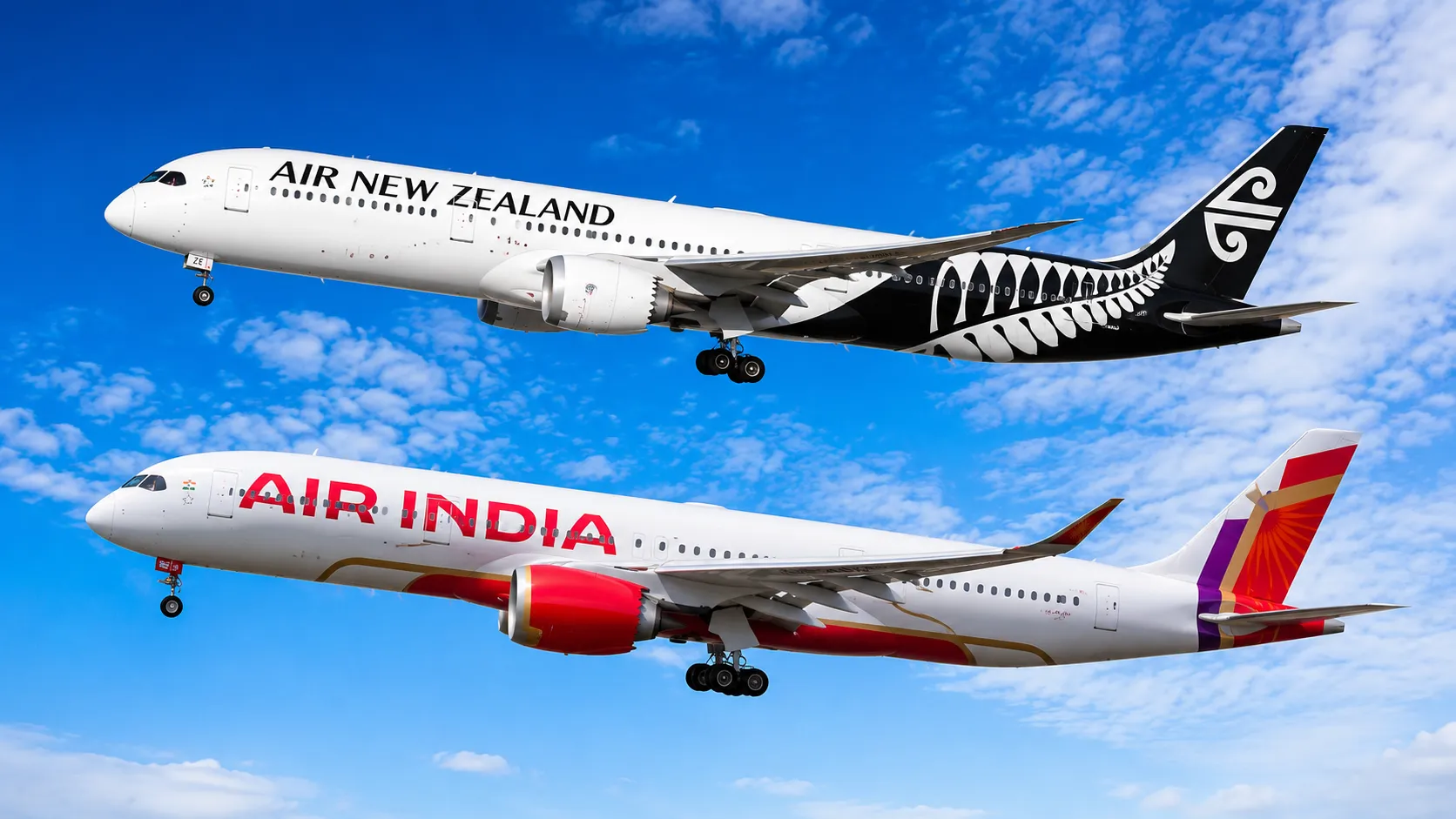
For the sizeable Indian diaspora in New Zealand, along with the steady flow of Kiwi tourists, students and business travellers heading the other direction, a single practical fact has shaped every trip between the two countries for decades: there is no non-stop flight. Every journey routes through a third country — Singapore, most commonly, via Singapore Airlines' partnership network — adding hours of transit time and a layer of logistical friction to a travel corridor that both governments increasingly want to see treated as a strategic priority rather than an afterthought. That may finally be changing, though not as quickly as either side's aviation ambitions might suggest: Air India and Air New Zealand are actively working toward a commercial joint venture that could, if regulatory approvals come through, pave the way for genuine non-stop flights between the two countries by the end of 2028.
The groundwork for the current push dates back to March 2025, when the two carriers signed a memorandum of understanding aimed at improving travel options between India and New Zealand, followed by the introduction of a codeshare arrangement that has already given passengers more flexible booking and connection options through each airline's existing networks, even without any new direct capacity being added. That MoU has since evolved into something considerably more ambitious: a proposed commercial joint venture that would allow the two airlines to coordinate network planning, scheduling, pricing and sales across the India-New Zealand corridor — the kind of deep commercial integration that goes well beyond a simple codeshare arrangement, and that typically requires the two carriers to share meaningful commercial and financial data with each other, subject to appropriate anti-trust safeguards, in order to jointly optimise route economics in ways neither airline could achieve operating independently.
Air New Zealand Chief Executive Nikhil Ravishankar has been notably direct about both the airline's genuine interest in the route and the specific conditions the carrier wants to see satisfied before committing aircraft to it. Speaking at the China Business Summit, Ravishankar confirmed the airline was in the process of putting in a formal application for joint venture authorisation that would allow it to begin flying direct services into India, while emphasising the underlying commercial opportunity: it's a big market that has all of the characteristics we look for before committing aircraft to a route. That characteristically cautious framing — genuine enthusiasm paired with an insistence on demonstrated demand before capacity commitment — reflects the considerable financial risk inherent in launching any new ultra-long-haul route, where a single wide-body aircraft represents hundreds of millions of dollars in capital commitment that can take years to prove out commercially if underlying passenger demand fails to materialise as projected.
Ravishankar specifically identified three distinct customer segments the airline wants to see robust demand evidence across before committing to non-stop service: travellers visiting friends and relatives — a segment that, given the size and geographic spread of the Indian diaspora in New Zealand, likely represents one of the more reliably large and price-sensitive demand pools; corporate and business travellers, whose willingness to pay a premium for time savings on a genuinely long ultra-long-haul sector matters enormously to route profitability; and premium leisure travellers, a smaller but higher-yield segment whose spending on business and premium economy fares can disproportionately determine whether a long-haul route breaks even. Rather than passively waiting for a route launch to test whether that demand exists, Air New Zealand has signalled it intends to actively stimulate demand in advance through targeted marketing campaigns, alongside establishing a stronger on-the-ground commercial presence in India by deploying senior marketing staff to key Indian cities specifically tasked with promoting New Zealand as a premium travel destination ahead of any actual non-stop service launching.
Government-level support for the initiative has been substantial and increasingly public. During a recent visit by Prime Minister Narendra Modi, India and New Zealand signed a Memorandum of Arrangement on Tourism in Auckland on July 11, 2026, explicitly aimed at strengthening bilateral cooperation in the tourism sector, with a joint statement issued following talks between Modi and New Zealand Prime Minister Christopher Luxon specifically encouraging airlines to begin non-stop flights between the two countries — about as direct a governmental endorsement as an aviation partnership of this kind typically receives, short of the two governments actually negotiating the specific bilateral air services agreement terms themselves. That high-level political support matters considerably for the practical regulatory process ahead, since any commercial joint venture of this scale requires anti-trust immunity approval from competition regulators in both India and New Zealand — a process that can take considerable time even with strong political goodwill behind it, given the genuine complexity of assessing competitive effects across a bilateral aviation market.
Singapore Airlines' continued involvement in the broader discussions adds an important additional layer of complexity, and opportunity, to the evolving partnership structure. Air New Zealand's statement on the matter specifically noted the airline is continuing to work with Air India, alongside Singapore Airlines, to identify opportunities to strengthen air links between the countries — a three-way dynamic that reflects Singapore Airlines' own long-established and deeply integrated joint venture alliance with Air New Zealand, reauthorised for a further five years through March 2029, under which the two carriers have jointly grown seat capacity between New Zealand and Singapore by nearly 50 percent over the preceding decade. Precisely how a new India-focused Air India-Air New Zealand joint venture would interact with that existing, well-established Singapore Airlines partnership — whether complementary, competitive, or requiring some genuinely novel three-way commercial arrangement — remains one of the more interesting structural questions still to be resolved as the proposed joint venture application moves through the approval process.
Passenger demand data underlying the route case offers useful, if imperfect, evidence for the underlying commercial opportunity both carriers are betting on. According to Statistics New Zealand data, Indian visitor arrivals to New Zealand reached 116,000 in the year ending February 2026, up roughly 10,000 from the preceding annual period — steady, if not explosive, growth in one direction of the travel corridor. Movement in the opposite direction proved even larger: New Zealand recorded 117,000 arrivals of New Zealand-resident travellers returning home after visiting India in the year ending April 2026, the highest annual level recorded for that specific travel pattern — a reminder that a meaningful share of the underlying demand for this route reflects New Zealand's own substantial and growing Indian-origin population travelling back to India to visit family, rather than purely one-directional inbound tourism from India into New Zealand.
A specific, near-term event has emerged as an unusually clean real-world test case for the underlying route economics: a government-backed month of Indian sporting events scheduled for New Zealand in November 2026, which aviation analysts have flagged as likely to provide the clearest available signal yet of genuine passenger demand, spending patterns and route viability ahead of any permanent capacity commitment. Analysts covering the potential route have suggested a strong November performance would not, on its own, automatically justify launching a daily, year-round non-stop service — but could support a more gradual, lower-risk progression toward permanent capacity, potentially beginning with event-specific charter flights, seasonal services, or limited weekly frequencies rather than jumping directly to a full daily commitment.
The broader strategic context within which Air New Zealand is evaluating this specific route deserves attention, given the airline's parallel, more expansive network ambitions across the region. The carrier has been actively exploring deeper cooperation with Air India across a considerably larger network than just a single non-stop route, with reports indicating the two airlines are working together across sixteen distinct international routes as part of a broader long-haul strategic rethink, evaluating direct connectivity specifically with India's major metropolitan markets including Delhi, Mumbai, Bengaluru and Chennai. That broader ambition suggests Air New Zealand's India strategy, if the underlying joint venture and eventual non-stop services prove commercially successful, could extend well beyond a single flagship Auckland-Delhi or Auckland-Mumbai route into a considerably more extensive network presence across India's largest aviation markets over time.
For now, the practical reality facing prospective travellers remains connecting through Singapore or another intermediate hub, with genuine non-stop service still realistically several years away even under an optimistic timeline. But the combination of a formal joint venture application now in preparation, explicit high-level government backing from both Wellington and New Delhi, and a concrete November 2026 demand test already on the calendar suggests this particular long-discussed aviation ambition has moved meaningfully closer to commercial reality than at any previous point in the decade-long conversation about direct India-New Zealand air links.

The economics of ultra-long-haul aviation routes of this kind deserve brief additional context, since they explain much of the caution both airlines have shown despite the evident political and commercial enthusiasm surrounding the proposal. A genuine non-stop Auckland-to-India service would rank among the longer scheduled passenger routes operated anywhere in the world, requiring either a purpose-configured long-range wide-body aircraft or careful payload-range trade-offs that typically limit how much cargo and how many passengers a carrier can profitably carry on the sector. Airlines operating routes of comparable distance elsewhere in the world have historically needed several years of sustained, carefully managed demand-building — precisely the kind of marketing and demand-stimulation programme Ravishankar has described — before committing to permanent, year-round daily capacity, making the 2028 target timeline both ambitious relative to the current codeshare-only status quo and realistic relative to how comparable ultra-long-haul routes have typically been developed by other carriers globally.
For India's own aviation sector more broadly, a successful Air India-Air New Zealand joint venture would add to a growing list of international partnerships the Tata-owned carrier has pursued since its privatisation and subsequent restructuring, part of a broader strategic push to rebuild Air India's international network and codeshare relationships after years of underinvestment under previous state ownership. Whether the India-New Zealand route ultimately launches on the current 2028 timeline, sooner following a strong November 2026 demand signal, or later should regulatory approvals prove more protracted than either carrier currently anticipates, the direction of travel — both figuratively and, eventually, literally — appears to be firmly toward genuine non-stop connectivity between two countries whose people have waited considerably longer than either government would prefer for that basic travel convenience to finally arrive.
Comparable joint venture partnerships elsewhere in the world offer a useful benchmark for what success might ultimately look like should the Air India-Air New Zealand arrangement receive full regulatory approval. Airline joint ventures on other long-haul, thinner-demand international corridors have, in several documented cases globally, succeeded in growing overall passenger volumes and improving route profitability considerably faster than either partner airline could have achieved operating the same route independently, precisely because coordinated scheduling, shared marketing spend and joint revenue management allow the partnership to optimise capacity and pricing across the entire corridor rather than each carrier competing separately for a still-developing pool of passenger demand. That precedent gives both Air India and Air New Zealand genuine grounds for the confidence they have expressed publicly about the partnership's eventual prospects, even as the specific demand characteristics of the India-New Zealand corridor — spanning a large diaspora population, growing corporate ties, and an emerging premium leisure segment — will ultimately determine whether this particular route follows that same successful trajectory.


