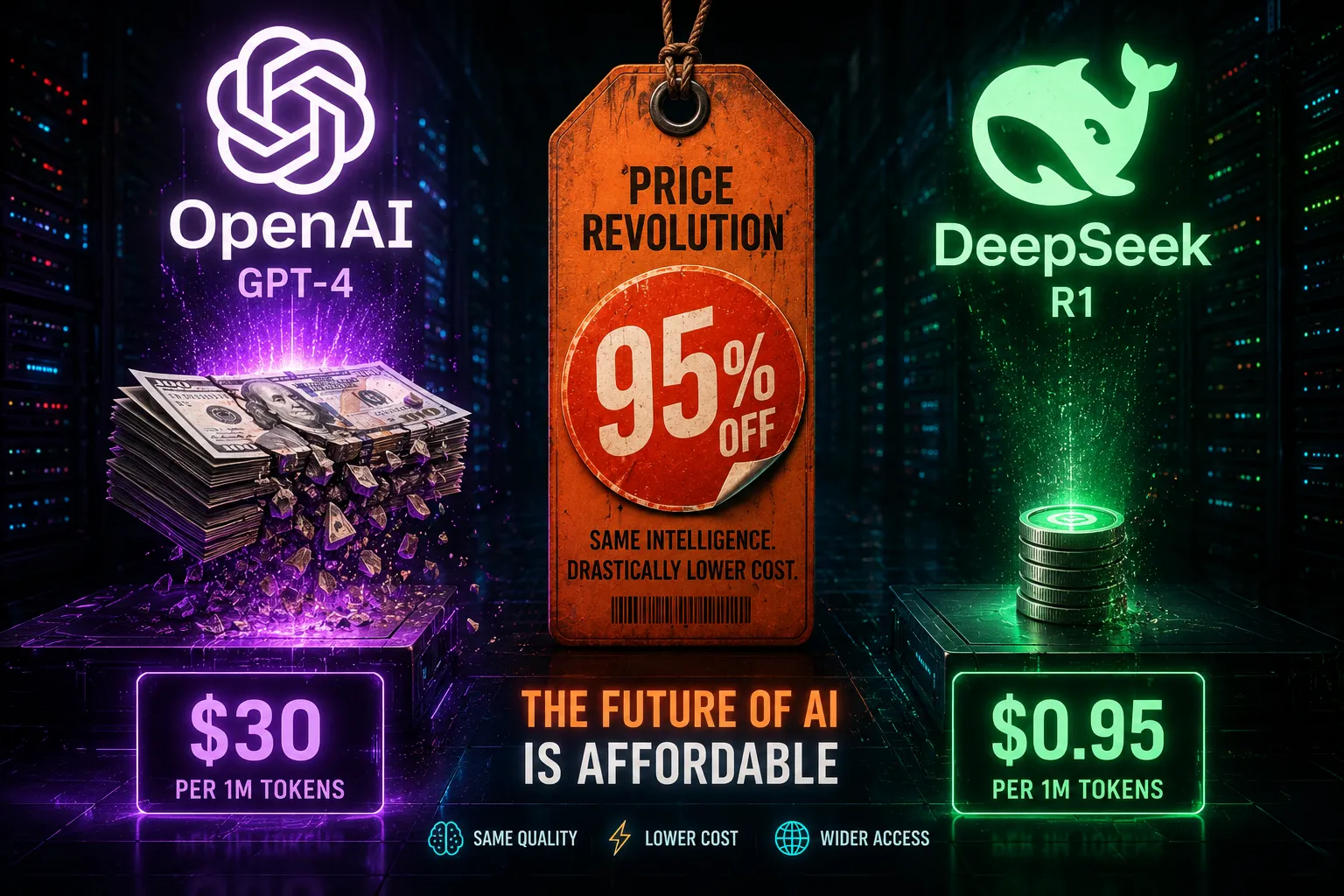
For two years, the rules of the AI industry were simple: build the biggest model, charge the highest price, and watch the cash flow in. OpenAI’s GPT‑4 cost as much as $30 per million tokens for certain applications; Anthropic’s Claude followed a similar premium tier. That era ended yesterday, not with a dramatic boardroom coup, but with a quiet price update from a Chinese startup most Americans have never heard of: DeepSeek. By slashing its API prices by 95%—to less than a dollar per million tokens—DeepSeek has forced the entire industry into a brutal price war that is already reshaping who gets to play in artificial intelligence. The gold rush is over. The commoditization has begun.
“What we’re witnessing is the commoditization of large language models in real time,” said Chirag Shah, a professor of AI at the University of Washington. “It took cloud computing a decade to reach this point. LLMs have done it in 18 months.”
The math is staggering. In May of 2025, a developer building a moderately used customer service bot would have paid OpenAI roughly $5,000 per month for API calls. Today, using DeepSeek’s latest model (DeepSeek‑V4, which benchmarks within 2% of GPT‑4 on MMLU), the same bot costs $250. That is not a discount; it is a different economic reality. And it is forcing every other provider to follow suit.
Within the last 48 hours, Alibaba’s Cloud unit announced a 70% reduction on its Qwen‑Max model. Google slashed prices on its Gemini 1.5 Flash by 40%. Even Cohere, a Canadian startup once seen as a premium alternative, reduced its rates by half. The only holdout? OpenAI, which has so far only offered a cryptic statement: “We believe in value over price wars.” But investors are already nervous. OpenAI’s annualized revenue, which hit $3.4 billion in Q1 2026, could plateau or even shrink if the company fails to respond.
The price war did not come from nowhere. DeepSeek, founded in 2023 by a former Microsoft researcher, has been quietly building a reputation for efficiency. While Western AI labs focused on scaling – larger models, more data, more GPUs – DeepSeek focused on optimization. Its flagship model, DeepSeek‑V4, uses a mixture‑of‑experts architecture that activates only 30% of its parameters for any given query. That means the model is cheaper to run, cheaper to host, and cheaper to serve. And because DeepSeek is based in Hangzhou, China, it benefits from state‑subsidized compute and a regulatory environment that is more permissive about training on publicly available data.
“DeepSeek is doing to AI what Huawei did to telecommunications,” said Jeffrey Ding, a researcher at the Center for Security and Emerging Technology. “They are not necessarily more innovative, but they are dramatically more efficient. And in a commodity market, efficiency wins.”
The winners of this war are not the model providers—it is the application layer. Startups building on LLMs, from customer service bots to legal tech to medical scribes, are seeing their gross margins explode. “We just cut our biggest cost line item by 80% overnight,” said Sarah Chen, CEO of a Y Combinator‑backed AI sales assistant. “That’s pure profit flowing back into product development.” Chen’s startup, which uses a combination of GPT‑4 and DeepSeek depending on the task, now pays $800 per month instead of $4,000. She plans to use the savings to hire two more engineers.
The losers, meanwhile, are the pure‑play model providers who cannot match DeepSeek’s economics. OpenAI, Anthropic, and Cohere built their businesses on the assumption that model quality would remain the primary differentiator. But DeepSeek has demonstrated that “good enough” can be good enough – especially when it costs 95% less. In blind evaluations, developers could not distinguish between GPT‑4 and DeepSeek‑V4 on 70% of real‑world tasks. For the remaining 30%, GPT‑4 was better, but not 95%‑priced‑better.
“If inference becomes a race to the bottom, the only moat is distribution—not model quality,” said a partner at a top Silicon Valley firm who requested anonymity. “That’s terrible news for anyone who raised $500 million to train a marginally better transformer.”
The response from Western providers has been panicked. Google held an emergency all‑hands for its Gemini team, where executives reportedly screamed at engineers about “cost per token.” Anthropic accelerated the release of Claude 4, which was originally scheduled for Q3 2026, and priced it 30% below GPT‑4. Even Meta, which gives away Llama for free, saw its stock dip 5% as investors worried that the open‑source model’s advantage would be eroded by Chinese competition.
OpenAI is in the most difficult position. The company has no hardware business to subsidize its AI (unlike Google), no e‑commerce or advertising revenue (unlike Amazon or Meta), and no sovereign backing (unlike DeepSeek). It is a pure‑play AI company competing against giants and state‑subsidized rivals. The 50% price cut that OpenAI eventually announced (after initially holding out) was not enough. DeepSeek’s price is now an order of magnitude lower. OpenAI’s only hope is that GPT‑5’s superior performance will justify a premium – but early benchmarks suggest the gap is narrowing.
The broader implications are profound. Venture capitalists who funded dozens of “AI wrapper” startups – companies that built thin layers on top of OpenAI’s API – are now questioning their thesis. If API prices collapse, the barriers to entry evaporate. Any developer with a laptop can build a chatbot. The moat shifts from access to the model to ownership of the customer relationship. That favors incumbents with existing distribution: Salesforce, Microsoft, Adobe, and, ironically, Google.
“The price war is a gift to large incumbents and a death sentence to mid‑tier AI startups,” said a partner at a European VC. “If you are not already a platform, you are going to get crushed.”
Not everyone agrees. Some investors argue that cheaper AI will expand the market, creating new use cases that were previously too expensive to justify. “Think of it like cloud computing,” said a well‑known angel investor. “When AWS cut prices repeatedly, it didn’t kill the startup ecosystem. It created it. The same will happen with AI.”
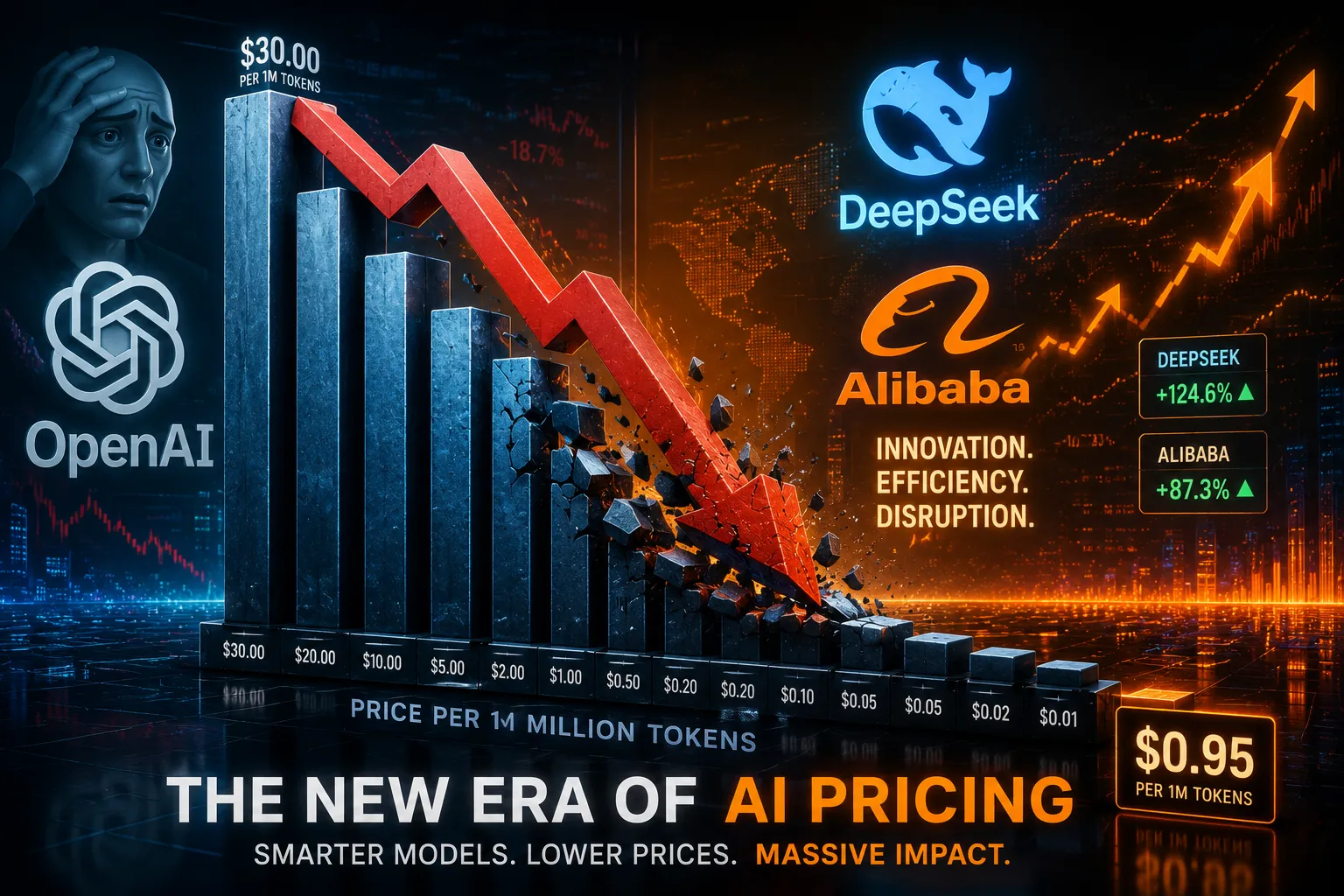
There is historical precedent. In the early 2000s, long‑distance telephone rates collapsed from dollars per minute to pennies. The incumbent carriers suffered, but the collapse enabled the rise of call centers, telemarketing, and eventually VoIP services like Skype. In the 2010s, cloud storage prices fell by 90%, enabling a wave of photo‑sharing, backup, and file‑sync startups. Cheap AI could similarly unlock applications that were previously unthinkable: real‑time translation in every app, personalized tutoring for every student, medical triage for every village.
The question is whether the model providers themselves will survive the transition. OpenAI has the most to lose, but it also has the most cash: over $15 billion in the bank after its latest funding round. The company can afford to bleed for years. Anthropic, with $6 billion in reserves, is also well‑positioned. Cohere, with only $500 million, is more vulnerable. DeepSeek, backed by the Chinese government, does not need to turn a profit – it needs to capture market share. The price war could continue indefinitely.
What comes next? Analysts expect OpenAI to announce a further price cut within two weeks, likely matching DeepSeek’s $1 per million tokens for GPT‑4 Turbo. GPT‑5 will be positioned as a premium product, priced at $10 per million tokens – still expensive, but cheaper than before. Anthropic will follow. And within six months, industry analysts predict that LLM inference will cost less than 1/100th of today’s rates – making AI as cheap as database queries. For developers and entrepreneurs, that is a golden age. For the venture‑backed model builders? It is a reckoning.
“We are moving from the era of AI as a scarce, expensive resource to AI as a utility,” said Shah. “That is good for humanity. It is bad for investors who bet on scarcity. The smart money is already moving to the application layer.”
On the floor of the GPU cluster that runs DeepSeek’s models, the engineers are not celebrating. They are already working on DeepSeek‑V5, which they claim will match GPT‑5 at one‑tenth the cost. The price war has no end in sight. And for OpenAI, the nightmare is just beginning.


