Agnikul Cosmos and the Great Indian Space Race: Rockets on Startup Timelines
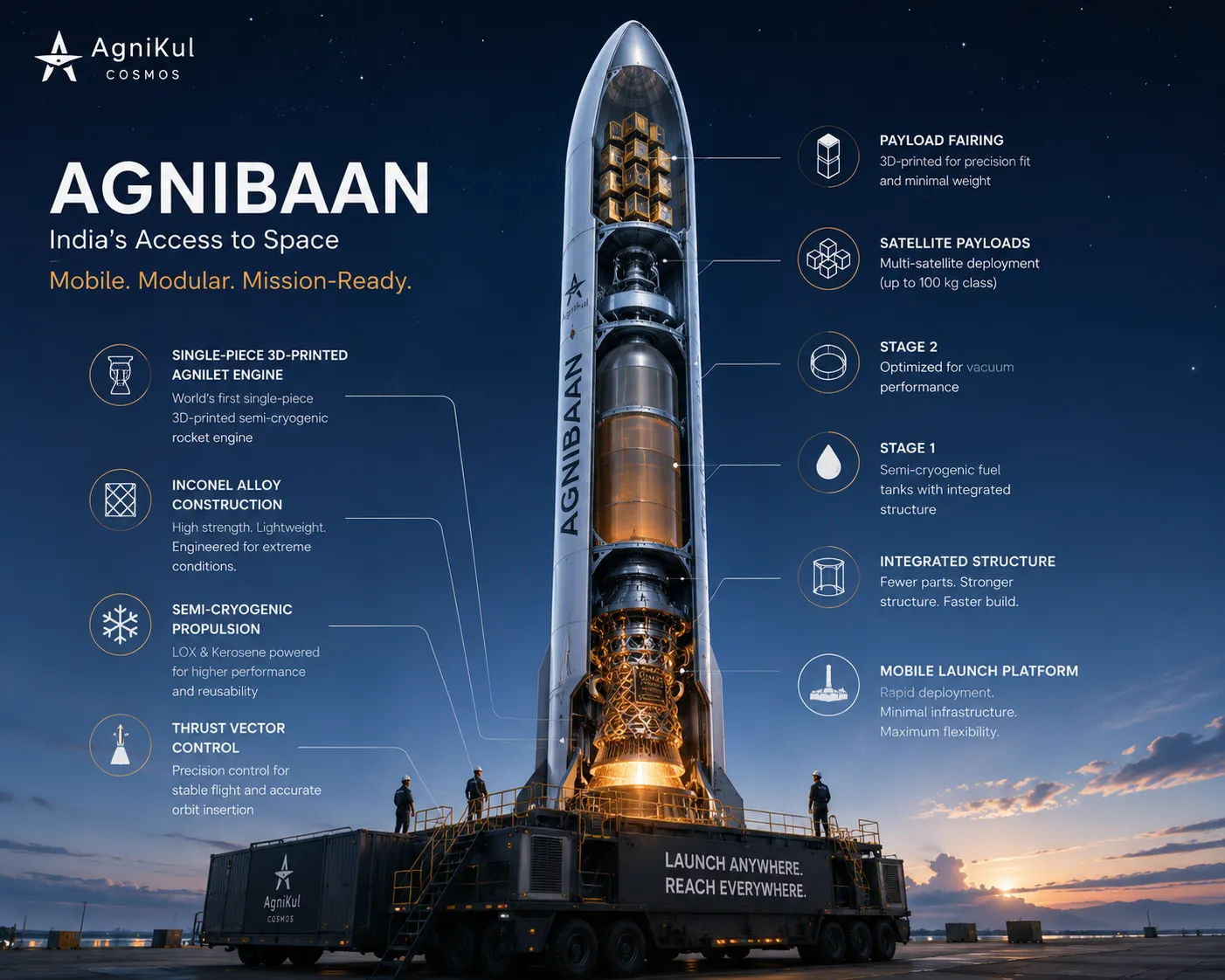
CHENNAI — May 2026 – In May 2024, a rocket lifted off from India's Satish Dhawan Space Centre that did not look like any rocket India had launched before. It was 6.2 meters tall—small by orbital standards—and powered by a single-piece 3D-printed semi-cryogenic engine called the Agnilet. The launch was suborbital. The payload was symbolic. The significance was not. For the first time in history, a privately built Indian rocket had flown, and it had done so using an engine that was manufactured in a single piece rather than assembled from hundreds of components. The company was Agnikul Cosmos. The message to the global space industry was unambiguous: India's private space era had begun.
Two years later, Agnikul is in the thick of a fundraising round that will define its trajectory into the commercial market. In May 2026, the company confirmed it is in talks to raise $50–75 million at a valuation of approximately $500 million. The round, an extension of its Series C, is being discussed with growth-stage investor Avataar Ventures and several existing shareholders. In March, the Tamil Nadu government's investment arm, TIDCO, invested ₹25 crore (about $2.65 million) in the company. The funding will expand production capacity and accelerate a launch manifest that includes 35 planned missions between 2026 and 2028, with more than 20 customers already onboarded and over $200 million in soft revenue commitments.
Agnikul is not yet a unicorn. But it is moving on a trajectory that suggests it could become India's second, following Skyroot Aerospace's landmark $1.1 billion valuation earlier in May. The two companies, based in Chennai and Hyderabad respectively, represent a new model for deep-tech entrepreneurship in a country that, until very recently, treated space as a government monopoly.
The 3D-Printed Revolution
Agnikul's founding story is intertwined with IIT Madras, one of India's premier engineering institutions. The company was founded in 2017 by Srinath Ravichandran, Moin SPM, and Professor S.R. Chakravarthy from IIT Madras's aerospace engineering department. The founders shared a conviction that rocket manufacturing could be fundamentally reimagined. Traditional rocket engines are assemblies of hundreds or thousands of individually machined parts, each requiring precision tooling, quality control, and assembly labor. The result is an engine that takes months to build, costs millions, and carries the accumulated risk of every joint, weld, and fastener.
The Agnilet engine was different. Fabricated in a single piece using an EOS metal 3D printer with a build volume of 400 mm x 400 mm x 400 mm, it eliminated assemblies, reduced part count to one, and slashed production time from months to days. When Agnikul successfully test-fired the engine in 2022 and then flew it on the Agnibaan suborbital launch vehicle in 2024, it became the first company in the world to launch a rocket powered by a single-piece 3D-printed semi-cryogenic engine. The achievement earned Agnikul a U.S. patent and, more importantly, a manufacturing advantage that competitors—dependent on traditional supply chains—would find difficult to replicate quickly.
The implications of this manufacturing philosophy extend beyond cost reduction. A single-piece engine is inherently more reliable because it has no joints to fail, no seals to leak, and no assembly tolerances to drift. It is also faster to iterate. When you can print an entire engine, test it, modify the design in software, and print a new version in 72 hours, the pace of improvement accelerates dramatically. Agnikul is applying software-style iteration cycles to hardware that has historically moved at aerospace speed—which is to say, glacial speed.
The Market That Is Opening
India's space sector has undergone a transformation in the regulatory environment that is as significant as the technological advances coming out of its startups. In 2020, the government opened the sector to private participation, creating the Indian National Space Promotion and Authorization Centre to provide startups with access to ISRO's facilities, expertise, and launch infrastructure. The result has been an explosion of entrepreneurial activity: from a single space startup in 2014 to over 300 by early 2026.
The economic logic is compelling. India's space program, built on decades of ISRO achievement, has demonstrated that launches can be performed at a fraction of the cost of Western competitors. ISRO's Mars mission cost less than the Hollywood movie Gravity. Its Chandrayaan lunar missions delivered world-class science on shoestring budgets. The private sector is now taking that frugal engineering culture and combining it with venture-backed speed. Agnikul's investor pitch projects more than $200 million in revenue from soft commitments, long-term annual revenue of $100 million, and gross margins of approximately 70% at scale. For a company that has only completed suborbital test flights, these are ambitious numbers. They are also numbers that the global launch market—desperate for capacity as satellite constellations proliferate—may be willing to support.
What Every Entrepreneur Can Learn
Agnikul's trajectory offers distinct lessons from its better-funded peer, Skyroot, while reinforcing some common principles.
First, manufacturing innovation can be as differentiating as design innovation. Agnikul's 3D-printed engine is not just a cost play. It is a speed play. In a market where launch cadence is the constraint—where customers are waiting months or years for a ride to orbit—the company that can manufacture engines fastest wins. The manufacturing process is the moat.
Second, government as infrastructure, not competitor. Like Skyroot, Agnikul has used ISRO's testing facilities, launch ranges, and technical expertise as a springboard rather than viewing the space agency as an obstacle. The Tamil Nadu government's direct investment through TIDCO is further evidence that Indian state governments see spacetech as an economic development opportunity. Deep-tech founders in any country should map the government assets available to them—labs, ranges, testing facilities, procurement budgets—and treat them as non-dilutive infrastructure.
Third, capital efficiency in deep tech is possible but requires discipline. Agnikul has raised its capital in deliberate, milestone-linked tranches: seed funding for engine development, Series A for suborbital test flights, Series B and C for orbital vehicle development and commercial scaling. Each round was priced based on demonstrated technical progress, not promises. The valuation has climbed steadily without the wild spikes that can create misaligned expectations between founders and investors. In a sector where the temptation to over-raise is intense, Agnikul's discipline is instructive.
The Road Ahead
Agnikul's path to commercial viability will be demanding. The company must transition from suborbital test flights to reliable orbital launches, a step that has destroyed many promising rocket startups. It must manufacture engines at a cadence that supports 35 launches in three years. It must compete not only with Skyroot but with a global market that includes SpaceX, Rocket Lab, and a growing roster of international small-launch providers. And it must do all of this while managing the expectations of investors who have valued the company at $500 million on the basis of commitments, not executed contracts.
But the Indian private space sector has momentum that was difficult to imagine five years ago. Skyroot's unicorn round, Agnikul's $50–75 million raise, and the broader surge in spacetech funding—$196 million in 2025, with 2026 already crossing $100 million—suggest that investors are pricing in a future where Indian rockets are a meaningful part of the global launch supply chain. Agnikul's 3D-printed engines, its mobile launch architecture, and its growing order book position it to capture a share of that future. The company that began in an IIT Madras lab, with an engine printed in a single piece, is now within striking distance of orbit. The pieces are in place. The countdown has begun.


