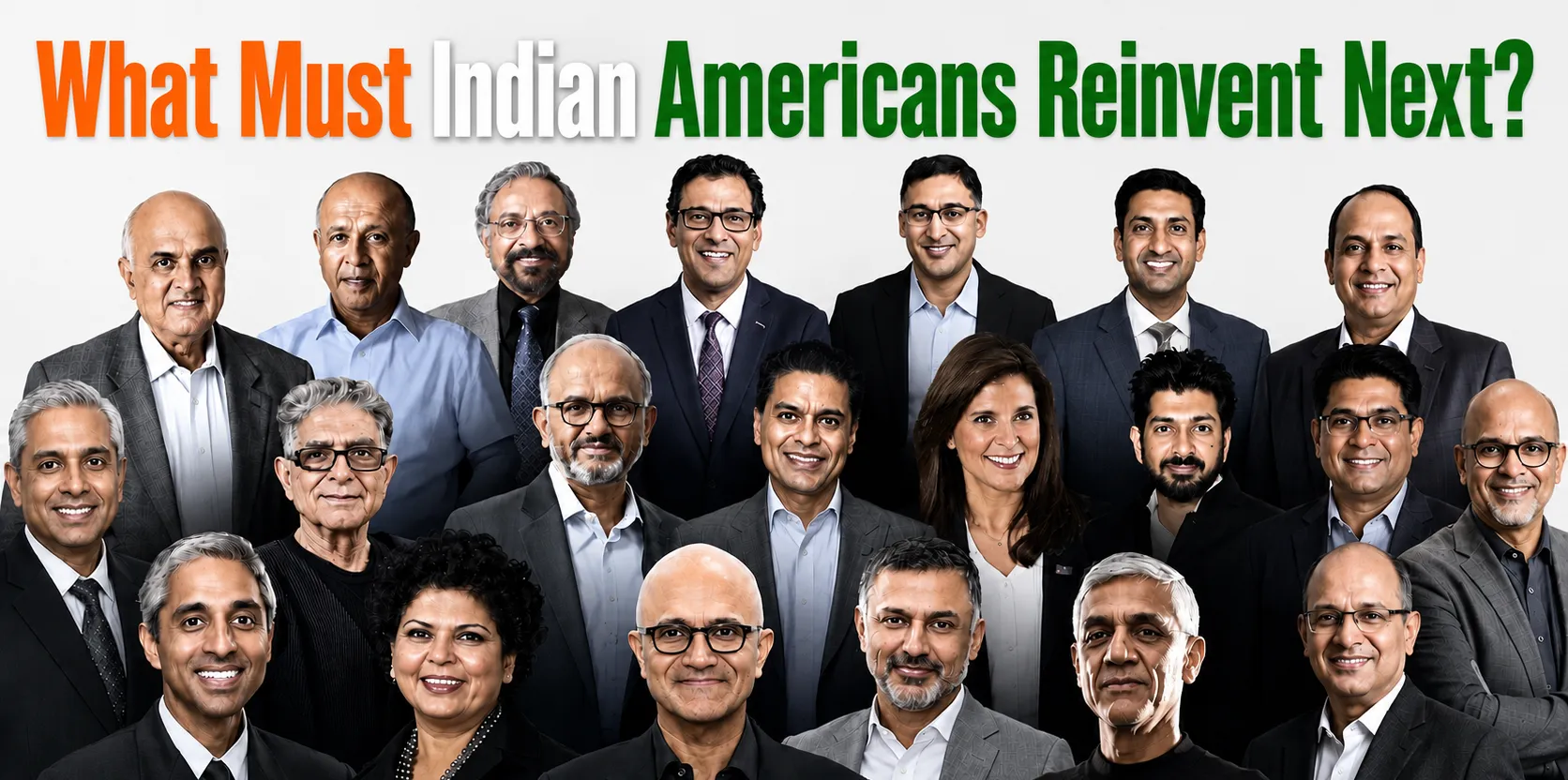
The Summit Is Not the Destination
There is a particular kind of silence that settles in after the achievement. The C-suite office. The IPO celebration. The medical degree framed on the wall. The seven-figure net worth quietly crossed at 42. For hundreds of thousands of Indian Americans, that silence has arrived — and with it, a question that no immigrant hustle manual ever prepared them for:
Now what?
The Indian American story has become one of the most remarkable chapters in the history of American immigration. Comprising less than 1.5% of the U.S. population, Indian Americans account for a staggeringly disproportionate share of the country's most influential institutions. They lead some of the world's most powerful companies — Google, Microsoft, IBM, Adobe, Palo Alto Networks, FedEx. They are overrepresented in medicine, law, academia, and finance. Their median household income consistently ranks among the highest of any ethnic group in America. By almost every conventional measure of success, the Indian American community has won.
But winning, as it turns out, is only the beginning of a much more complicated journey.
The generation that arrived from India in the 1970s, 80s, and 90s — clutching student visas and dreams stitched together from sacrifice and stubborn ambition — came with a singular mission: survive, succeed, and secure the future. They did all three, often spectacularly. They built a formidable foundation. But foundations are not legacies. They are prerequisites.
What Indian Americans must now confront is not a crisis of capability, but a crisis of imagination. The reinvention required is not of their skill sets, but of their purpose.
The Identity Question They Keep Avoiding
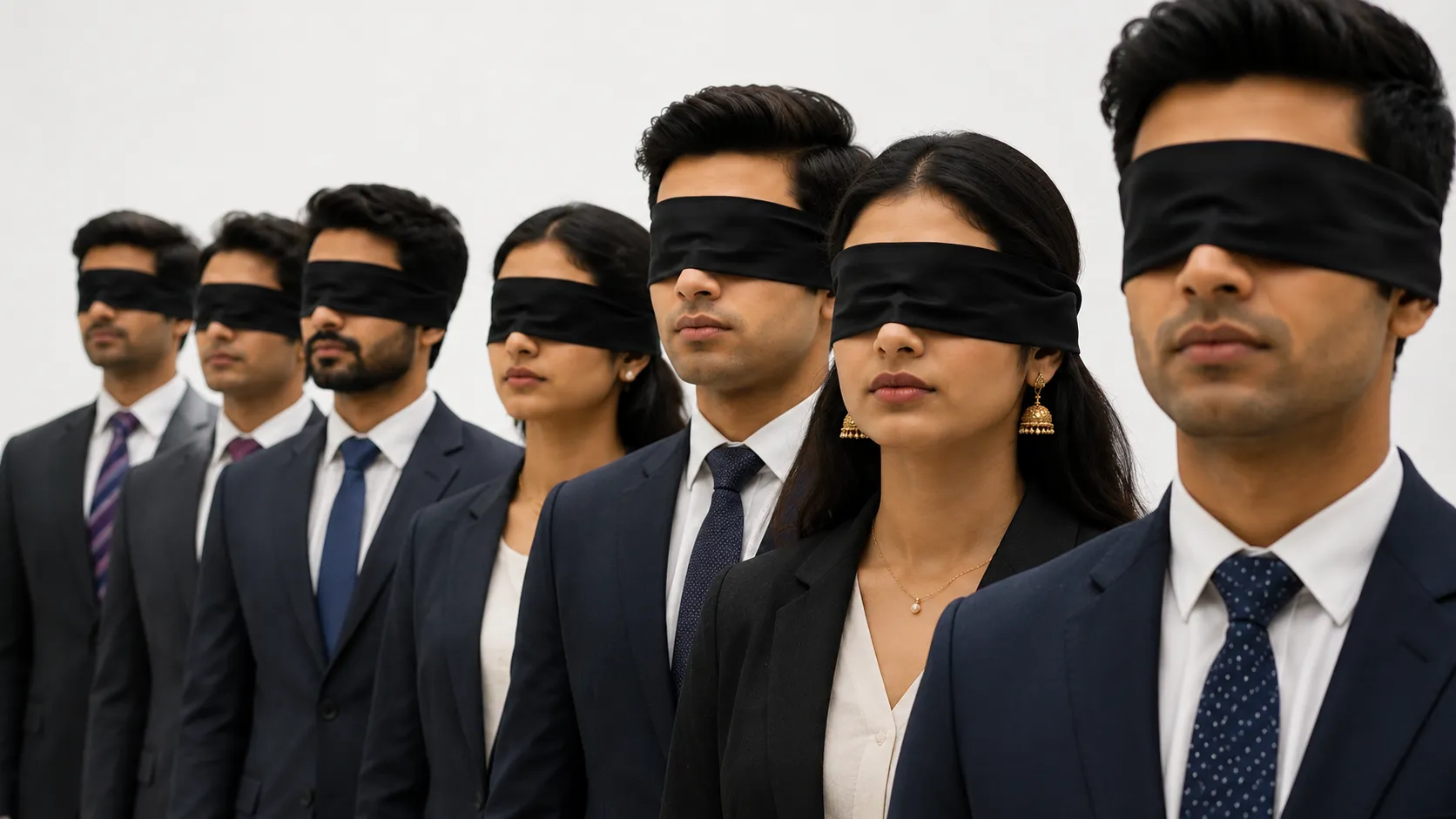
Walk into any gathering of successful Indian Americans — a Diwali gala at a convention center, a Silicon Valley networking dinner, a fundraiser for a prestigious university — and you will notice something curious. Identity is everywhere in the décor and nowhere in the conversation.
The saris. The diyas. The biryani. The Bollywood soundtrack. Indian culture is performed, celebrated, and photographed. But ask a 50-year-old Indian American tech executive who they are — not what they do, but who they are — and the answer often reveals a quietly fractured inner world.
"I felt like I spent 30 years becoming American enough to be accepted, and now I realize I don't fully know what I gave up," says one venture capitalist based in the Bay Area, who requested anonymity. "My children speak no Indian language. I haven't visited my ancestral village in 15 years. I've optimized my career beautifully and somewhat lost myself in the process."
This is not an uncommon story. It is, in fact, a defining tension of the Indian American experience at the apex of success: the achievement was built on a kind of self-editing. To rise, many had to sand down the edges of their Indianness — the accent, the name pronunciation, the spiritual practices, the communal worldview — and replace them with fluency in the dominant culture. The trade-off was rational. The loss, only now becoming visible, is profound.
The reinvention Indian Americans need here is not nostalgic. It is about doing the harder work of constructing an authentic, hyphenated identity — one that draws unapologetically from both traditions, contributes distinctively to American life, and passes something more than financial security to the next generation.
Identity, at this stage of the journey, is not a soft concern. It is the bedrock of everything else that follows.
Beyond the Model Minority: The Leadership Ceiling They Must Shatter
Here is the paradox that defined the last decade of Indian American professional life: Indians run American companies but rarely run American institutions.
Sundar Pichai leads Google. Satya Nadella transformed Microsoft. Sonia Syngal reshaped Gap. Indra Nooyi reinvented PepsiCo. These are not small achievements. But look beyond the corporate boardroom — into the structures that shape policy, culture, media, philanthropy, and civic life — and Indian Americans remain conspicuously underrepresented.
There are 4.4 million Indian Americans in the United States. There have been four Indian American governors in U.S. history. Indian Americans give generously to universities and hospitals, but their names are rarely on the buildings that shape public discourse. They fund political campaigns but seldom are the political candidates. They advise institutions but rarely found them.
This is not a failure of ambition. It is a failure of translation — the inability or unwillingness to convert economic and professional success into social and political capital.
The reinvention required here is a move from optimization to audacity. Indian Americans must stop playing by the rules of a game designed for them to be excellent employees and start designing new games entirely. The community must build political power with the same ferocity it built technical skill. It must fund media, create cultural institutions, and produce writers, artists, filmmakers, and philosophers who give the community a voice in shaping the American story.
The glass ceiling that most Indian Americans don't talk about is not above their heads in the corporate hierarchy. It is in their own imagination — an invisible boundary between professional achievement and civic power.
Kamala Harris broke one version of that ceiling in 2020. But one name, however historic, is not a movement. The community that produced her must now build the infrastructure to produce many more like her — and unlike her, too.
Philanthropy Reimagined: From Donor to Architect
When a prominent Indian American family in New Jersey donated $10 million to their local hospital system, the ceremony was elaborate and moving. Their name now graces a wing of the cardiac unit. Lives will be saved because of their generosity. This is unambiguously good.
But here is the harder question: who decided that cardiac care in suburban New Jersey was where $10 million of Indian American wealth would have its greatest impact?
Indian American philanthropy, for all its generosity, has historically been reactive and institutional. It follows the ask rather than leading with vision. It donates to the schools that educated the donors, the hospitals where they were treated, the temples where they worship. These are worthy causes. They are not a strategy.
The reinvention of Indian American philanthropy requires a shift from donor to architect — from funding existing structures to building new ones. It requires asking not 'which institution should I support?' but 'what institution does not yet exist that the world urgently needs?'
India's founding generation of industrial philanthropists — the Tatas, the Birlas, the Narayana Murthys — built universities, research institutions, and hospitals that outlived their founders by generations. Indian Americans, sitting on comparable wealth, have not yet produced their equivalent. The reinvention of Indian American philanthropy at this moment in history is not just an act of generosity. It is an act of civilizational responsibility.

The Children They're Raising — And the Conversation They're Not Having
At weekend cricket matches in Fremont and Edison and Sugar Land, a ritual plays out with almost comic precision. The parents — many of them software architects, cardiologists, and investment bankers — watch their American-born children play, and quietly share the same anxiety: Are they going to be okay? Are they driven enough? Do they understand what we sacrificed?
The anxiety is real. But it is often misdirected.
The children of successful Indian Americans — the so-called 'second generation' — face a fundamentally different challenge than their parents did. Their parents had to prove they belonged. The second generation has to figure out who they belong to, and what they belong for.
Many second-generation Indian Americans report growing up with an acute sense of their parents' expectations but a striking absence of permission to explore, fail, or choose differently. The message, spoken or unspoken, was often: 'We came here so you could have every option. Now choose medicine, law, or engineering.'
The reinvention Indian American parents must undertake is one of the most personally demanding: letting go of the success blueprint that saved them and trusting their children to write a new one. This means having honest conversations about mental health — a topic still stigmatized in many Indian American households. It means celebrating a child who becomes a poet or a public school teacher with the same pride as one who becomes a physician.
The next generation of Indian Americans needs to be raised not just to succeed in America, but to lead it — including the wisdom to examine which structures need changing, not merely climbing.
Culture as Competitive Advantage
For decades, Indian Americans treated culture as a private matter — something you celebrated at home and softened at the office. The bindi was removed before the board meeting. The lunch was eaten quietly, away from colleagues who might find the smell of tadka unfamiliar.
That era is ending. And the Indian Americans who recognize this first will have an extraordinary advantage.
The global economy is increasingly defined not just by technological innovation but by cultural intelligence — the ability to navigate complexity, hold multiple worldviews simultaneously, and build across difference. These are precisely the capacities that a life lived between two civilizations develops naturally.
Indian Americans carry within them a dual fluency that is increasingly rare and valuable: deep roots in one of humanity's oldest and richest civilizations, and full command of the world's most powerful economy and culture. The Vedantic tradition of finding unity in diversity. The philosophical comfort with ambiguity and paradox. The multigenerational joint-family model of distributed leadership. These are not soft, sentimental assets. They are frameworks for solving hard, modern problems.
When Satya Nadella credits his Indian philosophical education with shaping his 'growth mindset' leadership philosophy — the framework that turned Microsoft around — he is not being nostalgic. He is describing a genuine competitive advantage, drawn from the deepest wells of Indian intellectual tradition. The challenge for the broader community is to make that connection consciously, not accidentally.
Building the Global Indian Network — For Impact, Not Just Commerce
The Indian diaspora is 32 million people strong, spread across every continent, embedded in every significant economy. No other diaspora on earth combines this scale of geographic reach with this concentration of professional achievement. And yet, it remains one of the most underutilized networks in the history of human migration.
The Indian American community has excellent chambers of commerce, professional associations, and social networks. What it lacks is a coordinated, ambition-scaled vision for what the diaspora could accomplish together — not just in business, but in diplomacy, science, culture, and governance.
Imagine a coordinated Indian American response to the climate crisis — connecting environmental scientists in California, clean energy entrepreneurs in Texas, policy advocates in Washington, and innovators in Bangalore and Hyderabad. Imagine a diaspora-led initiative to bridge the U.S.-India relationship in an era of growing geopolitical importance. Imagine a Giving Pledge-equivalent that pools diaspora resources to solve shared challenges in both countries.
This is not fantasy. It is simply ambition that has not yet been organized.
The reinvention here is from network to force — from a community that celebrates its connections to one that deploys them with deliberate purpose toward goals larger than any individual's success.
The Inner Life: What Success Cannot Buy
There is a quieter reinvention required — one that rarely makes it into LinkedIn posts or keynote speeches, but may be the most important of all.
In the Indian American community, rates of anxiety, depression, and what clinicians now call 'high-functioning unhappiness' are significantly higher than popular perception acknowledges. The community's public face is one of relentless achievement. Its private experience is often one of relentless pressure — on children to perform, on adults to maintain, on families to project a seamless surface.
The spiritual traditions that sustained Indian civilization for millennia — yoga not as a fitness routine but as a philosophy of integration; mindfulness not as a productivity hack but as a practice of presence; dharma not as a career trajectory but as a question of one's deepest purpose — have, for many Indian Americans, been traded away in the climb toward success. The irony is that Silicon Valley now sells watered-down versions of these practices back to the same community that gave them to the world.
The Indian philosophical tradition has always been honest about this: artha (wealth) and kama (pleasure) are legitimate human goals, but they are insufficient without dharma (right living) and moksha (liberation from the ego's endless demands). A community that built its American chapter on artha must now make room for the other three.
The Call: From Success to Significance
There is a word in Tamil — uzhavan — that means one who tills the soil and prepares it for the next season. It is a word for someone who works not for immediate harvest, but for future abundance. It is the opposite of the extractive model of success — taking from the land until it is exhausted — and it is the posture that this moment in Indian American history demands.
The Indian Americans who arrived in America with nothing and built extraordinary lives did something beautiful and historic. They proved that merit, discipline, and ambition could triumph over the accidents of birth and geography. That story deserved to be told, celebrated, and honored.
But it was never the whole story. It was always the prologue.
The next chapter — the one that must now be written — is about what you do with the foundation once it is built. It is about choosing significance over merely sustaining success. It is about asking the hardest question that prosperity ever generates:
For whom am I doing this, and what will remain when I am gone?
Indian Americans now have the wealth, the education, the networks, the cultural wisdom, and the historical moment to make a contribution of truly extraordinary scale — not just to their families, not just to their companies, not just to their community, but to the American story, to the Indian story, and to the human story.
The success was earned. The reinvention is a choice.
Choose wisely. The world is watching.


