14 Days to 100 Days, 25 Kg to 350 Kg, One Moon to a Space Station: Inside India's Great Space Acceleration
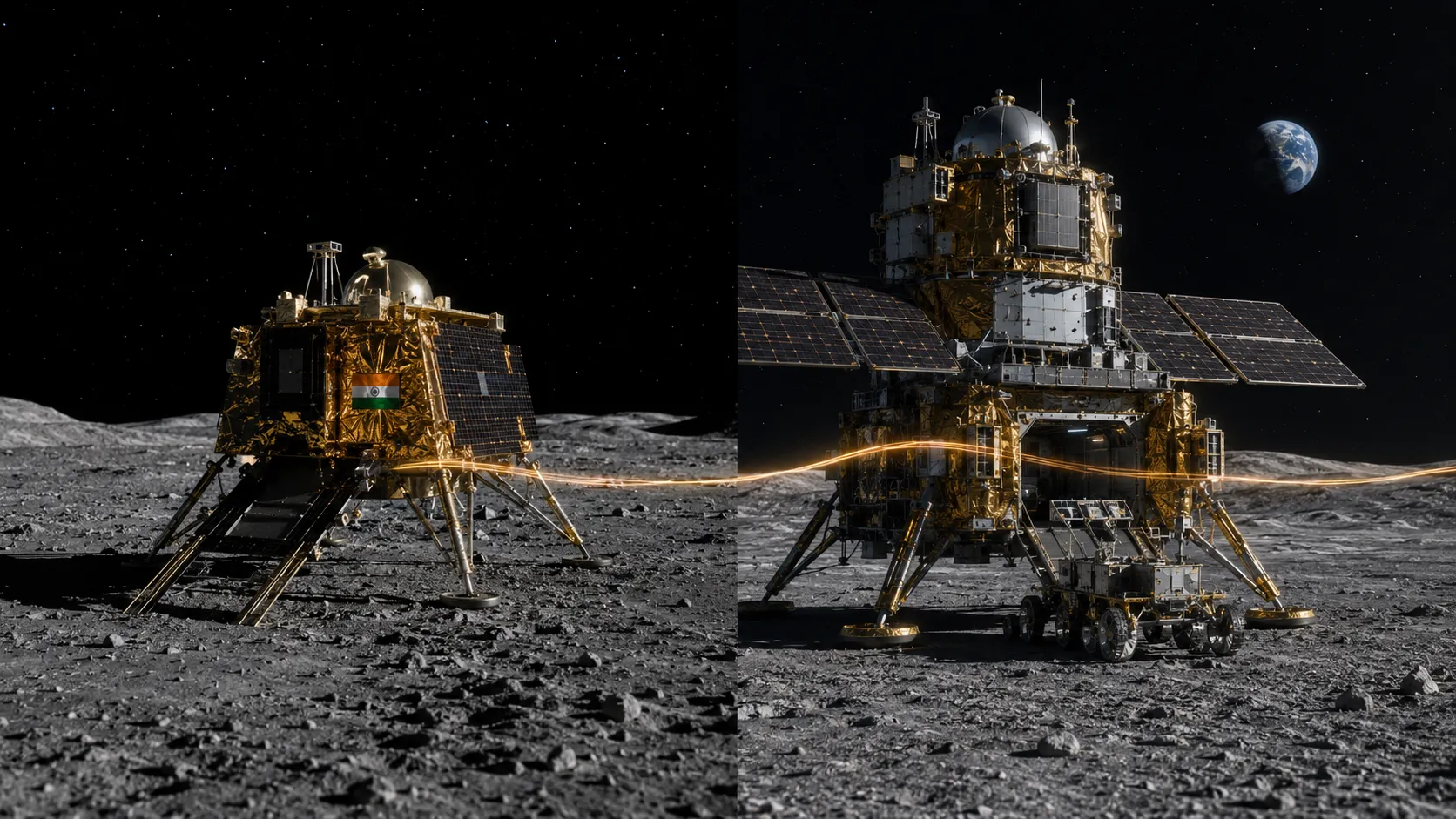
BENGALURU — May 26, 2026 — In August 2023, a four-legged lander named Vikram touched down on the lunar surface near the Moon's south pole, and India became the fourth nation in history to achieve a soft landing on another world. The mission was designed to last 14 days. The rover it carried weighed 25 kilograms. When the sun set on the lunar plain, the lander went to sleep, as planned, and did not wake up. It was, by any measure, a triumph—a demonstration of technological capability that had eluded far wealthier nations and that announced India's arrival as a serious space power.
Three years later, ISRO is no longer content with arrival. "Now we are working on the continuation of the Chandrayaan programme," Chairman V. Narayanan said at the START 2026 programme inauguration in March. "In Chandrayaan-4, we plan to collect samples and bring them back. Chandrayaan-5 will involve a heavier lander with a longer mission life." The lander that once lasted 14 days will be replaced by one designed to survive 100 days. The rover that weighed 25 kilograms will be replaced by one weighing 350 kilograms—more than a small car. The mission that proved India could reach the Moon is being succeeded by missions that will prove India can stay there, work there, and bring pieces of it home.
This acceleration is not limited to the Moon. On March 29, 2026, the Vikram Sarabhai Space Centre issued an Expression of Interest to Indian industry for the structural realisation of the first module of the Bharatiya Antariksh Station—India's own orbital outpost, which will be assembled module by module over the coming decade and fully operational by 2035. The first module, BAS-01, is scheduled for deployment by 2028 at an estimated cost of ₹1,763 crore. Five modules are planned by 2035. The station will orbit at an altitude of 400 to 600 kilometres, support a sustained human presence in Low Earth Orbit, and serve as a hub for microgravity research, technology maturation, and strategic autonomy. And all of this—the sample return, the heavier lander, the longer mission life, the space station, the ambition to land Indians on the Moon by 2040—is unfolding simultaneously, on overlapping timelines, funded by a budget that is a fraction of what NASA and CNSA spend annually.
The Sample-Return Calculus
The most strategically significant dimension of India's lunar programme is not the destination. It is the round trip. Chandrayaan-4, approved by the Union government and designed as India's most complex lunar endeavour yet, aims to do something no Indian spacecraft has ever attempted: land on the Moon, collect samples of lunar soil and rock, and return them to Earth.
The complexity of a sample-return mission is orders of magnitude greater than a simple landing. A lander that touches down on the Moon and stays there is a one-way vehicle. A lander that must take off again, rendezvous with a return module in lunar orbit, and transfer its precious cargo for the journey home is an entirely different engineering challenge. It requires ascent propulsion, autonomous docking, thermal protection for Earth re-entry, and a level of reliability that tolerates no single point of failure. Only three nations—the United States, the Soviet Union, and China—have ever achieved lunar sample return. India intends to be the fourth.
The landing site for Chandrayaan-4 has already been identified. ISRO scientists, led by Amitabh, K. Suresh, and Ajay K. Prashar, used data from the Chandrayaan-2 orbiter's high-resolution camera to map craters, boulders, and slopes near Mons Mouton, a mountain-like massif near the lunar south pole. After evaluating four candidate patches, the landing site selection committee chose the MM-4 patch as the safest and most scientifically valuable location. "The OHRC data allowed them to map craters, boulders and slopes," The Times of India reported. "The MM-4 patch will host India's first attempt to bring back pieces of the Moon."
The mission is at least two years away, but the site selection signals that ISRO is no longer in the experimental phase of lunar exploration. It is in the operational phase. The agency is not asking whether it can land on the Moon. It is asking where, specifically, it should land—and the answer is being determined by the same kind of high-resolution orbital reconnaissance that NASA and CNSA use to select their own landing sites. The capability is mature. The ambition is growing. The mission that will bring pieces of the Moon back to Earth is being planned, component by component, trajectory by trajectory, in the same Bengaluru campus that planned the missions that came before it.
Chandrayaan-4 will also serve as a technological bridge to Chandrayaan-5. The sample-return architecture—the ascent from the lunar surface, the autonomous docking in orbit, the return to Earth—is directly applicable to future crewed missions. The technologies that ISRO develops for the robotic sample return will, in modified form, be the same technologies that bring Indian astronauts home from the Moon in the 2040s. The roadmap is not a collection of disconnected missions. It is a single, integrated programme, each mission building on the one before it, each capability enabling the next.
The Japan Partnership and the 350-Kilogram Rover
The most technologically ambitious dimension of India's lunar programme is not Chandrayaan-4. It is Chandrayaan-5—a joint mission with the Japan Aerospace Exploration Agency (JAXA) that will send an Indian-built lander and a Japanese-built rover to the Moon's south pole to hunt for water ice.
In April 2026, an ISRO delegation visited Japan's Tanegashima Space Centre to inspect launch facilities and prepare for tests ahead of the planned lift-off. The mission will launch on Japan's H3 rocket—a vehicle that is newer, larger, and more powerful than ISRO's workhorse PSLV and GSLV. The choice of launcher reflects the scale of the mission. Chandrayaan-5 will carry a lander that is substantially heavier than anything ISRO has ever sent to the Moon, and a rover that weighs 350 kilograms—fourteen times the mass of the 25-kilogram Pragyan rover that trundled across the lunar surface during Chandrayaan-3. "The mission will last at least three-and-a-half months on the Moon and could run up to a year," India Today reported. "It builds on India's success with Chandrayaan-3."
The Japanese rover will be equipped to drill into the lunar soil to a depth of nearly 5 feet—far deeper than any previous robotic mission to the south pole—and analyse the ice and other materials it uncovers. Instruments from NASA and the European Space Agency will also be onboard, making Chandrayaan-5 one of the most internationally collaborative lunar missions ever attempted. The rover will search for water ice in the permanently shadowed craters near the south pole, where temperatures never rise above minus 200 degrees Celsius and where the ice has been accumulating for billions of years. The presence of accessible water on the Moon would transform the economics of lunar exploration. Water can be split into hydrogen and oxygen for rocket fuel. It can be purified for drinking. It can be used to grow plants, to shield habitats from radiation, and to sustain a permanent human presence on the lunar surface. The nation that maps the water ice, that understands its distribution and accessibility, will have a decisive advantage in the next phase of lunar exploration. India and Japan intend to be that nation.
The collaboration between ISRO and JAXA has deepened significantly over the past year. The two agencies have held multiple technical meetings to finalise designs and plans. India's lander has seen progress with new engine tests. Japan's rover is in advanced development. The teams that gathered at Tanegashima in April posed under the flags of India and Japan—a photograph that captured more than diplomatic pleasantry. It captured the emergence of a new axis in space exploration, one that is independent of the U.S.-China rivalry that has dominated the conversation about the Moon for years. India and Japan are not choosing sides. They are building their own.
The Orbital Independence
The most geopolitically significant dimension of India's space programme is not the Moon missions. It is the Bharatiya Antariksh Station—the orbital outpost that will, by 2035, make India one of only a handful of nations to operate an independent space station.
The International Space Station, which has been the centrepiece of human spaceflight for more than two decades, is scheduled for retirement around 2030. When it is deorbited, the only operational space stations will belong to China (Tiangong) and, eventually, to India (BAS). Russia has announced its own ROS station, with which India has aligned its orbital inclination at 51.6°—a decision that ensures cooperative access, shared research initiatives, and a sustained human presence in Low Earth Orbit after the ISS era ends. The alignment is not a treaty, but it is a signal: the post-ISS architecture of human spaceflight is being designed now, and India intends to be a participant, not a spectator.
The BAS project has moved decisively from concept to execution. In September 2024, the Union Cabinet approved the development and launch of the first module (BAS-01) by 2028, as part of a revision in the scope of the Gaganyaan programme. The overall configuration—five modules, assembled incrementally over a decade—was reviewed by a national-level committee and greenlit. The budgetary allocation for BAS-01, estimated at ₹1,763 crore, was included in the expanded Gaganyaan programme budget, which now stands at ₹20,193 crore. "ISRO has worked out overall configuration of Bharatiya Antariksh Station comprising of five modules," the Department of Space informed Parliament in February 2026. "BAS will provide a platform to undertake microgravity research and scientific studies in various fields including life sciences and medicine."
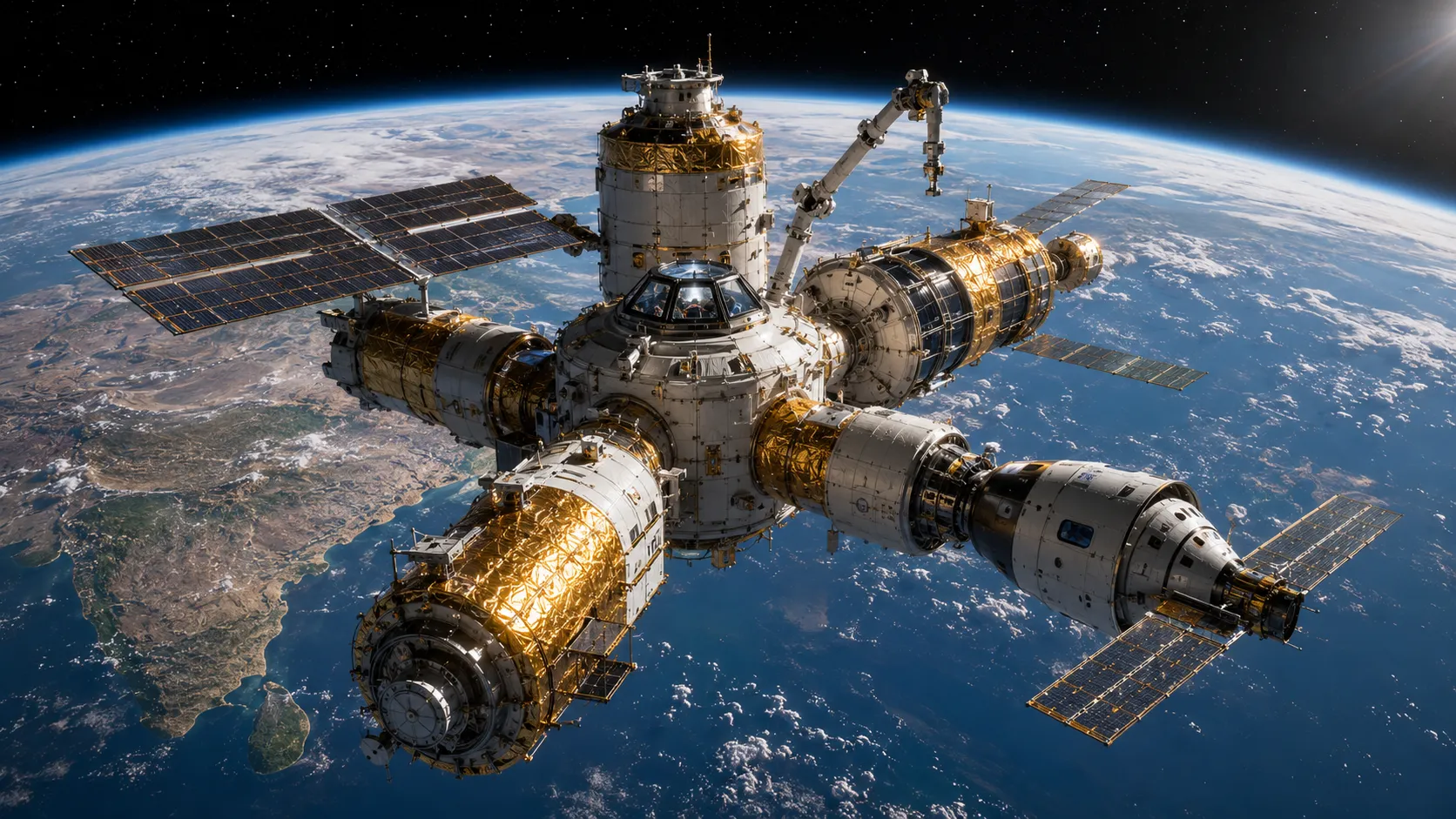
On March 29, 2026, the Vikram Sarabhai Space Centre issued an Expression of Interest to Indian industry for the structural realisation of the first orbital module. This was not a symbolic gesture. It was a formal invitation to the private sector to participate in the construction of critical space infrastructure—a deliberate pivot away from the state-monopoly model that defined Indian space for decades. The EOI specified rigorous technical standards: precision fabrication, advanced welding, certified space-grade materials. The module must be compatible with current and future ISRO launch vehicles. It must support autonomous and crew-assisted rendezvous and docking. It must accommodate robotic arms for external operations, in-orbit refuelling capabilities, and the life-support systems required for long-duration human habitation. "By issuing an Expression of Interest, ISRO is pivoting toward a more collaborative model that leverages the manufacturing prowess of the private sector," India Strategic reported. "This public-private synergy is expected to accelerate the timeline and foster a robust industrial base capable of supporting future deep-space missions."
The station is being designed to compete with the world's most advanced orbital platforms. It will feature standardised Indian docking systems, reducing integration complexity and increasing flexibility for various crew and cargo craft. It will support external robotics for payload management and orbital replacement. It will incorporate in-orbit refuelling capabilities to extend the life of visiting spacecraft. It will serve as a logistics and servicing node for future Indian platforms in higher orbits, including cislunar missions. And it will function as a microgravity laboratory, hosting experiments in life sciences, pharmaceuticals, material sciences, and advanced manufacturing that are impossible to conduct on Earth. The station is not a destination. It is a platform—the foundation on which India's human spaceflight programme will build for the next generation.
The Gaganyaan programme, which will deliver the first Indian astronauts to orbit, is the bridge to the station. Chairman Narayanan told the START 2026 programme that the first crewed flight is targeted within the next two years. "We are currently working on the Gaganyaan programme and are planning to send our own astronauts into space and bring them back safely, possibly within the next two years," he said. Union Minister Jitendra Singh, speaking at a press conference in May, reiterated the timeline and added further milestones: "By 2035, we will have our own space station, Bharat Antariksh Station. And by 2040, we might be landing an Indian on the surface of the Moon."
The Great Acceleration
The most remarkable dimension of India's space programme in 2026 is not any single mission. It is the simultaneity of them. Chandrayaan-4 and Chandrayaan-5 are being planned in parallel, not sequentially. The Bharatiya Antariksh Station is being designed even as Gaganyaan prepares for its first crewed flight. The Venus Orbiter Mission and the Mars landing mission are moving through the approvals pipeline. The docking technology demonstrated by SpaDeX-1 is being refined for SpaDeX-2 and SpaDeX-3. The entire programme is accelerating, and the acceleration is being driven by a conviction that the window for establishing a sovereign presence in space is finite—and that the nations that establish themselves in this window will own the next era of human spaceflight.
The budget that supports this acceleration is, by the standards of spacefaring nations, minuscule. NASA's annual budget exceeds $25 billion. China's is estimated at $14 billion. ISRO's is roughly $1.8 billion—less than 8 percent of NASA's. And yet, the agency has achieved soft landing on the Moon, deployed a solar observatory at the L1 Lagrange point, demonstrated autonomous docking in orbit, and now has a credible roadmap to lunar sample return, heavy rover deployment, and an independent space station. The efficiency is not magic. It is the product of decades of institutional discipline, a workforce that is paid a fraction of what their counterparts earn in Houston or Beijing, and a culture that values frugality as a design constraint rather than a limitation. "With its ability to execute high-quality missions at comparatively low cost," Narayanan said at the D.Y. Patil International University convocation, "India is now counted among the top five space-faring nations in the world."
The broader context is a global space industry that is undergoing the most significant restructuring since the Apollo programme. The ISS is retiring. China is expanding Tiangong. Russia is building ROS. The United States is funding commercial space stations through NASA's Commercial LEO Destinations programme. The Moon is being contested by multiple nations, each with its own ambitions and its own alliances. In this environment, the nation that can establish an independent, permanent presence in orbit and on the lunar surface will have a strategic advantage that extends well beyond the scientific. The Bharatiya Antariksh Station is not just a laboratory. It is a statement—that India will not be dependent on foreign space stations for its research, its technology development, or its human spaceflight programme. The Chandrayaan missions are not just scientific expeditions. They are the foundation of a capability that will, by 2040, put Indian boots on the Moon.
The acceleration is real. The lander that once lasted 14 days will soon last 100. The rover that weighed 25 kilograms will soon weigh 350. The space station that was once a concept will soon be an industrial reality, with its first module under construction by Indian companies on Indian soil. The nation that was once a spectator in the space race is now a competitor—and the competition is just getting started.
What This Signals
The Indian space programme's great acceleration is not primarily about technology. It is about sovereignty. The ISS era, which lasted more than two decades and was defined by unprecedented international cooperation, is ending. The post-ISS era, which will be defined by national and regional space stations operated by the United States, China, Russia, and India, is beginning. The nations that have sovereign access to orbital platforms will control the research, the technology development, and the strategic capabilities that those platforms enable. The nations that do not will be dependent on the goodwill of those that do. India has chosen to be among the former.
The Moon is the next frontier. The south pole, with its permanently shadowed craters and its billions of tonnes of water ice, is the most strategically valuable real estate in the solar system. The nation that maps the ice, that understands how to extract it, and that establishes the infrastructure to use it will have a decisive advantage in the lunar economy that is beginning to take shape. India's Chandrayaan programme—from the discovery of water by Chandrayaan-1, to the failed landing of Chandrayaan-2, to the triumphant landing of Chandrayaan-3, to the sample return of Chandrayaan-4 and the heavy rover of Chandrayaan-5—is a systematic, incremental campaign to establish exactly that capability. The programme is not a race. It is a siege—a patient, methodical, decades-long effort to build the capacity to live and work on the Moon. The 14-day lander was the first step. The 100-day lander is the next. The Indian astronauts who will walk on the lunar surface in 2040 are, today, in training—and the spacecraft that will carry them is being designed, component by component, in the same laboratories that designed the missions that came before.
V. Narayanan, the chairman who has overseen this acceleration, is not a showman. He does not give TED Talks or cultivate a social media presence. He works, and he lets the missions speak for themselves. The missions are speaking. The sample-return capsule is being designed. The space station module is being tendered to Indian industry. The Japanese rover is being prepared for its journey to the south pole. The 350-kilogram rover that will drill into the lunar ice is being built. The acceleration is quiet, methodical, and unmistakable. The nation that once launched its first satellite on a bicycle-drawn rocket is now building a space station and planning to put its citizens on the Moon. The 14 days are over. The 100 days are coming. The space station is rising. The Moon is waiting


