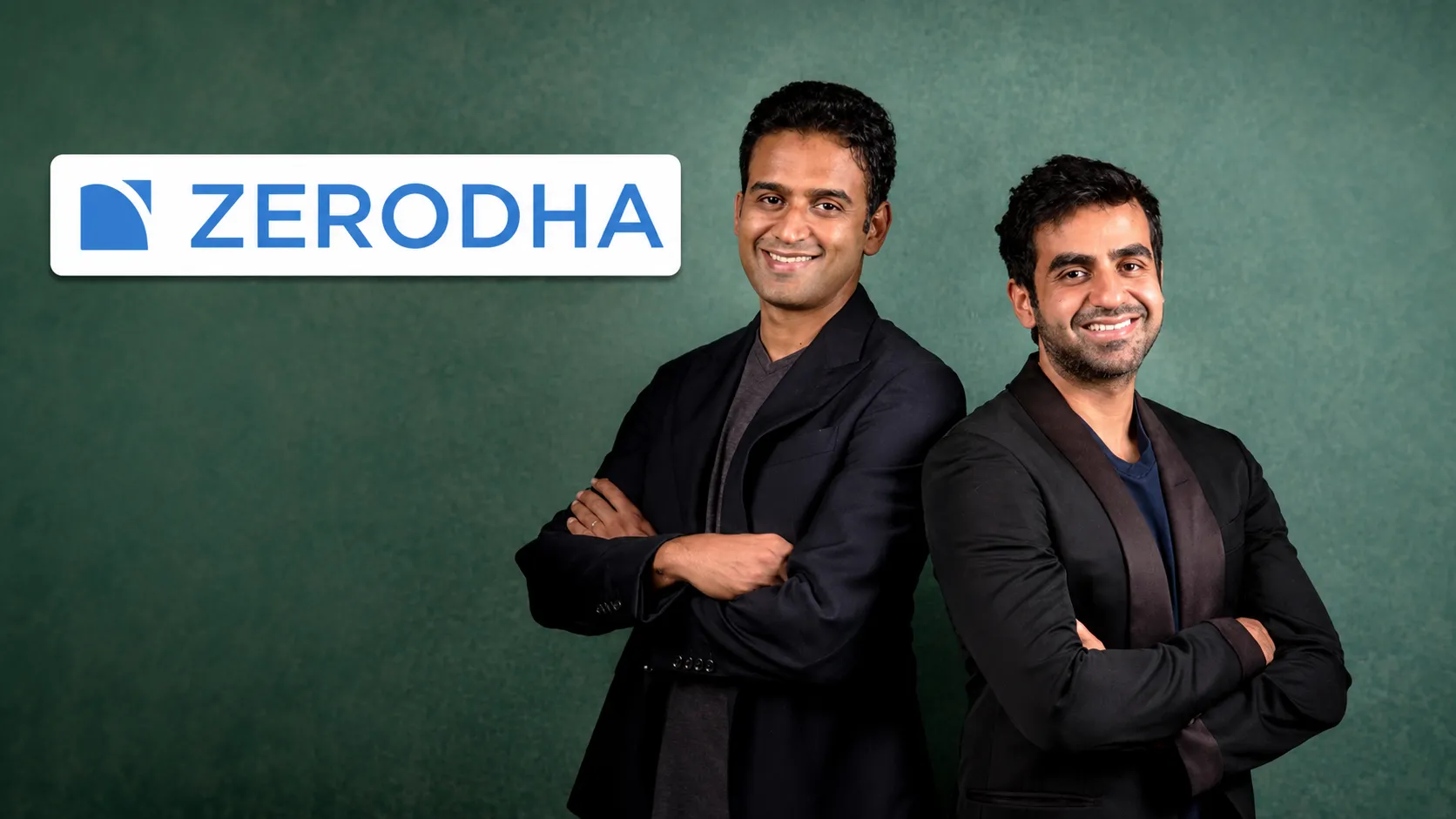
A Burned-Out Trader, ₹10 Lakh, and a Sanskrit Word
Rewind to 2010. Nithin Kamath had spent the better part of a decade as a full-time trader — and ten years of trading had taught him exactly how stacked the deck was against ordinary investors. Brokers charged a percentage of every trade, which meant the more you traded — or the bigger your trade — the more you bled in fees, regardless of whether you actually made money. On top of that: clunky technology, mountains of paperwork, and a system that quietly told most Indians the stock market wasn't built for them.
Nithin had a simple, almost stubborn belief: the right thing, done long enough, pays off on its own. So instead of chasing investors, he and his younger brother Nikhil put in ₹10 lakh of their own savings and started a company. They named it Zerodha — “Zero” plus “Rodha,” the Sanskrit word for barrier. Not a clever brand exercise. A literal mission statement.
While their contemporaries were busy raising Series A rounds, the Kamaths did the opposite — they bootstrapped, kept the company 100% family-owned, and built slowly on their own terms. No board telling them to chase growth metrics. No investor pressure to “engage” users more. Just two brothers and a bet that fairness, transparency, and good tech would eventually win.
The ₹20 Flat Fee That Detonated an Industry
Here's the move that changed everything. Zerodha became India's first discount broker — and the first to charge zero brokerage on delivery trades and a flat ₹20 per executed order for intraday trades, no matter how large the trade was.
To understand how radical this was: imagine every other brokerage in the country charging you a cut of your trade, and one company suddenly saying — we don't care if you're trading ₹5,000 or ₹5 crore, the fee is the same flat amount. For India's small retail investors — the chai-stall owner, the college student, the salaried employee with a side interest in stocks — this was the difference between investing being “for people like me” and “not for people like me.”
The ripple effect was massive. Full-service brokers who had built their entire business on commission percentages were suddenly competing against a company that had thrown out their entire playbook. Within a few years, “discount broking” stopped being a niche category and became the dominant model in Indian retail investing — and almost every major broker that followed was, in some way, reacting to Zerodha.
The Tech Team That Refused to Be Normal
This is the part of the Zerodha story most people don't know — and it's arguably the most important.
In 2013, Kailash Nadh, a self-taught coder with a PhD in AI and Computational Linguistics, joined as CTO and built Zerodha's entire technology team from scratch. Nadh isn't your typical fintech CTO — he's a long-time open-source advocate, the creator of widely-used open-source tools, and someone who hires “hackers” who've built and broken things for fun rather than people with the “right” pedigree.
Under his leadership, Zerodha made a series of contrarian bets that became core to its identity:
Self-hosting everything. While most fintechs rushed to the cloud, Zerodha runs its own infrastructure — including multi-terabyte PostgreSQL databases handling hundreds of billions of rows — with a deliberately small, lean engineering team.
Scaling brutally fast, on purpose-built systems. The platform scaled from 2 million to 8 million users in just 18 months without the bloated teams most companies would assume that requires.
“User disengagement” as a philosophy. While most apps are designed to maximize time-on-app, Zerodha explicitly built around the opposite idea — a trading platform that respects your time and doesn't manipulate you into checking it fifty times a day. Features like “Nudge” actively warn users against risky trades in illiquid stocks, rather than encouraging more activity.
Giving back to open source. In 2024, Zerodha launched a $1 million annual fund to support free and open-source software projects globally — a rare move for a company of its size, and one that reflects the engineering culture baked in from day one.
This wasn't just good PR. It was a genuine structural advantage: lower costs, faster iteration, and a brand built on trust rather than gamification — at a time when “growth hacking” and dark patterns were the industry norm everywhere else.
The Empire — By the Numbers
By the early 2020s, the bet had paid off beyond anything the Kamath brothers might have imagined in 2010:
Over 1.6 crore (16 million) clients placing billions of orders annually
15%+ of all Indian retail trading volume running through Zerodha's platforms
7.5 million active NSE-registered customers as of May 2024
₹9,372 crore (~$1.1 billion) in revenue and ₹5,496 crore (~$650 million) in net profit in FY24 alone
A full ecosystem: Kite (trading), Coin (mutual funds), Console (back office), Varsity (free investor education that's quietly educated millions), available even in regional languages like Telugu
Rainmatter, Zerodha's self-funded incubator, quietly seeding dozens of fintech and adjacent startups — all without taking a rupee of outside capital
For over a decade, Zerodha wasn't just a brokerage. It was proof that a company could dominate an entire industry in India without venture capital, without an IPO, and without the growth-at-all-costs playbook — built instead on radical fee transparency and an engineering culture obsessed with doing more with less.
The Cracks Appear — 2025/26 and the Fall From #1
And then, almost as if to prove that no throne is permanent, the ground shifted under Zerodha's feet — fast.
Regulation hit where it hurt most. New rules tightening open interest limits and raising securities transaction taxes landed squarely on futures and options trading — historically one of Zerodha's biggest revenue engines. The result: brokerage revenue fell by as much as 40% year-on-year in some quarters of FY26.
Investors got cold feet, industry-wide. Market volatility through 2025 made retail traders more cautious across the board. Zerodha alone saw a drop of roughly 12.68 lakh (1.27 million) active clients in a single year — a startling reversal after years of relentless growth.
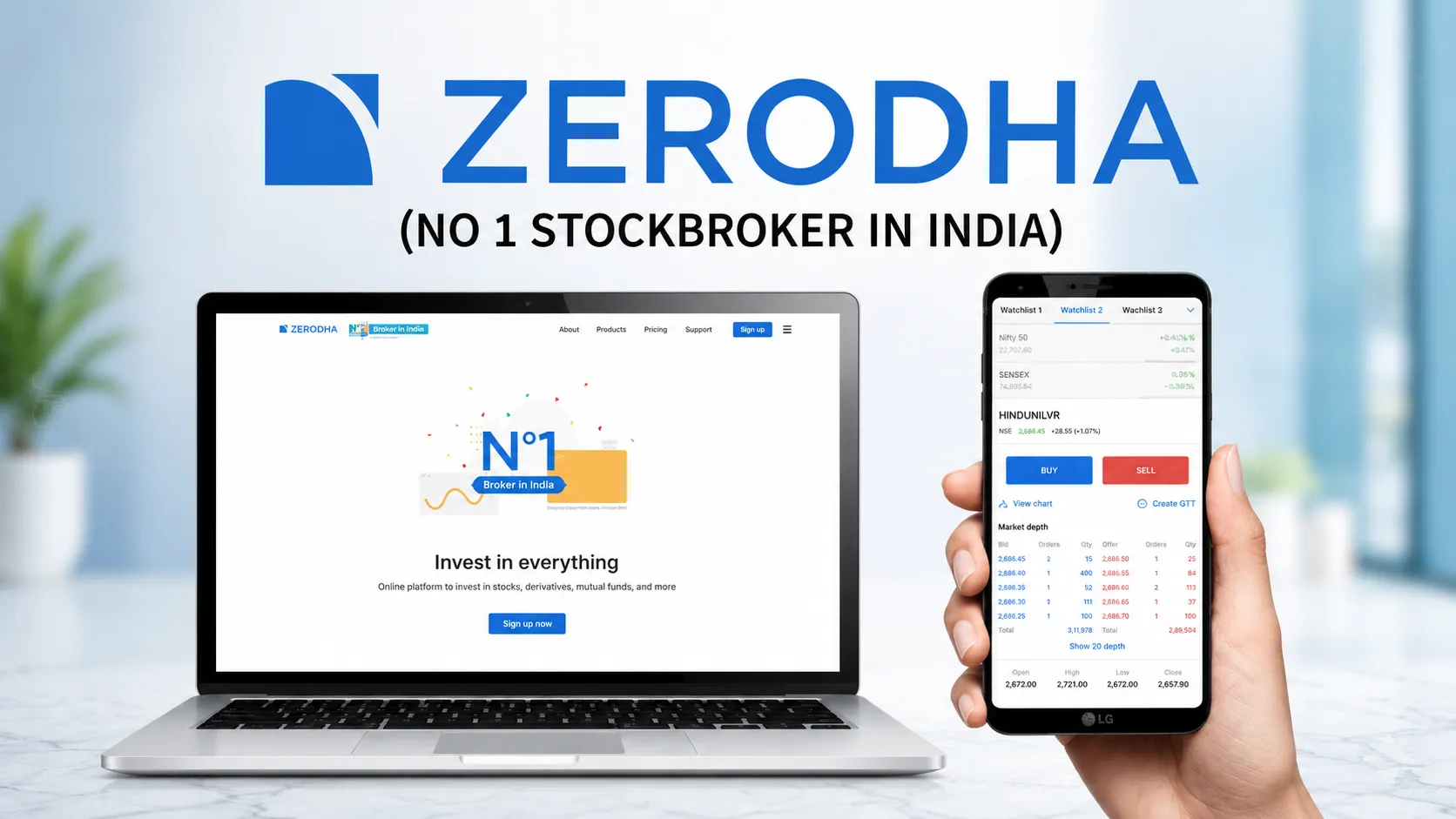
The crown changed hands. For the first time since Zerodha's ascent began, a rival — Groww — overtook it in active client numbers, ending Zerodha's reign as India's largest broking platform by that metric. Groww's Q4 2025 IPO only underscored how fast the competitive landscape was reshuffling, with Zerodha's own client base reportedly making up a notable chunk of Groww's IPO-day trading activity.
Not every bet survived. Zerodha shut down Zero1, its creator-economy initiative, due to regulatory concerns — a sign that even a company sitting on a mountain of cash will kill a project the moment it stops making sense.
For a company that had spent fifteen years as the disruptor, suddenly being the disrupted was a genuinely new feeling.
The Pivot — Where Zerodha Is Placing Its Chips Now
Here's where the story gets exciting again — because Zerodha's response to all this hasn't been to retreat. It's been to expand outward in almost every direction at once.
Banking & financial services over an IPO. Despite constant speculation, Nithin Kamath has repeatedly said an IPO isn't an immediate priority. Instead, the explicit focus is shifting toward banking and broader financial services — territory that would put Zerodha in direct competition with traditional banks, not just brokers. If a public listing ever happens, it's increasingly framed as a means to fund this bigger ambition, not the goal itself.
US stock trading via GIFT City. Zerodha is building a product — using the regulatory clarity offered by the IFSCA's GIFT City framework — that would let Indian users trade US-listed stocks directly. This has been one of the most requested features from users for years, and it represents a genuinely new revenue stream completely insulated from Indian F&O regulation changes.
Lending — turning users into a credit business. Through its NBFC arm, Zerodha Capital, the company lets users pledge stocks and mutual funds as collateral for loans. It's a clever flywheel: the same 16 million-strong user base that trades on Kite becomes a pool of potential borrowers with verifiable portfolios — lower risk, built-in trust.
Fixed deposits on Coin. As trading revenue gets more volatile, Zerodha has quietly added fixed deposits to its Coin platform, riding the broader wave of digital FD adoption in India. It's unglamorous — but it's sticky, low-risk revenue that smooths out the wild swings of brokerage income.
Rainmatter goes big — and gets weird (in the best way). This is the wildcard that makes Zerodha's story genuinely viral-worthy:
Rainmatter has now deployed roughly ₹1,500 crore across startups, even as Kamath publicly flags risks from foreign portfolio investor pullbacks affecting Indian markets.
It backed PrimeInvestor, a wealth-tech platform, and co-invested $2.5 million (with Turbostart) in Lawyered, a legal-tech startup.
And in arguably its boldest swing yet: Rainmatter and Nexus Venture Partners poured ₹225 crore into Agilitas, a sportswear manufacturing and brand platform — which, on June 21, 2026, is launching One8, a high-performance sportswear brand co-founded with cricket legend Virat Kohli.
Read that again: the company that disrupted Indian stockbroking with a ₹20 flat fee is now, through its investment arm, in the business of building a sportswear brand with one of the most famous athletes on the planet. That's not mission drift — that's a bootstrapped conglomerate flexing its balance sheet in directions nobody saw coming a decade ago.
The Big Picture: What This Story Is Really About
Zerodha's journey isn't a straight “rags to riches” arc — and that's exactly what makes it worth paying attention to. It's a story in three layers:
The disruption layer — how two brothers with ₹10 lakh and zero outside funding broke open an entire industry through radical pricing transparency.
The engineering layer — how a deliberately small, open-source-loving, anti-“engagement” tech team built infrastructure that scaled to tens of millions of users while staying lean.
The reinvention layer — how, faced with regulatory headwinds, shrinking F&O revenue, and a rival overtaking it for the first time ever, a profitable founder-owned giant is now betting on banking, global markets, lending, and an eclectic startup portfolio that includes a cricket star's sportswear line.
Whether Zerodha reclaims its #1 spot or evolves into something closer to a diversified financial-services group hiding behind a brokerage app, one thing is certain: a company built on the idea of removing “barriers” is now actively dismantling the barriers of its own business model — and betting everything that doing the right things long enough still pays off, even when the rules of the game keep changing.