Walk into almost any startup conference today and you will hear a familiar narrative.
India is witnessing a surge in women entrepreneurship. Government programs highlight women-led enterprises, investors speak about diversity and inclusion, and startup ecosystems increasingly showcase successful female founders. From fintech and health-tech to sustainability, consumer brands and artificial intelligence, women are building companies in sectors that were once overwhelmingly dominated by men. On the surface, it appears that the entrepreneurial playing field is becoming more balanced than ever before.
The numbers tell a more complicated story.
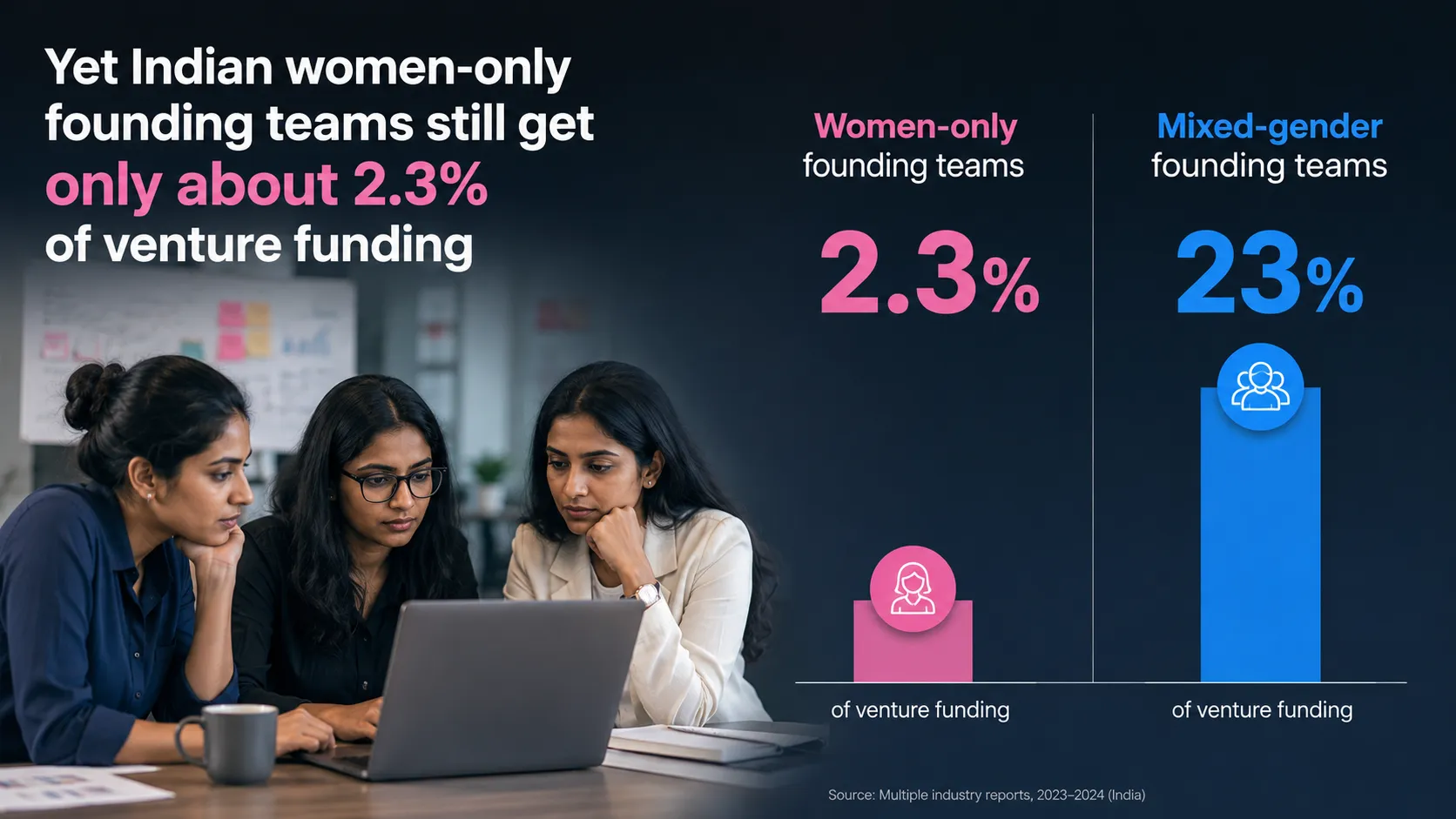
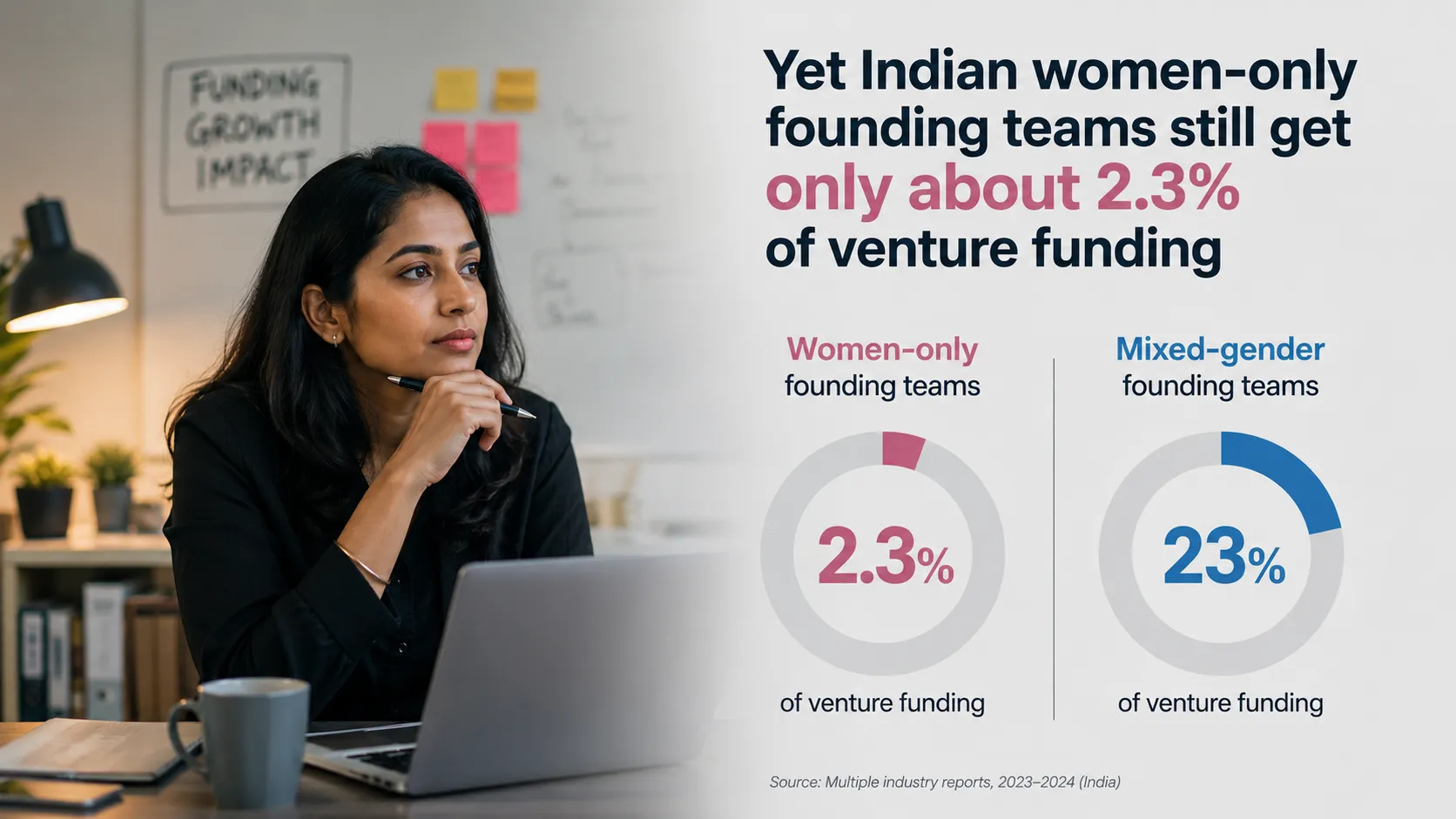
While women are starting businesses at record rates, capital continues to flow unevenly. According to multiple startup ecosystem analyses, women-only founding teams receive only a tiny fraction of total venture funding. Mixed-gender founding teams attract significantly more investment, while all-male founding teams continue to dominate funding allocations. The result is a striking disconnect between participation and investment. Women are increasingly present within the startup ecosystem, but access to growth capital remains far from equal.
This matters because startups do not scale on ambition alone.
Building a successful company requires capital for hiring, product development, distribution, marketing and expansion. Without access to funding, even the most promising ideas can struggle to move beyond the early stages. Venture capital does not merely provide money. It creates access to networks, mentorship, partnerships and future fundraising opportunities. When capital is distributed unevenly, opportunities become uneven as well.
The funding gap therefore represents more than a statistical imbalance.
It represents thousands of businesses that could have grown faster, hired more people and generated greater economic value if they had access to the same resources as their peers.
Women Founders Are No Longer The Exception
One of the most important changes in India's startup ecosystem is the growing number of women entering entrepreneurship.
Over the past decade, women have launched companies across industries ranging from education and healthcare to fintech, logistics and climate technology. Many are solving problems that directly affect underserved consumers and overlooked markets. Others are building innovative products aimed at mainstream audiences. The diversity of businesses being created by women founders reflects the increasing maturity of the entrepreneurial ecosystem itself.
Government initiatives have also contributed to this growth.
Programs supporting startups, women entrepreneurs and innovation have helped create pathways for more founders to enter the ecosystem. Incubators, accelerators and mentorship networks focused specifically on women entrepreneurs have expanded significantly. These initiatives have helped address barriers related to awareness, networking and early-stage support, making entrepreneurship more accessible than it once was.
The result is visible across the country.
Thousands of women-led startups are now operating across major metropolitan areas as well as emerging startup hubs. Many have demonstrated strong growth and built sustainable businesses. Several have raised significant funding rounds and achieved national recognition. The success stories are real and increasingly impossible to ignore.
Yet the broader funding landscape remains stubbornly unequal.
The growth in participation has not translated into a proportional increase in venture capital allocation.
Why The Funding Gap Persists
The reasons behind the funding disparity are complex and often interconnected.
Venture capital is fundamentally driven by pattern recognition. Investors frequently back founders and business models that resemble previous successes. Because the startup ecosystem has historically been dominated by male founders, unconscious biases can influence perceptions of risk, leadership and growth potential. Investors may not deliberately exclude women founders, but existing patterns often reinforce themselves over time.
Access to networks also plays a significant role.
Many funding decisions begin long before a formal pitch meeting occurs. Relationships with investors, mentors and industry leaders often influence opportunities to raise capital. Historically, these networks have been less accessible to women entrepreneurs, particularly first-time founders. While this is gradually changing, network gaps continue affecting fundraising outcomes across the ecosystem.
Another challenge involves perception.
Research conducted globally has repeatedly shown that women founders are often questioned differently during fundraising conversations. Discussions frequently focus on risk mitigation rather than growth opportunities, leading to different narratives around identical business fundamentals. Over time, these subtle differences can significantly influence investment outcomes.
The result is not a shortage of talent.
It is a shortage of capital reaching that talent at the same rate.
Investors May Be Missing A Significant Opportunity
The funding gap is often discussed as an inclusion issue.
It is also increasingly becoming an economic issue. Investors exist to identify opportunities before they become obvious. If large numbers of capable entrepreneurs remain underfunded, the market may be overlooking significant value creation opportunities. Some of the most successful businesses emerge from founders who understand underserved customer segments and unmet needs. Diverse founder backgrounds often produce unique insights that can lead to differentiated products and services.
Evidence supporting this argument continues to grow.
Multiple studies globally have found that diverse leadership teams often outperform expectations across various business metrics. While no founder should receive investment solely because of gender, investors increasingly recognize that overlooking entire categories of entrepreneurs may create blind spots within portfolios. Diversity is gradually shifting from being viewed as a social objective to being viewed as a competitive advantage.
Several investment firms have already begun adapting.
Dedicated funds, founder-support programs and targeted investment initiatives focused on women entrepreneurs have emerged across the ecosystem. While these efforts remain relatively small compared to overall venture-capital activity, they signal growing recognition that the funding imbalance represents both a challenge and an opportunity.
The question is whether these efforts can scale quickly enough.
Because the gap remains substantial.
Why Closing The Gap Matters For India
India's startup ecosystem is now one of the largest in the world.
The country's long-term economic ambitions depend heavily on innovation, entrepreneurship and job creation. Ensuring that talented founders have access to resources is therefore not simply a fairness issue. It is a growth issue. Economies perform better when opportunities are distributed broadly and when capable entrepreneurs can build businesses regardless of background.
Women founders represent a significant source of untapped economic potential.
Many are creating solutions in sectors ranging from healthcare and education to financial inclusion and sustainability. These businesses often address challenges that affect large populations while generating employment and economic activity. Increasing access to funding could accelerate the growth of companies that contribute meaningfully to both economic and social outcomes.
The impact would extend beyond individual startups.
More successful women-led companies create more role models, attract more founders and strengthen the broader entrepreneurial ecosystem. Success tends to generate momentum. Every founder who breaks through barriers makes it easier for others to imagine similar possibilities.
That dynamic can become a powerful engine for long-term growth.
The Bigger Story
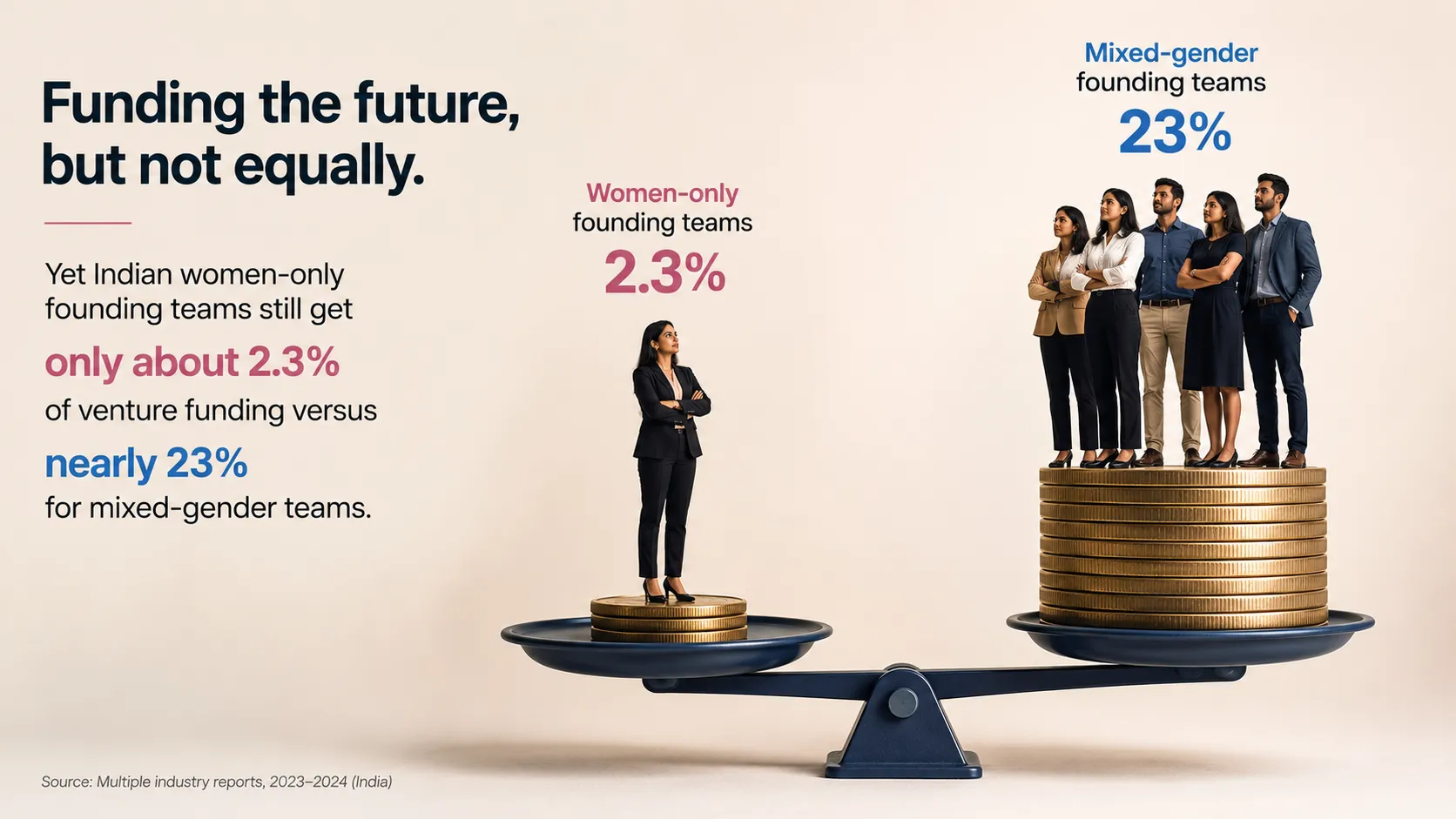
Viewed narrowly, the statistic is startling.
Women-only founding teams receive just 2.3% of venture funding while mixed-gender teams secure nearly ten times as much. Viewed more broadly, however, the statistic highlights one of the most important opportunities within India's startup ecosystem. The challenge is not a lack of women entrepreneurs. It is ensuring that capital reaches them at a scale that matches their growing presence and potential.
The ecosystem has already demonstrated that women can build successful companies.
The next challenge is ensuring that funding systems evolve alongside entrepreneurial participation. Investors, policymakers and ecosystem builders increasingly recognize that the future of innovation depends on accessing the widest possible pool of talent. Doing so is not simply a matter of representation. It is a matter of competitiveness.
Because India's next generation of great companies could come from anywhere.
The question is whether capital is willing to look everywhere.


