
The Record Just Got Set. So Did the Limit.
In 1972, Katharine Graham of The Washington Post became the first woman to lead a Fortune 500 company. She was alone. Not as in she was number one — as in she was the only one. One woman, out of five hundred, leading one of America's largest companies by revenue.
Fifty-four years later, the number is 55.
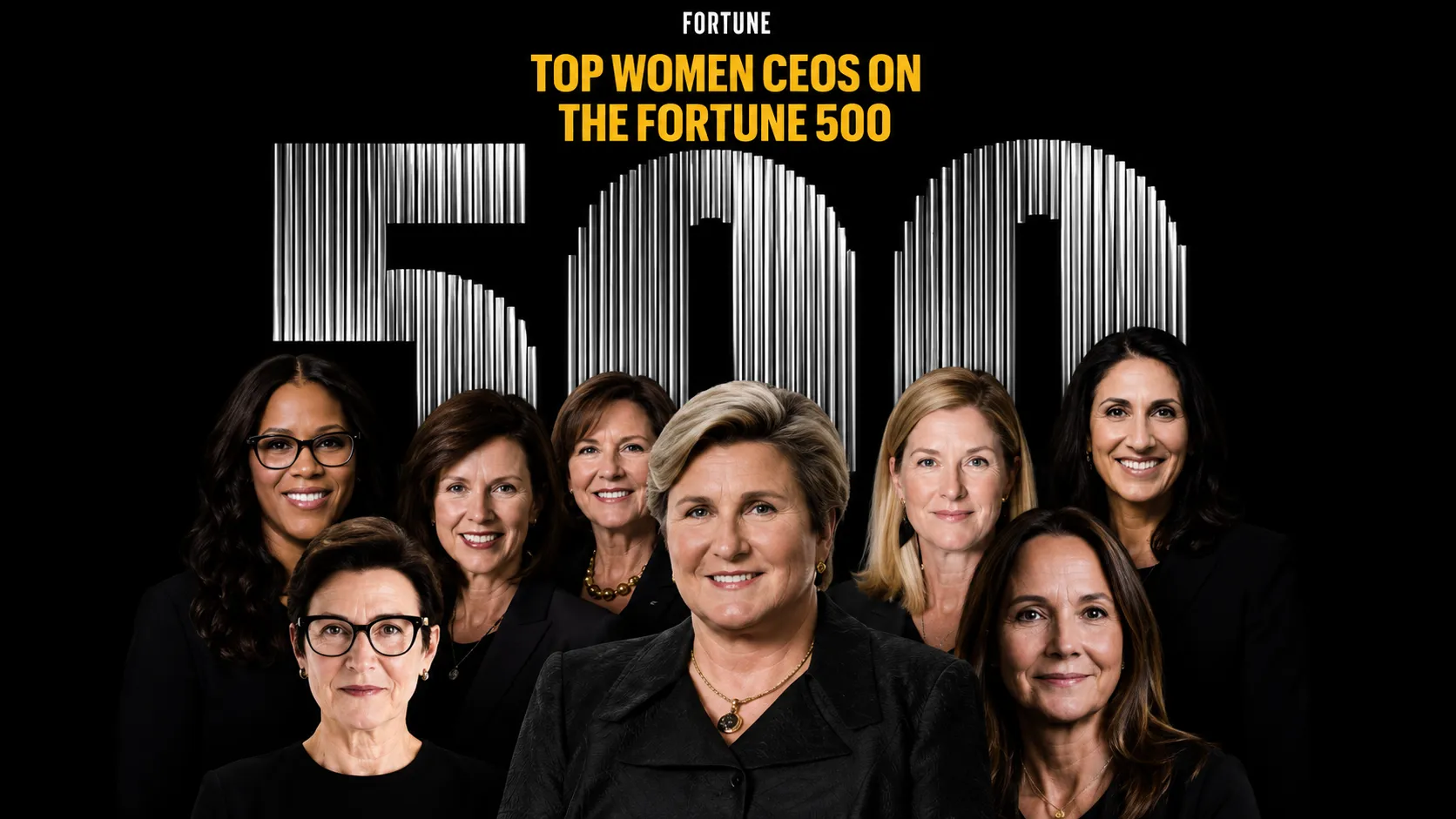
That sounds like progress. It is progress. The 2026 Fortune 500, released in early June, confirms that 55 women now lead the country's largest companies by revenue — 11 per cent of the list, the highest share in the ranking's 72-year history, and the fourth consecutive year the figure has remained in double digits. For the first time since Katharine Graham sat in that seat alone, there is something that resembles a cohort rather than an anomaly.
And in the same year that record was set, Oracle lost Safra Catz. Fannie Mae lost Priscilla Almodovar — the departure that left the Fortune 500 without a single Latina CEO for the first time since 2022. Hershey lost Michele Buck. SAIC lost Toni Townes-Whitley. Several of those seats were filled by men.
The record and the regression happened simultaneously. That is the complicated truth of where corporate America stands on women's leadership in 2026 — and that tension, more than any single number, is what the story actually requires you to sit with.
The Women at the Top — and Where They Are
Before the caveats, the names deserve to be said clearly, because they represent something real.
Jane Fraser, Chair and CEO of Citigroup, tops Fortune's 2026 Most Powerful Women in Business list — the first time she has held the number one spot in the 29-year history of the ranking. Fraser became the first woman to lead a major Wall Street bank when she took Citi's corner office in 2021. Since her appointment, Citi's stock is up more than 90 per cent, and the bank's profitability is finally approaching that of its rivals as Fraser executes a closely watched turnaround. She did not inherit a well-run institution. She inherited one of the most operationally complex and underperforming banks in American finance and has spent five years rebuilding it from the inside. The stock market, which is not known for its sentimentality, has noticed.
Gail Boudreaux leads Elevance Health at number 18 on the Fortune 500 — the highest-ranked women-led company on the 2026 list. She has led the health insurer, formerly known as Anthem, since 2017. Sarah London leads Centene at number 19, making her, at 42, the youngest female CEO of a Fortune 500 company. Mary Barra leads General Motors at number 23, having steered the automaker through electrification, supply chain disruption, and geopolitical headwinds since becoming CEO in 2014. Thasunda Brown Duckett leads TIAA. Corie Barry leads Best Buy. Gunjan Kedia leads U.S. Bancorp.
Fortune's 2026 Most Powerful Women list includes 16 newcomers across a broad range of fields, including Gunjan Kedia of U.S. Bancorp, Kecia Steelman of Ulta Beauty, Latriece Watkins of Sam's Club, and Christina Zhu, president and CEO of Walmart China.
These are not figurehead positions. These are women running companies that collectively represent trillions of dollars in revenue and employ millions of people. The business case for what they are doing is written in earnings reports and share prices, not diversity statements.
How They Got There — The Internal Promotion Pipeline
One of the most important structural findings in the 2026 Fortune 500 data is not the headline number. It is the mechanism behind it.
In the past decade, the majority of women who have risen to a Fortune 500 corner office have done so through internal promotion rather than outside hiring, according to Fortune data. This is not a small detail. It fundamentally changes the conversation about what organisations need to do differently if they want more women at the top.
The implication is clear: the companies that are producing women CEOs are not the ones writing diversity commitments and then hiring from outside. They are the ones building internal pipelines — identifying women early in their careers, giving them operational roles with profit-and-loss responsibility, and then promoting them through the organisation over years or decades until they are the obvious successor when the top job opens.
Kecia Steelman, who joined Ulta Beauty in 2014 and worked her way up through operations roles before being named CEO in January 2025, told Fortune's Leadership Next podcast she is grateful for the long runway. "Being really grounded and humble with my beginnings, I wouldn't change that," she said.
That sentence is worth unpacking. A decade of building operational knowledge, working across the business, understanding the supply chain, the customer, the logistics, the technology — that is what the runway looks like. It is not a mentorship programme. It is not a sponsorship initiative. It is a decade of being given hard jobs, being trusted with the outcomes, and being seen as the right person for the next role when it opens.
Companies like Freeport-McMoRan, Principal Financial Group, Ulta Beauty, U.S. Bancorp, J.B. Hunt Transport, and Marathon Petroleum have all appointed women from within their executive ranks to the CEO role. The pattern is consistent: the women who make it to the corner office earned their way there through organisations that made the decision to give them real accountability long before the CEO conversation happened.
The Glass Cliff Is Still Real
The record is also shadowed by a concept that researchers have been documenting for two decades and that the 2026 data confirms is still very much in play: the glass cliff.
The glass cliff describes the tendency for women to be appointed to CEO roles during periods of crisis, turmoil, or when a company is already struggling. The pattern is well established in academic research: boards become more willing to take a "risk" on a woman when the downside of sticking with the conventional choice looks bad anyway. The result is that many women step into CEO roles under harder conditions than their male predecessors faced — and if things do not improve quickly, they become the visible face of failure.
Fortune's own 2026 coverage notes that Jane Fraser "flipped the glass-cliff script at Citi" — an explicit acknowledgement that she was appointed to one of the hardest restructuring jobs in American banking and has delivered the kind of results that justify the appointment many times over. That framing matters because it is honest about the conditions under which she took the role.
Jennifer McCollum, president and CEO of Catalyst — a workplace gender equity organisation — is direct about what the record actually means in context. "This minor uptick, while positive, is not a signal that we can ease off our efforts; if anything, it shows the deep-seated nature of the barriers that still exist," she told Fortune.
"Deep-seated" is doing a lot of work in that sentence. The barriers are not external — they are not policies or legal restrictions. They are structural, embedded in how succession planning works, how sponsorship flows, which roles get counted as "CEO-track" and which don't, and who sits in the room when the board makes the final decision.
The Exits That Complicate the Record
The 2026 record did not arrive clean. It arrived through a year of significant turbulence at the top that reveals exactly how fragile the progress is.
Several Fortune 500 CEOs including Oracle's Safra Catz, Fannie Mae's Priscilla Almodovar, and Hershey's Michele Buck exited their corner offices in a span of weeks during the fall of 2025. Almodovar's departure left the Fortune 500 without a Latina CEO for the first time since she took the job in 2022. Then, SAIC's Toni Townes-Whitley stepped down in October, briefly narrowing the ranks of Black women running Fortune 500 companies to just one — TIAA's Thasunda Brown Duckett — until the September 2025 addition of DTE Energy CEO Joi Harris.
Six women-led companies lost their female CEOs in a single year — some through retirement or resignation, some through business decisions, some through corporate transactions. Nine women joined the list. The net gain was three.
Three. In one year. With all the corporate commitments to gender diversity, all the board-level conversations, all the published reports and pledges and gender equity frameworks — the net addition to the Fortune 500's women CEO cohort in 2026 was three people.
The DEI backlash that has accelerated since 2023 — with several major US corporations reducing or eliminating their diversity, equity, and inclusion programmes in the face of political pressure and legal risk — adds a specific concern to the trajectory. Women's progress to the top job has historically been supported by the infrastructure of DEI: sponsorship programmes, succession planning frameworks that explicitly track women's advancement, and board-level commitments to diverse candidate slates. As those programmes are scaled back, the pipeline they were building does not instantly disappear, but it does stop being actively maintained.
The Representation Gap That the Headline Number Hides
Eleven per cent is a record. It is also a measurement of how far the gap remains.
Women make up 51 per cent of the US population and 47 per cent of the total labour force. At the Fortune 500 CEO level, they hold 11 per cent of the seats. At the current pace of progress — three net new women CEOs per year — reaching proportional representation at the Fortune 500 CEO level would take well over a century.
The intersectional picture is sharper still. Only two Black women lead Fortune 500 companies: Thasunda Brown Duckett at TIAA and Joi Harris at DTE Energy. The Latina CEO seat is currently vacant following Priscilla Almodovar's departure. Asian-American women are represented but remain a small share of the cohort. The headline number of 55 is an aggregate that, when disaggregated, reveals that progress has been even more uneven than the single figure suggests.
The industries with the strongest female CEO representation are healthcare, retail, and utilities — sectors that have historically had stronger internal talent development pipelines for women, and where the customer base is disproportionately female, creating boards and leadership teams that are more likely to see the business case for women at the top.
The industries with the weakest representation — energy, technology, manufacturing, and financial services outside of a handful of prominent exceptions — are precisely the sectors that generate the largest share of Fortune 500 revenue and the highest levels of executive compensation.
What the Record Actually Teaches
The 55 figure is real. The progress it represents is real. The people behind it — Jane Fraser turning Citi around, Gail Boudreaux leading America's largest women-led company, Kecia Steelman building a decade-long runway at Ulta before taking the top job — are doing something that the data consistently shows produces better outcomes for the organisations they lead.
Companies with female CEOs in the two years following appointment saw stock outperform male-appointed counterparts by an average of 20 per cent. The 32 women-led S&P 500 companies have returned 384 per cent over ten years, compared to 261 per cent for the rest. These are not soft numbers. These are the kind of numbers that end arguments in boardrooms.
And yet the progress is three people per year, in a 500-company list, in the world's largest economy.
The lesson the 2026 record actually teaches is not that corporate America has fixed the problem. It is that the organisations producing women CEOs are doing something specific and replicable: they are building internal pipelines, giving women operational authority early, letting them accumulate the kind of cross-functional experience that creates unambiguous CEO candidates, and then not flinching when the succession moment arrives.
The organisations that have not produced women CEOs are, in most cases, not doing those specific things — regardless of what their diversity statements say.
Progress at 11 per cent after 72 years is not evidence that the system is working. It is evidence of what is possible when individual organisations do the right internal work, inside a system that still does not require them to.
The glass ceiling has not been broken. It has developed cracks — 55 of them, each one the result of a specific decision by a specific board to give a specific woman the job she had already spent a decade or more earning.
That is not failure. But it is also not nearly enough.


