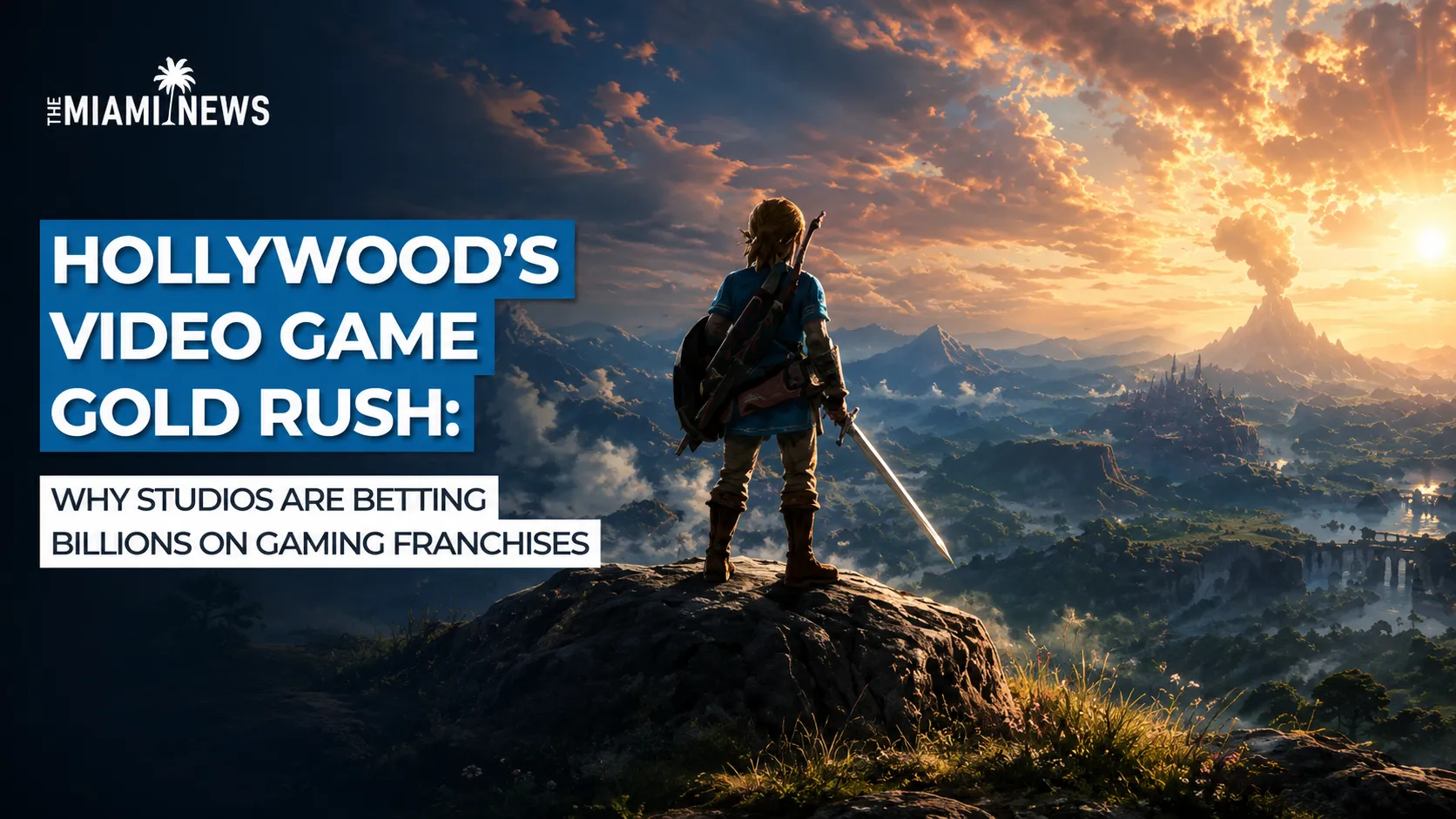
The Highest-Grossing Film of 2025 Was Based on a Video Game. Hollywood Noticed.
In April 2025, a film about a man and his children getting sucked into a cubic, pixellated world populated by blocky animals and green exploding creatures became the highest-grossing film of the year. A Minecraft Movie, starring Jack Black and Jason Momoa, grossed $424 million in the United States and Canada, and $961 million globally — on a production budget of $150 million. That is roughly a 500 per cent return on investment, achieved in a year when the US and Canadian box office as a whole declined to $8.56 billion, down from $8.91 billion the year before.
Before Minecraft, The Super Mario Bros. Movie had already rewritten what was possible. Released in April 2023, it generated $574 million domestically — the highest of any video game adaptation ever — and over $1.3 billion globally, the first video game film to reach that milestone. It earned a Guinness World Record for the largest global opening for an animated film. Greta Gerwig's Barbie was the only film released that year to earn more.
On streaming, the pattern is equally stark. Amazon Prime Video's Fallout, the adaptation of Bethesda's post-apocalyptic RPG franchise, debuted in 2024 as one of the platform's most-watched series ever. Its second season, due in December 2026, has earned near-perfect reviews. HBO's The Last of Us Season 2 maintained a 92 per cent Rotten Tomatoes score. Netflix's Devil May Cry anime adaptation found a new audience for a franchise that had been commercially dormant for years.
Hollywood has noticed all of this. In April 2026, Paramount announced it was developing a live-action Call of Duty movie — a franchise with over one billion players and $35 billion in all-time revenue. Street Fighter, Mortal Kombat II, Resident Evil, and a Super Mario Bros. sequel are all in various stages of production for 2026 and 2027 release. Amazon is developing Tomb Raider as a live-action series, recently casting Game of Thrones' Sophie Turner in the lead role. Mass Effect is in development as a space-set streaming series.
The shift is real, it is accelerating, and it is driven by economics so compelling that the only surprising thing is how long it took to get here.
Why Original IP Is Losing and Gaming IP Is Winning
To understand why Hollywood is betting billions on gaming, you first have to understand what Hollywood is betting against.
The theatrical film business has been under sustained economic pressure for years. Total US and Canadian box office revenue in 2024 came in at $8.56 billion — a recovery from the pandemic lows, but significantly below the $11.9 billion peak of 2019, and on a downward trajectory in 2024 compared to 2023. The average budget for a major studio film has climbed to $100 million to $200 million for franchise tentpoles, with marketing costs often adding an equivalent sum on top. In this environment, the commercial failure of an original film — one without a built-in audience, without pre-existing fan loyalty, without the guarantee of any opening-weekend floor — is existentially risky.
Gaming IP solves this problem structurally.
A video game franchise like Minecraft does not arrive at a studio pitching an unknown concept. It arrives with 170 million monthly active users across multiple platforms, a decade of established visual language, a generational audience that grew up inside its world, and a fanbase that has already demonstrated its willingness to pay for access to that world repeatedly. The commercial risk profile is fundamentally different from an original screenplay.
The gaming industry itself is also growing in the opposite direction from the film industry. According to Variety's May 2025 Video Game Industry Report, the global games market is projected to hit $186 billion, driven by the Nintendo Switch 2 launch, the May 2026 release of Grand Theft Auto 6, and continued growth in mobile and live-service gaming. Roblox earned nearly $1 billion in revenue over a single holiday quarter, with 85 million daily active users. Fortnite has hundreds of millions of registered players. These are not audiences that the film industry can ignore.
Call of Duty's announcement makes this logic explicit. Paramount is not making a Call of Duty film because it has a great story to tell. It is making a Call of Duty film because there are one billion Call of Duty players in the world who already know what the franchise feels like, and the conversion rate from existing fan to film ticket buyer is measurably higher than the conversion rate from stranger to film ticket buyer.
What Changed: The Collaboration Model Replaced the License Model
The dirty secret of the original wave of video game film adaptations — from the 1994 Street Fighter to the 1993 Super Mario Bros. to the early Resident Evil series — is that most of them failed artistically and commercially. The reasons for that failure were structural, not incidental.
Those productions licensed the IP and then ignored the people who made it. The game developers, who understood the creative DNA of the franchise, were treated as IP vendors rather than creative partners. Studios applied standard Hollywood production formulas to properties that had entirely different narrative mechanics, visual languages, and character relationships. The results were films that satisfied neither fans nor newcomers.
The current generation of adaptations has reversed that model. HaZ Dulull, filmmaker and game director at Beyond the Pixels, put it precisely during a gaming IP panel at Focus 2026:
This is the creative model that produced The Last of Us. Neil Druckmann, co-creator of the game, was deeply involved in the HBO adaptation. The result was a series that was simultaneously faithful to the game's emotional and narrative logic and accessible to audiences who had never played it. It won critical acclaim, audience loyalty, and Emmy nominations — and it made the next wave of gaming adaptations significantly easier to greenlight, because it proved that the collaboration model works.
The same principle holds for the Sonic franchise, which recovered from its initially disastrous character design reveal in 2019 — when public backlash caused the studio to redesign the character before release — to generate over $1 billion globally across three films and a spin-off streaming show, with a fourth film due in 2027. The recovery happened because the studio listened and adapted. The ongoing success happened because it maintained creative alignment with what makes Sonic work.
The Streaming Dimension: Why Series Beat Films for Some Gaming IP
The theatrical and streaming strategies around gaming IP are not identical, and understanding the difference is important.
Gaming franchises with complex, expansive worlds — Fallout, The Last of Us, Mass Effect, Tomb Raider — translate more naturally to series than to films. A two-hour film can introduce a character and tell a contained story. A 40-hour game builds a world, a political system, a set of moral dilemmas, and dozens of characters who each have their own narrative weight. The episodic format of a streaming series can accommodate that complexity in ways that a feature film cannot.
Amazon's commitment to Fallout as a series — rather than a film — is a strategic recognition of this. The Fallout universe, which spans six mainline games and three decades of post-nuclear American fiction, has political satire, horror, black comedy, character drama, and world-building at a scale that any single film would necessarily compress beyond recognition. A series lets the adaptation breathe in a way that matches the source material's actual scope.
This has led to a bifurcation in studio gaming strategy. Warner Bros., following The Last of Us, has indicated it will not pursue further gaming TV adaptations — the episodic budget structure, which tends to be among the highest in prestige streaming, does not fit its current strategy. Other studios and streamers, particularly Amazon and Netflix, are actively developing gaming series because the long-form format suits their subscriber retention model: a compelling 8-episode series keeps subscribers engaged for weeks, which is a different value proposition from a two-hour film.
The result is that gaming IP is being deployed across both theatrical and streaming formats simultaneously — maximising the franchise's commercial footprint across platforms rather than concentrating it in a single release window.
What Gaming IP Actually Offers — and Why It Is Undervalued
The deepest strategic reason Hollywood is betting on gaming is one that gets less attention than the box office numbers: pre-sold global awareness.
When Universal released The Super Mario Bros. Movie, it was not releasing a film into an empty market. It was releasing a film into a global cultural context where virtually every adult in the developed world, and a significant proportion of adults globally, already had an emotional relationship with the character. Mario is not a franchise. He is a cultural institution. The film did not need to introduce him. It needed only to present him well.
This is the fundamental commercial advantage of gaming IP over original IP, and it is why studios are willing to pay premium acquisition prices for gaming properties. An original screenplay arrives at a theatre with zero built-in audience and must generate awareness from scratch through marketing spend that can equal or exceed the production budget. A Mario film, a Minecraft film, a Call of Duty film arrives with a guaranteed opening weekend floor determined by the franchise's existing fan loyalty — which then expands through word of mouth if the film is good, as Mario and Minecraft both demonstrated.
The gaming industry's trajectory makes this advantage compound over time. As the Variety data shows, the global gaming market approaching $186 billion means that the cultural footprint of major gaming franchises — the number of people who have emotional relationships with these characters and worlds — continues to expand every year. Grand Theft Auto 6, releasing in May 2026, will be the most commercially anticipated entertainment release of the year across any medium. The franchise's audience dwarfs the audience of any existing film franchise. GTA has never had a serious film adaptation. That fact is less an oversight than an opportunity that the right studio, working in collaboration with Rockstar, could capture at an extraordinary scale.
The Risk Nobody Is Talking About
The gaming IP bet is not without its dangers. Several are worth naming precisely because the current enthusiasm around the category can obscure them.
Quality is still the gate. Minecraft's 500 per cent box office return required a film that the audience actually wanted to see. The 1994 Street Fighter's failure, at a time when Street Fighter was one of the most popular game franchises in the world, is a reminder that IP recognition alone does not guarantee commercial success. The adaptations that have worked — Mario, Minecraft, Sonic, The Last of Us, Fallout — worked because the creative execution honoured what the source material meant to its fans.
The collaboration model has to be authentic. Studios that acquire gaming IP and then treat the developers as irrelevant are likely to repeat the failures of the 1990s. The lesson of the current wave is not that gaming IP is reliable. It is that gaming IP is reliable when the creative process genuinely involves the people who understand it.
Saturation is a real risk. As every major studio simultaneously moves toward gaming IP, the category could develop the same problems that superhero movies developed after 2019 — audience fatigue driven by volume rather than quality, as studios greenlight sequels and adaptations based on financial logic rather than creative merit.
But those risks are acknowledged within the industry, not hidden from it. The studios betting on gaming IP in 2026 are doing so with a set of proven data points — Sonic, Mario, Minecraft, Last of Us, Fallout — that simply did not exist five years ago. The question is not whether gaming IP works. The data has answered that. The question is whether the industry can maintain the creative standards that made the successful adaptations work, as the volume of adaptations scales to match the financial opportunity.
The billion-dollar bet Hollywood is quietly making is not on games as a category. It is on the specific insight that audiences who love a game already have an emotional relationship that no amount of marketing can manufacture. The studios that build authentic creative partnerships with game developers are purchasing something that original IP cannot offer at any price: a billion people who already know the world, already love the characters, and are already looking for the ticket to buy.