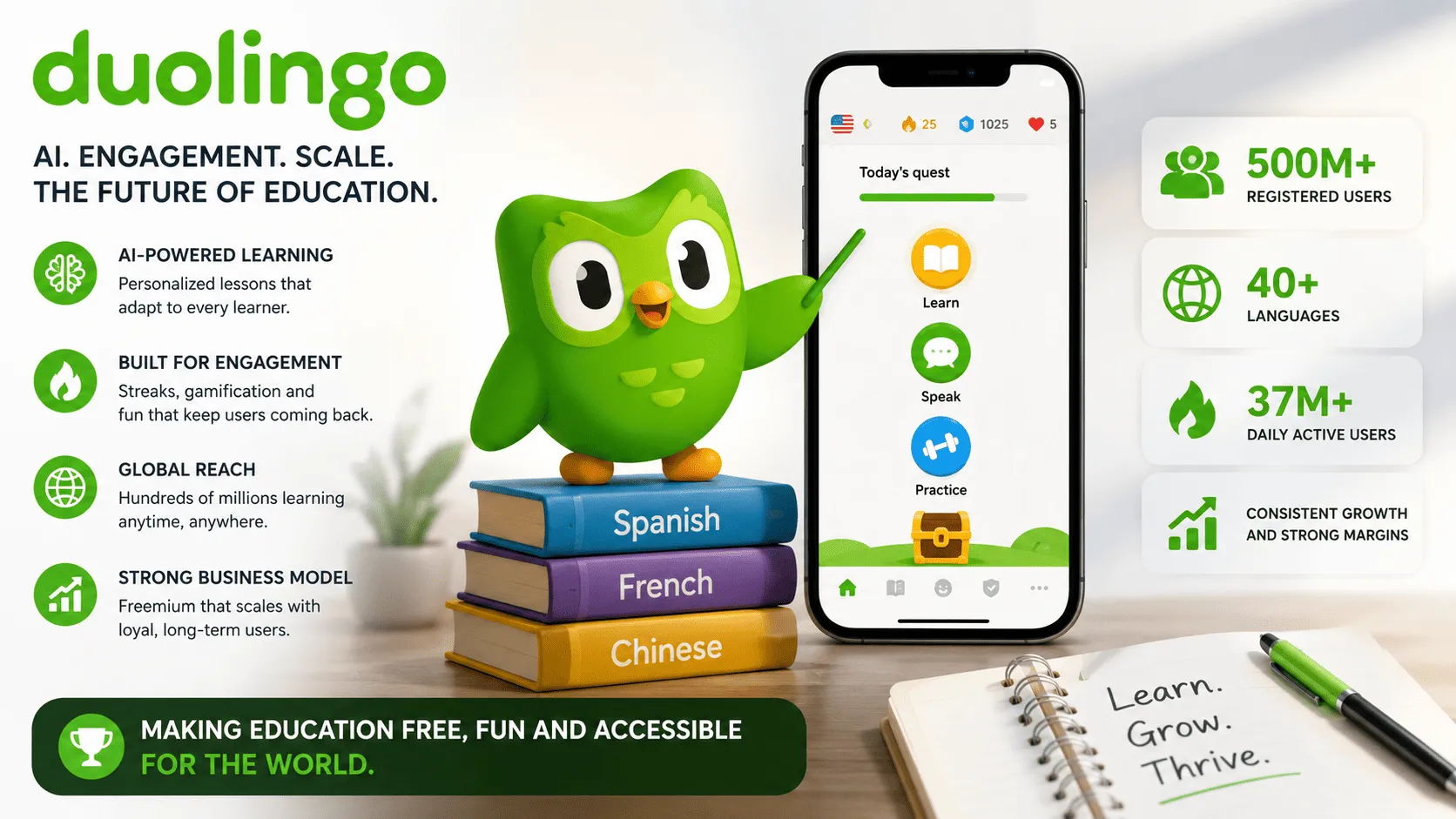
Artificial Intelligence Is Transforming Language Learning Faster Than Most People Realize. Duolingo Is Positioning Itself To Benefit More Than Almost Anyone Else.
For decades, language learning followed a familiar formula.
Students purchased textbooks, attended classes, memorized vocabulary lists and spent years gradually improving through structured lessons. The process often felt slow, expensive and difficult to sustain. While millions of people wanted to learn new languages, relatively few remained committed long enough to achieve meaningful fluency. Education companies repeatedly tried to solve this problem, yet many struggled to make learning both effective and engaging at scale.
Duolingo approached the challenge differently.
Instead of treating education like traditional schooling, the company borrowed ideas from gaming, behavioral psychology and consumer technology. Lessons became short. Progress became visible. Learning turned into daily habits reinforced through streaks, rewards and competition. What initially appeared to be a simple mobile app gradually evolved into one of the world's largest education platforms, attracting hundreds of millions of users and transforming how people think about language learning.
Today, a new shift is underway.
Artificial intelligence is rapidly changing what educational software can accomplish. Personalized tutoring, conversational practice, adaptive learning and instant feedback are becoming increasingly accessible. Few companies are better positioned to benefit from this transformation than Duolingo.
Duolingo Solved Motivation Before It Solved Education
One of the biggest problems in education is not access to information.
Knowledge has become increasingly abundant. Videos, articles, online courses and digital resources are available almost everywhere. Yet completion rates often remain low because motivation is difficult to maintain. Students begin enthusiastically but gradually lose momentum. Traditional education platforms frequently focus on content quality while underestimating the importance of user behavior.
Duolingo recognized this challenge early.
The company's breakthrough was not simply teaching languages online. It was making people return every day. Features such as streaks, achievement badges, progress tracking and notifications transformed learning into a habit-forming experience. Users became emotionally invested in maintaining consistency, creating engagement levels that many educational products struggled to achieve.
This insight became a significant competitive advantage.
Companies can always create lessons. Building daily habits is far more difficult. By focusing on engagement alongside education, Duolingo created a platform capable of sustaining long-term user relationships. Those relationships would later become increasingly valuable as artificial intelligence expanded the possibilities of digital learning.
Why AI Changes Everything
For most of its history, educational software faced a fundamental limitation.
Applications could present lessons and evaluate answers, but they could not truly interact like human teachers. Personalized instruction remained expensive because it depended heavily on human expertise. Students often received standardized experiences regardless of individual learning styles, strengths or weaknesses.
Artificial intelligence is beginning to remove those constraints.
Modern AI systems can generate explanations, simulate conversations, answer questions and adapt responses based on user behavior. Language learning is particularly well suited to these capabilities because communication naturally involves interaction. Instead of simply completing exercises, learners can increasingly engage in dynamic conversations that feel closer to real-world practice.
Duolingo has embraced this opportunity aggressively.
The company is integrating AI-powered features that allow users to practice speaking, receive personalized feedback and interact with virtual characters capable of responding naturally. These tools move the platform closer to something education companies have pursued for decades: scalable individualized instruction.
The implications extend far beyond language learning.
The Economics Of AI Favor Companies Like Duolingo
One reason investors pay close attention to Duolingo is its position within the AI ecosystem.
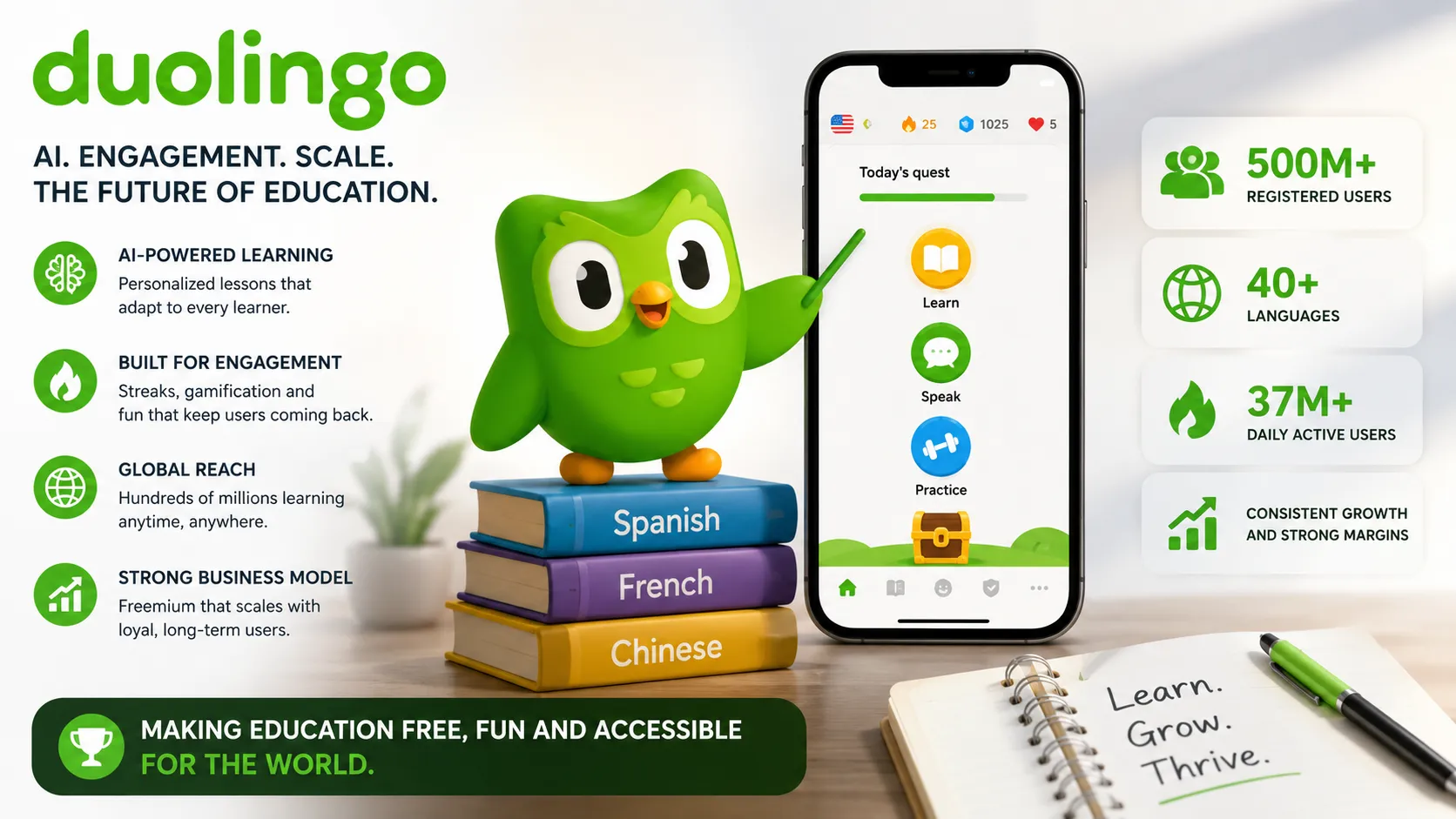
Many artificial intelligence startups possess impressive technology but lack large audiences. Duolingo possesses something equally important: hundreds of millions of users already engaged in learning. This provides a distribution advantage that is difficult to replicate because new AI features can be introduced directly to an existing global user base.
The company's business model also benefits from this dynamic.
Premium subscriptions become more attractive when users receive experiences that feel personalized and interactive. AI-powered features create opportunities to increase perceived value without requiring proportional increases in human staffing. Unlike traditional tutoring businesses that scale through labor, software platforms can potentially scale through technology.
This creates powerful economics.
If AI significantly improves learning outcomes while maintaining operational efficiency, companies capable of deploying these tools effectively could strengthen both growth and profitability. Duolingo's combination of audience scale, brand recognition and product engagement places it in a particularly favorable position.
The market increasingly recognizes this advantage.
Duolingo Is Becoming More Than A Language Company
One of the most interesting developments surrounding Duolingo is its gradual expansion beyond languages.
The company has introduced courses in mathematics, music and other educational categories, signaling broader ambitions. While language learning remains central to its identity, management increasingly appears focused on building a learning platform rather than a single-purpose application.
This strategy mirrors the evolution of many successful technology companies.
Businesses often begin by solving one specific problem before expanding into adjacent markets. Amazon started with books. Netflix began with DVDs. Spotify focused initially on music. Each company eventually leveraged its audience and infrastructure to enter new categories.
Duolingo seems to be following a similar path.
Its expertise in engagement, habit formation and digital instruction can potentially apply across multiple educational disciplines. Artificial intelligence further strengthens this opportunity because many learning experiences share common requirements such as feedback, personalization and interactive guidance.
The company's future may therefore look considerably larger than language education alone.
Education Is Becoming A Consumer Technology Business
Historically, education and technology operated according to different rules.
Schools focused on curriculum. Technology companies focused on user experience. Increasingly, those worlds are converging. Learners now expect educational products to feel intuitive, engaging and personalized. Applications compete not only against other educational tools but against every digital experience consumers use daily.
Duolingo understood this shift earlier than many competitors.
Its design philosophy resembles consumer technology more than traditional education software. The company invests heavily in product design, behavioral science and engagement strategies because it recognizes that learning outcomes depend partly on whether users continue showing up.
Artificial intelligence amplifies this advantage.
As educational products become more interactive, the quality of user experience becomes even more important. Companies capable of combining strong technology with engaging design may gain substantial advantages over competitors focused solely on content delivery.This helps explain why Duolingo stands out within the education sector.It behaves less like a traditional education company and more like a modern technology platform.
The Future Of Learning May Look Like Duolingo
The broader significance of Duolingo extends beyond one company.
It represents a shift in how education is delivered, consumed and monetized. Learning is becoming more personalized, more interactive and more accessible than previous generations could have imagined. Artificial intelligence is accelerating these trends by enabling experiences that increasingly resemble one-on-one instruction without the associated costs.
Few companies are better positioned to capitalize on that transformation.
Duolingo combines global scale, strong engagement, recognizable branding and growing AI capabilities within a category affecting hundreds of millions of people. While many businesses are experimenting with artificial intelligence, the company is integrating it into a product already embedded within daily routines around the world.
That is why Duolingo matters.The story is not simply about language learning.It is about how artificial intelligence is reshaping education itself.And if the next era of learning is defined by personalized, interactive and technology-driven experiences, Duolingo may emerge as one of its biggest winners.