The LA Lakers Just Sold for $10 Billion. That Number Tells You Everything About What Sports Has Become.
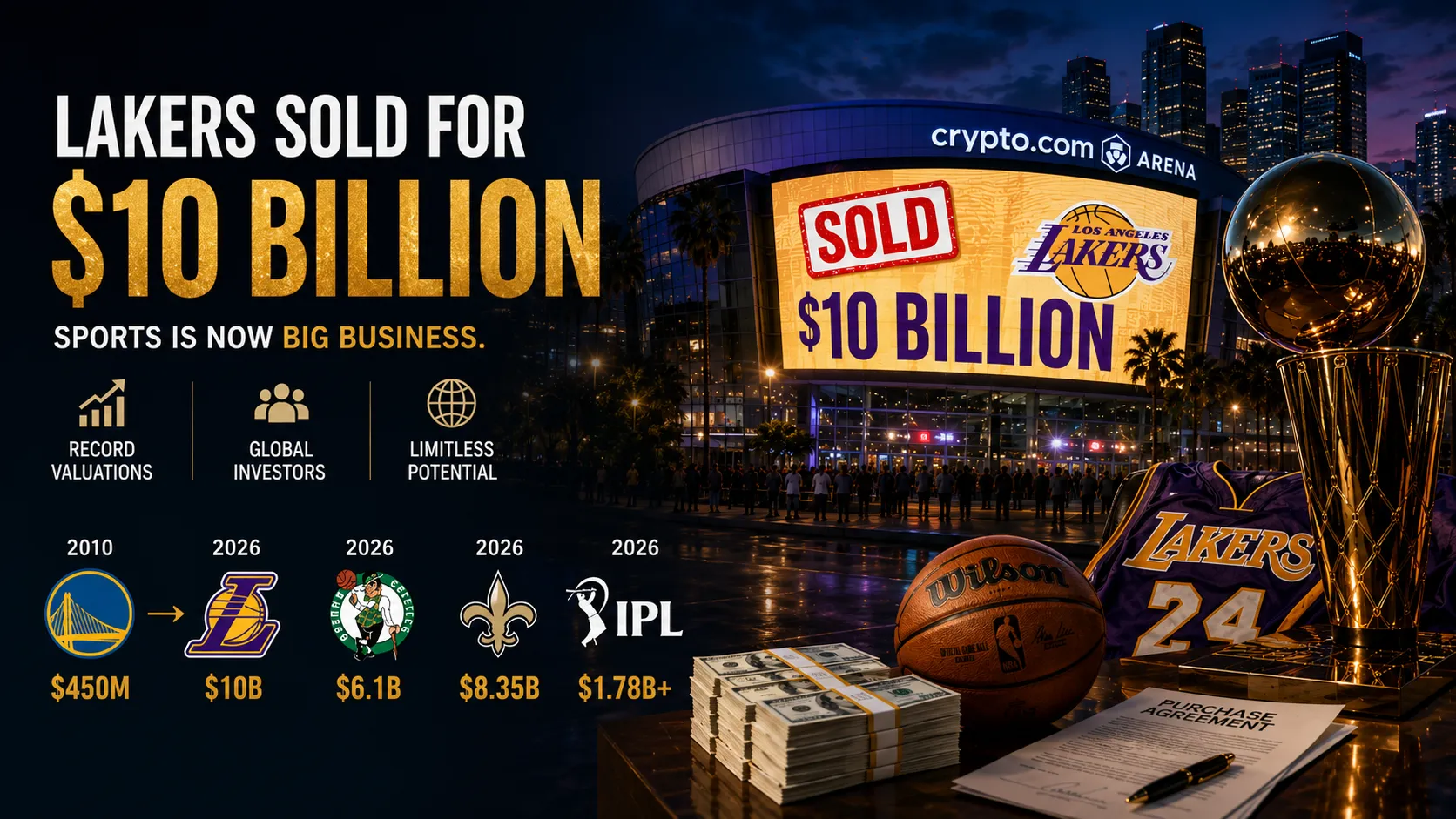
In 2010, Joe Lacob and a group of partners purchased the Golden State Warriors for $450 million. It was considered, at the time, an extraordinary sum for a struggling basketball franchise with no recent championships and a half-empty arena in Oakland. Bay Area sports commentators wrote that Lacob had paid roughly double what was reasonable.
In 2026, the LA Lakers sold for $10 billion.
Not $10 billion for a consortium of teams. Not $10 billion for an entire league. For one basketball franchise, in one city, playing 82 games a year.
In the same year, the Boston Celtics — which had just won an NBA championship — changed hands for $6.1 billion, in a deal led by Sixth Street Partners and Apollo Sport. The New Orleans Saints and the New Orleans Pelicans are worth a combined $8.35 billion under Gayle Benson. Two IPL franchises — Royal Challengers Bengaluru and Rajasthan Royals — sold for $1.78 billion and $1.63 billion respectively, on the same day, in deals that left India's cricketing great Sourav Ganguly saying: "It's mind-boggling numbers. But great news for Indian cricket. I think it's already as big as the NBA."
JP Morgan Private Bank's 2025 Principal Discussions Report, which surveyed 111 ultra-wealthy families, found that approximately 20 per cent of them now own a controlling stake in a sports team. In 2023, that figure was 6 per cent. In two years, the share of the world's wealthiest families who are sports team owners has more than tripled.
Sports ownership has undergone a fundamental transformation. It has moved from passion project to institutional asset class, from prestige purchase to strategic investment, from hobby to portfolio cornerstone. And understanding exactly why that happened — and what it means — requires following the money with precision.
The Returns That Changed the Conversation
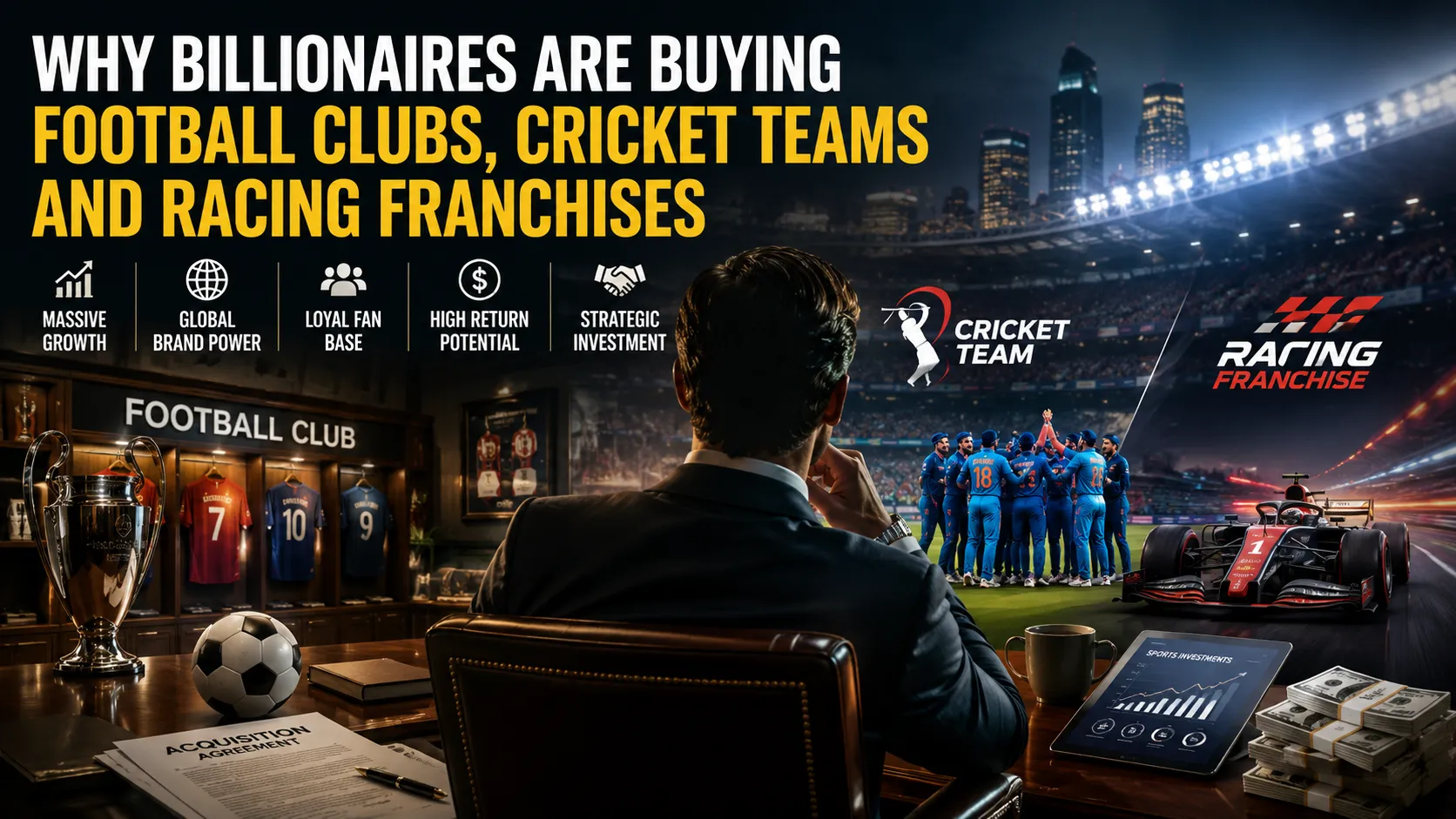
The intellectual inflection point in sports as an investment category is the returns data — because once you see it laid out against comparable alternatives, the question stops being "why would a billionaire buy a sports team?" and starts being "why would they buy anything else?"
Major US sports teams have experienced average annual value appreciation of approximately 13 per cent over the last two decades, according to Goldman Sachs data. The S&P 500 has returned approximately 8 per cent annually over the same period. US and European sports franchises are valued at approximately $400 billion combined, according to JPMorgan Private Bank — and total sports mergers, acquisitions, and investment has increased eightfold over the past five years.
The IPL data makes the case most vividly, because the timeline is compressed enough to trace the returns precisely. CVC Capital Partners acquired a controlling stake in Gujarat Titans in 2021. In 2025, CVC sold its 67 per cent stake — and earned a 350 per cent return. Not over decades. Not through a complex derivatives structure. A 350 per cent return on a cricket franchise in four years.
The original Rajasthan Royals franchise was auctioned in 2008 for $67 million — purchased by liquor baron Vijay Mallya. The same franchise was acquired in 2026 by a consortium led by Rob Walton, the former Walmart chairman, and Kal Somani for $1.63 billion. That is a compound annual growth rate of approximately 18.5 per cent across 18 years. Similarly, RCB was originally auctioned for $111.6 million in 2008. Its $1.78 billion sale in 2026 represents a 16.5 per cent CAGR — sustained, uninterrupted, across two decades of economic cycles, global crises, and pandemic shutdowns.
Business Standard analysis noted that IPL on a per-match basis is already the second most valued sports league in the world after the NFL, according to Deloitte — ahead of the English Premier League and the NBA on that specific metric. The entire IPL ecosystem runs 74 matches a year. The NFL runs 272 games across 32 teams. The value density of IPL is, by that calculation, extraordinary.
The financial case is straightforward, documented, and compelling. The more interesting question is why the returns are so reliable — and what structural features of sports as an asset class create that reliability.
Why Sports Teams Appreciate: The Structural Reasons
Sports franchise values are not driven by the same fundamentals that drive equity markets. They are driven by three things that operate almost independently of macroeconomic cycles: scarcity, media rights, and emotional demand.
Scarcity. There are exactly 30 NBA teams. Exactly 32 NFL teams. Exactly 10 IPL franchises. The number does not increase with demand. When the pool of ultra-wealthy buyers grows — as it has dramatically in the last decade of tech wealth creation — and the supply of available franchises stays fixed, the natural result is price appreciation. JP Morgan's survey found that 20 per cent of 111 ultra-wealthy families now own a controlling stake. As that percentage grows, the scarcity premium on available franchises increases proportionally.
Media rights. The value of a sports franchise is fundamentally a function of its media rights income, and media rights have been resetting at unprecedented valuations in every major league simultaneously. The IPL's broadcast rights for the 2023–2027 cycle sold for $6.4 billion — more than double the $2.4 billion paid for the previous five seasons. The NFL's media rights deals are valued in the tens of billions. The NBA's new media rights deal, signed in 2024, represents a massive step up from the previous agreement. Each time media rights reset, the underlying income base of every franchise in the league increases — and franchise valuations follow.
Every IPL franchise receives approximately ₹484 crore per year from the BCCI's central media rights pool, distributed equally regardless of team performance. That annuity-like income structure — recurring, contractually guaranteed, not dependent on any individual team winning — is what gives IPL franchises their 37 to 40 per cent EBITDA margins and what makes them look less like sports businesses and more like regulated utilities with fanatical customers.
Emotional demand. Sports is one of the very few consumer categories that creates genuine, deep, multi-generational loyalty in ways that no amount of marketing can manufacture. A Mumbai Indians fan does not switch to Chennai Super Kings because the merchandise is cheaper. A New Orleans Saints fan does not switch to the Dallas Cowboys because the Saints had a bad season. That loyalty creates a revenue floor — ticket sales, sponsorships, merchandise, broadcast viewership — that is structurally protected from the competitive pressures that erode most consumer businesses.
JPMorgan's report articulated this precisely: "this asset class has transcended fandom. For many principals, ownership is both a strategic and emotional endeavour — a way to align family unity, institutional capital and generational legacy around shared passion and enduring value."
The Influence Dimension — Why the Money Is Only Part of the Story
The financial case for sports ownership is strong enough to justify the investment on returns alone. But the JPMorgan survey reveals that the buyers themselves frame the decision differently. The returns matter. The influence matters more.
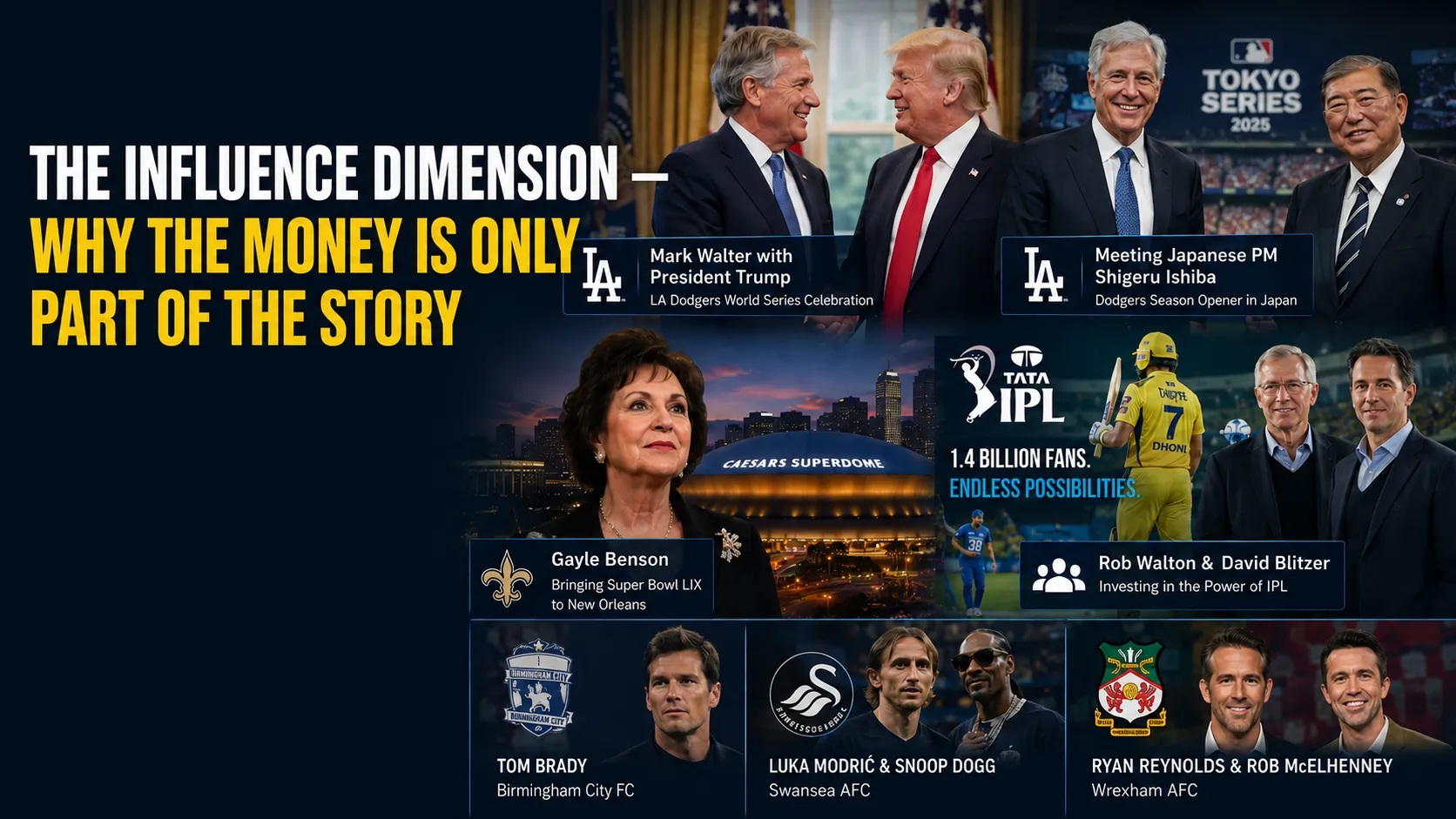
Mark Walter, controlling owner of the LA Dodgers, received private time with President Trump at the White House when the Dodgers were invited to celebrate their World Series win. He was invited to meet Japanese Prime Minister Shigeru Ishiba in March 2025 when the Dodgers opened the baseball season in Japan. Sports ownership, at the level of a major franchise, provides direct access to heads of state, cultural leaders, and business decision-makers in contexts that no amount of corporate lobbying, charitable endowment, or media presence can replicate.
Gayle Benson was instrumental in bringing Super Bowl LIX to New Orleans. The economic impact of a Super Bowl on a host city runs into hundreds of millions of dollars, and the ability to influence that decision — to advocate successfully for your city to receive it — is a form of civic power with no direct market price.
American investors including Rob Walton and David Blitzer's Bolt Ventures are buying IPL franchises not only because the returns are extraordinary. They are buying them because IPL ownership provides a direct institutional relationship with India's 1.4 billion people, through the sport that commands more emotional attention in that country than any other. For global businesses looking to establish presence in what is now the world's most populous country, IPL ownership is a form of cultural access that no advertising spend can approximate.
Tom Brady's stake in Birmingham City FC, Luka Modrić and Snoop Dogg's stake in Swansea AFC, Ryan Reynolds and Rob McElhenney's ownership of Wrexham — the athlete and celebrity ownership wave follows the same logic at a different scale. These are people who already have global audiences using sports ownership to build business credibility, geographic reach, and cultural relevance that extends beyond what they could generate through their primary careers alone.
The Private Equity Infrastructure — How the Industry Changed the Rules
Until recently, the structural limits on sports ownership were significant. Most major leagues required individual or family ownership, prohibited private equity, and limited ownership stakes to ensure that no institutional capital dominated team governance. Those rules have been systematically relaxed.
The NBA now allows private equity firms to own up to eight team stakes with passive investment structures. The NFL loosened ownership bylaws to permit more liquidity without requiring full control transfers. The NWSL permits private equity to take majority or even 100 per cent ownership of a franchise — the most permissive structure of any major US professional sports league.
The result has been the deployment of dedicated sports investment vehicles by some of the world's largest alternative asset managers. CVC Capital Partners has launched a $14 billion global sports group enabling investment across multiple sports, geographies, and investment types — from league equity stakes to media rights partnerships. Apollo Global Management's $5 billion sports vehicle has entered the market with a similar mandate. Nearly two-thirds of NBA teams entering the 2025–26 season have at least some connection to private equity money.
This institutional infrastructure is what is accelerating the pace of deals. When CVC can deploy a $14 billion vehicle across multiple sports simultaneously, and when the NBA's rules permit PE firms to own stakes in multiple teams, the capital flowing into sports ownership is no longer constrained by the supply of individually wealthy buyers. It is constrained only by the supply of available franchises — which, as noted, is fixed.
What This Means for the Future of Sport
The institutionalisation of sports ownership carries implications that go well beyond the deals themselves.
Valuations will continue rising as long as media rights continue to reset upward — and the competition for streaming audiences, which drives media rights pricing, shows no sign of abating. McKinsey's research estimates that women's sports alone could generate at least $2.5 billion in value for rights holders in the US by 2030, a 250 per cent increase from the $1 billion generated in 2024. One JPMorgan survey participant put the women's sports investment opportunity in terms that cut through the abstraction: "Twenty years from now, people will not believe that you could acquire a women's team for $100 million."
The influence dimension will intensify. As more ultra-wealthy individuals, tech billionaires, and institutional investors enter sports ownership, the governance structures of major sports leagues will increasingly reflect the strategic interests of capital — not just fandom. That is not necessarily negative, but it is a structural change with real implications for how leagues govern themselves, how player compensation evolves, and how the relationship between sports and geopolitics is managed.
And the IPL's trajectory will be watched globally as a template for what sports as an asset class can become. A league that runs 74 matches a year, distributes guaranteed media rights income equally to ten franchises, earns 37 to 40 per cent EBITDA margins, and returns 18.5 per cent CAGR on franchise value over 18 years is not just a cricket tournament. It is a financial architecture. And the billionaires paying $1.6 billion for a piece of it are not paying for the cricket.
They are paying for the architecture.